


Building a padel court · 10 July 2026 · 11 min read
How do you maintain the lighting of a newly built padel court?
Learn how to maintain LED lighting on a padel court, when to replace it, and what 50,000+ burning hours means in practice.
In this article
- How long does LED lighting on a padel court last?
- How often should you inspect the lighting of a padel court?
- What are the most common problems with padel court lighting?
- How do you clean the fixtures of a padel court correctly?
- What is the influence of outdoor weather on padel court LED lighting?
- When is it better to replace lighting than to repair it?
- Who is responsible for maintaining padel court lighting?
- How I-Padel helps with the lighting of your padel court
- Frequently asked questions
LED lighting on a padel court lasts an average of 50,000 to 100,000 burning hours under normal use, which amounts to many years of intensive use. Even so, good maintenance is essential to actually reach that service life. In this article we answer the most frequently asked questions about maintaining padel court lighting, from inspection frequency to the point at which replacing is smarter than repairing.
How long does LED lighting on a padel court last?
LED lighting on a padel court lasts an average of 50,000 to 100,000 burning hours under normal use. With average use of eight hours a day, this means a technical service life of more than ten years. The actual service life depends heavily on the quality of the fixtures, the environmental conditions and the way the installation is maintained.
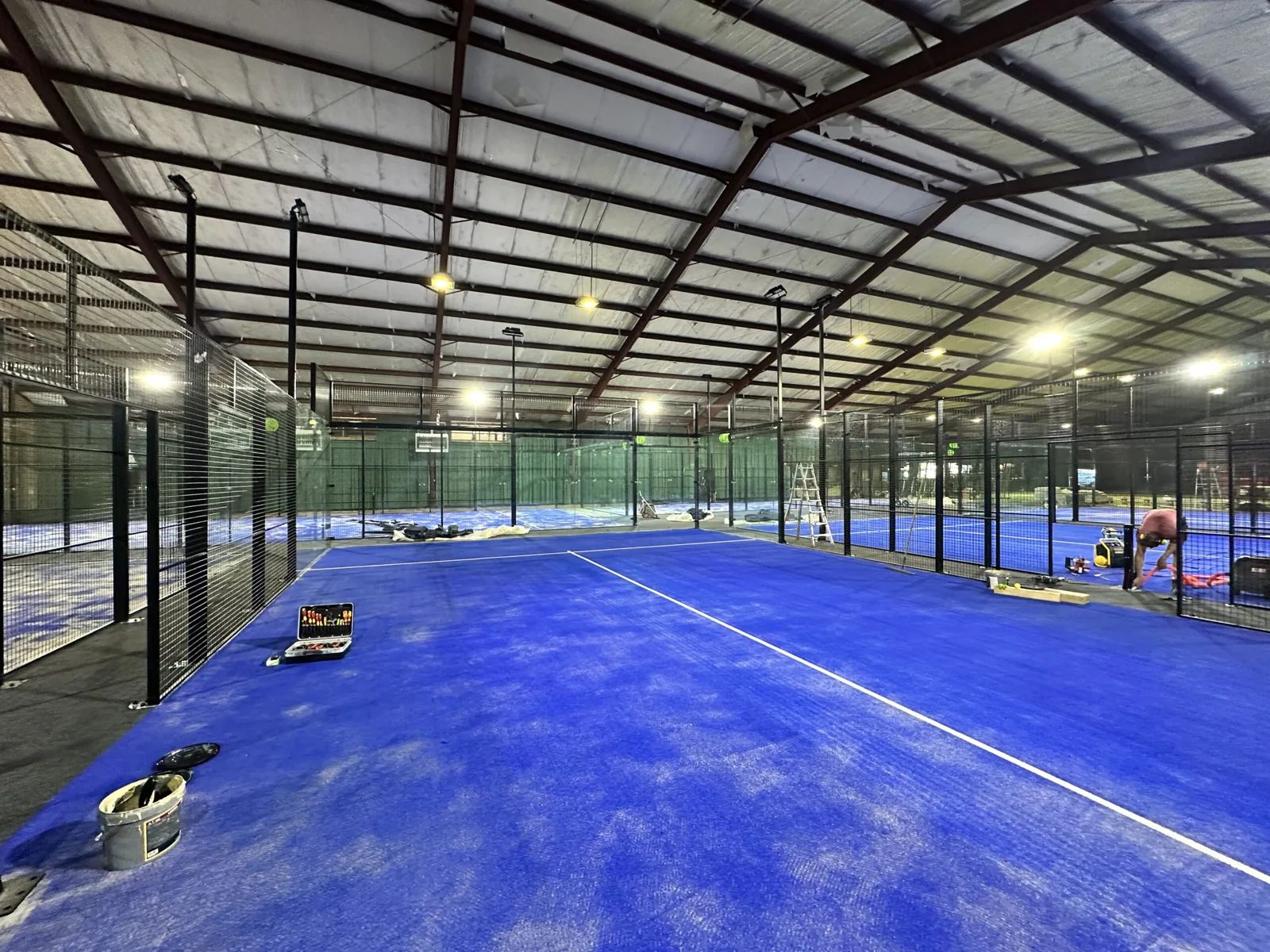
Besides burning hours, so-called lumen depreciation also plays a role. LED lighting gradually loses light output. When the illuminance on the playing area drops below an acceptable level, replacement is called for, even if the lamp technically still works. For professional use on a padel court, a minimum illuminance of 300 to 500 lux applies, depending on the level of use. On an indoor padel court, consistent lighting quality is especially important because there is no daylight to make up for shortcomings.
When building a padel court, always invest in high-quality LED lighting with a high IP protection rating, especially for outdoor courts. Cheaper fixtures rarely achieve the promised burning hours in practice.
How often should you inspect the lighting of a padel court?
Inspect the lighting of a padel court at least twice a year, preferably at the start and the end of the intensive playing season. For outdoor courts, an extra inspection after the winter period is strongly recommended, because frost, wind and moisture put more strain on the installation than in indoor situations.
A practical maintenance schedule looks like this:
- Monthly: visual check for damaged fixtures, loose fixings or visible moisture ingress.
- Every six months: thorough inspection of all fixtures, cables, connections and switch cabinets.
- Annually: measurement of the illuminance on the playing area to check whether the light output still meets the requirements.
Record the findings of every inspection. This helps to spot trends, such as a gradual decline in light output or recurring problems with a specific fixture. At sites with intensive use, such as commercial padel centres, a higher inspection frequency is wise.
What are the most common problems with padel court lighting?
The most common problems with padel court lighting are moisture ingress in fixtures, loose fixings caused by vibration, failed drivers or control electronics, and gradual lumen depreciation due to ageing. With outdoor courts, corrosion and damage from extreme temperature changes are added to this.
Below is an overview of the problems that occur most often and their causes:
- Moisture ingress: occurs when the seal of a fixture is damaged or the IP rating is not suitable for the outdoor environment. This causes short circuits or early failure.
- Loose fixtures: vibrations caused by wind load or the impact of balls can gradually work fixings loose. This is a safety risk that must be remedied immediately.
- Failed driver: the driver is the electronic component that supplies the LED with power. A defective driver causes a fixture to fail completely, while the LED itself is still intact.
- Uneven lighting: when one or more fixtures fail or drop sharply in light output, dark zones appear on the playing area. This affects playing quality and can be dangerous.
- Condensation: with temperature changes, condensation can penetrate fixtures with insufficient IP protection.
How do you clean the fixtures of a padel court correctly?
Clean the fixtures of a padel court twice a year with a soft cloth and a mild cleaning agent. Never use pressure washers or abrasive products, as these damage the seal and the surface of the fixture. Always switch the lighting off and wait until the fixtures have cooled down completely before you start.
Follow these steps when cleaning:
- Switch the lighting off at the switch cabinet and make sure the power is completely cut.
- Let the fixtures cool down for at least 30 minutes.
- Remove coarse dirt, dust and insects with a dry, soft cloth or a brush.
- Clean the housing with a slightly damp cloth and a mild soap solution.
- Dry the fixture with a dry cloth to prevent moisture ingress.
- While cleaning, immediately check the condition of the seal and the fixing.
Clean fixtures deliver noticeably better light output. Dirt and dust on the glass or lens of a fixture can reduce the illuminance by ten to twenty percent, without anything being technically wrong with the lamp itself.
What is the influence of outdoor weather on padel court LED lighting?
Outdoor weather has a significant influence on the service life and performance of LED lighting on a padel court. Rain, frost, heat and wind load accelerate the wear of fixtures, seals and fixings. Outdoor courts therefore require fixtures with a higher IP rating and more robust fixings than indoor installations.
The main weather influences at a glance:
- Rain and moisture: water that penetrates a fixture damages the electronics. Fixtures for outdoor use must be certified to at least IP65.
- Frost: when freezing, moisture inside a fixture can expand and damage the housing. Condensation caused by temperature changes increases this risk.
- Heat and UV radiation: prolonged exposure to direct sunlight accelerates the ageing of plastic parts and seals.
- Wind: constant wind load causes mechanical fatigue of fixings. This is especially relevant for courts on open sites or coastal locations.
When building an outdoor court, it is wise to take this into account when choosing the lighting installation. Fixtures suited to the specific environmental conditions of the site perform considerably better and last longer than standard models.
When is it better to replace lighting than to repair it?
Replacement is wiser than repair when fixtures are older than ten years, when the light output is structurally below the required level, or when repair costs exceed fifty percent of the replacement value. With several simultaneous faults in an installation, complete replacement is almost always the better investment.
Consider replacement in the following situations:
- The fixtures are older than ten years and the light output has noticeably dropped.
- Spare parts, such as drivers or specific LED modules, are no longer available.
- Several fixtures have failed at the same time, which points to ageing of the entire installation.
- Energy costs are high compared with more modern alternatives. New generations of LED lighting are considerably more efficient than installations from five years ago.
- The installation no longer meets the lighting standards that apply to official use or tournaments.
Repair makes sense for a relatively new installation in which an isolated component, such as a single driver or a loose fixture, has become defective. Always have the assessment made by an installer who evaluates the condition of the entire installation, not just the defective component.
Who is responsible for maintaining padel court lighting?
Responsibility for maintaining padel court lighting lies with the owner or operator of the site. This also applies when the court was built by an external party. After handover, the maintenance obligation passes to the owner, unless a separate maintenance contract has been concluded with the builder or a specialised installer.
At commercial padel centres and tennis clubs, it is wise to set out responsibilities clearly in advance:
- Owner or operator: responsible for periodic inspection, cleaning and calling in an installer in good time in the event of faults.
- Installer or builder: responsible for any warranty obligations on the installation and the fixtures during the warranty period.
- Maintenance contract: at larger sites with several courts, a maintenance contract with a fixed partner is a practical solution. This gives certainty about response times and prevents maintenance from being postponed.
When building a padel court, always check which warranty terms apply to the lighting installation and what exactly is covered by the warranty. The warranty on LED lighting generally covers the fixtures and the driver, but not always wear caused by incorrect use or insufficient maintenance. Also consult the cost overview for an indoor padel court if you want to understand how lighting costs relate to the total investment.
How I-Padel helps with the lighting of your padel court
We supply and install LED lighting as part of our complete turnkey package for new padel courts. This means the lighting is not added as an afterthought, but is included from the outset in the design and construction of the court. That way you can be sure the fixtures match the site, the structure and the intensity of use.
What we offer in concrete terms when it comes to lighting:
- LED lighting tailored to the specific requirements of the site, both indoor and outdoor.
- Fixtures with the right IP protection for the environmental conditions.
- Installation as part of the total package, so there is one point of contact for the entire court.
- Advice on lighting standards and what is needed for official use or tournaments.
- Support with renovation or replacement of lighting on existing courts.
Want to know what the lighting installation costs as part of a new project, or do you have questions about the lighting of an existing court? Get in touch for an initial exploration, we are happy to think along with you, without obligation.
Frequently asked questions
Can I maintain the lighting of my padel court myself, or do I need an installer?
As an owner or manager you can perfectly well carry out visual inspections and clean the fixtures yourself, provided you do so safely with the power switched off. For technical work such as measuring the illuminance, replacing drivers, checking the switch cabinet or assessing the electrical connections, always call in a certified installer. Unqualified intervention on the electrical installation is not only dangerous, but can also void the warranty on the fixtures.
What is an IP protection rating and which one do I need for my padel court?
The IP rating (Ingress Protection) indicates how well a fixture is protected against dust and moisture. For outdoor padel court lighting, IP65 is the minimum: this means the fixture is completely dust-tight and resistant to water jets from any direction. At sites with particularly harsh conditions, such as coastal areas with salty air or courts with a lot of precipitation, IP66 or higher is advisable. For indoor courts, IP54 is sufficient in many cases, but always check the specific environmental conditions of your site.
How many lux is actually needed on a padel court and how do I measure it?
For recreational use, a minimum illuminance of 300 lux on the playing area applies, while competitive or tournament use requires 500 lux or more. The measurement is carried out with a lux meter at a set height above the playing surface, spread over several measuring points on the court. This is work for an installer or a specialised light measurement company, which can also draw up a report as proof of compliance for official use or when the court is rented out.
What should I do if one fixture fails while the rest are still working well?
First check whether the problem lies with the driver, because this is the most common cause of a completely failed fixture while the LED itself is still intact. Note the type and serial number of the defective fixture and contact the installer or supplier to have the driver or the fixture replaced.
Do not wait too long to repair it: a dark zone on the playing area is not only annoying for players, but can also pose a liability risk if an accident happens because of poor visibility.
Can I save energy on the lighting of my padel court without compromising on quality?
Yes, there are several ways to reduce energy consumption without compromising lighting quality. Dimmable LED lighting combined with a timer or motion sensor ensures that the lighting only burns at full power when that is really needed. Moreover, the latest generation of LED fixtures uses up to thirty percent less energy than installations from five years ago, which also makes replacing an outdated installation financially attractive in the longer term.
What does a maintenance contract for padel court lighting usually include and is it worth it?
A maintenance contract generally includes periodic inspections, cleaning of fixtures, measurement of the illuminance and a fixed response time in the event of faults. For commercial padel centres or sites with several courts, a maintenance contract is almost always worth it: it prevents maintenance from being postponed, gives certainty about response times and protects the investment in the installation. When concluding a contract, always compare exactly what is included, and pay particular attention to whether emergency repairs and replacement parts fall within the contract or are invoiced separately.
Does the choice between indoor and outdoor lighting also affect the purchase costs and payback period?
Yes, fixtures for outdoor courts are generally more expensive to buy than comparable indoor fixtures because of their higher IP protection, more robust housing and corrosion-resistant materials. The payback period, however, is strongly influenced by the energy savings compared with older lighting technologies and the lower maintenance costs of high-quality fixtures. A good cost-benefit analysis takes into account the purchase price, expected service life, energy consumption and maintenance costs over the entire period of use, not just the initial investment.


