Blog · 10 August 2026 · 11 min read
How do distance and orientation affect padel noise?
Padel noise at your location? Find out how distance and orientation determine the noise impact and when additional measures are needed.
In this article
- How much noise does a padel court produce at different distances?
- Which orientation of a padel court causes the least noise nuisance?
- What is the statutory noise standard for an outdoor padel court in the Netherlands?
- How does an acoustic consultant calculate the noise situation of a padel court?
- When are sound-absorbing panels needed in addition to distance and orientation?
- How do sound-absorbing panels affect the structure of the court?
- Not sure whether outdoor padel is feasible at your location?
- Frequently asked questions
Distance and orientation have a direct influence on the noise a padel court produces for its surroundings. The greater the distance to homes, the lower the noise level that residents perceive. The orientation of the court determines which side produces the most noise and in which direction that noise spreads.
Both factors play a role in the site analysis and the permit process for an outdoor padel court. Below, we answer the most common questions about noise, distance, orientation and the technical measures you can consider.
How much noise does a padel court produce at different distances?
During active play, a padel court produces a sound power level of around 91 dB. At shorter distances this noise is clearly audible. As the distance increases, the noise level drops. The exact reduction depends on the surroundings, obstacles, the orientation of the court and the presence of reflective surfaces.
Padel noise is mainly impulse noise. These are short, clearly recognisable peaks caused by the racket and the ball hitting the glass and the fencing. Residents find impulse noise more annoying than continuous background noise, even when the measured noise level is comparable. This explains why noise nuisance from a padel court can still be experienced as disturbing at greater distances.
As a point of comparison: tennis produces a sound power level of around 81 dB. The difference of roughly 10 dB means that a padel court produces considerably more noise than a tennis court. This has direct consequences for the distance needed to meet the applicable noise standards and for the question of whether additional noise measures are necessary.
Because the noise situation differs greatly from one location to another, it is not possible to give a fixed distance beyond which noise is no longer a problem. An open site without buildings behaves differently from a location that borders a residential area with tall buildings. An independent acoustic consultant can use the specific site data to calculate which noise level can be expected at which distance.
Which orientation of a padel court causes the least noise nuisance?
The orientation of a padel court determines which side of the court sends the most noise into the surroundings. The back walls and side walls of a padel court produce the most impact noise, because that is where the ball is hit against them the hardest. By orienting the court so that these sides do not face noise-sensitive destinations such as homes, the noise impact at those locations can be limited.
In practice, this means the back walls are preferably directed towards less sensitive sides of the site, such as a road, a green strip or an uninhabited area. However, this is not always possible. Many locations offer limited space or are surrounded by homes on several sides. In those cases, orientation is only one of the available measures.
Orientation is a measure that must be taken into account at an early stage of project planning. Once a court has been built, its orientation can no longer be changed. It therefore pays to assess during the site analysis which orientation results in the most favourable noise situation. An acoustic consultant can support you by calculating various scenarios.
What is the statutory noise standard for an outdoor padel court in the Netherlands?
In the Netherlands, the noise standards for outdoor padel courts are laid down in the Besluit activiteiten leefomgeving (Bal, the Environment Activities Decree) and in local environmental plans. Limit values apply to sports activities for the long-term average rating level (LAr,LT) and for peak noise (LAmax). The exact standards depend on the area category and the times at which the court is used.
As a general guideline, a limit value of 50 dB(A) applies in the daytime period for the long-term average rating level at the facade of homes. In the evening period this limit value is lower, usually around 45 dB(A). Separate standards apply to peak noise and can differ from situation to situation. Municipalities may impose additional requirements in the environmental plan.
Because padel noise consists mainly of impulse sounds, the assessment also takes into account a penalty for impulse noise. This can mean that the effective noise impact is higher than the measured value, which affects whether a location meets the standards.
A correct assessment of the noise situation requires an independent acoustic study. Based on the location, the use and the surroundings, an acoustic consultant calculates whether the court can meet the applicable standards and which measures may be necessary to do so. You can find more information about applying for a permit for a padel court on our permit page.
How does an acoustic consultant calculate the noise situation of a padel court?
An acoustic consultant calculates the noise situation of a padel court by combining the court’s sound power level with the specific characteristics of the location. Recognised calculation models are used that simulate the transmission of sound from the source to the surroundings. The result is a calculated noise level at the facades of nearby homes or other noise-sensitive destinations.
The input data for such a calculation include the distance to homes, the height of the court, the presence of obstacles, the ground conditions, the orientation of the court and the expected use. When noise measures are being considered, such as sound-absorbing panels or a noise barrier, the acoustic properties of those measures are also included in the calculation.
For the calculation, the acoustic consultant needs reliable product specifications and structural data. As the manufacturer, we supply the technical information required to carry out the acoustic calculation correctly. The consultant then independently determines which measures are needed at a specific location and whether the situation can meet the applicable standards.
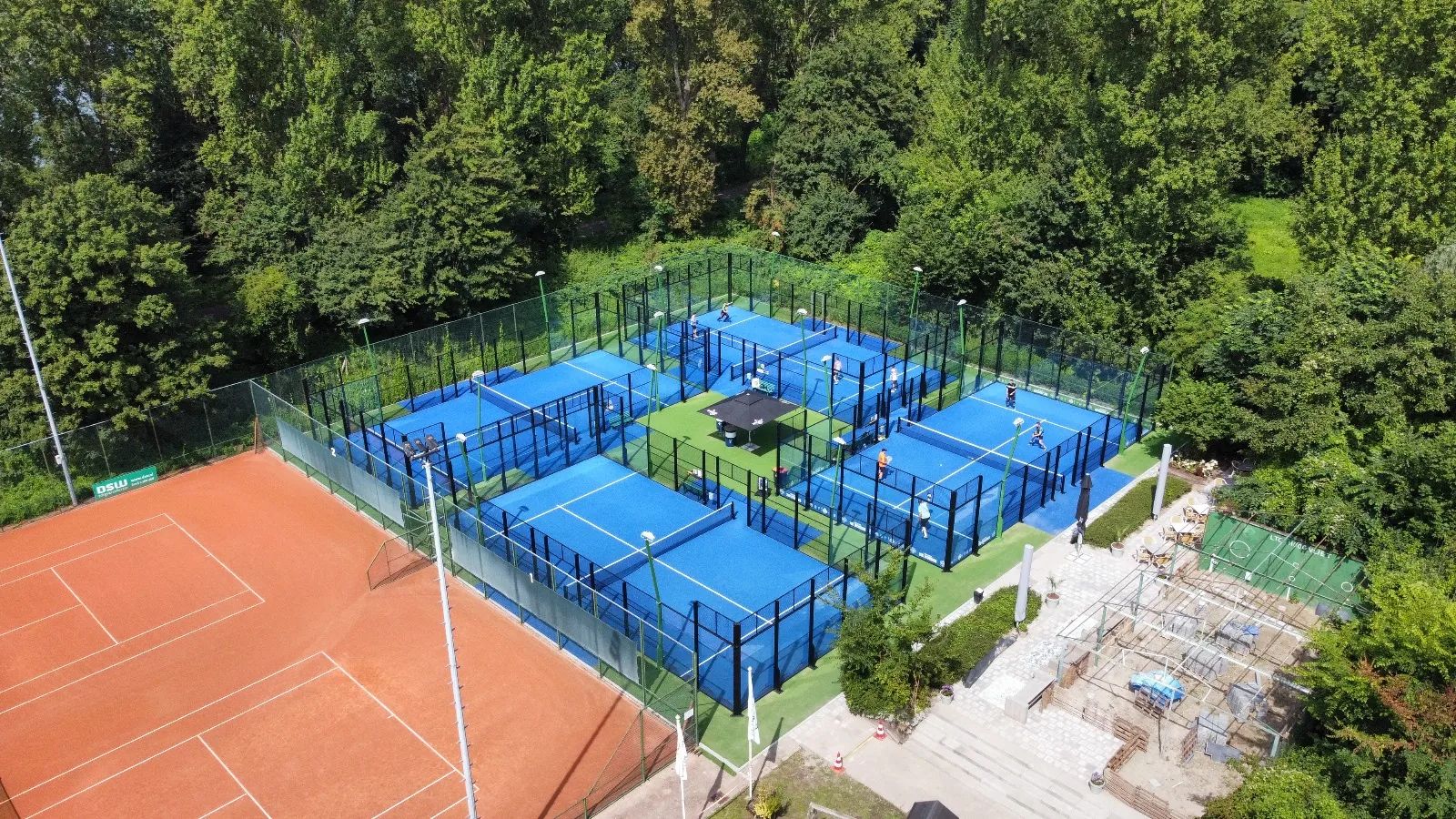
In addition to calculations, a field measurement can also be carried out. In a field measurement at LTC Hofgeest, an indicative noise reduction of approximately 3 dB(A) was measured within the configuration studied, after correction for background noise. These results apply only to the situation studied and must not be applied to other projects without further assessment.
When are sound-absorbing panels needed in addition to distance and orientation?
Sound-absorbing panels may be needed when distance and orientation are not enough to meet the applicable noise standards. This is particularly the case for locations close to homes, for courts that cannot be oriented favourably because of the layout of the site, or when the municipality requires additional noise measures as part of the permit process.
Sound-absorbing panels are a source measure. This means they are applied directly at the noise source, on the outside of the cage structure. They absorb sound instead of reflecting it back, which limits the spread of padel noise to the surroundings. The acoustic solutions for padel that we use have been independently tested and have sound absorption class A with an absorption value of 0.80.
Whether panels are sufficient in a specific situation, or whether additional measures such as a noise barrier are needed, depends on the results of the acoustic study. In some situations a combination of panels and a noise barrier is the most suitable. A noise barrier works over a greater distance and blocks noise towards homes, while panels reduce noise production at the source. Which combination is suitable differs from project to project.
How do sound-absorbing panels affect the structure of the court?
Sound-absorbing panels have a direct effect on the wind load on the steel structure. Panels are closed surfaces that catch the wind. The more closed surface a court has, the greater the wind forces acting on the structure. These forces are transferred through the steel structure to the foundation. When panels are added, the structure must be recalculated accordingly and reinforced where necessary.
This applies both to new courts and to existing courts to which panels are added later. For an existing court, a structural assessment is required before panels are mounted. Not every existing steel structure is suitable for safely taking up the extra wind load. If the structure is not strong enough, modifications may be needed, such as heavier posts, additional columns or adapted connections.
Because we manufacture the steel structures entirely in-house, structural adjustments can already be made during the engineering phase. When an acoustic study shows that sound-absorbing panels are necessary, the structure is immediately tailored to them. This avoids having to modify a standard structure afterwards. You can read more about the relationship between structure and wind load on our structure page.
The steel structures are made from S350 structural steel and, for outdoor applications, are hot-dip galvanised and finished with a high-quality powder coating. This duplex system offers long-lasting protection against corrosion and the elements, which contributes to a long service life for the structure, even when additional features such as sound-absorbing panels are integrated. We provide a fifteen-year warranty on the steel structure, in line with the applicable product specifications and configurations.
The same principle applies to the foundation. The extra wind load from panels also affects the forces that are transferred through the structure to the foundation. The padel court including groundwork must be assessed as a whole, so that the structure and foundation are matched to each other and the total load can be safely absorbed.
Not sure whether outdoor padel is feasible at your location?
We are happy to think along with you about the court configuration, structural preparation and possible noise measures. Together with your acoustic consultant, we look at which solution is technically feasible and suits the project. Get in touch via our page on acoustic solutions for padel for an initial, no-obligation exploration.
Frequently asked questions
How early in the planning process should I bring in an acoustic consultant?
We strongly recommend bringing in an acoustic consultant before the choice of location is final. In the early planning phase, adjustments to orientation, positioning and court configuration are still possible that can no longer be made later. An early acoustic exploration avoids costly changes afterwards and increases the chance of a successful permit.
Can I also add sound-absorbing panels to an existing padel court later?
In principle, yes, but it always requires a structural assessment of the existing steel structure first. Not every standard structure is designed for the extra wind load that closed panels bring. Depending on the outcome, modifications to the posts, connections or foundation may be necessary before panels can be safely mounted.
What is the difference between a noise barrier and sound-absorbing panels, and when do you choose which solution?
Sound-absorbing panels are a source measure applied directly to the cage structure, reducing noise production at the source. A noise barrier is a transmission-path measure placed at a greater distance from the court that blocks noise towards homes. In complex situations, such as locations close to buildings on several sides, a combination of both measures may be necessary. Which solution is most suitable follows from the acoustic study.
Which documents or data do I need to have an acoustic study carried out?
For an acoustic study, the consultant usually needs a site plan showing the exact location of the court and nearby homes, the planned hours and intensity of use, the height and configuration of the court structure, and any data on obstacles and ground conditions. As the manufacturer, we supply the necessary technical product specifications so that the consultant can carry out the calculation correctly and completely.
Do the ground or paving around the padel court affect the transmission of noise to the surroundings?
Yes, the ground conditions and paving around the court play a role in noise transmission. Hard, reflective surfaces such as concrete or asphalt can spread noise further than soft, absorbing surfaces such as grass or gravel. An acoustic consultant includes the ground conditions as an input parameter in the calculation models, so that the calculation matches the actual situation as closely as possible.
What happens if the acoustic study shows that the location cannot meet the noise standards?
If a location cannot meet the applicable standards with the available measures, there are several options: moving the court or orienting it differently, limiting the hours of use (for example, no evening play), adding further measures such as a noise barrier, or, as a last resort, reconsidering the location. An acoustic consultant can calculate multiple scenarios to determine which combination of measures is feasible.
Do the same noise standards apply to a padel court at a sports club as to a commercial padel club?
In principle, the noise standards are linked to the area category of the location and the times of use, not to the type of operator. However, the intensity of use at a commercial padel club may be higher, which leads to a greater noise impact and stricter requirements for the measures to be taken. In addition, municipalities may include tailored requirements in the environmental plan that can differ from situation to situation, regardless of whether it concerns a club or a commercial party.