


Building a padel court · 29 May 2026 · 11 min read
How can a tennis club best plan the switch to padel?
Tennis club switching to padel? Find out about costs, permits and common mistakes, and plan the construction smartly from start to handover.
In this article
- Why are more and more tennis clubs choosing padel?
- What does it cost for a tennis club to build a padel court?
- Which permits does a tennis club need for a padel court?
- What is the difference between an indoor and outdoor padel court for clubs?
- How do you choose the right contractor for building padel courts?
- How long does it take to build a padel court?
- What mistakes do tennis clubs make when building padel courts?
- Frequently asked questions
More and more tennis clubs are making the move to padel, and that is no coincidence. Padel attracts new members, fills empty court hours and gives clubs a fresh boost. But how do you approach such a switch properly? What does it cost, which permits do you need and where does it go wrong? In this article we answer the questions most often asked by club boards seriously considering converting a tennis court into a padel court.
Whether you are the chair, the treasurer or a member of the building committee: after reading this article you will know what to expect and how to plan smartly.
Why are more and more tennis clubs choosing padel?
Tennis clubs choose padel because the sport attracts new target groups who pass over the traditional tennis court. Padel is easier to learn, more social in character and popular with younger age groups. For clubs facing declining membership, padel offers a direct way to reverse that trend.
Padel has been growing fast in the Netherlands for years. The sport demands less technical skill than tennis, which means new members enjoy it sooner. That leads to better retention and more activity at the sports park. In addition, existing tennis courts can in many cases be converted into padel courts, which keeps the investment manageable. A tennis court of 36 x 18 metres has room for two padel courts side by side, including run-off zones.
Clubs that make the move also find that padel generates new income through court rental, lessons and tournaments. That makes it not only a member recruitment tool, but also a way to strengthen the club’s financial base.
What does it cost for a tennis club to build a padel court?
As an indication, an indoor padel court is possible turnkey from around €23,000 per court, including cage structure, glass, artificial turf, LED lighting and installation. An outdoor padel court costs more: count on an indicative price from around €50,000 per court, including the foundation. The exact price always depends on the location, the number of courts and the chosen specification.
What makes an outdoor padel court more expensive?
With an outdoor court, the foundation plays a major role. The cage structure has to be built heavier because of wind load and weather conditions, and the foundation depends strongly on the location. Foundation costs average between €20,000 and €40,000, depending on soil conditions and the civil works required. That makes it difficult to name a fixed price without a site assessment.
Can you save by reusing an existing tennis court?
Yes, that is certainly possible. When converting a tennis court into a padel court, the existing substructure can in many cases be partly reused. That saves on foundation costs. Whether reuse is feasible depends on the condition and type of the current base. A site check beforehand quickly gives clarity on this.
When comparing quotes, always look at exactly what is included. A low price without foundation, lighting or artificial turf is hard to compare with a complete turnkey package. Also look at the lifespan of the materials and the warranty terms, because a cheaper court can turn out more expensive in the long run.
Which permits does a tennis club need for a padel court?
For an outdoor padel court, an environmental permit is mandatory in almost all cases. For an indoor padel court in an existing hall, without structural changes, it is not always needed, but that depends on the situation. Never build without first checking whether a permit is required via the Omgevingsloket (the Dutch permit portal).
An environmental permit is required when the padel court is placed outdoors, when structural work takes place, or when noise or lighting affects the surroundings. With padel that last point is almost always the case: padel produces an average sound power level of around 91 dB, roughly 10 dB more than tennis. For a location near homes, an acoustic study is almost always mandatory with the permit application.
For a complete permit application you will generally need the following documents:
- Structural calculations in accordance with the Dutch Building Decree (Bouwbesluit)
- Acoustic study
- Lighting study
- Site plan
- Possibly an ecological or archaeological survey
Count on an average lead time of 8 to 12 weeks for the permit, depending on the municipality and the complexity of the project. Building without a permit is not an option: the municipality can shut down the project, impose fines or require you to remove the cage structure.
What is the difference between an indoor and outdoor padel court for clubs?
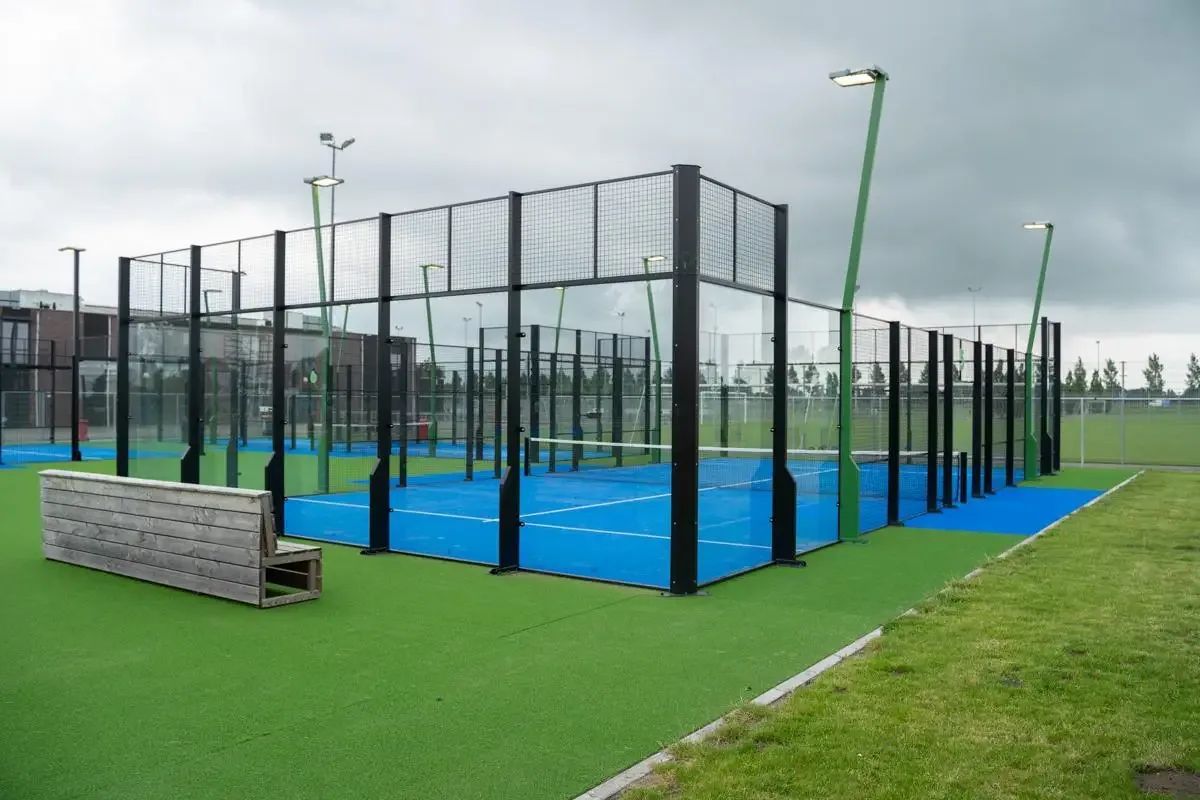
The biggest difference lies in the structural requirements, the costs and the use. An indoor padel court is built in an existing or new hall, requires a lighter cage structure and is not affected by the weather. An outdoor padel court requires a heavier structure, a robust foundation and, in most cases, an environmental permit. Both types offer year-round playing enjoyment, but in different ways.
When do you choose indoor?
Indoor is the most cost-efficient choice if you already have a hall or if you are having a new hall built for several courts. The cage structure is lighter, the foundation less complex and the playing conditions are always optimal. An indoor padel court needs a minimum clear height of 6 metres; the higher, the better for playing quality.
When do you choose outdoor?
Outdoor courts are the logical choice if you want to convert existing tennis courts and have no hall available. The higher investment is offset by the lower construction costs for the enclosure. Do take into account extra measures for noise, lighting and the weather resistance of the cage structure. Hot-dip galvanised steel is standard on outdoor courts to prevent rust and wear from the weather.
How do you choose the right contractor for building padel courts?
The right contractor for a padel court combines technical knowledge, structural expertise and experience with the permit process. When choosing, check whether the contractor can handle the entire process, including foundation, cage structure, artificial turf and LED lighting. A party that subcontracts everything gives you multiple points of contact and fragmented responsibility if something goes wrong.
Also check whether the materials meet the applicable standards. In the Netherlands, all foundation components must be approved by Kiwa ISA Sport. Working with uncertified materials can mean your court is not admitted for official competition use by the KNLTB. A good contractor is aware of this and works exclusively with certified products.
Request a quote from several parties and make sure you compare like with like. Ask specifically what is and is not included, what the warranty terms are for the cage structure, and whether the contractor has experience with noise solutions. For many clubs that last point only comes up late in the process, but it should be factored in early in the planning.
How long does it take to build a padel court?
The total lead time of a padel court project averages 10 to 12 weeks, from initial order to handover. The installation itself is quick: the cage structure is up in 2 days, and the artificial turf is laid in 1 to 2 days. The longest phase is the preparation, including production, delivery and any permit procedures.
Keep in mind that the permit procedure is separate from the construction time. If you still need to apply for the permit, that adds an average of 8 to 12 weeks. So plan this process as early as possible. Submit the permit application while production of the cage structure is already under way, so that both processes run in parallel and you avoid unnecessary delay.
A realistic timeline for a tennis club wanting to convert an outdoor court looks roughly like this:
- Site assessment and foundation advice based on cone penetration tests
- Environmental permit application (8 to 12 weeks)
- Production of the cage structure (in parallel with the permit process)
- Groundwork and foundation
- Installation of the cage structure (2 days)
- Installation of glass and LED lighting
- Laying the artificial turf (1 to 2 days)
- Handover and inspection by Kiwa ISA Sport, if desired for competition use
What mistakes do tennis clubs make when building padel courts?
The most common mistakes tennis clubs make when building a padel court are: starting the permit application too late, giving too little consideration to noise, and choosing purely on lowest price without looking at what is included. In practice these three mistakes lead to delays, extra costs and conflicts with the municipality or local residents.
Starting the permits too late
Many clubs only start the permit application after the contractor has been chosen and the plans are concrete. That quickly costs you a season. Start the permit procedure as early as possible, preferably in parallel with requesting quotes. First do a zoning plan check and a permit check via the Omgevingsloket to find out what applies at your location.
Underestimating noise
Padel is noisier than tennis, and that surprises many clubs. The impact noise of balls against glass and steel, amplified by the cage structure acting as a sounding board, can cause complaints from local residents. Discuss this early with the contractor and ask whether sound-absorbing panels are needed. Note: when panels are attached to the cage structure, its wind exposure changes. The cage structure then has to be structurally reinforced, which affects the cost and the planning.
Comparing on price alone
A quote that only includes the superstructure looks cheaper than a complete turnkey package, but rarely is once you add everything up. Always compare what is included: foundation, artificial turf, LED lighting, installation and warranty. A padel court that has to last 25 to 40 years deserves an investment in quality and a supplier who is there for you after handover too.
At I-Padel we guide clubs from the first conversation through to handover. We think along with you on the location, the foundation, the permits and the noise solutions, so that you are not faced with surprises. Do you want to know what building padel courts means for your club? Get in touch for an initial exploration, and we will look at it with you, without obligation.
Frequently asked questions
How many padel courts fit on the site of one tennis court?
On a standard tennis court of 36 x 18 metres, two padel courts fit side by side, including the required run-off zones. This makes the conversion financially attractive: you double the number of playing courts on the same surface area, which has a direct effect on court occupancy and potential rental income.
Can we apply for a subsidy or financing as a club for building padel courts?
Yes, there are several options. NOC*NSF and municipalities sometimes offer subsidies for sports facilities through the Nationaal Sportakkoord. The KNLTB also offers support and advice to tennis clubs that want to expand with padel. It is wise to contact your municipality and the KNLTB early in the process to find out which schemes apply to your situation.
What if local residents object to the arrival of padel courts?
Objections from local residents are almost always about noise and lighting. By having an acoustic study and a lighting study carried out early in the process, you can show that you meet the statutory standards. Communicating proactively with the neighbourhood, even before the permit application, considerably reduces the chance of formal objections. Sound-absorbing panels can also offer a concrete solution if the measurement results require it.
Which type of artificial turf is suitable for a padel court and how often does it need to be replaced?
For padel courts, specific padel artificial turf is used: a short, sand-filled carpet with a pile height of around 10 to 12 mm, matched to the speed and bounce of the padel ball. With normal use and good maintenance, quality artificial turf lasts 8 to 12 years on average. Regular brushing and keeping the sand infill topped up extend its lifespan considerably.
Can our existing tennis members also play on the padel courts, or do they need a separate licence?
Members do not need a separate licence to play padel recreationally on your own club’s courts. If, however, your club wants to take part in official KNLTB competitions or organise tournaments, specific requirements apply to both the court (inspection by Kiwa ISA Sport) and player registration. It is advisable to coordinate this with the KNLTB in good time so that your court is delivered competition-ready.
What annual maintenance costs for a padel court should we take into account?
Count on annual maintenance costs for the artificial turf (brushing, topping up sand), the cage structure (inspection, repainting non-galvanised parts if necessary) and the LED lighting (periodic checks). For an outdoor padel court, annual maintenance costs average between €500 and €1,500 per court, depending on how intensively it is used and the quality of the materials used. A maintenance contract with the contractor provides certainty and prevents unexpected costs.
How do we make sure the padel courts are actually used after they have been built?
A successful launch starts before handover: communicate actively to existing members, organise an opening tournament and offer introductory clinics for beginners. Consider working with a certified padel coach for group lessons, because it is precisely the social and accessible nature of padel that attracts new members. Link court reservations to a user-friendly booking app to keep the threshold for spontaneous play as low as possible.


