Blog · 11 September 2026 · 12 min read
What first steps should you take when noise is a concern for a new padel project?
Noise at a padel project? Find out which first steps to take: site assessment, an acoustic consultant and a smart approach to the permit process.
In this article
- How great is the noise risk with an outdoor padel court?
- Is an acoustic study mandatory for a new padel court?
- Which noise measures are possible for a padel court?
- What is the difference between sound-dampening panels and a noise barrier?
- How does a permit process work when noise plays a role?
- When should you engage a structural engineer or acoustic consultant?
- Not sure whether outdoor padel is feasible at your location?
- Frequently asked questions
When noise is a concern for a new padel project, it is best to start with a site assessment and an early conversation with an independent acoustic consultant. That way you map out in good time what the risks are, which measures may be needed and what this means for the permit process.
The steps you take after that depend heavily on the location, the distance to homes and the requirements of the municipality. This article covers the most frequently asked questions about noise at padel courts, from the first risk assessment to choosing the right measures.
How great is the noise risk with an outdoor padel court?
The noise risk with an outdoor padel court is greater than with most other outdoor sports. Padel mainly produces impulsive noise: short, sharp peaks of sound created by racket contact and by the ball hitting glass or fencing. The average sound power level of a padel court is around 91 dB, which is roughly 10 dB higher than with tennis. That difference is audible and noticeable to local residents.
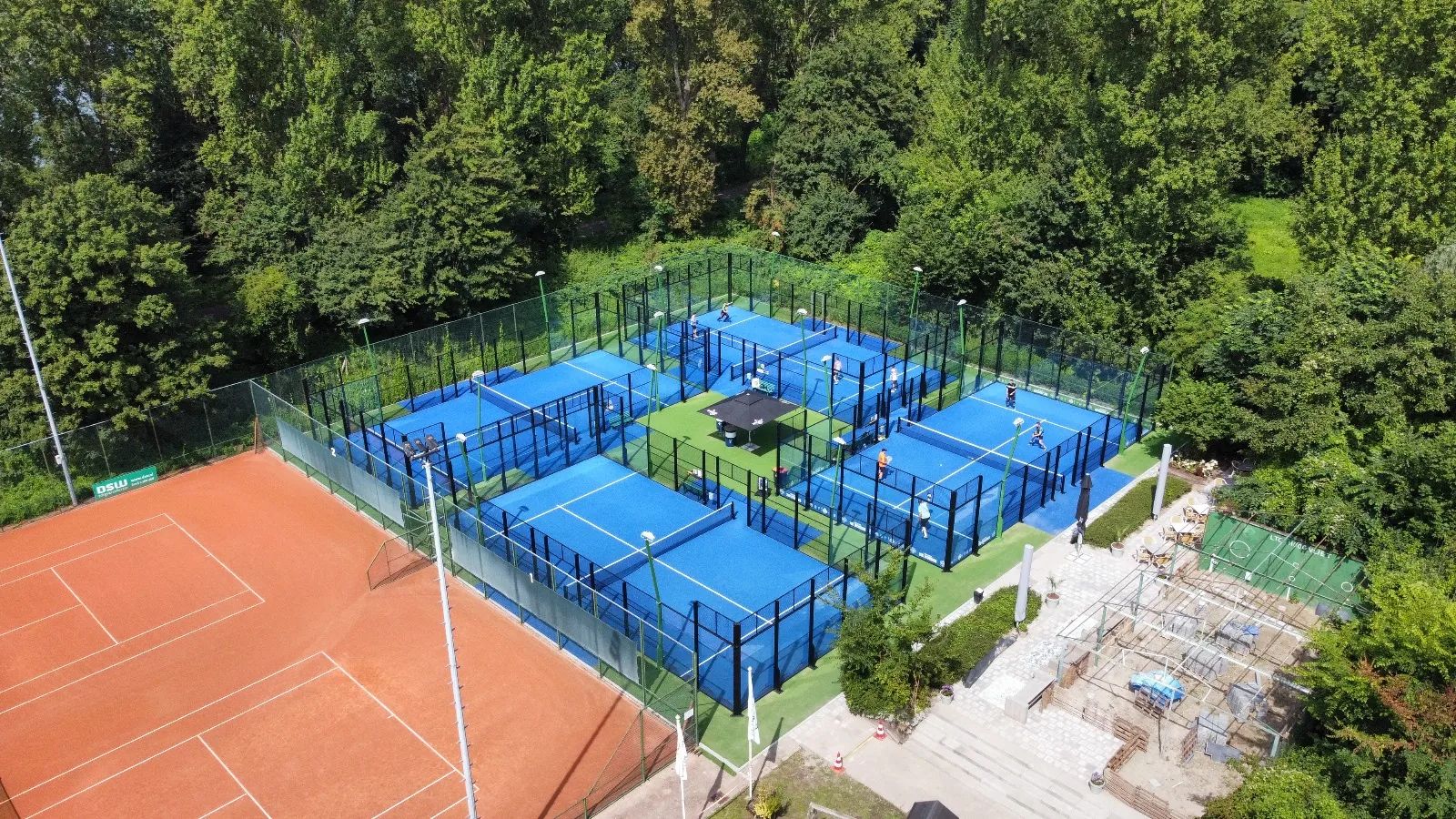
The cage structure amplifies this effect. Glass and steel reflect sound, so the court acts as a kind of sound box. This means the noise is not only spread directly from the court, but also ends up in several directions through reflections.
How great the actual risk is at a specific location depends on several factors:
- The distance between the padel court and nearby homes or other noise-sensitive uses.
- The orientation of the court relative to those homes.
- The number of courts and the expected intensity of use.
- The presence of other noise barriers, buildings or planting that can dampen sound.
- Local background noise and the openness of the site.
At an open location right next to a residential area, the risk of complaints and objections is considerably greater than at a sports park that is already surrounded by other facilities or planting. An early assessment of this risk helps you avoid surprises later in the process.
Is an acoustic study mandatory for a new padel court?
An acoustic study is not legally mandatory in every situation, but when homes or other noise-sensitive uses are located nearby, it almost always forms part of the permit process in practice. The municipality ultimately decides which studies are necessary for an environmental permit application.
For outdoor padel courts an environmental permit is mandatory in most cases, because of the structural nature of the court, its effect on noise and its spatial impact. As part of that application, the municipality regularly asks for an acoustic report showing that the noise load on the façades of nearby homes stays within the applicable standards.
An acoustic study is carried out by an independent acoustic consultant. We do not carry out acoustic studies ourselves, but we supply the technical product specifications, structural data and engineering needed to carry out the calculations correctly. On the basis of the study results, it can then be determined which measures are needed.
It is wise to contact both the municipality and an acoustic consultant early in the project. That way you know in good time what is expected and avoid having to commission additional research later in the process. You can find more information about the permit process on our page about permit for a padel court.
Which noise measures are possible for a padel court?
Several noise measures are possible for a padel court, and the most suitable solution differs per location. The two most commonly applied measures are integrated sound-dampening panels as a source measure and freestanding noise embankments. In some situations a combination of both is the most effective.
Sound-dampening panels as a source measure
Sound-dampening panels are fixed directly to the outside of the cage structure. They work as a source measure: the noise is tackled at the source, before it spreads to the surroundings. The panels absorb part of the sound energy instead of reflecting it back.
In a practical measurement at LTC Hofgeest in Velserbroek, an indicative noise reduction of around 3 dB(A) was measured for the configuration studied, after correcting for background noise. These results apply only to that specific situation and must not be regarded as a general performance for every location.
An important technical point: when panels are fitted to the structure, the wind permeability of the cage structure decreases. This increases the wind load on the structure, so the steel structure has to be structurally recalculated and in many cases reinforced. This is not a side issue, but a technical requirement that must be included in the engineering phase. You can read more about how this solution works on our page about acoustic solutions for padel.
Noise embankments
A noise embankment is a freestanding structure placed next to or around the padel court. Unlike panels, a noise embankment works at a greater distance and blocks the sound towards a specific sensitive direction. Noise embankments can be built up to heights of 6 to 8 metres and can also be realised with a green finish, which can increase acceptance by the municipality and local residents. An environmental permit is almost always needed for placement and structural calculations are required.
In situations where panels alone are insufficient, a combination of panels and a noise embankment may be the most suitable approach. In that case the noise embankment can sometimes be built lower, which saves costs and can simplify the permit process.
What is the difference between sound-dampening panels and a noise barrier?
The main difference is the position relative to the sound source. Sound-dampening panels are fixed directly to the cage structure of the padel court and work as a source measure. A noise barrier or noise embankment stands separate from the court and acts as a screen between the source and the surroundings.
Sound-dampening panels tackle the noise where it arises. They absorb sound energy and thereby reduce the amount of sound leaving the court. This makes them compact and space-saving, which can be a practical advantage at locations with limited space.
A noise barrier or noise embankment works differently: it places a physical barrier between the court and the sensitive surroundings. This can be effective when sound has to be stopped in a specific direction. A drawback is that a noise embankment takes up more space, has a greater visual impact and almost always requires a separate permit as an independent structure.
Which measure is most suitable depends on the location, the space available, the direction of sensitive receivers and the results of an independent acoustic study. At some locations integrated source measures are sufficient, while at others additional barriers or embankments are necessary. An overview of the available options can be found on our page about acoustic solutions for padel.
How does a permit process work when noise plays a role?
When noise is a concern, the permit process for an outdoor padel court broadly follows a number of fixed steps. The municipality assesses the application on the basis of the full situation, with noise being one of the assessment criteria alongside structural safety, spatial integration and the applicable regulations.
A typical process looks like this:
- Preliminary consultation with the municipality: Discuss the plan early with the municipality to find out which studies and documents are expected. This avoids surprises later in the process.
- Acoustic study: An independent acoustic consultant carries out calculations based on the site data, the type of court and the planned measures. The results determine whether additional measures are needed.
- Structural calculations: The structure of the padel court has to be calculated in accordance with the applicable standards. If sound-dampening panels are used, the extra wind load and structural requirements must be included.
- Environmental permit application: The application generally contains a site plan, structural calculations, the acoustic report, a lighting study and sometimes additional studies depending on the location.
- Assessment by the municipality: The processing time averages 8 to 12 weeks, depending on the municipality and the complexity of the project.
Sound-dampening panels or other measures can contribute to a feasible permit process, but do not guarantee that a permit will be granted. The municipality always assesses the application as a whole. We can guide and coordinate the permit process, including liaising with acoustic consultants and structural engineers.
When should you engage a structural engineer or acoustic consultant?
Engage an acoustic consultant and a structural engineer as early as possible, preferably in the feasibility phase of the project. The earlier these specialists are involved, the better the technical and permit-related conditions can be included in the design. Waiting until the permit application has already been submitted often leads to delays and changes in practice.
An acoustic consultant is relevant as soon as homes or other noise-sensitive uses are near the planned location. On the basis of calculations, the consultant determines what noise load can be expected on the façades of nearby homes and which measures may be needed to stay within the applicable standards. I-Padel supplies the technical product specifications and structural data that the consultant needs for these calculations.
A structural engineer is needed as soon as there is an outdoor padel court, additional noise measures or deviating site conditions such as high wind load or a complex subsoil. When sound-dampening panels are used, the wind catchment of the structure changes and the steel structure has to be recalculated. This is a technical requirement that must not be skipped. Our structure and wind load page gives more insight into how we approach this technically.
Padel projects involve several technical disciplines. Structural engineers, acoustic consultants, permit specialists and manufacturers each have their own expertise. By combining this knowledge early in the project, an integrated design emerges in which safety, feasibility and permit feasibility are optimally aligned.
Not sure whether outdoor padel is feasible at your location?
We are happy to help you think through the court configuration, structural preparation and possible noise measures. Together with your acoustic consultant, we look at which solution is technically feasible and suits the project. Get in touch for an initial exploration via our page on acoustic solutions for padel.
Frequently asked questions
How many dB(A) of reduction can realistically be expected from noise measures on a padel court?
The achievable reduction differs greatly per location and per type of measure. In a practical measurement at LTC Hofgeest, sound-dampening panels delivered an indicative reduction of around 3 dB(A), but this is no guarantee for other situations. A noise embankment can in theory offer more reduction, depending on the height, position and the distance to the sensitive receiver. Only an independent acoustic consultant can make a reliable estimate based on your specific location.
What are the most common mistakes when planning a padel court near homes?
The most common mistake is starting the acoustic study and the preliminary consultation with the municipality too late. Many initiators wait until the permit application has already been drawn up, after which additional research turns out to be needed and the process is delayed. A second common mistake is underestimating the structural consequences of sound-dampening panels: the extra wind load on the steel structure is regularly overlooked, which leads to costly modifications afterwards.
Can I use the orientation of the padel court to limit noise nuisance?
Yes, the orientation of the court relative to nearby homes is one of the most cost-effective measures you can apply already in the design phase. By positioning the court so that the short sides (where most noise is released at the back wall) do not face homes directly, the noise load on sensitive façades can be considerably reduced. This not only lowers the chance of complaints, but can also limit the scale and cost of additional measures. Always discuss this early with your acoustic consultant.
Are there specific noise standards for padel courts in the Netherlands?
There is no separate legislation specifically for padel courts, but padel courts generally fall under the regulations for sports facilities. In practice, they are often tested against the guidelines of the VNG (Association of Netherlands Municipalities) for businesses and environmental zoning, or against the standards from the Activiteitenbesluit milieubeheer (Dutch Environmental Management Activities Decree).
The exact standards that apply depend on the zoning of the location and the municipality’s environmental plan. Your acoustic consultant and the municipality can tell you exactly which standards apply in your situation.
What does an acoustic study for a padel court cost on average?
The cost of an acoustic study varies depending on the complexity of the location, the number of courts and the number of sensitive uses in the surroundings to be assessed. For a simple situation with one or two courts and a limited number of nearby homes, the cost is generally between €1,500 and €3,500 excluding VAT. For more complex locations with several courts, a dense built environment or additional research questions, the cost may be higher. Always request several quotes from certified acoustic consultants.
Are sound-dampening panels also applicable to covered or semi-covered padel courts?
Sound-dampening panels were developed primarily as a source measure for the cage structure of outdoor padel courts, but can in principle also be used in semi-covered situations. With fully covered courts, the transmission of sound to the outside plays a different role, and the acoustic challenges are often focused more on the interior itself, such as reverberation time and sound reflections. For covered or semi-covered situations it is especially important to involve an acoustic consultant who assesses the specific situation.
What happens if local residents file complaints after the padel court has already been put into use?
If local residents file complaints after the court has been put into use, the municipality can have a measurement carried out to check whether the padel court meets the permitted standards. If the noise load turns out to be too high, the municipality can impose additional measures or restrict the hours of use. To avoid this scenario, it is wise to have a baseline measurement carried out before the court is put into use and to document the results. This gives both the operator and the municipality a clear reference point in any later discussions.