


Building a padel court · 17 April 2026 · 13 min read
What is the difference in occupancy rate between indoor and outdoor padel courts?
Indoor padel courts achieve 55–75% occupancy, outdoor only 35–55%. Discover which choice gives the best return on your investment.
In this article
- What exactly is the occupancy rate of a padel court?
- How many hours a day is an indoor padel court available?
- What are the biggest disadvantages of outdoor padel courts for occupancy?
- What is the difference in annual occupancy rate between indoor and outdoor?
- Which factors determine the occupancy rate of a padel court?
- When is an outdoor padel court a good choice after all?
- How does the foundation influence the choice between indoor and outdoor?
- What is the payback period of an indoor versus an outdoor padel court?
- Frequently asked questions
Building indoor or outdoor padel courts: it seems like a simple choice, but for your returns it makes a big difference. The occupancy rate directly determines how many hours per year your courts can be rented out, and therefore how much you earn back on your investment. An indoor padel court achieves a higher average occupancy rate than an outdoor court, simply because the weather plays no role. But there are more factors that determine which choice is the most profitable for your situation.
In this article, we answer the most frequently asked questions about occupancy rate, payback period and the choice between indoor and outdoor. That way, as an entrepreneur, club or property developer, you can make a well-considered decision about your padel court investment and returns.
What exactly is the occupancy rate of a padel court?
The occupancy rate of a padel court is the percentage of available playing hours that are actually booked and played. A court with 60 available hours per week that is booked 42 hours on average has an occupancy rate of 70%. The higher this percentage, the more revenue you generate per court.
For operators and investors, the occupancy rate is one of the most important key figures. It says more about a venue's returns than the purchase price of the courts alone. A cheaper court with low occupancy earns less than a more expensive court that is structurally fully booked.
In practice, the occupancy rate depends on two things: how many hours the court is available and how many of those hours are actually filled. The first is strongly determined by the type of court. The second by location, marketing and pricing. Together, both factors determine your ultimate padel court investment and returns.
How many hours a day is an indoor padel court available?
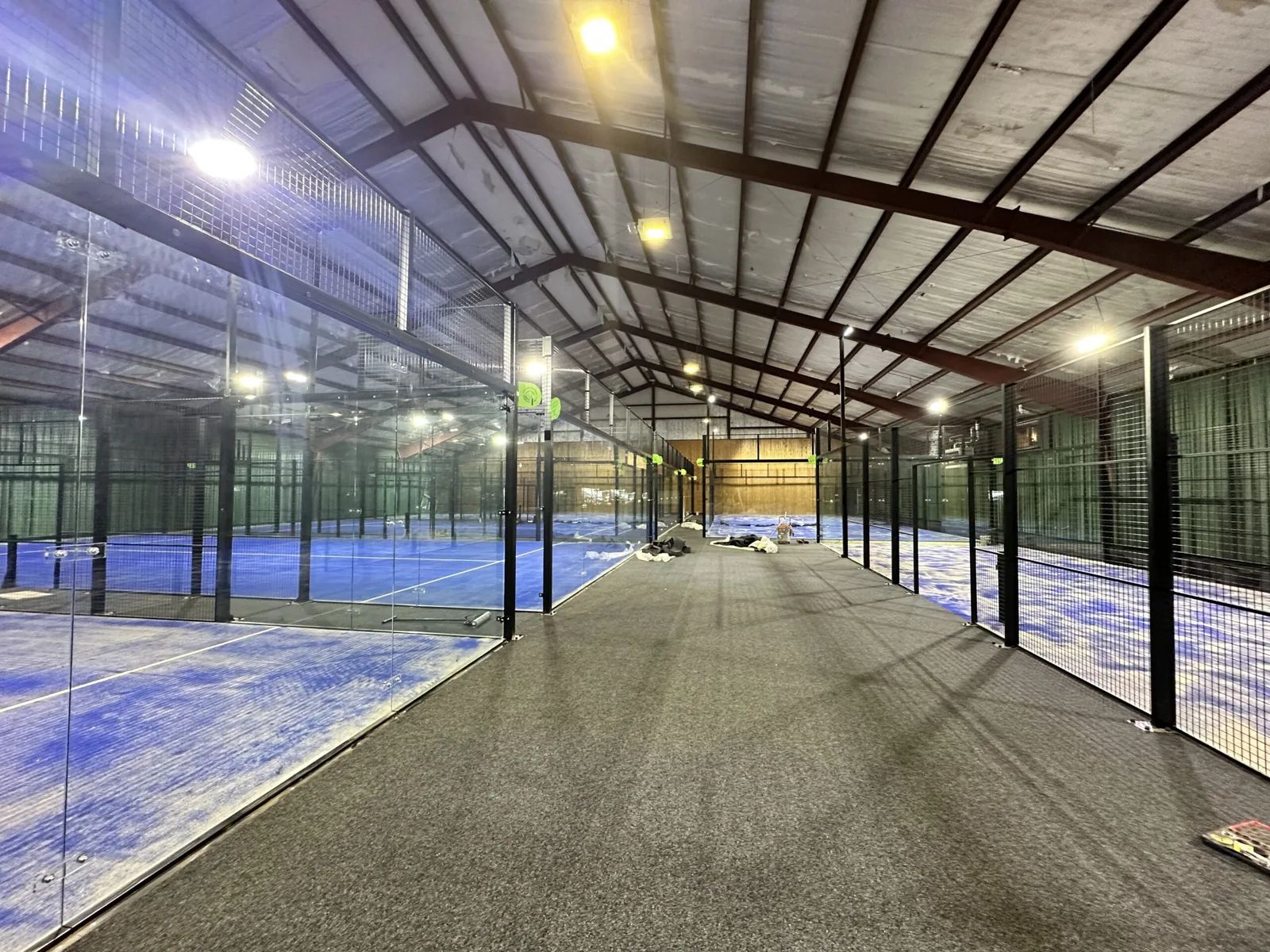
An indoor padel court can in principle be played on all year round, regardless of the season or the weather. In practice, daily availability depends on the venue's opening hours. Most indoor padel venues are open from 07:00 to 23:00, which amounts to 16 available playing hours per day.
Over a full year, that theoretically adds up to more than 5,800 hours per court. Even at an occupancy rate of 50 to 60 percent, which is realistic for a well-run venue, that is more than 2,900 paid playing hours per court per year. At an hourly rate of 20 to 30 euros on average, that is considerable revenue per court.
Important to know: at indoor venues, peak hours are usually in the evening and at weekends. Occupancy is highest in those periods. During the day and on weekday mornings, occupancy is lower, but those hours can certainly be filled with memberships, clinics and corporate sports.
What are the biggest disadvantages of outdoor padel courts for occupancy?
The biggest disadvantage of an outdoor padel court for occupancy is its dependence on the weather. In the Netherlands, that means in concrete terms: rain, wind and cold cause cancellations and empty courts, especially in autumn and winter. On average, outdoor courts in the Netherlands are less playable or not playable at all for two to four months a year because of weather conditions.
That has a direct impact on annual returns. Not only does the court itself stand empty, but the associated revenue from hospitality, memberships or rentals also disappears in those periods. Operators of outdoor venues sometimes see their occupancy rate drop below 20 percent in the winter months.
Besides the weather, the following factors also play a role in the lower occupancy of outdoor courts:
- Limited lighting in the winter evenings, which means playing hours are lost
- Permit restrictions that limit evening playing times, particularly at locations near residential areas
- A higher threshold for players to go outside in bad weather
- Time needed after rain before the court is playable again, depending on the foundation type
A good water-permeable foundation, such as drainage concrete or Supersub, considerably shortens the recovery time after rain. Drainage concrete is a water-permeable concrete floor in which rainwater drains directly through the foundation into the subsoil. Supersub is based on foam concrete and can handle up to 500 millimetres of rainfall per hour. Both solutions help increase occupancy, but they do not completely solve the fundamental problem of weather dependence.
What is the difference in annual occupancy rate between indoor and outdoor?
In the Netherlands, indoor padel courts achieve an average annual occupancy rate of 55 to 75 percent, depending on location and operation. Outdoor padel courts are structurally lower, between 35 and 55 percent on average, due to weather influences and seasonal drops. The difference of 20 to 30 percentage points translates directly into a significant difference in annual revenue per court.
To make this concrete: suppose a court is available 16 hours a day and charges an hourly rate of 25 euros. An indoor court with 65 percent occupancy then generates roughly 95,000 euros per year. An outdoor court with 45 percent occupancy comes to around 66,000 euros. That is a difference of almost 30,000 euros per court per year, purely because of the difference in occupancy rate.
On top of that, indoor venues also suffer less from seasonal peaks. Outdoor courts do well in summer, but that only partly compensates for the loss-making months in winter. Indoor courts have a more stable spread across the year, which is also financially better for planning.
Which factors determine the occupancy rate of a padel court?
The occupancy rate of a padel court is determined by a combination of location factors, operating decisions and external circumstances. The five most important factors are: the type of court (indoor or outdoor), the location and accessibility of the venue, pricing, the range of lessons and activities, and the quality of the booking system.
Location and accessibility
A location in or near a residential area with good parking structurally attracts more players than a location on the edge of an industrial estate. Visibility and convenience are decisive for spontaneous visitors and regular customers. The easier it is to book and reach a court, the higher the occupancy.
Pricing and memberships
Venues that work with memberships, fixed playing times or customer cards have a more stable occupancy than venues that rely purely on one-off rentals. Members reserve fixed time slots, which guarantees base revenue and structurally increases the occupancy rate.
Range of activities
Venues that offer clinics, leagues, corporate sports and youth lessons in addition to rentals fill the off-peak hours much better. During the day and on weekday mornings, those hours are otherwise hard to fill. A varied programme considerably increases the average occupancy rate.
Permits and playing times
At outdoor venues, municipal noise standards can limit evening playing times. This has a direct impact on the occupancy rate, because evening hours are the busiest periods. Sound-absorbing measures can help to obtain longer playing times, but that always depends on the situation and requires an acoustic report.
When is an outdoor padel court a good choice after all?
An outdoor padel court is a good choice when the investment needs to stay lower, when no covered space is available, or when the location lends itself to seasonal operation. For tennis clubs that want to convert existing outdoor courts to padel, an outdoor solution is also often the most logical step.
Outdoor courts are popular in the summer months and generate high occupancy in that period. For locations in tourist areas or at campsites, that can be enough to achieve a healthy return. The key then lies in low operating costs and good summer occupancy that compensates for the quieter winter months.
In addition, there are situations in which outdoor is simply the only option. Think of tennis clubs with existing outdoor facilities, municipal sports parks or locations without an available hall. In those cases, the return on an outdoor court is still positive, provided the investment and expectations are well aligned.
An outdoor court also has a lower entry threshold in terms of investment. The superstructure starts at around 30,000 euros as an indication. However, the foundation is a separate and considerable cost item for outdoor courts, depending on the soil conditions and the location.
How does the foundation influence the choice between indoor and outdoor?
For outdoor padel courts, the foundation has a major influence on both costs and occupancy rate. A well water-permeable foundation, such as drainage concrete or Supersub, ensures that the court is playable again quickly after rain. With a poor foundation, a court can be out of use for hours or even days after a rain shower, which directly lowers the occupancy rate.
For indoor courts, the foundation plays a different role. Here it is less about water drainage and more about flatness, stability and playing comfort. Supersub is also used indoors, but in a non-water-permeable variant tailored to the indoor environment.
Foundation types and their impact on occupancy
Drainage concrete is one of the most widely used solutions for outdoor padel courts. The open structure of the concrete lets rainwater pass straight through to the subsoil, preventing puddles and keeping the court playable quickly. A drainage concrete floor lasts an average of 25 to 40 years with proper use and maintenance, which also makes it a profitable choice in the long term.
Supersub, a foundation solution based on foam concrete, has similar water-permeable properties but adds shock absorption. This increases playing comfort and reduces strain on joints. For venues where playing comfort is a selling point, that can have a positive effect on occupancy.
ZOAB asphalt, a porous type of asphalt, is less common for padel, but can be a good option in specific situations. Which foundation type fits best always depends on the soil conditions, the wind zone and the use. In the Netherlands, all foundation components must be approved by Kiwa ISA Sport. Working with certified materials is not only mandatory, but also protects you against unexpected problems afterwards.
What is the payback period of an indoor versus an outdoor padel court?
The payback period of an indoor padel court is usually between three and six years, depending on the number of courts, the occupancy rate and the operating costs. An outdoor padel court has a lower purchase price, but also a lower occupancy rate, so the payback period can be comparable or even longer. The total investment and the expected annual return together determine which option is financially more attractive.
For an indoor court, an investment from around 23,000 euros per court is an indication, turnkey, including steel structure, glass, artificial turf, LED lighting and installation. At an occupancy rate of 60 percent and an average hourly rate of 25 euros, you generate annual revenue of well over 80,000 euros per court. After deducting operating costs, the investment is paid back within a few years at a well-run venue.
An outdoor court starts at around 30,000 euros as an indication for the superstructure, but the foundation comes on top of that. A complete outdoor project including foundation usually starts at around 50,000 euros, depending on the location and the soil conditions. The lower occupancy rate in the winter months means the payback period is longer than for a comparable indoor court.
With several courts at one location, economies of scale arise, both in construction and in operation. That lowers the cost per court and shortens the payback period. For commercial venues and padel centres, that is a relevant consideration when determining the number of courts.
Do you want to know what the best choice is for your specific location and situation? At I-Padel, we are happy to think along with you, without obligation, about the options, the costs and the expected returns. Get in touch for an initial exploration or take a look at our options for the construction of padel courts to get a good idea of what we can do for you.
Frequently asked questions
How can I increase the occupancy rate of my new padel court as quickly as possible?
Start building a loyal customer base before the opening through pre-sales of memberships and fixed playing times. Also provide a user-friendly online booking system, because a low booking threshold considerably increases spontaneous occupancy. Fill the off-peak hours structurally with clinics, youth lessons and corporate sports packages, so that you are not entirely dependent on evening and weekend bookings.
Is a combination of indoor and outdoor courts at one location a smart choice?
Yes, a hybrid venue can offer the best of both worlds: the outdoor courts generate high occupancy in the summer months, while the indoor courts guarantee stable income all year round. This spreads the risk and makes the venue more attractive to a wider audience. It does require a higher initial investment, so make sure you have a solid business plan before making this choice.
Which common mistakes should I avoid when estimating my returns?
A common mistake is calculating with an overly optimistic occupancy rate in the first year of operation. A new venue needs time to build up a loyal customer base; in the first year, expect an occupancy rate of 30 to 45 percent, not 65 percent straight away. Also don't forget to include operating costs such as maintenance, energy, staff costs and marketing budget in your return calculation, because they have a big impact on net income.
How long does a padel court last on average and what are the main maintenance costs?
The artificial turf of a padel court has an average lifespan of 8 to 12 years, depending on usage and the quality of the material. The foundation, in particular drainage concrete or Supersub, lasts considerably longer, an average of 25 to 40 years. The biggest recurring maintenance costs are the replacement of the artificial turf, upkeep of the glass walls and maintenance of the lighting; set aside a budget for this each year to avoid surprises.
Which permits do I need before I can build a padel court?
Building a padel court requires an environmental permit in most cases, especially when building a covered structure or installing floodlight masts. For outdoor courts near residential areas, an acoustic study is also often mandatory because of municipal noise standards. It is strongly advisable to contact the municipality at an early stage to check which permits and requirements apply to your specific location.
Does the choice of a specific type of artificial turf make a difference to the occupancy rate?
Yes, the quality and type of artificial turf indirectly influence the occupancy rate because they determine playing comfort and maintenance needs. High-quality artificial turf with the right level of sand infill gives a more consistent playing feel, which brings players back and generates positive word of mouth. Also make sure the artificial turf used is certified by a recognised body such as Kiwa ISA Sport, so that you comply with the applicable standards and run into no problems at any inspections.
What is the effect of a professional booking system on occupancy and returns?
A good booking system lowers the threshold to book, reduces no-shows through automatic reminders and gives you valuable data on which time slots structurally remain empty. With those insights, you can run targeted discount promotions or programmes to fill off-peak hours. Popular systems such as Playtomic or CourtReserve have been developed specifically for padel venues and often also integrate with payment systems and customer management.


