


Building a padel court · 15 April 2026 · 10 min read
What is the difference between Supersub and drainage concrete for padel courts?
Drainage concrete or Supersub for your padel court? Discover the differences in weight, shock absorption and cost, and make the right foundation choice.
In this article
- What is drainage concrete and how does it work for a padel court?
- What is Supersub and what makes it different from traditional concrete?
- What is the difference between Supersub and drainage concrete?
- Which foundation is best for an outdoor court?
- May any foundation be used for a padel court in the Netherlands?
- How do you choose the right foundation for your padel court?
- Frequently asked questions
The foundation of a padel court is one of the most decisive choices in the entire construction process. Yet it is also one of the components that many clients know least about. Two names keep coming up: drainage concrete and Supersub. Both are water-permeable foundation solutions for padel courts, but they work differently, cost differently and suit different situations. In this article, we explain the difference, so you know what to look out for.
What is drainage concrete and how does it work for a padel court?
Drainage concrete is a water-permeable type of concrete in which rainwater drains directly through the foundation into the subsoil. The open structure of the material makes this possible. It is a proven and widely used foundation solution for outdoor padel courts where water drainage, stability and long-term playability are important.
What drainage concrete means in practice: after a rain shower, no water remains on the court. The water drains away through the foundation itself, so the court is quickly playable again. For an outdoor court, that is not a luxury but a basic requirement if you want to use the court intensively.
What are the technical properties of drainage concrete?
Drainage concrete scores well on several fronts. The surface is extremely flat, which ensures consistent ball bounce and professional playing behaviour. The load-bearing capacity is high enough to carry the heavy steel structure and glass walls of a padel court, including the forces caused by wind load. In addition, the porous structure has a slight sound-absorbing effect, which can be relevant at locations near residential areas.
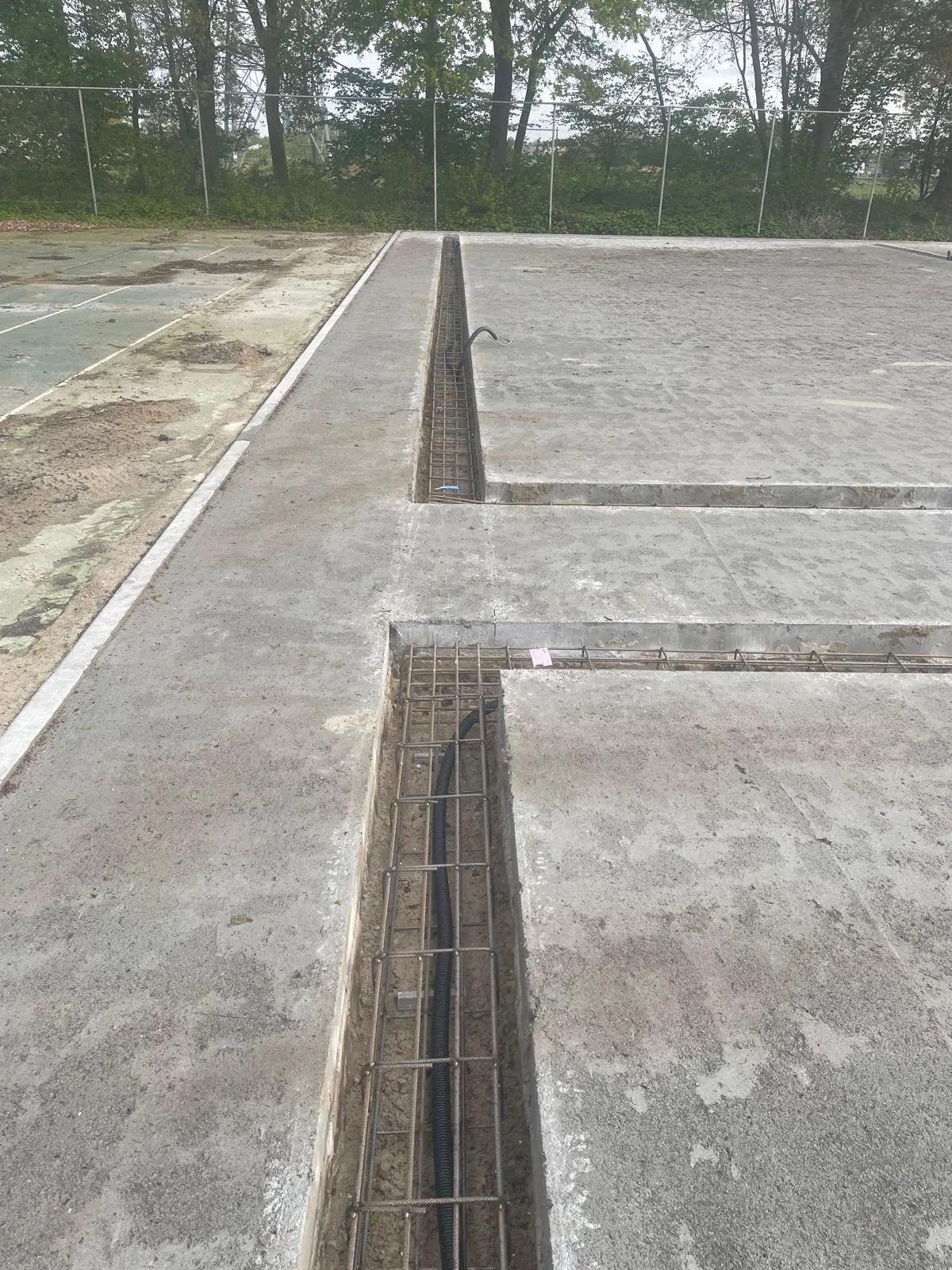
The lifespan of a drainage concrete foundation averages between 25 and 40 years with correct use and maintenance. The material withstands frost, heat and intensive use. For padel courts, drainage concrete is almost always combined with a ring foundation with steel reinforcement, so that the forces from the cage structure and wind load are properly absorbed.
What is Supersub and what makes it different from traditional concrete?
Supersub is an innovative foundation solution based on foam concrete: a light, self-levelling type of concrete that provides a flat and stable base. It differs from traditional concrete in that it is considerably lighter, levels itself during pouring and has a shock-absorbing effect that traditional concrete does not offer.
That foam concrete may sound fragile, but it is not. Supersub is light but very strong and hardly susceptible to settlement or cracking. The resilient build-up provides a better distribution of forces during play, which reduces the strain on joints and muscles. That is an advantage players notice immediately, especially with intensive use.
Does Supersub also work for existing courts or renovations?
Yes, and that is exactly where Supersub proves its added value. It is used not only in new-build projects, but also when converting existing sports fields, for example when converting tennis courts into padel courts. For renovations, the usual thickness is around 10 centimetres. For new builds, it is around 15 centimetres. The exact thickness is always determined on the basis of the soil conditions and the project requirements.
Because Supersub is light and quick to process, it can in many cases be poured within a single day. That saves time in the schedule, which is a concrete advantage for projects with tight deadlines.
What is the difference between Supersub and drainage concrete?
The most important difference between Supersub and drainage concrete lies in the material composition and the additional properties that come with it. Drainage concrete is a more traditional, heavier type of concrete with an open structure for water drainage. Supersub is a lightweight foam concrete that, besides water drainage, also offers shock absorption and sound damping.
The main differences at a glance:
- Weight: Supersub is considerably lighter than drainage concrete, which brings advantages in transport, processing and load on the subsoil.
- Shock absorption: Supersub has a resilient build-up that reduces the strain on joints. Drainage concrete does not offer this.
- Water permeability: Both solutions are water-permeable. The outdoor variant of Supersub can handle up to 500 mm of rainfall per hour.
- Sound damping: Supersub helps limit noise nuisance. Drainage concrete has a limited sound-absorbing effect due to its porous structure.
- Lifespan: Drainage concrete has a proven lifespan of 25 to 40 years. Supersub is relatively new, but because of its low susceptibility to cracking it is also designed for the long term.
- Sustainability: Supersub requires less transport and raw materials than traditional foundations and is fully recyclable, resulting in lower CO₂ emissions.
- Processing time: Supersub can in many cases be poured within a single day. Drainage concrete usually takes more time.
Both solutions are suitable as a base for a Supersub padel court or as a drainage concrete foundation for an outdoor court. The choice depends on the location, the soil conditions, the use and the budget.
Which foundation is best for an outdoor court?
For an outdoor padel court, both drainage concrete and Supersub are suitable foundation options, but the best choice depends on the specific situation. Drainage concrete is the most traditional and proven solution with a long track record. Supersub is the more modern variant with additional advantages in terms of shock absorption, noise and sustainability.
The following factors play a role in the choice:
- Soil conditions: Cone penetration tests determine which foundation is technically the most suitable for the location.
- Noise requirements: Is the court near residential buildings? Then the sound-absorbing effect of Supersub can be an extra argument.
- Budget: Drainage concrete is a cost-efficient choice in many cases. Supersub offers more properties, which can be reflected in the price.
- Renovation or new build: When converting an existing tennis court, Supersub is in many cases a better fit because of its thin application and low weight.
Besides drainage concrete and Supersub, there is also ZOAB asphalt (very open asphalt concrete), a porous type of asphalt that lets water through. This is less common for padel courts, but a good option in certain situations. Tailored foundation advice, based on cone penetration tests, always gives the most reliable answer for your specific location.
May any foundation be used for a padel court in the Netherlands?
No, not every foundation is simply permitted. In the Netherlands, all foundation components for padel courts must be approved by Kiwa ISA Sport. This is the recognised quality mark for sports infrastructure and a condition for certification if the court is used for official competitions under the auspices of the KNLTB.
This is a point that many clients underestimate. Anyone who chooses a non-certified foundation product risks the court failing the inspection later. That can mean the court may not be used for organised competition, or that adjustments are still needed that bring extra costs.
Kiwa ISA Sport tests both the sports floor and the foundation build-up against sports-technical and material-technical requirements. The inspection takes place after handover and includes, among other things, measurements of ball bounce at several measuring locations. Make sure, therefore, that the materials used are demonstrably certified and appear on the sports products list.
How do you choose the right foundation for your padel court?
You do not choose the right foundation for a padel court on the basis of a single factor, but on a combination of location, use, budget and applicable requirements. Always start with a site check and soil investigation (cone penetration test), so that the foundation advice matches the actual situation on site.
A good approach follows these steps:
- Have cone penetration tests carried out. The soil conditions help determine which foundation is technically sound and what thickness is needed.
- Determine the site conditions. Think of wind load, proximity of homes, accessibility for equipment and the presence of existing paving.
- Establish the intensity of use. A court that is used intensively every day places different demands on the subsoil than a court that is played on recreationally.
- Look at certified materials. Check whether the chosen foundation solution is approved by Kiwa ISA Sport, so you don't face surprises at the inspection later.
- Weigh up the added value of Supersub. If shock absorption, fast processing or sustainability are relevant to your project, Supersub as a base for a padel court is worth considering alongside drainage concrete.
The foundation is not the place to cut costs. A wrong or undersized foundation leads over time to settlement, tilting and damage to the steel structure. Those are costs you would rather prevent than have to fix afterwards.
At I-Padel, we guide you through this entire process: from site check to foundation advice and full construction. We work exclusively with certified materials and know the requirements of Kiwa ISA Sport inside out. Whether you choose drainage concrete, Supersub or another solution: we make sure the choice suits your location and project. Want to know more about building padel courts? Get in touch for an initial exploration, and together we will look at what best suits your situation.
Frequently asked questions
What does a drainage concrete or Supersub foundation for a padel court cost on average?
The cost of a padel court foundation varies depending on the soil conditions, the solution chosen and the site conditions. Drainage concrete is generally a more cost-efficient choice, while Supersub, thanks to additional properties such as shock absorption and sound damping, can involve slightly higher material costs. Because every situation is different, a bespoke quote, after cone penetration testing and a site check, is the only reliable way to determine the actual costs.
How long does it take in practice to build a padel court foundation?
The construction time depends heavily on the foundation solution chosen and the preparation of the subsoil. Supersub can in many cases be poured within a single day, which makes it particularly suitable for projects with tight deadlines. Drainage concrete usually requires slightly more processing time. Also allow for the curing time of the concrete before the next construction phase can start.
What happens if the soil conditions are poor? Can a padel court be built at all?
Poor soil conditions do not have to be a showstopper, but they do call for a careful foundation design. Cone penetration tests determine which approach is technically sound, for example a deeper foundation, extra stabilisation layers or a lightweight solution such as Supersub that puts less load on the subsoil. Skipping this investigation is the biggest risk: without good soil data, the chance of settlement and damage to the structure is considerably greater.
Can I reuse an existing concrete foundation if I want to build a padel court at a former tennis park?
That depends on the condition, thickness and flatness of the existing foundation. In some cases, the existing subsurface can be used as a base, with Supersub applied as a levelling and additional layer. This is even one of the strong applications of Supersub in renovations. Always have the existing foundation assessed by a specialist, so you know whether reuse is technically sound and whether the build-up meets the requirements of Kiwa ISA Sport.
What maintenance does a drainage concrete or Supersub foundation need after handover?
Both foundation types are relatively low-maintenance, but regular inspection is advisable. With drainage concrete, it is important to keep the pores free of leaves, sand and other debris that can impede water permeability. Periodic cleaning with a high-pressure washer is usually sufficient. Supersub requires comparably little maintenance; pay particular attention to the condition of the top layer and the sealing around the cage structure to prevent moisture problems.
Is Supersub also suitable for a covered or indoor padel court?
Yes, Supersub can be used for both outdoor and indoor padel courts. With a covered court, the requirement of extreme water permeability falls away, but the advantages of shock absorption, fast processing and the self-levelling nature of the material remain fully applicable. For indoor projects too, the exact build-up and thickness are determined on the basis of the soil conditions and the specific project requirements.
What are the most common mistakes when choosing a padel court foundation?
The most common mistake is skipping the soil investigation to save costs, which in time leads to settlement and expensive repair work. A second common mistake is choosing a non-certified foundation product that is not on the Kiwa ISA Sport sports products list, so the court fails the inspection later. Finally, many clients underestimate the importance of a ring foundation with steel reinforcement to correctly absorb the forces from the cage structure and wind load.


