


Building a padel court · 23 May 2026 · 11 min read
Can I have a padel court customised to my venue’s branding?
Customise a padel court to your branding? Discover which parts can be tailored, what it costs and when a custom solution is truly worth it.
In this article
- Can a padel court be customised to a corporate identity?
- Which parts of a padel court can be customised?
- How is the colour of a padel court determined?
- What is the difference between a custom court and a standard court?
- Can I also have sound-absorbing panels installed in my branding?
- What does it cost to customise a padel court to your branding?
- When is it smart to choose a custom padel court?
- Frequently asked questions
Yes, a padel court can be customised to the branding of your venue. Think of the colour of the steel structure, the artificial turf, the LED lighting and any panels around the court. The degree of customisation depends on the type of court and the supplier’s production method. Whoever produces the steel structure themselves has more freedom than someone who imports a standard court.
Whether you run a sports hall, a tennis club or a commercial padel venue, the look of your courts says something about your brand. In this article you will read exactly which parts can be customised, what that costs and when a custom solution is worth it.
Can a padel court be customised to a corporate identity?
Yes, a padel court can be tailored to a venue’s corporate identity in several ways. The most common adjustments are the colour of the steel structure and cage structure, the colour and type of artificial turf, the design of the LED lighting and the finish of any panels or fencing. This is possible for new courts and, to a limited extent, for existing courts.
Customisation to match your branding is not a luxury reserved for large venues. Gyms, tennis clubs and commercial padel centres increasingly opt for a recognisable look that fits their brand or surroundings. A consistent visual identity makes a venue look more professional and attracts more visitors.
That said: the more freedom you want in colour, size or structure, the more important it is that the supplier produces the steel structure themselves. An importer who sources standard courts from Spain can generally deviate very little from the fixed range.
Which parts of a padel court can be customised?
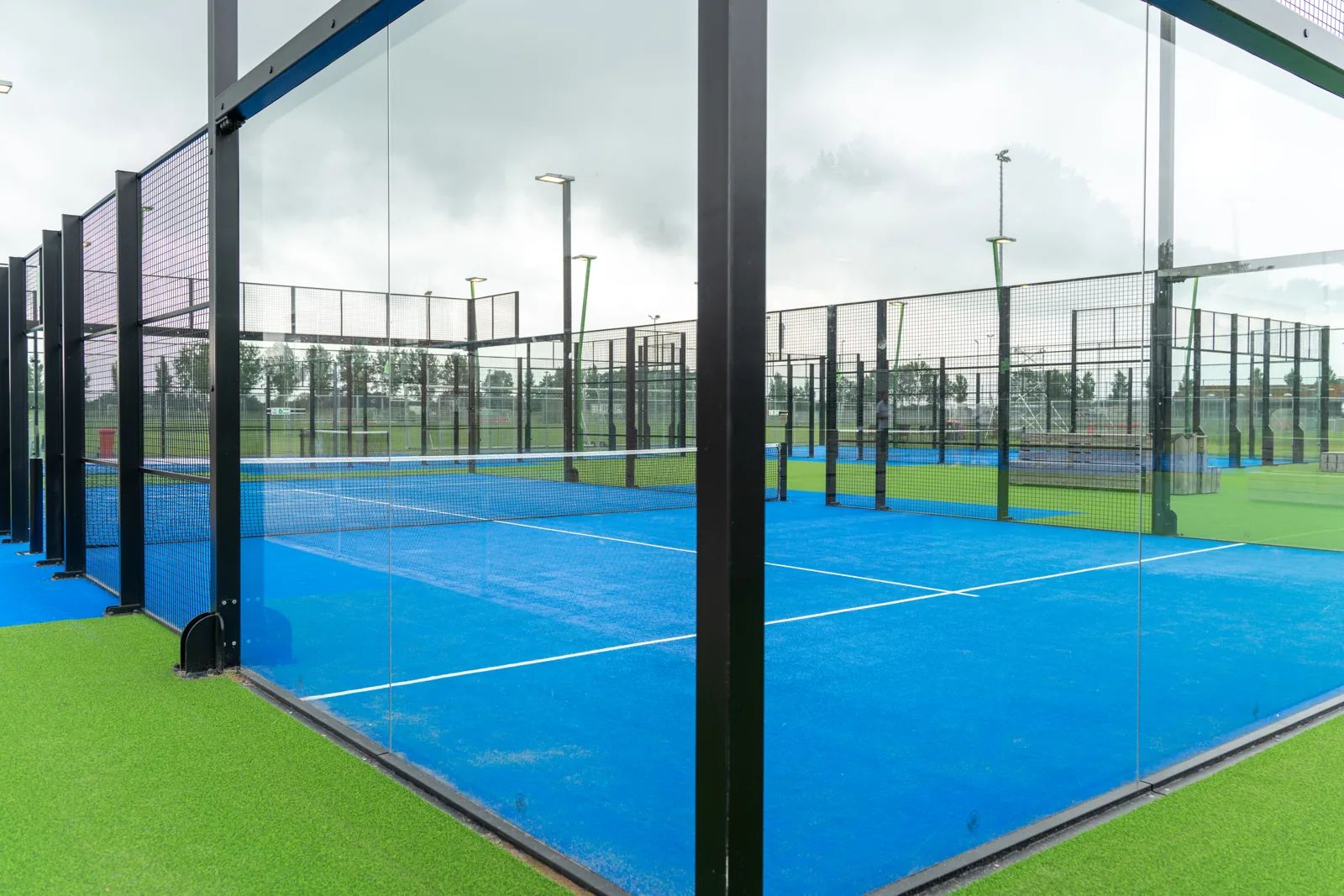
The parts of a padel court that can be customised are the steel structure (colour and coating), the artificial turf (colour and type), the LED lighting (colour of the posts and light colour), the mesh panels and any sound-absorbing panels. Each of these parts can be adapted to the wishes of the venue to a greater or lesser extent.
Steel structure and cage structure
The steel structure is the most decisive element for the visual appearance of a padel court. As standard, steel is hot-dip galvanised to protect against the weather, but on top of that a powder coating in a colour of your choice can be applied. That immediately gives the court its own character.
Artificial turf
Artificial turf for padel courts is in most cases supplied in blue or green, but more options are available. Do note that the artificial turf used must be certified for padel use. In the Netherlands, artificial turf and padel sports floors must be on the sports products list and be approved by Kiwa ISA Sport. This protects you as a buyer against products that do not meet the sports-technical and sports-safety requirements.
LED lighting and light posts
Light posts are available in straight or curved versions and can be given a coating that matches the rest of the court. The colour temperature of the LED lighting itself can also be adjusted, although technical minimum requirements apply to the lighting level for official use.
Mesh panels and fencing
The stainless steel mesh panels around the court are installed in an injury-safe enclosure. The colour of the surrounding structure and the frame of the panels can be adjusted. With sound-absorbing panels, choices in finish and colour are also possible.
How is the colour of a padel court determined?
The colour of a padel court is determined by the powder coating on the steel structure and the colour of the artificial turf. The coating is applied after the steel has been hot-dip galvanised and is available in virtually any RAL colour. The artificial turf is chosen from the supplier’s certified range.
In practice, most venues choose a combination that matches their corporate identity or surroundings. A sports hall with blue house colours, for example, chooses a blue cage structure with blue artificial turf. An outdoor venue in a green setting is more likely to choose a dark or neutral colour that blends into the landscape.
Important to know: the choice of colour has no effect on the structural properties of the court, but it does affect the lifespan of the coating. A good powder coating on a hot-dip galvanised structure lasts for decades without rusting or fading, provided it is applied correctly.
What is the difference between a custom court and a standard court?
A standard court is a predetermined model with fixed dimensions, a standard colour and a fixed structure. A custom padel court is designed on the basis of the specific requirements of the location: non-standard dimensions, a specific colour, a structure adapted for wind load or noise, or a special layout. Custom work takes more time and generally more money, but fits the location better.
The difference lies not only in the appearance, but also in the structural execution. Every location faces different conditions: the wind load in an open rural area is different from that in a sheltered urban environment. With an indoor padel court, the height or width of the hall can impose limitations that a standard model does not solve.
Anyone who opts for a custom solution gets a court calculated for the specific requirements of the spot. That is not just a matter of aesthetics, but also of safety and lifespan. A structure that has not been calculated for the actual wind load or location conditions can cause problems in the longer term.
Can I also have sound-absorbing panels installed in my branding?
Yes, sound-absorbing panels can be finished in a colour and finish that matches the venue’s branding. The panels are attached to the outside of the mesh of the cage structure and are available in different versions. This lets you combine a functional noise solution with a visually fitting look.
Sound-absorbing panels are placed on the side of the court that faces homes or other noise-sensitive uses. They dampen the noise at the source instead of blocking it at a distance. High-quality panels achieve absorption class A, which in practice results in a clearly audible reduction in noise nuisance at distances of around 40 to 100 metres.
What many venues do not know: installing sound-absorbing panels has a structural consequence. The panels reduce the wind permeability of the cage structure, which increases the wind load on the structure. The steel structure must therefore be reinforced, with heavier posts, additional columns or modified connections. This is not an optional step, but a safety requirement. Always check whether your supplier can carry out this recalculation, because not every provider does so for small numbers of courts.
The panels can also be fitted afterwards to existing courts, provided the structure is suitable or is adapted. In that case a structural assessment is made first before the panels are installed.
What does it cost to customise a padel court to your branding?
The extra cost of customising a padel court to a corporate identity depends on the adjustments you want. A colour coating on the steel structure adds a limited amount to the total price. A non-standard artificial turf colour or a special lighting design can cost somewhat more. Custom dimensions or structure always call for a tailor-made quote.
As an indication, a standard indoor padel court is possible turnkey from around €23,000 per court, including cage structure, artificial turf, LED lighting and installation. Adjustments in colour and finish generally fall within a limited extra price, as long as the basic structure does not change significantly. As soon as the dimensions differ or the structure has to be adapted for wind load or noise, the price rises and a tailor-made quote is needed.
For outdoor padel courts the costs are structurally higher, because the steel structure has to be heavier due to the weather and the foundation is a large, location-dependent cost factor. As an indication: a complete outdoor padel court, including foundation, starts from around €50,000. The exact price always depends on the location, subsoil and chosen specification.
Do not be tempted by the lowest price without context. A good coating, certified artificial turf and a structure calculated for the location conditions determine the lifespan of the court. In the long run you pay more for a cheap court that needs replacement or maintenance sooner.
When is it smart to choose a custom padel court?
A custom padel court is smart when the location has specific requirements that a standard model cannot meet. Think of non-standard dimensions, a high wind load on an open outdoor location, noise requirements from the municipality, or a corporate identity that defines the look of the venue. In all these cases a custom solution gives a better result than a standard solution that is adapted afterwards.
Concrete situations in which a custom solution is preferable:
- An indoor location with limited height or width where a standard court does not fit
- An outdoor location in open terrain or a coastal area with increased wind load
- A location near homes where sound-absorbing panels must be structurally integrated
- A commercial venue with a strong brand identity that must be carried through to the courts
- A tennis club that wants to convert existing courts while keeping the existing foundation
With a custom padel court, the steel structure is calculated for the specific conditions of the location. That means the wind load, the soil conditions and any noise requirements are all taken into account in the design. All foundation components in the Netherlands must be approved by Kiwa ISA Sport. Working with certified materials is not only a quality choice, but also protection against non-conformity, which can cause problems at an inspection after handover.
At I-Padel we produce the steel structure entirely ourselves, which gives us the freedom to structurally adapt every court to the location. That also applies to sound-absorbing panels, non-standard dimensions and colour wishes. Do you want to know what is possible for your location? Get in touch for an initial exploration and we are happy to think along with you, without obligation.
Frequently asked questions
How long does it take to design and build a custom padel court?
The lead time of a custom padel court depends on the complexity of the design and the availability of materials, but count on an average of 8 to 16 weeks from quote to handover. The design phase, structural calculations and production of the steel structure take the most time. Plan this well in advance, especially if you have a fixed opening date or depend on seasonal conditions for the foundation.
Can I still have an existing padel court given a brand colour?
To a limited extent that is possible, but it is less straightforward than with a new court. Re-coating an existing steel structure on site is technically more challenging than applying a coating in the factory, and the result is generally less durable. It is wise to ask a supplier whether the structure is suitable for after-treatment and what warranties apply. For artificial turf and panels, later modifications are quite feasible.
Which mistakes do venues make most often when choosing a custom padel court?
The most common mistake is choosing on price without taking location conditions into account, such as wind load or noise requirements. In addition, many venues underestimate the importance of certified materials: artificial turf and foundation components that are not on the Kiwa ISA Sport list can cause problems at handover or inspection. A third common mistake is not involving the municipality in time regarding noise or permit requirements, which makes adjustments necessary afterwards that considerably increase the cost.
Does the colour of the artificial turf affect the playing experience or the way the ball plays?
The colour of the artificial turf in itself has no direct effect on how the ball plays; that is determined by the pile height, the infill and the quality of the fibres. It is important, however, that the chosen artificial turf is certified for padel use, regardless of colour. Some uncertified turf types look visually attractive, but do not meet the sports-technical requirements for bounce behaviour and safety.
Do I need to apply for a different permit for a custom padel court than for a standard court?
The permit requirement depends on the location, the type of court (indoor or outdoor) and the municipality, not so much on whether it is custom or standard. For outdoor padel courts an environmental permit is required in most cases, especially if light posts or sound-absorbing panels are installed. Always check beforehand with your municipality which requirements apply, including any noise standards, so that the structure can be aligned with them already in the design phase.
How do I maintain the colour coating on the steel structure to prevent ageing?
A powder coating on a hot-dip galvanised steel structure is very low-maintenance: regular cleaning with water and a mild cleaner is in most cases sufficient. Inspect the coating annually for damage, scratches or places where the steel has been exposed, and have minor damage repaired in good time to prevent rust. Avoid aggressive cleaning agents or high-pressure cleaners at close range, as these can damage the coating and shorten its lifespan.
Is it possible to give several padel courts at one venue each a different colour, or does that look messy?
Technically it is possible to build courts in different colours, but visually a consistent colour scheme generally works more professionally and is stronger for brand perception. A commonly used approach is to keep the cage structure in a uniform brand colour and introduce subtle variations in the artificial turf or lighting. Ask the supplier or a designer for advice, so that the overall look of the venue stays cohesive.


