


Building a padel court · 7 July 2026 · 12 min read
Can I convert an existing sports hall into a padel venue?
Converting a sports hall to padel? Find out about costs (from €23,000/court), permits, build time and how many courts fit in your hall.
In this article
- Is an existing sports hall suitable for padel courts?
- How many padel courts fit in a sports hall?
- What are the costs of converting a sports hall to padel?
- Which permits are needed for a padel venue in a sports hall?
- What is the difference between an indoor and an outdoor padel court?
- How long does it take to build padel courts in a sports hall?
- Which foundation options are there for indoor padel courts?
- Who is responsible if something goes wrong during construction?
- Frequently asked questions
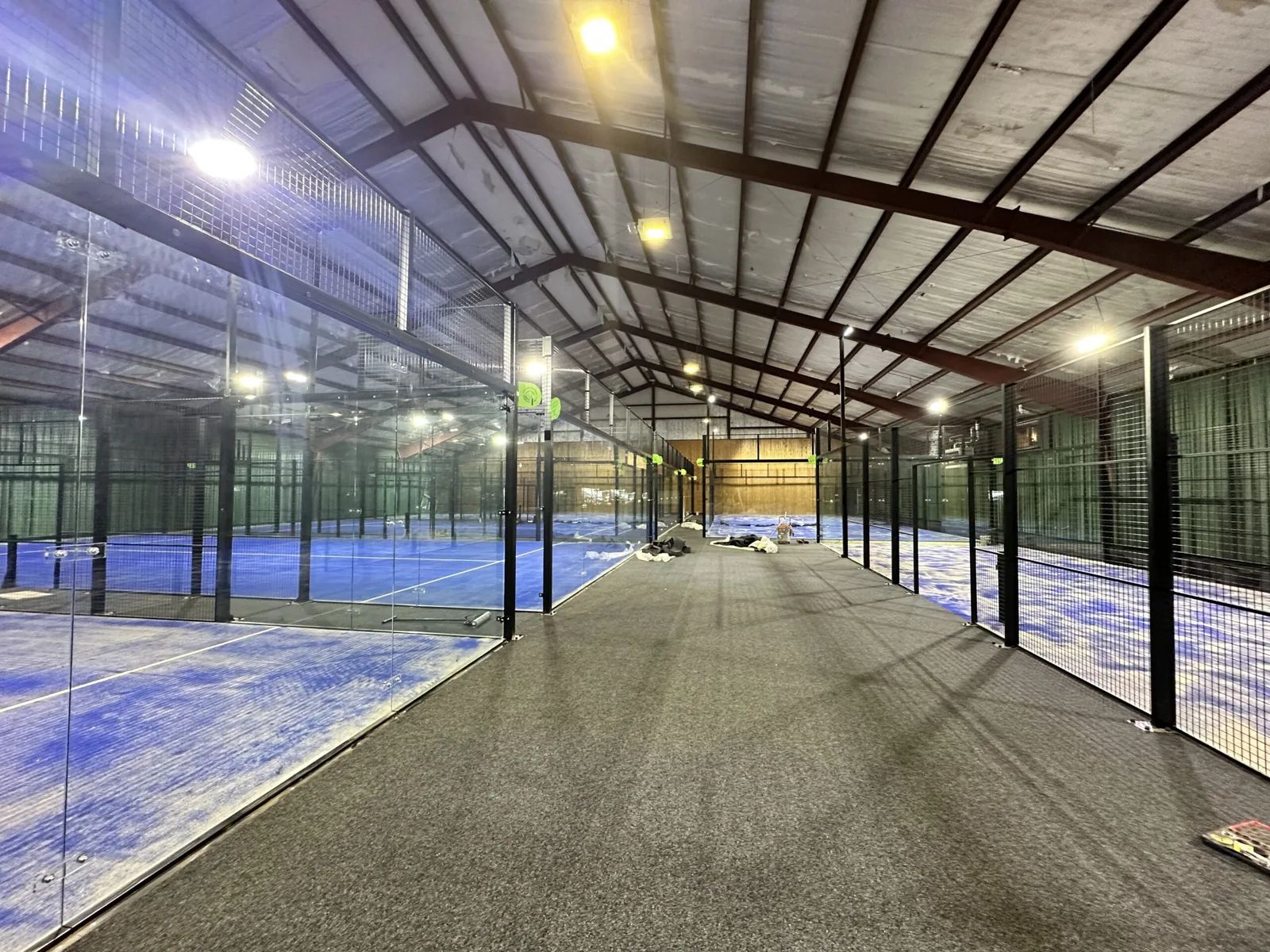
Converting an existing sports hall into a padel venue is perfectly feasible in many cases. Most halls with a clear height of at least 6 metres and sufficient floor area are suitable for one or more padel courts. What exactly you need, what it costs and how long it takes, you can read below, answered question by question.
Is an existing sports hall suitable for padel courts?
An existing sports hall is suitable for padel courts if the clear height is at least 6 metres and the floor area is large enough for the required playing size plus run-off space. Most standard sports halls meet these basic conditions, but a site check is always wise before you take further steps.
Besides height and surface area, the load-bearing capacity of the floor, accessibility for installation and the existing installations also play a role. Think of the position of roof beams, existing light fixtures and the condition of the existing floor. In most cases no major structural alterations to the hall itself are needed. The padel courts are placed on the existing floor as free-standing structures.
A hall with a clear height below 6 metres is technically less suitable. Play is restricted and the court then does not meet the standards of NOC*NSF and the KNLTB. For professional use or tournaments, a clear height of more than 6 metres is advisable.
How many padel courts fit in a sports hall?
The number of padel courts that fit in a sports hall depends on the available floor area. Each padel court needs a minimum installation space of 21 x 11 metres. For a comfortable playing experience with run-off zones, 21 x 14 metres per court is recommended. A hall of 1,000 m² can generally accommodate four to six courts with a good layout.
When planning the layout, it is smart to also reserve space for walkways between the courts, an entrance area and any changing rooms or a hospitality area. The latter is definitely worth including in the planning phase for commercial venues.
A handy rule of thumb: allow at least 250 to 300 m² of gross floor area per court, including walkways and run-off zones. With a tight design and a rectangular hall you can sometimes lay things out slightly more efficiently, but never go below the minimum playing size of 20 x 10 metres.
What are the costs of converting a sports hall to padel?
The costs of converting a sports hall into a padel venue start indicatively from around €23,000 per indoor padel court, including steel structure, glass, artificial turf, LED lighting and installation. For a venue with four courts, that comes to an indicative price of around €92,000 to €100,000, depending on the specification and site-specific factors.
What is included in that price?
A turnkey package includes the following components: the steel structure (cage structure), safety glass around the court, padel-specific artificial turf including sand bed and line markings, LED lighting and the complete installation. Groundwork and foundation depend on the condition of the existing floor and are calculated separately.
What can make the price higher?
The final price is influenced by the type of court you choose. A panoramic court has a different visual appearance from a pro court and is generally priced slightly higher. In addition, the accessibility of the site, the number of courts (more courts bring economies of scale) and any extra options, such as sound-absorbing panels, play a role. An existing floor that is not flat enough or needs extra reinforcement also counts towards the total price.
Which permits are needed for a padel venue in a sports hall?
For an indoor padel venue in an existing sports hall, a separate building permit is not always needed. If no structural alterations are made to the building itself, installing padel courts in many cases falls within the existing use designation. Even so, there are always rules on fire safety and use that you must comply with.
Check with your municipality whether the current designation of the hall allows sports use and whether the activities you want to undertake, such as commercial rental or organising tournaments, fit within the existing permit. If in doubt, a zoning plan check is the first step.
Noise plays a smaller role at indoor venues than outdoors, but for a hall in a residential area or near other sensitive functions, an acoustic study may still be requested. Padel produces more noise than tennis. The ball hitting glass and steel results in an average sound power level of around 91 dB. Bear this in mind when choosing the site and fitting out the hall.
After handover the following applies: for official tournaments under the auspices of the KNLTB, an inspection by Kiwa ISA Sport is mandatory. All foundation components and sports floor materials must meet the associated certification requirements. If you work with certified materials from a recognised supplier, this is not an obstacle, but it is something to check in advance.
What is the difference between an indoor and an outdoor padel court?
The biggest difference between an indoor and an outdoor padel court lies in the steel structure and the foundation. An outdoor padel court must withstand wind load, rain, frost and temperature changes. This requires a heavier steel structure made of hot-dip galvanised steel, and the foundation is more complex and more dependent on the site. Indoor padel courts are lighter in construction and simpler to build.
In the Netherlands, three wind zones are used. Every outdoor court is structurally calculated for the wind zone of the site. That means heavier posts, different connections and sometimes additional anchoring. This does not apply to indoor courts. The hall itself offers protection against wind and weather.
The costs also differ. An indoor padel court starts indicatively from around €23,000 turnkey. An outdoor padel court excluding foundation starts from around €30,000, and the complete project including foundation quickly rises to around €50,000 or more, depending on the ground conditions and the civil works required.
Reasoning from the advantages of an indoor padel court as a sports venue: you are not dependent on the weather, the courts can be played on all year round and you have fewer permit requirements relating to noise and lighting. For commercial operation, that is a relevant advantage.
How long does it take to build padel courts in a sports hall?
Installing a padel court in a sports hall takes an average of three to four days per court. The cage structure is installed in two days. Laying the artificial turf takes one to two extra days. The total lead time of a project, including production, delivery and installation, averages ten to twelve weeks.
Those ten to twelve weeks include the production phase of the steel structure. Because the structure is produced in our own factory, there is no dependence on foreign production schedules or long import times. That gives more certainty about the planning.
Bear in mind that preparation, including the site check, structural calculation and any permit procedure, also takes time. A permit process takes an average of eight to twelve weeks, depending on the municipality and the complexity of the project. If you are planning an opening on a fixed date, it is smart to start that preparation as early as possible.
Which foundation options are there for indoor padel courts?
For indoor padel courts, the most commonly used foundation options are Supersub, drainage concrete and a ring foundation with strong plastic plates. The choice depends on the condition of the existing floor, the ground conditions and the desired playing comfort. With an existing concrete floor in good condition, an additional sports floor on top of the existing subfloor is sometimes sufficient.
What is Supersub?
Supersub is a foundation solution based on foam concrete, a lightweight and self-levelling type of concrete that provides a flat and stable subfloor. It is shock-absorbing, which reduces the load on joints and muscles and contributes to a more comfortable playing experience. For indoor use, a non-water-permeable build-up is applied, tailored to the indoor environment. The thickness is around 10 cm for renovation and around 15 cm for new builds.
What is drainage concrete?
Drainage concrete is a water-permeable type of concrete with an open structure. Indoors it is used less often than outdoors, but it is a stable and durable option at sites where the subfloor needs extra load-bearing capacity. The average service life is 25 to 40 years with correct use and maintenance.
A good foundation is not just a technical matter. It determines the service life of the court and the quality of play. A flat subfloor is important for consistent ball bounce, which directly affects the playing experience. Tailored foundation advice is always drawn up on the basis of soil probing. All foundation components used in the Netherlands must be approved by Kiwa ISA Sport. Working with certified materials is a requirement for this.
Who is responsible if something goes wrong during construction?
If you opt for a turnkey approach in which one party handles the entire process, from groundwork and foundation to structure, glass, artificial turf, LED lighting and installation, that party is fully responsible for the end result. There is one contact person, one warranty and no room for dispute about who is liable if components do not fit together.
That sounds logical, but in practice many construction firms work with subcontractors for different components. The steel structure comes from an importer, the artificial turf from another supplier, and the lighting is arranged separately. If something then goes wrong, such as settlement, a connection that does not fit or a warranty issue, it can become unclear who is responsible.
With a complete package from a single source you do not have that lack of clarity. Everything falls under the same responsibility and warranty terms. A warranty period of 15 years applies to the steel structure, a long period that shows confidence in our own product quality. Do bear in mind that warranty terms can differ per component: the 15 years apply specifically to the steel structure, not automatically to the artificial turf or the LED lighting.
Want to know what converting your hall into a padel venue involves in concrete terms? At I-Padel we are happy to think along with you, without obligation, about building padel courts. From the first exploration to a complete tailored quote. Get in touch for an initial conversation without obligation.
Frequently asked questions
Can I use an existing sports hall floor, or does a new foundation always have to be built?
That depends on the condition and flatness of the existing floor. A concrete floor in good condition can in some cases serve as a base, possibly supplemented with a sports floor or Supersub layer on top. Soil probing and a site check are always the first step, on the basis of which tailored foundation advice is drawn up. Never rely on assumptions: a floor that looks good can still have insufficient load-bearing capacity or flatness for professional padel use.
What are the most common mistakes when converting a sports hall to padel?
A common mistake is underestimating the space needed per court — planning too tightly leads to insufficient run-off zones and a poor playing experience. In addition, permit and zoning plan procedures are often started too late, so that the planned opening date is not met. Another pitfall is working with several separate suppliers without central responsibility, which can lead to unclear liability when problems arise.
Is an indoor padel venue also suitable for organising tournaments and league matches?
Yes, provided the courts meet the standards of NOC*NSF and the KNLTB and have been inspected by Kiwa ISA Sport. This means, among other things, a clear height of at least 6 metres, certified materials and an approved foundation. When planning, make sure you choose courts that meet these requirements — then an inspection afterwards is not an obstacle but a confirmation of quality.
What does maintenance of indoor padel courts involve?
Indoor padel courts generally need less maintenance than outdoor courts, because they are not exposed to weather influences. The artificial turf needs regular brushing to keep the sand bed evenly distributed and the fibres upright. In addition, periodically check the glass connections, the condition of the line markings and the operation of the LED lighting. An annual inspection by the supplier is a good habit to maximise the service life of the court.
What is the difference between a panoramic court and a pro court, and which is suitable for my site?
A panoramic court has more glass around the structure, which gives an open and visually attractive look — ideal for commercial venues where experience and visibility are important. A pro court has more steel panels and a more robust look that suits a sporty or club-oriented environment better. The panoramic court is generally priced slightly higher. The choice depends on your target group, operating concept and available budget.
How do I finance converting a sports hall to padel — are there subsidies or financing options available?
There are various ways to finance the investment. Municipalities and provinces sometimes offer subsidies for sports infrastructure, especially if the site fulfils a social function. Sports funds such as the Nationaal Sportfonds or the Waarborgfonds Sport can play a role in commercial or club projects. In addition, some suppliers offer lease or financing arrangements. Explore the options early, so that financing does not cause delays in the planning.
What do I need to arrange after handover before I can officially open the courts?
After handover there are a number of practical steps: arrange a Kiwa ISA Sport inspection if you want to organise official tournaments, check that the site meets the fire safety requirements and draw up house rules for users. For commercial operation you will also need a booking system, insurance and possibly a Chamber of Commerce (KvK) registration. Schedule the inspection and administrative handling well before the desired opening date, so that you can start without delay.


