


Building a padel court · 27 March 2026 · 13 min read
Can an outdoor tennis court be converted into an indoor padel venue?
Converting a tennis court to indoor padel? Discover costs, foundation options, permits and technical requirements, including price indications from €23,000.
In this article
- Is an outdoor tennis court suitable for conversion to padel?
- What are the technical differences between a tennis court and a padel court?
- What foundation options are there for a conversion to padel?
- What does it cost to convert a tennis court into an indoor padel venue?
- How does realising an indoor padel venue work, step by step?
- What are the noise requirements for a padel venue near homes?
- What permits are needed for an indoor padel venue?
- What should you look out for when choosing a padel builder?
- Frequently asked questions
Converting a tennis court into a padel court is perfectly possible in many cases. The existing foundation can sometimes be partly reused, which saves costs. Even so, there are technical differences you should not underestimate: the dimensions, the base, the structure and the noise requirements all call for a specific approach. In this article we answer the most frequently asked questions about this conversion, from technical details to permits and costs.
Is an outdoor tennis court suitable for conversion to padel?
Yes, an existing outdoor tennis court is in many cases a good starting position for a padel venue. The foundation and the surfacing are already there, and depending on the condition and type of base, part of it can be reused. That saves on foundation costs, which quickly mount up on an outdoor project.
Even so, it is not as simple as placing a new cage structure on the existing court. A tennis court is 23.77 by 10.97 metres, whereas a padel court measures 20 by 10 metres. The proportions are different, the base has different sports-technical requirements and the structural load of a padel cage differs substantially from that of a tennis net. In addition, specific rules apply to padel for ball bounce and playing surface, which are tested by Kiwa ISA Sport when certifying for competitive sport.
In short: the conversion is feasible, but it calls for a thorough assessment of the existing situation before you take decisions on reuse or replacement.
What are the technical differences between a tennis court and a padel court?
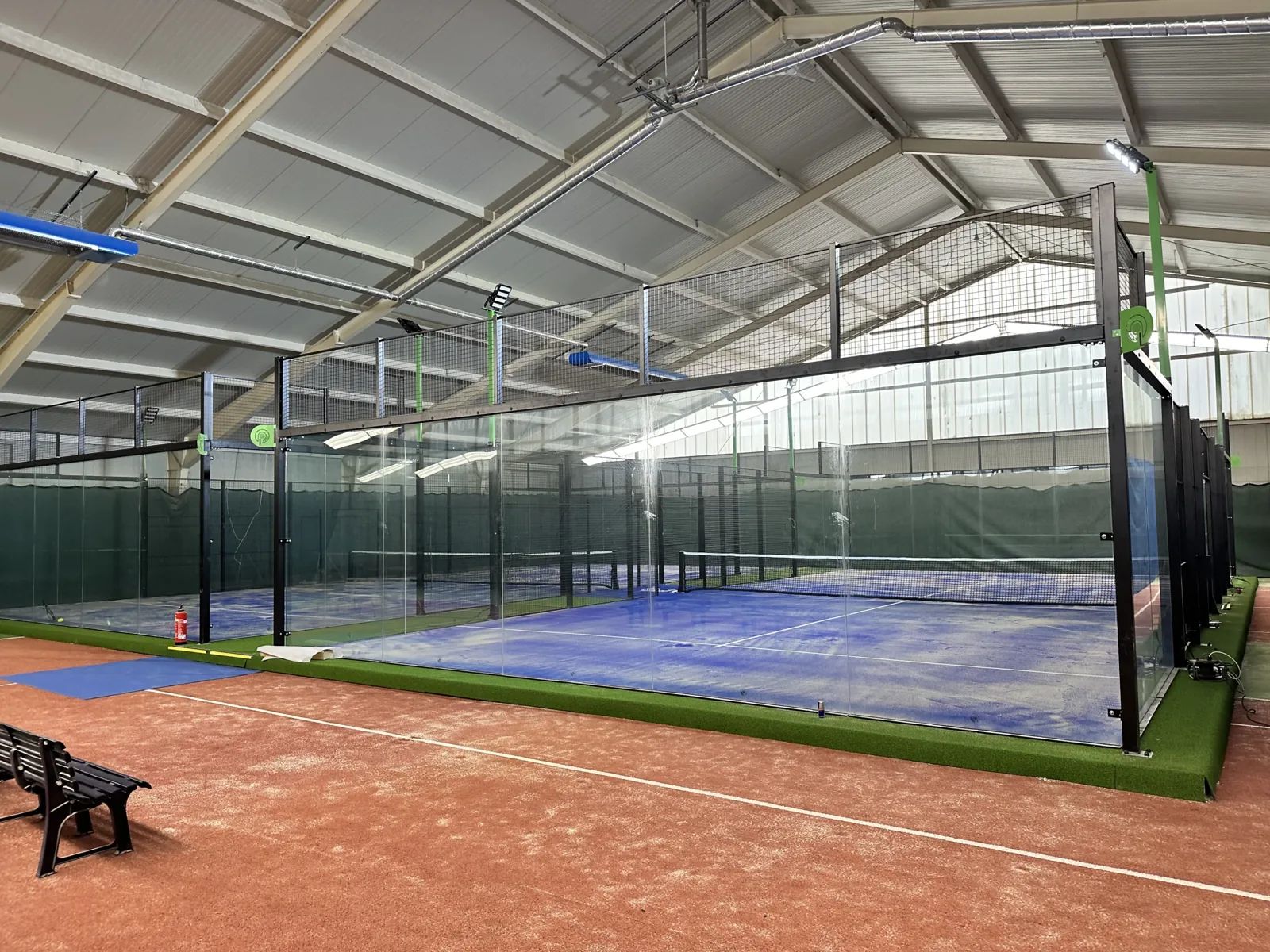
The technical differences between a tennis court and a padel court are greater than they appear at first glance. A padel court is smaller, completely enclosed by a cage structure of steel and glass, and has a specific playing surface with its own requirements for ball bounce, permeability and flatness. A tennis court has no cage and therefore has a fundamentally different structural load.
Dimensions and space
A padel court has a playing area of 20 by 10 metres. For installation you need at least 21 by 11 metres, but 21 by 14 metres including run-off zones is recommended. That extra space around the court is not only pleasant for the players, but also necessary for safety. A tennis court is wider and longer, so the available space has to be measured and assessed afresh.
Structural load
A padel cage consists of a steel structure with glass walls and mesh. That structure carries considerable weight and absorbs wind load. A tennis court has only a net and a few posts, which is not comparable structurally. The foundation must be calculated for the forces the padel cage causes, including the wind load on the glass panels.
Playing surface
Specific requirements apply to the padel playing floor. Ball bounce must be consistent, the floor must be sufficiently level and, for outdoor use, water must drain away quickly. When certifying for official matches, Kiwa ISA Sport tests whether the sports surface meets the applicable standards. An old tennis base is far from always compliant without adjustments.
What foundation options are there for a conversion to padel?
When converting a tennis court into a padel court, there are three commonly used foundation options: drainage concrete, Supersub and ZOAB asphalt. Which one fits best depends on the soil conditions, the budget, the location and whether the existing substructure can be reused. There is no universally best choice.
Drainage concrete
Drainage concrete is a permeable concrete floor in which rainwater drains directly through the layer into the subsoil. It is a proven solution for outdoor padel courts, with an average lifespan of 25 to 40 years with correct use. The porous structure also contributes to some sound dampening. With existing tennis courts, drainage concrete is often combined with a ring foundation with steel reinforcement to absorb the forces of the cage structure and wind load properly.
Supersub
Supersub is a foundation solution based on foam concrete, a lightweight, self-levelling material that creates a level and stable base. It is shock-absorbing, permeable (in the outdoor variant) and, when renovating an existing tennis court, can be applied in a layer of around 10 centimetres. Supersub can in many cases be poured within a single day, which limits the construction time. The material is fully recyclable and requires less transport than traditional foundations.
ZOAB asphalt
ZOAB asphalt (open-graded asphalt concrete) is a porous type of asphalt that lets water through. It is less common for padel courts than drainage concrete or Supersub, but a good option in certain situations, for example if the location already has an asphalt base that is partly reused.
Important: all foundation components must be approved by Kiwa ISA Sport in the Netherlands. If you work with a supplier who cannot demonstrate this, you run the risk that the court does not meet the certification requirements for competitive sport.
What does it cost to convert a tennis court into an indoor padel venue?
The cost of converting a tennis court into an indoor padel venue varies greatly per situation. As an indication, an indoor padel court is possible turnkey from around €23,000 per court, including cage structure, glass, artificial turf, LED lighting and installation. That is the superstructure. Foundation costs come on top of that and depend heavily on the existing situation.
If the existing tennis substructure can be partly reused, that saves on foundation costs. If not, foundation costs for an outdoor project average between €20,000 and €40,000, depending on soil conditions, accessibility and the civil engineering work required. For a complete outdoor project, including foundation, an amount from around €50,000 per court applies as an indication.
The exact price always depends on the number of courts, the location, the condition of the existing base and any extra options, such as sound-absorbing panels or a non-standard lighting installation. Quoting a fixed price without that context would not be honest. Always request a tailor-made quote.
How does realising an indoor padel venue work, step by step?
Realising an indoor padel venue follows a fixed sequence of steps: site assessment, design and structural calculation, permit process, foundation work, installation of the cage structure, laying the artificial turf and installing the LED lighting. The total lead time averages 10 to 12 weeks.
- Site assessment: Measuring the available space, assessing the existing base and determining the foundation approach. When converting a tennis court, the condition of the existing surfacing is also assessed.
- Structural calculation: Each court is structurally calculated for the specific location, including wind load, soil conditions and any special features, such as sound-absorbing panels.
- Permit process: For indoor installation in an existing hall, a separate building permit is not always needed, but fire safety and use regulations always play a role. The permit process takes an average of 8 to 12 weeks.
- Foundation work: Construction or adaptation of the foundation on the basis of the foundation advice. In a conversion, this may mean that the existing tennis base is partly removed or topped up.
- Installation of the cage structure: Placing the steel structure takes an average of 2 days per court.
- Artificial turf and LED lighting: Laying the artificial turf takes 1 to 2 days. The LED lighting is installed afterwards.
- Completion and inspection: After completion, an inspection by Kiwa ISA Sport can be requested if the court is to be used for official matches.
What are the noise requirements for a padel venue near homes?
Padel produces more noise than tennis. The ball hitting glass and steel, combined with the cage structure acting as a sounding board, results in an average sound power of around 91 dB, roughly 10 dB more than tennis. For a location near homes, an acoustic study is almost always mandatory and the municipality sets specific requirements for the noise level.
Sound-absorbing panels
Sound-absorbing panels are placed on the outside of the mesh of the cage structure. They absorb the sound at the source instead of reflecting it back. Independently tested in an acoustic laboratory, high-quality panels achieve absorption class A, with an absorption value of 0.80 and a sound insulation index of 19 dB. In practice the effect is clearly audible at distances of 40 to 100 metres.
Note: when panels reduce the wind permeability of the cage, the wind load on the structure increases. The cage structure must be structurally reinforced for this. This is not a detail, but a safety requirement. Not every supplier can deliver this, certainly not for smaller numbers of courts.
Noise barriers
If panels alone are not enough, a noise barrier can be placed next to or around the court. A noise barrier blocks and absorbs the sound towards homes and can reach heights of 6 to 8 metres. A noise barrier is regarded as a structure and almost always requires an environmental permit, including a structural calculation. In many cases a combination of panels and a noise barrier is the most effective. The barrier can then be built lower, which saves costs and makes obtaining a permit easier.
What permits are needed for an indoor padel venue?
For an indoor padel venue in an existing hall, a separate building permit is not always needed, but that depends on the situation. If no structural changes are made to the building, installing the padel courts sometimes falls within the existing use permit. Even so, fire safety, escape routes and use regulations always play a role.
A different situation applies to outdoor padel venues: an environmental permit is almost always needed there because of noise, lighting and spatial impact. The documents required for a permit application are:
- Structural calculations in accordance with the Dutch Building Decree (Bouwbesluit)
- Acoustic study
- Lighting study
- Site plan
- Possibly an ecological or archaeological study
The lead time of a permit application averages 8 to 12 weeks, depending on the municipality and the complexity of the project. Building without a permit is not an option: the municipality can halt the project, impose fines or require the cage structure to be removed. So make sure the permit process is under way before the first spade goes into the ground.
What should you look out for when choosing a padel builder?
When choosing a padel builder for converting a tennis court into a padel venue, there are a number of points that make the difference between a project that runs smoothly and one that causes problems. Price is a factor, but certainly not the only one.
- In-house production or purchasing: Many suppliers import their structures from Spain and coordinate the rest via subcontractors. That means more links, longer delivery times and less control over quality. A builder who produces in-house has more grip on the process and can deliver tailor-made solutions.
- Structural tailoring: Every location has different conditions. Wind load, soil conditions and any noise solutions require a structural calculation per location. Always ask whether the supplier can deliver this and whether the structure is adapted to your situation.
- Certified materials: All foundation components must be approved by Kiwa ISA Sport in the Netherlands. Ask your supplier about this explicitly. Inexperienced customers only notice this kind of non-conformity when the inspection for competitive sport is requested.
- Complete package or separate components: A builder who delivers everything from a single source, including foundation, structure, glass, artificial turf and LED lighting, gives you one point of contact and one responsibility. As soon as several parties are involved, it quickly becomes unclear who is responsible when problems arise.
- Warranty on the structure: Ask explicitly about the warranty terms. A long warranty period on the steel structure gives an indication of the confidence the builder has in their own product.
- Permit support: Not every builder helps you through the permit process. If you have to arrange this yourself, you run the risk of delays or errors in the application.
At I-Padel we produce our steel structures entirely in our own factory, guide the full process from design to completion and work exclusively with certified materials. Whether it concerns the conversion of an existing tennis court or a new-build project: we are happy to think along with you, without obligation, about what is feasible at your location. Take a look at our approach to building padel courts or get in touch directly for an initial exploration.
Frequently asked questions
Can I convert a covered (indoor) tennis hall directly into an indoor padel venue, or do different rules apply than for outdoor?
An existing indoor tennis hall often offers a good basis for an indoor padel venue, but there are specific points of attention. The clear height must be at least 6 to 7 metres, the floor load must be suitable for the padel cage and the fire safety rules of the hall remain fully in force. You also have to take the acoustics inside the hall into account: without additional sound-absorbing measures, the noise indoors can rise sharply.
What if my existing tennis base cannot be reused — how much longer does it take then?
If the existing tennis base has to be removed completely and replaced, that usually adds 1 to 2 weeks to the total construction time, depending on the scope of the demolition work and the removal of materials. The total lead time then averages 12 to 14 weeks. It is wise to have this established during the site assessment, so that your planning and budget are adjusted accordingly.
How many padel courts fit on the site of one tennis court?
On the footprint of one standard tennis court (23.77 x 10.97 metres), theoretically one padel court of 20 x 10 metres fits, including the minimum run-off zones. If you also want to keep to the recommended run-off zones of 21 x 14 metres, space is tight. If you have several tennis courts side by side, it is often more efficient to re-divide the total available space for an optimal placement of several padel courts.
What are the most common mistakes when converting a tennis court to padel?
The most common mistakes are: not having the foundation recalculated for the specific load of the padel cage, starting the permit process too late so that construction is delayed, and choosing a supplier without certified materials, as a result of which the court later fails to meet the requirements of Kiwa ISA Sport. Another common mistake is underestimating the noise issue at locations near homes, where an acoustic study is made mandatory by the municipality after the fact.
Is it possible to carry out the conversion in phases, for example one court first and more later?
Yes, phased realisation is possible and is regularly used for larger projects. It is important, however, that the foundation and the spatial layout are designed from the first phase with the end situation in mind, so that later expansion can take place without unnecessary adjustments or extra costs. Discuss this explicitly with your padel builder during the design process, so that the structural calculations and the permit process already take the future situation into account.
Which type of artificial turf is suitable for an outdoor padel court and how long does it last?
For outdoor padel courts, artificial turf with polypropylene or polyethylene fibres is usually used, filled with sand or a combination of sand and rubber granulate. The choice of artificial turf type influences ball bounce, playing comfort and durability. With correct use and regular maintenance, outdoor artificial turf lasts an average of 8 to 12 years. For official matches the artificial turf must meet the standards of Kiwa ISA Sport, so always check whether the artificial turf supplied by your builder is certified.
What are the annual maintenance costs of an outdoor padel court after the conversion?
The annual maintenance costs of an outdoor padel court consist mainly of regularly brushing and levelling the artificial turf, cleaning the glass panels and inspecting the steel structure and fixing points. As a rough indication you can allow for an annual maintenance budget of around €500 to €1,500 per court, depending on the intensity of use and the location. A good maintenance schedule considerably extends the lifespan of both the artificial turf and the structure and prevents expensive repairs in the long term.


