


Building a padel court · 7 May 2026 · 11 min read
Can an indoor padel court also be used for other sports?
An indoor padel court for other sports? Discover what is possible, where the limits lie and when a multifunctional hall is the better choice.
In this article
- What exactly is an indoor padel court and how is it built?
- Which sports can be played on an indoor padel court?
- What are the limitations of a padel court for other sports?
- Is the artificial turf of a padel court suitable for other sports?
- Can a padel court be converted for multifunctional use?
- When is a multifunctional sports hall a better choice than a padel court?
- Frequently asked questions
An indoor padel court is known first and foremost as a place to play padel. But if you operate or manage a hall, it is only logical to wonder whether that court can also be used for other sports. The short answer: to a limited extent, yes, but a padel court is not a multifunctional sports space.
The dimensions, the artificial turf and the enclosed cage structure make the court specifically suited to padel, and to a lesser extent to a handful of similar sports. For truly multifunctional use, there are better solutions.
What exactly is an indoor padel court and how is it built?
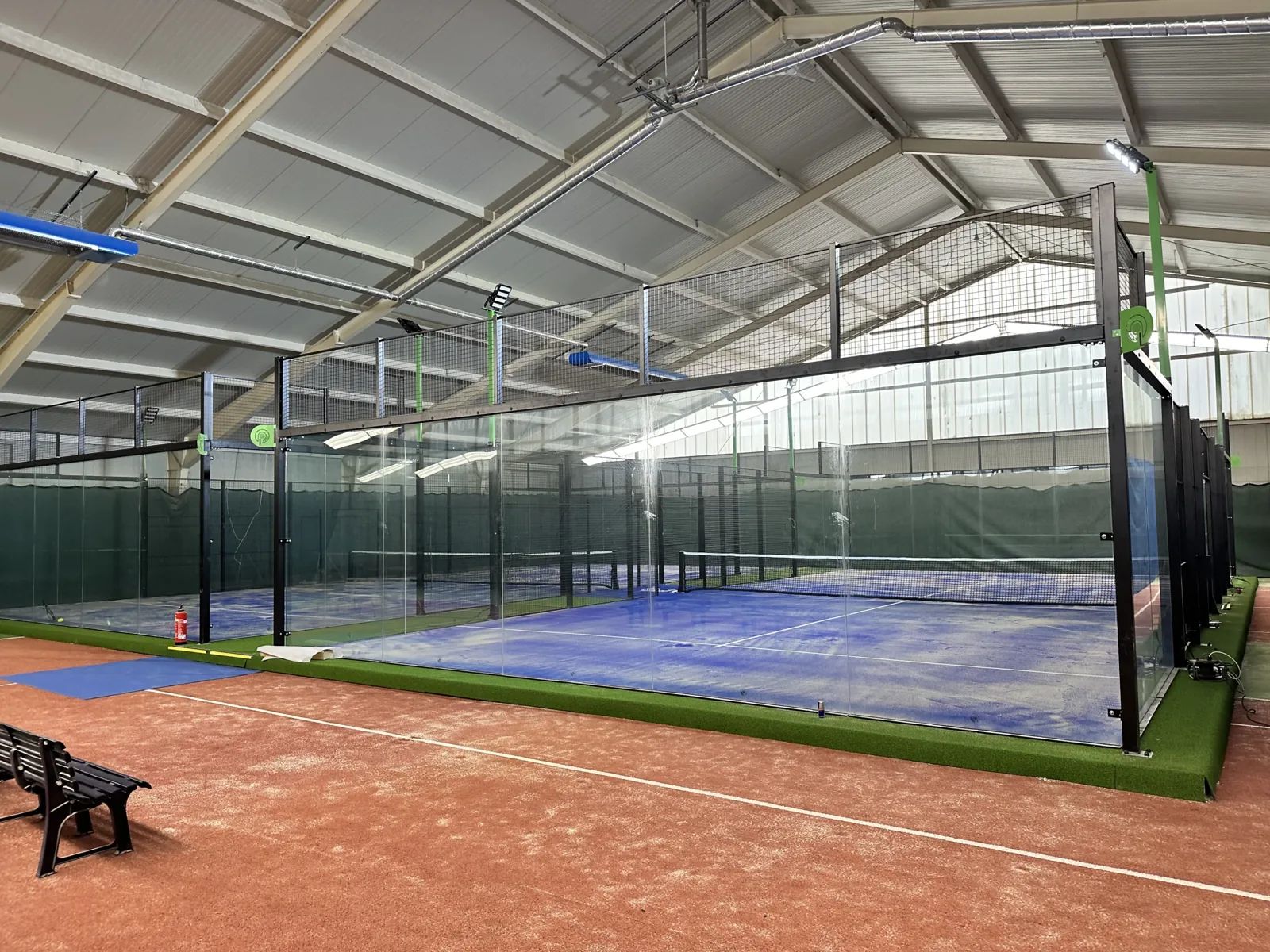
An indoor padel court is a defined playing area of 20 by 10 metres, enclosed by a steel structure with glass walls and metal mesh panels. The playing surface consists of padel-specific artificial turf with sand infill. The court stands completely free in a hall and needs a minimum clear height of 6 metres to be played on safely.
The build-up of an indoor padel court consists of a number of fixed components. The steel structure forms the skeleton of the court and carries the glass walls, the mesh and the LED lighting. Around the playing area there is glass up to a height of roughly 3 to 4 metres, depending on the side of the court. Above that, metal mesh closes off the cage. The artificial turf lies on a foundation that must be stable and flat even indoors. LED lighting provides sufficient light on the playing area.
What sets the indoor padel court apart from an open sports floor is the enclosed cage structure. The court is literally a cage: you play inside it, not around it. That fact largely determines which other sports are or are not possible.
Which sports can be played on an indoor padel court?
Besides padel, you can play a limited number of other racket sports on an indoor padel court. Squash and pickleball are the most obvious alternatives, because they have similar game dynamics and use walls as part of the game. Badminton is possible in theory, but the dimensions of a padel court differ from those of an official badminton court.
Pickleball
Pickleball is currently one of the fastest-growing sports in Europe and fits well on a padel court. The playing area for pickleball is smaller than a padel court, which means you can mark out several pickleball courts on a single padel court. The sport uses a similar artificial turf surface, and the lower intensity of the game suits the construction of the court. Many operators already offer padel and pickleball combined on the same courts.
Squash-like variants
Because the glass walls are part of the game in padel, you can also play sports in which the walls are used as a playing element. Informal squash variants or padel-related training formats are examples of this. However, these are not official sports variants with their own rules.
Badminton and tennis
Badminton and tennis are technically possible on a padel court, but not ideal. An official badminton court is 13.4 by 6.1 metres, which is smaller than a padel court. A clear height of 6 metres is on the low side for badminton, because the shuttlecock goes high into the air. Tennis on a padel court is not suitable for serious use because of the dimensions and the surface.
What are the limitations of a padel court for other sports?
The biggest limitation of an indoor padel court for other sports is the enclosed cage structure. That cage is designed for padel and has fixed dimensions, fixed walls and a specific surface. Sports that require an open field, need more space or call for a different floor simply do not fit in or on a padel court.
In concrete terms, you run into the following limitations:
- The dimensions of 20 by 10 metres are specific to padel and differ from the official field sizes of most other sports.
- The enclosed cage makes it impossible to play sports that need more space or in which the walls would get in the way.
- The artificial turf with sand infill is not suitable for sports that require a hard floor, parquet or synthetic rubber.
- The minimum height of 6 metres is too low for some sports, and for others too high to light efficiently.
- The cage structure is fixed and cannot easily be turned into an open sports floor without removing the structure.
Sports such as basketball, volleyball, indoor football or handball are not possible on a padel court. Those sports require different dimensions, a hard floor and an open space without fixed walls close to the field.
Is the artificial turf of a padel court suitable for other sports?
The artificial turf of an indoor padel court is specifically designed for padel and meets the requirements of the KNLTB and Kiwa ISA Sport. It has a certain fibre length, a specific sand bed and a ball bounce matched to the padel ball. For most other sports this surface is not ideal and sometimes downright unsuitable.
Padel artificial turf has a relatively low pile height and an even sand bed. That ensures a consistent ball bounce in padel, but gives different results for other sports than you would expect. A football bounces differently on artificial turf with sand infill than on a hard floor or a synthetic sports field. Athletics, dance or sports in which you change direction quickly on a hard surface are less safe and less comfortable on artificial turf.
For pickleball and badminton the artificial turf is acceptable for recreational use, but official competitions take place on other surfaces. If you seriously want to offer several sports at one location, it is wise to consider a separate sports floor alongside the padel courts, rather than trying to use the padel court itself for everything.
All the artificial turf we use is on the Kiwa ISA Sport sports products list and meets the certification requirements for professional padel use. That is a requirement for padel courts in the Netherlands and it also protects you as a client, because you can be sure that the material meets the standards set.
Can a padel court be converted for multifunctional use?
A padel court can be adapted to a limited extent for multifunctional use, but a complete conversion into a multifunctional sports floor is technically complex and costly. The most practical adaptation is adding extra line markings to the artificial turf for a second sport, such as pickleball. Going further than that requires changes to the structure itself.
What is possible:
- Adding extra line markings to the artificial turf for pickleball or badminton. This is relatively simple and cheap.
- Installing removable nets or posts for another sport, provided the cage offers room for it.
- Adapting the lighting for another form of sport, if the installation allows it.
What is not or hardly possible:
- Removing the cage structure to create an open sports floor. This is a complete demolition operation.
- Replacing the artificial turf with a hard floor without adapting the foundation.
- Changing the dimensions of the court to the sizes of another sport.
If multifunctional use is a serious wish, it is wiser to plan from the start for a combination of padel courts and a separate multifunctional sports space. That gives more flexibility and a better user experience for all sports.
When is a multifunctional sports hall a better choice than a padel court?
A multifunctional sports hall is a better choice than a padel court when you want to offer several sports on a structural basis, serve large groups, or when the target group calls for an open, flexible sports space. A padel court is a specialist product, optimal for padel and limited for everything else.
Choose a multifunctional sports hall if:
- You want to offer sports such as basketball, volleyball, indoor football or handball alongside padel.
- You serve a school, municipality or broad sports club that asks for variety in its sports offering.
- The available space is large enough to build both padel courts and an open sports floor.
- You expect demand for padel to be seasonal and you want to use the space all year round.
Choose a dedicated padel court if:
- Padel is the primary sport at your location.
- You want to operate a commercial padel venue with a clear focus.
- The investment has to be aimed at maximum return per court.
In practice we increasingly see a combination: a hall with several padel courts and a separate multifunctional space. That gives the best balance between specialisation and flexibility. Want to know which set-up best suits your location and target group? At I-Padel we are happy to think along with you, without obligation, from the first sketch to a complete quotation for building padel courts that fit your situation exactly. Get in touch for an initial exploration.
Frequently asked questions
How many pickleball courts fit on one padel court?
On one standard padel court of 20 by 10 metres you can mark out two official pickleball courts. An official pickleball court measures 13.4 by 6.1 metres, which fits comfortably within the dimensions of a padel court. You can lay out the two courts side by side with extra line markings, without having to change anything about the structure.
What does it cost to add extra line markings for pickleball or badminton to an existing padel court?
Adding extra line markings to an existing artificial turf surface is relatively cheap and can be done for a few hundred euros, depending on the method and the number of courts. Coloured tape or routed-in lines that do not damage the artificial turf are often used. This is the most cost-efficient way to make a padel court suitable for a second sport.
Can I simply offer another sport on my certified padel court without losing the certification?
Occasionally offering another sport such as pickleball or badminton on your padel court has no effect on the certification of the artificial turf in most cases, as long as you do not structurally change the surface.
The Kiwa ISA Sport certification is linked to the material and the installation of the artificial turf, not to the type of use. If you want to make structural changes, such as replacing the artificial turf or changing the foundation, always contact your installer to check whether the certification is retained.
What is the minimum hall size I need if I want to build both padel courts and a multifunctional sports floor?
As a rule of thumb, you need a space of at least 22 by 12 metres per padel court, including walking space around the cage, with a clear height of at least 6 metres. For an additional multifunctional sports floor for sports such as volleyball or basketball, you quickly need an extra area of 20 by 40 metres. The total hall size depends heavily on the number of courts and the desired variety of sports — a specialist builder can draw up a concrete layout based on your location.
Is a padel court also suitable for group lessons or fitness outside padel hours?
A padel court can be used to a limited extent for group lessons or functional fitness, provided the activities fit within the cage structure and do not require a hard floor. Think of padel-specific conditioning training, coordination exercises or small group lessons with rackets. Intensive fitness classes involving many fast changes of direction are less suitable because of the artificial turf surface with sand infill, which offers less grip for some movements than a hard sports floor.
What are the most common mistakes made by operators who want to use a padel court for several purposes?
The most common mistake is underestimating the limitations of the cage structure: operators assume that a padel court with a few adaptations is suitable for almost any sport, but quickly run into the fixed dimensions, the artificial turf and the limited height.
A second common mistake is wanting to add a multifunctional space afterwards, when the available hall space is no longer sufficient for it. The best approach is to include multifunctional use in the initial planning of the hall, so that the layout and investment are matched to it from the start.
How do I determine which sports set-up best suits my location and target group?
Start with an analysis of your target group: is it a commercial padel venue, a school sports hall, a municipal facility or a broad sports club? A commercial padel venue benefits most from dedicated padel courts with a sharp focus, whereas a municipal hall or school often benefits more from a combination of padel courts and an open multifunctional sports floor. Get advice from a specialist builder who can translate your target group and available space into a concrete, profitable hall layout.


