


Building a padel court · 21 April 2026 · 11 min read
Can a tennis club also build indoor padel courts?
Indoor padel courts for tennis clubs: discover costs, space requirements, build time and warranties. Extend your reach and court occupancy all year round.
In this article
- Can a tennis club have an indoor padel court built?
- What are the advantages of indoor padel courts for a tennis club?
- How much does an indoor padel court cost for a tennis club?
- What space requirements must a hall meet for an indoor padel court?
- What about noise from indoor padel courts in a sports hall?
- What is the difference between a turnkey package and a supply of materials only?
- How long does it take to build an indoor padel court?
- What warranty does a tennis club get on a new padel court?
- Frequently asked questions
Yes, a tennis club can certainly build indoor padel courts, and more and more clubs are doing so. Padel attracts new members, increases court occupancy and gives a club a fresh boost. Whether you have an existing sports hall, a covered tennis hall or are planning a new build: an indoor padel court is very feasible in many situations. Below we answer the most frequently asked questions, so that as a board you go to the table well prepared.
Can a tennis club have an indoor padel court built?
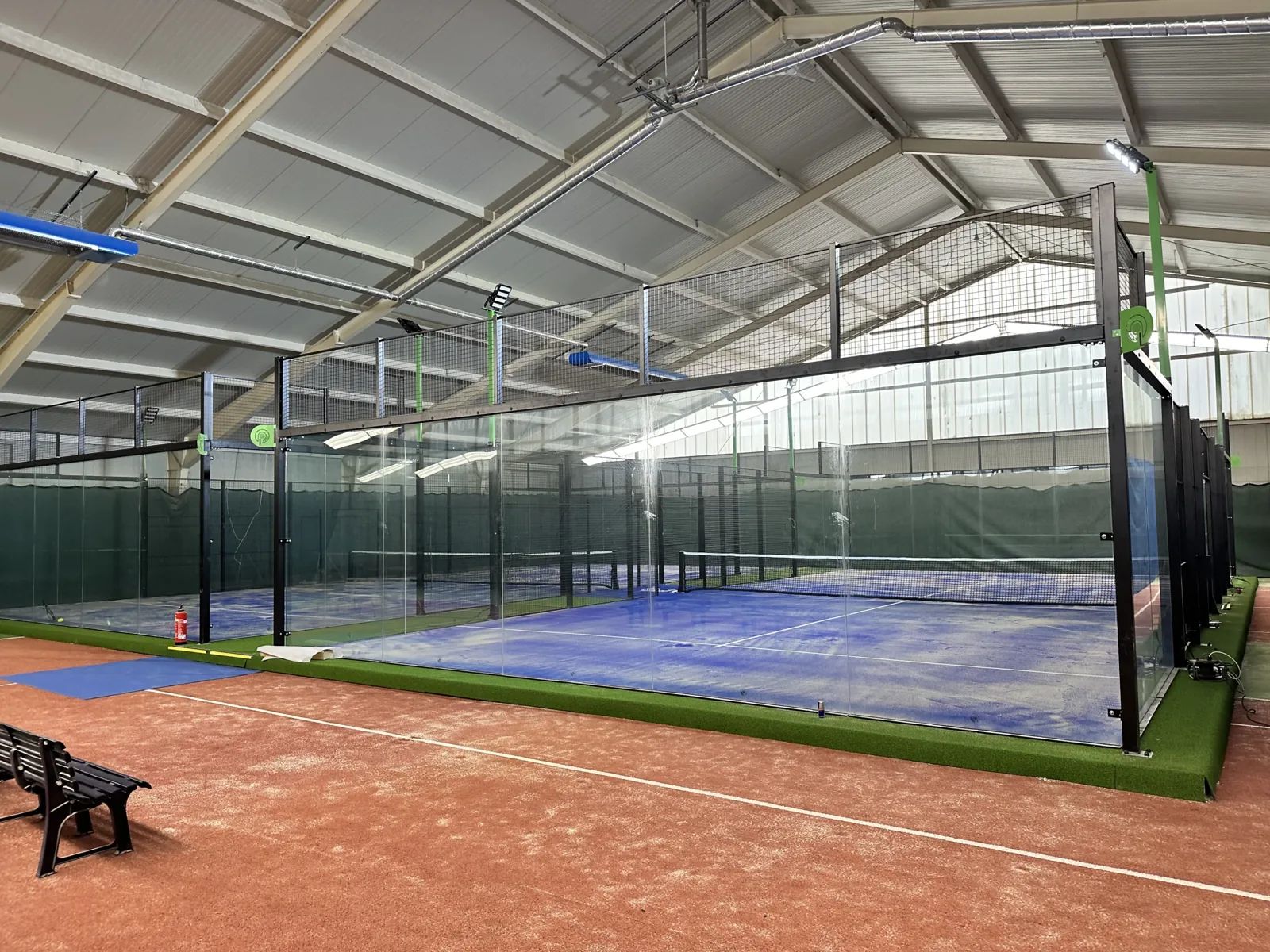
Yes, it can. A tennis club can have an indoor padel court built in an existing covered hall, a tennis hall or a newly built space. As long as the hall meets the minimum dimensions and clear height, an indoor padel court is technically feasible. Installing one in an existing hall does not always require a separate building permit, but that depends on the situation.
Building an indoor padel court differs from an outdoor court in a few respects. Indoors you have no wind load or weather influences to deal with, which makes the structural requirements somewhat simpler. At the same time, you have to take into account the space available to you, the height of the hall and any acoustic properties of the building. Good preparation starts with mapping those location-specific conditions.
What are the advantages of indoor padel courts for a tennis club?
The advantages of indoor padel courts for a tennis club are concrete: playing all year round regardless of the weather, higher court occupancy, more income and an attractive offering for new members. Padel appeals to a younger and broader audience than tennis, which helps counter membership decline.
Besides the membership benefit, there are also financial arguments. Indoor courts can be rented out all year round, including in the winter months when outdoor courts stand idle. That increases the return on investment considerably. Many clubs combine padel with their existing tennis offering, so that members can switch between the two sports.
In addition, the threshold for new players is lower than in tennis. Padel is quick to learn, social in nature and popular with people who have never held a racket before. For a club that wants to grow, that is a strong argument for seriously considering indoor padel courts.
How much does an indoor padel court cost for a tennis club?
As an indication, an indoor padel court is possible turnkey from around €23,000 per court. This includes the cage structure, glass, artificial turf, LED lighting and installation. The final price depends on the number of courts, the specification, the accessibility of the location and any extra options.
With several courts, economies of scale arise: the fixed costs for transport and installation are spread over more courts, which lowers the price per court. That is a relevant consideration for tennis clubs that want to build two or more courts.
Please note: the price of €23,000 applies to a standard indoor court. If you opt for a panoramic version with an open back wall and a different visual look, the costs are slightly higher because of the heavier structural requirements. Always request a custom quotation based on your specific location and wishes, because a fixed price without context is rarely reliable.
What space requirements must a hall meet for an indoor padel court?
A padel court has a playing size of 20 by 10 metres. The minimum installation space is 21 by 11 metres. For a comfortable playing experience, including run-off zones, a space of 21 by 14 metres is recommended. The minimum clear height is 6 metres, with greater height being better for playing quality.
The run-off zones behind and beside the court are not only pleasant for players, but also important for safety. In a hall with several courts side by side, you also have to take the space between the courts into account. A good layout of the hall determines how many courts realistically fit, without compromising on comfort or safety.
Do you have a hall with a ceiling lower than 6 metres? Then a padel court is not technically feasible. With a height just above 6 metres, the court is playable, but for professional use or matches, more space above the playing area is strongly recommended. Always have the hall measured before you make a final decision.
What about noise from indoor padel courts in a sports hall?
Noise is a point of attention for indoor padel courts, but less problematic than for outdoor courts. Indoors you have no neighbours bothered by the game, but the hall itself can be acoustically challenging. Balls hitting glass and steel produce noise that reflects well in an empty hall.
The cage structure acts as a resonance box. In a sports hall with hard walls and a high ceiling, that can lead to a high noise level within the space itself. This is unpleasant not only for players, but also for people in adjoining spaces, such as changing rooms or a clubhouse.
Sound-absorbing panels can also be used for indoor courts to reduce reverberation and improve playing comfort. Important to know: when panels reduce the wind permeability of the cage structure, the structure must be structurally reinforced. For indoor courts, wind load does not play a role, but the structural integration of panels always requires a calculation per situation. For a hall near residential areas or with thin partition walls, acoustic advice is wise.
What is the difference between a turnkey package and a supply of materials only?
With a turnkey package, the builder takes care of the complete process: from advice and foundation to structure, glass, artificial turf, LED lighting and installation. The tennis club does not have to arrange anything itself. With a supply of materials only, you receive all the components, but you carry out the installation yourself or have it done by a party of your own.
For most tennis clubs in the Netherlands, a turnkey package is the most practical choice. You have one point of contact, one responsible party and one warranty. If something goes wrong, there is no discussion about who is responsible. That gives peace of mind, especially with an investment of this size.
A supply of materials only is mainly relevant for parties that have their own installation capacity, such as construction companies or larger sports organisations abroad. For a tennis club without its own technical staff, this is rarely the best option. Coordination and risk then lie with the club itself, which makes execution considerably more complex.
How long does it take to build an indoor padel court?
Installing an indoor padel court takes 3 to 4 days on average: erecting the cage structure takes 2 days, and laying the artificial turf 1 to 2 days. The total lead time of a project, including production and delivery, averages 10 to 12 weeks.
Those 10 to 12 weeks cover production planning, transport and the actual installation on site. With in-house production of the steel structure, there is no dependence on foreign suppliers, which makes the planning more stable. You know sooner when the court will be ready and are less likely to face delays caused by import problems.
For tennis clubs that want to open a new padel court at the start of a new season, it is wise to start well in advance. Also add any permit procedure to the build time: that takes 8 to 12 weeks on average, depending on the municipality. If you start too late, you risk the court not being ready in time for the planned opening.
What warranty does a tennis club get on a new padel court?
A 15-year warranty applies to the steel structure of a padel court. This is an exceptionally long warranty period in the market and gives tennis clubs certainty on an investment that has to last for decades. The warranty applies specifically to the steel structure, in accordance with the general terms and conditions.
Other components, such as the artificial turf, the LED lighting and the glass, have their own warranty terms. It is important to understand this properly before you sign a contract: a 15-year warranty does not automatically apply to every component of the court. Always ask for clarity on exactly what is covered and for how long.
Besides the warranty on the structure, the certification of the court is also relevant for tennis clubs. All foundation components must be approved by Kiwa ISA Sport in the Netherlands. This is a requirement for the use of the sports product in matches under the auspices of the KNLTB. Working with certified materials protects you as a club against non-conformity, something that inexperienced buyers sometimes only run into afterwards.
Want to know what an indoor padel court concretely costs for your club and what is needed for it? At I-Padel we are happy to think along with you, without obligation. Take a look at our offering for building padel courts or get in touch directly for a tailored initial discussion.
Frequently asked questions
As a tennis club, do we need a building permit for an indoor padel court?
That depends on the situation. When you place a padel court inside an existing, covered hall without structural alterations to the building itself, a separate building permit is in many cases not required. As soon as you build a new hall or alter existing walls or the roof, an environmental permit is generally needed. Always contact your municipality beforehand to check this — a permit procedure takes 8 to 12 weeks on average and can greatly affect your schedule.
Can we apply for subsidy or financing for building indoor padel courts?
Yes, there are various options for financing or subsidy. The Waarborgfonds Sport offers loans on favourable terms to sports clubs that want to invest in facilities. In addition, there are municipal subsidies and funds such as the NOC*NSF Sports Agreement that contribute to sports infrastructure. It is strongly advisable to ask your municipality and the KNLTB which schemes are currently available for your specific situation.
What do I need to arrange in terms of LED lighting for an indoor padel court?
An indoor padel court always needs artificial light, regardless of the time of day. For a good playing level, a lighting level of at least 300 lux is recommended; for competition play it is higher, around 500 lux. LED lighting is now the standard: energy-efficient, long-lasting and easy to dim. Also make sure the lighting is evenly distributed across the playing area to avoid disturbing shadows or glare — this is a point you should agree with the supplier beforehand.
How do we plan the layout of our hall if we want to place several padel courts?
Start with a professional survey of the hall, including obstacles such as columns, emergency exits and technical installations. For each court, allow for the recommended space of 21 by 14 metres, plus the necessary spacing when several courts are placed side by side.
An experienced padel court supplier can produce a custom layout drawing to determine how many courts realistically fit without compromising on playing comfort or safety. Do not be tempted to plan too tightly: a poor layout costs more afterwards than it saves.
Which type of artificial turf is most suitable for an indoor padel court?
For indoor padel courts, a short, sand-filled artificial turf with a pile height of 12 to 13 mm is generally used. This type offers the right ball bounce and grip for players, and is at the same time durable enough for intensive use all year round.
Indoors you have no weather influences such as frost or rain to deal with, which benefits the lifespan of the artificial turf. When purchasing, always ask about the specific playing characteristics and the maintenance instructions, so that the court still performs optimally after years.
How can we best rent out or schedule the padel courts as a club?
An online booking system is almost indispensable as soon as you operate padel courts. Platforms such as Playtomic, CourtReserve or Sportbooker have been developed specifically for sports facilities and make court management, payment and member management simple. Link the system to your existing member administration to distinguish between member and non-member rates. Also draw up a clear rates and cancellation policy before opening, so that you do not have discussions afterwards.
What are common mistakes when building an indoor padel court that we as a club can avoid?
The most common mistakes are: starting the planning too late so that the court is not ready in time for the season, too little attention to acoustics in the hall, and choosing the cheapest provider without checking whether the materials are Kiwa ISA Sport certified.
The foundation is also regularly underestimated: a poor subsoil leads to subsidence and extra costs over time. Always work with a supplier who has experience with indoor projects and explicitly ask for references of comparable installations at other tennis clubs.


