Blog · 16 August 2026 · 13 min read
7 factors that determine the noise nuisance of a padel court
The noise nuisance of a padel court depends on 7 factors. Discover which ones you can influence and how to prevent nuisance before construction.

In this article
- What determines how much noise a padel court produces?
- 1: The type of ball and racket as a noise source
- 2: The construction materials of the court itself
- 3: The distance to surrounding buildings
- 4: The orientation and layout of the court
- 5: The presence of reflective surfaces
- 6: Playing times and intensity of use
- 7: Integrated sound absorption in the structure
- Which factors can you influence at your location?
- Frequently asked questions
Noise nuisance from a padel court is rarely the result of a single cause. In practice, several factors play a role at the same time, and their combination determines how much noise local residents actually experience.
Anyone who wants to build an outdoor padel court near homes would do well to understand these factors early in the project. Not every factor can be influenced equally well, but insight into all seven gives a realistic picture of what is possible at a specific location and where attention should go.
What determines how much noise a padel court produces?
Padel noise arises in several places at once: when the racket makes contact with the ball, when the ball impacts glass and steel, and through the way the cage structure as a whole responds to those impacts. The average sound power level of a padel court is around 91 dB, which is considerably higher than for tennis. That difference has everything to do with the enclosed cage structure, which amplifies sound and radiates it in multiple directions.
The seven factors below cannot be viewed in isolation. They influence one another, and the final noise level at a specific location is always the sum of all these elements. An independent acoustic study is therefore the most reliable way to determine which factors have the greatest impact at your location and which measures actually contribute to a solution.
1: The type of ball and racket as a noise source
The noise source in padel starts with the contact between racket and ball. The impact speed, the material of the racket and the hardness of the ball together determine how much sound is generated at the source. Harder balls and stiffer rackets generally produce a sharper and louder contact sound than softer variants.
This source noise is audible in itself, but only becomes truly problematic when it is amplified by the surrounding structure. The cage structure of a padel court functions, in a sense, as a resonance box: the sound of the ball reflects off glass and steel and is thereby amplified and radiated further.
For most projects, the type of ball or racket is not a factor you can directly influence as a site owner or club board member. It is useful, however, to understand that the noise problem in padel is fundamentally different from that in tennis, and that the cage structure plays a major role in the final noise level.
2: The construction materials of the court itself
The materials a padel court is built from have a direct influence on how sound behaves in and around the structure. Glass reflects sound strongly and thereby contributes to higher sound emission. Steel profiles can transmit and amplify vibrations. The way connections are executed, the stiffness of the structure and the quality of the fixings all play a role.
A steel structure that has been properly calculated structurally and built with high-quality materials behaves differently from a structure that has been designed less carefully. The same applies to the way glass is fixed: loose or poorly damped connections can cause extra vibrations and secondary noises.
In the structure and wind load of a padel court, account is taken of the structural properties that also influence acoustic behaviour. The stiffer and more precisely the structure is executed, the more predictable the court's behaviour is in practice, including acoustically.
3: The distance to surrounding buildings
Distance is one of the most decisive factors in the noise nuisance of a padel court. Sound decreases as the distance from the source increases. Each time the distance doubles, the sound level in open air drops by approximately 6 dB. That sounds like a large reduction, but in practice sports parks are often close to residential areas, so the available distance is limited.
When homes are located a short distance from the court, the chance of nuisance is greater and additional measures are needed more often. Municipalities apply noise standards that depend on the type of area and the time of day. For a location near homes, an acoustic study is generally part of the permit application for a padel court.
Distance is a given of the location and not easy to change. That is precisely why it is relevant to assess the other factors carefully: when the distance is limited, other measures have to make the difference.
4: The orientation and layout of the court
The direction in which a padel court is oriented partly determines which sides of the court radiate the most sound towards sensitive uses. The short ends of a padel court, where the back wall is located, generally produce more noise than the long sides. This has to do with the way the ball rebounds forcefully off the back wall.
By positioning the court so that the short ends do not face homes directly, the noise level at those locations can be reduced. This is a measure that can already be included in the design phase and that entails no extra costs.
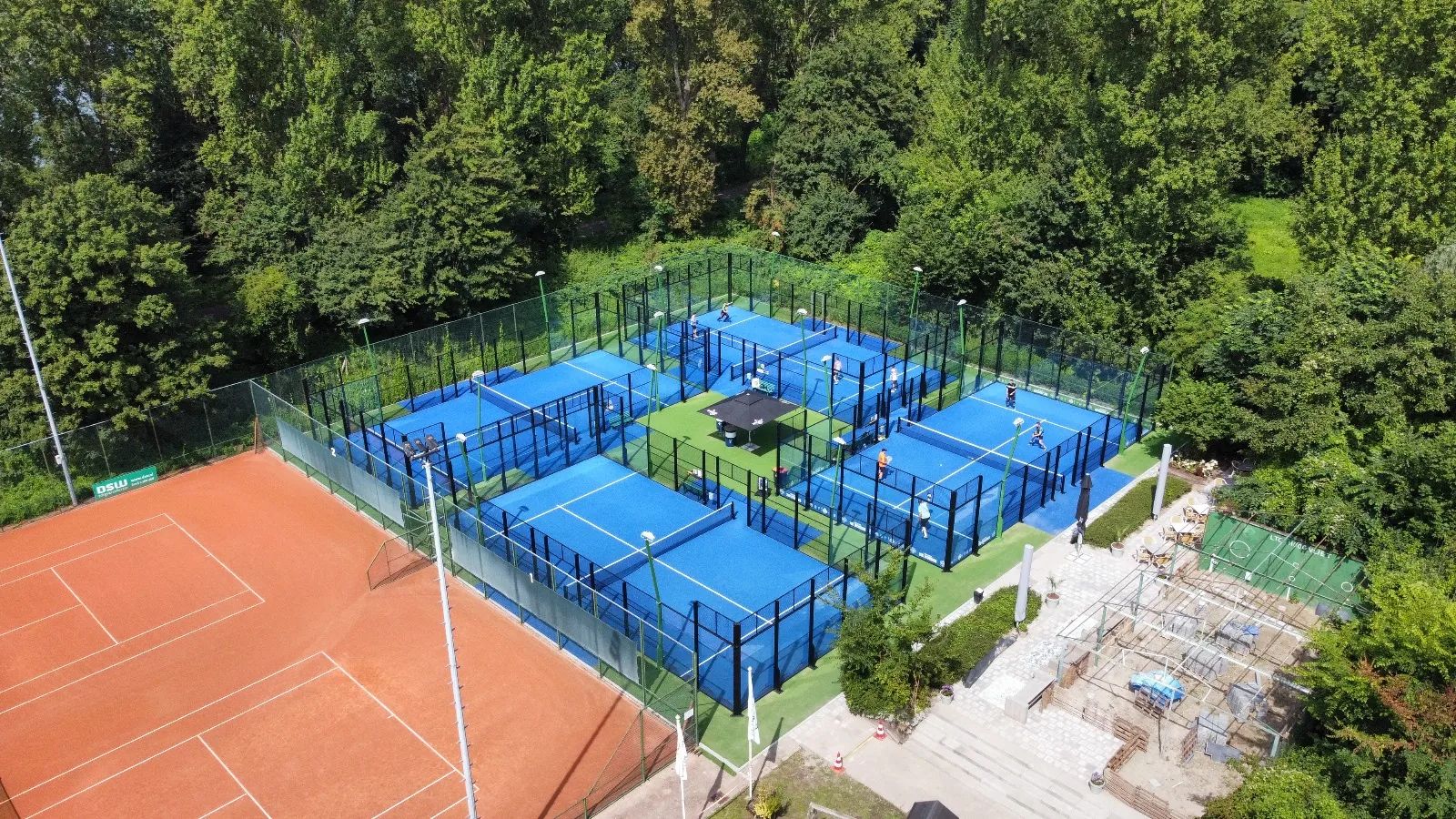
The layout of the site also plays a role. Other structures, hedges, stands or storage areas can act as natural screening. An acoustic consultant can assess at an early stage whether the orientation and layout of the site contribute to a lower noise level in the surroundings.
5: The presence of reflective surfaces
Reflective surfaces around a padel court can amplify sound and reflect it in unexpected directions. Think of hard building facades, concrete walls, paved car parks or other sports facilities. These surfaces act as a mirror for sound and can cause the noise level at certain points to be higher than would be expected based on direct distance alone.
This effect is location-specific and difficult to estimate without an acoustic study. In urban environments or on sites surrounded by a lot of hard buildings, the risk of reflections is greater than at open, green locations.
Absorbing greenery, earth banks or soft surfaces can partly counteract reflections. These are measures that are not always the first to be considered, but in combination with other solutions they can certainly contribute to reducing the noise level.
6: Playing times and intensity of use
How intensively a padel court is used, and at what times, has a direct influence on the degree of nuisance local residents experience. Evening and weekend play generally fall in periods when people are at home and sound is more quickly perceived as disturbing. Municipalities therefore apply stricter noise standards for evening and night periods than for the daytime period.
High intensity of use, with several courts in use at the same time, leads to a higher cumulative noise level. This is a factor that is relevant when determining the noise measures required: a location with four courts that are played on intensively every day requires a different approach than a location with one court used recreationally.
Playing-time policy can be part of the permit conditions. Some municipalities make it a condition that courts may no longer be played on after a certain time. This is a measure that limits the noise level, but also affects the operation of the location. It is a trade-off that must be made early in the project.
7: Integrated sound absorption in the structure
Sound-absorbing panels fixed directly to the cage structure are a source measure: they tackle the noise where it originates, rather than blocking it at a distance. Panels are made of materials with an open fibre structure, such as stone wool, which partially absorb sound waves because the kinetic energy of air particles is converted into heat. As a result, the amount of reflected sound decreases.
The distinction between sound absorption and sound insulation is relevant here. Absorption reduces reflections in and around the court. Insulation limits the transmission of sound from one side to the other. In padel projects, both principles often play a role at the same time, depending on the configuration and the location of the panels.
The position of the panels determines the result. During a practical measurement at LTC Hofgeest, panels were installed above the glass at the two short ends of the court. Within that specific configuration, an indicative noise reduction of approximately 3 dB(A) was measured after correction for background noise. These results apply only to the situation studied and must not be regarded as a generally applicable performance guarantee.
An important technical point of attention is that panels reduce the wind permeability of the structure. As a result, the wind load on the steel structure increases. The structure must be recalculated for this and reinforced where necessary. This is not an optional step: it is a structural requirement directly linked to the safety of the court. We take this into account in the engineering of every court. You can find more information about the possibilities on our page about acoustic solutions for padel.
The optimal configuration is always determined on the basis of an independent acoustic study, the distance to sensitive uses, the orientation of the court and the structural possibilities of the location. There is no standard solution that suits every situation.
Which factors can you influence at your location?
Of the seven factors, some are fixed and others can be influenced well. The distance to homes, the presence of reflective facades and the orientation of the site are largely fixed once a location has been chosen. But the construction materials, the presence of sound absorption, the layout of the site and the playing-time policy are factors you, as the client, can certainly influence.
It pays to assess these factors in the design phase. Anyone who only discovers after construction that noise nuisance is a problem faces more expensive and more drastic modifications than if measures had already been included in the design. An outdoor padel court that has been structurally prepared for noise measures offers more flexibility than a court that has to be modified afterwards.
The right approach differs per project. On an open site with sufficient distance to homes, the challenges are different from those at an urban location with buildings close by. An acoustic consultant can use the location data to determine which factors have the most influence and which measures are technically and permit-wise feasible. For this, we supply the engineering, product specifications and structural support needed to carry out those calculations correctly.
When a freestanding structure is needed in addition to source measures, noise barriers around padel courts can be an additional option. In some situations a combination of source measures and a noise barrier is the most effective, with the panels allowing the barrier to be kept lower and more compact, which can also benefit permit granting.
Every location requires its own assessment. What is sufficient in one place may be insufficient at another. That is what makes early collaboration between client, acoustic consultant and structural engineer so valuable: the sooner all factors have been mapped out, the better the final solution can be tailored to the specific situation.
Unsure whether outdoor padel is feasible at your location?
We are happy to think along with you about the court configuration, structural preparation and possible noise measures. Together with your acoustic consultant, we look at which solution is technically feasible and fits the project. Get in touch via our page about acoustic solutions for padel for an initial, non-binding exploration.
Frequently asked questions
How early in a project should I have an acoustic study carried out?
Ideally, you have an acoustic study carried out before the final choice of location, or at least before submitting the permit application. The sooner the acoustic conditions are known, the better the court, its orientation and the measures can be integrated into the design. Modifying afterwards is technically harder and considerably more expensive than taking the results into account early on.
What noise reduction can realistically be expected from acoustic panels on the cage structure?
The noise reduction depends heavily on the configuration, the position of the panels and the specific location conditions. In the practical measurement at LTC Hofgeest, an indicative reduction of approximately 3 dB(A) was measured with panels at the two short ends above the glass. A reduction of 3 dB(A) sounds modest, but in practice means a halving of the acoustic energy. There is no universal performance guarantee: effectiveness must always be assessed on the basis of a location-specific acoustic study.
Can I prevent noise nuisance completely, or is it always about limiting the nuisance?
Completely preventing noise is not realistic with an outdoor padel court: the sport inevitably produces sound with every ball and wall impact. The aim is to bring the noise level at sensitive uses below the municipality's applicable noise standards. With a combination of the right orientation, construction materials, acoustic panels and, where necessary, a noise barrier, this is achievable in most situations, provided the measures are included in the design early enough.
What common mistake do you see in projects where noise nuisance turns out to be a problem afterwards?
The most common mistake is that noise nuisance is only taken seriously after the court has already been built and local residents file complaints. At that point the options are more limited and the costs higher. A second common mistake is relying on the experiences of other locations without taking your own situation into account: distance, buildings, orientation and intensity of use differ per location and together determine the result.
Does the playing-time policy affect the structural noise measures required?
Yes, definitely. Municipalities apply stricter noise standards for the evening and night period. If a location is played on only during the day, this may mean that less far-reaching structural measures are needed to meet the standards. Conversely: if evening play is commercially important for the operation, the structural measures must be heavier in order to meet the standards in that period as well. The playing-time policy is therefore a factor directly linked to the technical and financial feasibility of the project.
Does the steel structure need to be modified if I want to add acoustic panels afterwards?
That depends on how the structure was originally calculated. Acoustic panels reduce the wind permeability of the cage structure, which increases the wind load on the steel structure. If the structure has not been prepared for this, it must be recalculated and possibly reinforced. This is a structural requirement, not an optional step. A court that was already prepared in the design phase for the possible addition of panels saves time and costs with a later modification.
When is a freestanding noise barrier a better choice than acoustic panels on the structure alone?
A freestanding noise barrier is particularly effective when the distance to homes is very limited and source measures alone do not provide sufficient reduction to meet the noise standards. In many cases a combination is the most effective: acoustic panels on the structure reduce the source noise, allowing the noise barrier to be kept lower and more compact. A more compact barrier is not only cheaper, but also makes permit granting easier. The right choice always depends on the outcome of the acoustic study.