


Building a padel court · 19 May 2026 · 12 min read
Why is the foundation important for a padel court?
A good padel court foundation prevents subsidence and costs €20,000–€40,000. Find out which type suits your location best.
In this article
- Why is a good foundation so important for a padel court?
- What types of foundation are there for a padel court?
- What is the difference between drainage concrete and Supersub?
- Which foundation is best for an outdoor court?
- What does a foundation for a padel court cost?
- Does a padel court foundation have to be certified?
- How long does it take to build a padel court foundation?
- Frequently asked questions
A good padel court starts underground. The foundation is the part you don't see, but it determines everything: the stability of the structure, the quality of play and the lifespan of your investment.
Without a solid base you risk subsidence, tilting and damage that is far more expensive to repair afterwards than a good foundation up front. In this article we explain what you need to know about the foundation of a padel court, from the different types to the costs and certification.
Why is a good foundation so important for a padel court?
A good foundation is important for a padel court because it determines the stability of the steel structure, prevents subsidence and directly affects the quality of play. A flat, stable base ensures consistent ball bounce and a safe playing experience. Without a proper foundation you can expect tilting, cracking and premature wear.
A padel court weighs a considerable amount. The steel structure, the glass walls and the cage structure together put substantial pressure on the ground, up to around 5 tonnes in some structures. If the soil does not distribute that load properly, the court starts to move. That leads not only to problems with playing comfort, but also to structural damage that is costly to repair.
On top of that, an outdoor padel court also has to deal with wind load. The cage structure catches the wind like a sail, especially when sound-absorbing panels are mounted on the outside. Those forces have to go somewhere, and that is the foundation. A foundation that has not been calculated for the specific location and wind zone can fail in the long term, with all the consequences that entails.
Finally, ball bounce plays a major role. NOC*NSF and the KNLTB set technical requirements for the playing quality of padel courts. An uneven or unstable base makes it impossible to meet those requirements. For official matches an inspection is mandatory, and a poor foundation will not pass it.
What types of foundation are there for a padel court?
There are three commonly used foundation types for a padel court: drainage concrete, Supersub and ZOAB asphalt. In addition, ring foundations with steel reinforcement and strong plastic plates are used as supplementary or alternative solutions. Which type is most suitable depends on the soil conditions, the location and the intended use.
Drainage concrete
Drainage concrete is a water-permeable concrete floor where rainwater drains straight through the foundation into the soil. It is a proven and widely used solution for outdoor padel courts. The open structure of the material ensures that the court is playable quickly after rain and that puddles are prevented.
Supersub
Supersub is a foundation solution based on foam concrete, a lightweight, self-levelling material that creates an extremely flat and stable base. It is used in both new builds and renovations, for example when converting tennis courts into padel courts.
ZOAB asphalt
ZOAB asphalt, also known as open asphalt concrete, is a porous type of asphalt that lets water through. It is less common for padel courts than drainage concrete, but can be a good option in certain situations, depending on the location and the soil conditions.
Ring foundation and plastic plates
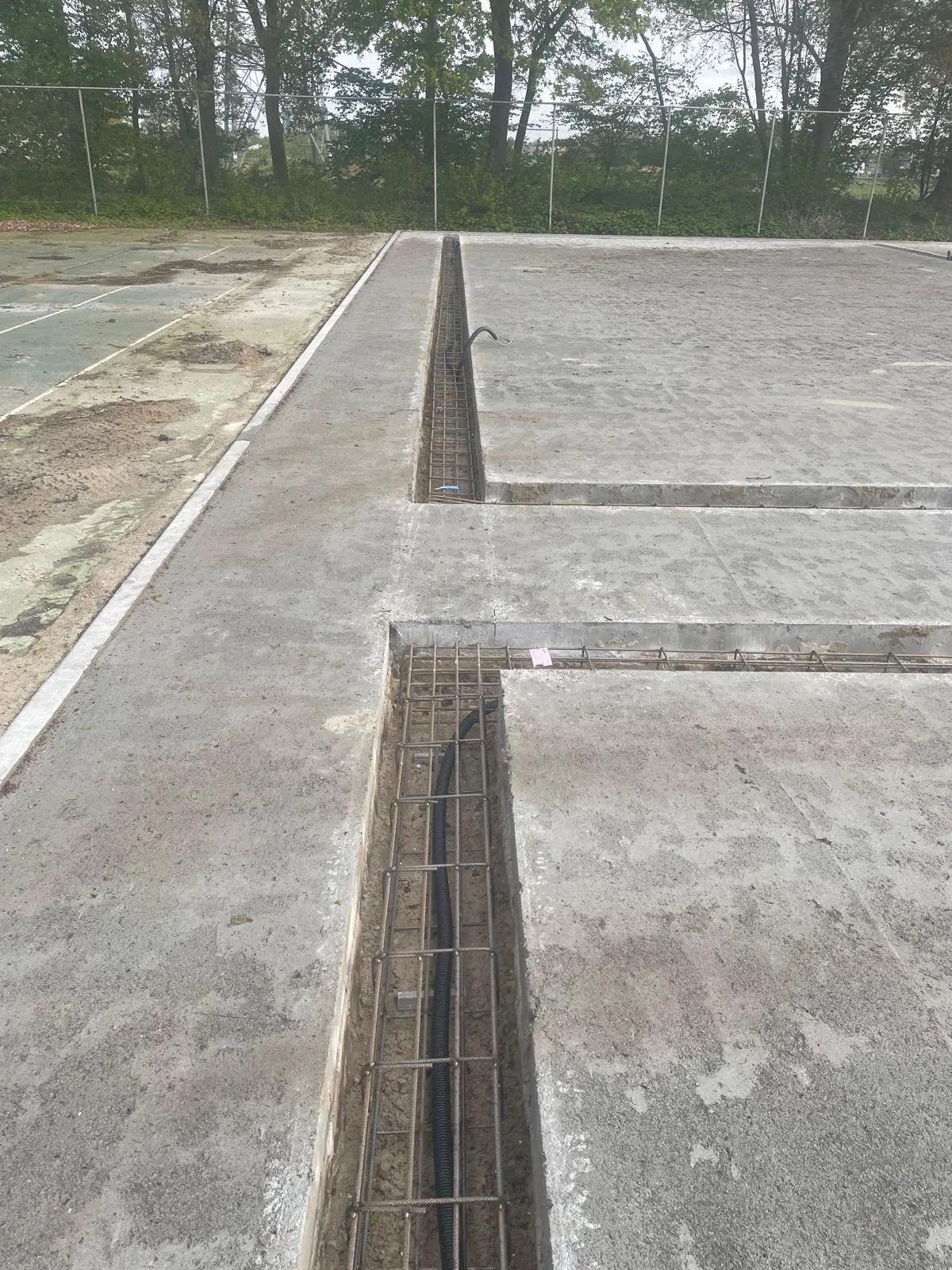
On outdoor courts, drainage concrete or Supersub is often combined with a ring foundation with steel reinforcement. That ring foundation absorbs the point load of the steel structure and distributes the forces well over the ground. In some situations, strong plastic plates are an alternative to poured concrete.
What is the difference between drainage concrete and Supersub?
The main difference between drainage concrete and Supersub lies in the material and the technical properties. Drainage concrete is a water-permeable type of concrete with a high load-bearing capacity and a lifespan of 25 to 40 years. Supersub is based on foam concrete and is lighter, self-levelling and shock-absorbing. Both are water-permeable, but they work differently and suit different situations.
Drainage concrete has very high stability and load-bearing capacity, resists frost and intensive use, and requires relatively little maintenance. It is the classic choice for outdoor padel courts where durability and load capacity come first. Repairs are easy to carry out and, with good maintenance, the material lasts for decades.
Supersub has different advantages. Because the foam concrete is self-levelling, an extremely flat base is created, which directly contributes to consistent ball bounce. The material is also shock-absorbing, which reduces the strain on joints and muscles while playing. In addition, Supersub can in many cases be poured within one day, which shortens construction time. The thickness varies from around 10 cm for renovations to around 15 cm for new builds, depending on the soil conditions.
Another difference is indoor application. Supersub is available in a non-water-permeable version for indoor use, whereas drainage concrete is primarily an outdoor solution. For converting an existing tennis court, Supersub is often a practical choice, precisely because of its thin build-up and fast processing.
Which type suits your project best depends on the soil conditions, the use and the budget. A location check up front is always wise.
Which foundation is best for an outdoor court?
For an outdoor padel court, drainage concrete or Supersub combined with a ring foundation is the most commonly used and reliable solution. Drainage concrete has the longest track record and the highest load-bearing capacity. Supersub offers extra advantages in terms of flatness, shock absorption and fast installation. The best choice depends on the specific location and soil conditions.
For outdoor courts, several factors play a role that you don't have in indoor projects. Water drainage is the first: an outdoor court must be playable quickly after heavy rain. Both drainage concrete and Supersub are water-permeable and prevent puddles. Drainage concrete can handle large amounts of rainfall; the outdoor version of Supersub handles up to 500 mm of rainfall per hour.
Wind load is the second factor. An outdoor court is exposed to wind, and if sound-absorbing panels are attached to the cage structure, the wind exposure increases further. The foundation must then be calculated for the higher forces this brings. This is not something you can handle as standard; it requires a structural calculation per location.
The soil conditions ultimately determine which type of foundation is feasible. Foundation advice is drawn up based on cone penetration tests. Without that information it is impossible to make a responsible choice. A foundation that sounds good on paper but doesn't suit the soil at your location will cause problems sooner or later.
What does a foundation for a padel court cost?
Foundation costs for an outdoor padel court average between €20,000 and €40,000 per court. This is a wide range, because the costs depend heavily on the soil conditions, the accessibility of the location and the civil works required. For indoor courts, foundation costs are generally lower and less dependent on location.
In outdoor projects the foundation is the biggest cost item. That is because it involves several activities: groundwork, removal of soil, installation of drainage, pouring the foundation itself and the ring foundation around the steel structure. All these activities are location-specific and difficult to standardise.
When converting an existing tennis court, part of the substructure can sometimes be reused. That saves costs, but requires a careful inspection beforehand. Not every tennis court foundation is suitable as a base for a padel court, especially if the soil has moved in recent years or if the drainage is not in order.
As a guide to the total cost of an outdoor padel court: the court excluding foundation starts from around €30,000, and a complete project including foundation starts from around €50,000. These are indicative prices; the exact price always depends on the situation. A no-obligation quote based on your location gives the most reliable estimate.
Does a padel court foundation have to be certified?
Yes, foundation components for padel courts must be approved by Kiwa ISA Sport in the Netherlands. This is a recognised inspection body that tests whether materials meet the applicable standards for sports infrastructure. Working with non-certified materials can lead to non-conformity, with the result that the court may not be used for official matches.
Kiwa ISA Sport carries out both laboratory measurements and field inspections. When inspecting a new padel court, the ball bounce, the level of the field and the properties of the artificial turf are tested, among other things. The foundation forms the basis of all those measurements: an uneven or unstable base makes it impossible to meet the sports-technical regulations of the KNLTB.
It is a point on which many inexperienced clients stumble. They choose the cheapest supplier without knowing whether the materials used are certified. After completion, the court turns out not to meet the requirements for competitive sport, and adjustments or even a complete re-inspection are needed. That costs time and money you would rather not lose.
The certification requirement applies not only to the foundation, but to the entire sports surface. Artificial turf, infill and the technical properties of the playing field are all tested. Make sure, therefore, that all components are demonstrably certified before you start building.
How long does it take to build a padel court foundation?
Building a padel court foundation takes two to five working days on average, depending on the type of foundation, the size of the project and the soil conditions. Supersub can in many cases be poured within one day. Drainage concrete takes a little more time because of the curing and processing procedures. Groundwork and preparation come on top of that.
The total lead time of a padel court project, from first conversation to completion, averages 10 to 12 weeks. That includes production planning, transport of the materials, groundwork, the foundation and the installation of the steel structure and the artificial turf. Installing the cage structure itself takes two days; laying the artificial turf takes another one to two days.
What often delays the schedule is not the execution itself, but the preparation. Cone penetration tests have to be carried out, foundation advice has to be drawn up and in some cases an environmental permit is needed before a single spade goes into the ground. For outdoor courts a permit procedure is almost always mandatory, and it takes 8 to 12 weeks on average. Factor that into your planning.
With several courts at once, which is common in commercial projects, the build time per court is often shorter thanks to economies of scale in planning and execution. The foundations of several courts can be partly carried out in parallel, which limits the total construction time.
Want to know what the foundation requires at your specific location? At I-Padel we handle the entire foundation process, from location check and cone penetration tests to construction, complete with certified materials.
We work exclusively with foundation components approved by Kiwa ISA Sport, so your court is ready for use and inspection immediately after completion. Get in touch for an initial exploration and read more about our approach on the page about padel court foundations — we are happy to think along with you, without obligation, about the best approach for your project.
Frequently asked questions
Do I need an environmental permit before having a padel court foundation built?
For most outdoor padel courts an environmental permit is required, and you must apply for it before the foundation is built. The permit procedure takes 8 to 12 weeks on average, so it is wise to start it early in the process. Contact your municipality to find out which specific requirements and procedures apply to your location.
What are the consequences if I choose a non-certified foundation supplier?
If you work with non-certified materials or suppliers, you run the risk that your court will not pass the Kiwa ISA Sport inspection after completion. This means the court may not be used for official KNLTB matches, and you will still have to have expensive adjustments or a complete re-inspection carried out. Always check in advance, therefore, that all foundation components are demonstrably approved by Kiwa ISA Sport.
Can I reuse an existing tennis court foundation for a padel court?
That is sometimes possible, but certainly not always. An existing tennis court foundation can serve as a base if the substructure is structurally in good condition, the drainage is in order and the soil has remained stable in recent years. A thorough inspection and cone penetration test are indispensable to assess this; never assume reuse without professional foundation advice, because an unsuitable substructure leads to costly damage in the long term.
Which soil investigations are needed before the foundation is built?
At a minimum, cone penetration tests (also known as CPT investigations) are necessary to map the load-bearing capacity and composition of the soil. Based on those tests, a structural engineer or foundation consultant draws up location-specific foundation advice. In some cases additional investigation is needed, for example into groundwater level or soil contamination, depending on the location and the building history of the site.
How do I maintain the foundation of my padel court to maximise its lifespan?
The foundation itself requires relatively little active maintenance, but regular inspection is important. Periodically check for cracks, subsidence or unevenness in the playing field, which can be an early sign of foundation problems. Also make sure the drainage stays free of leaves and dirt, so that water drainage remains optimal. With drainage concrete and Supersub, small repairs are easy to carry out if problems are spotted early.
What happens if the soil conditions at my location are poor, can a padel court still be built?
In most cases yes, but it requires an adapted foundation solution that takes the specific soil conditions into account. Think of extra soil improvement, deeper foundation layers or the use of lighter materials such as Supersub to reduce the load on the soil. The costs may then be higher than the average of €20,000 to €40,000. A location check and cone penetration test provide clarity in advance about what is feasible and what it costs.
Is an indoor padel court cheaper to found than an outdoor court?
Yes, indoor foundations are generally cheaper and less dependent on location. With an indoor court the requirements around water drainage and wind load largely fall away, which makes the foundation build-up simpler. Moreover, for indoor courts an existing concrete floor or substructure is more often available to serve as a base. For indoor use the non-water-permeable version of Supersub is also available, which offers extra flexibility in the choice of materials.


