


Building a padel court · 14 June 2026 · 11 min read
Why do premium clubs choose a panoramic indoor padel court?
Panoramic indoor padel court: find out why premium clubs choose glass, what it costs and what to look out for. Request a no-obligation quote.
In this article
- What sets a panoramic indoor padel court apart from a standard court?
- Why do clubs with a premium look specifically choose the panoramic variant?
- How much more does a panoramic padel court cost compared with an enclosed variant?
- What structural requirements does a panoramic court place on the steel structure?
- What effect does a panoramic court have on the playing experience and membership numbers?
- What should a club look out for when buying a panoramic indoor padel court?
- How I-Padel helps with the realisation of a panoramic indoor padel court
- Frequently asked questions
Premium clubs choose a panoramic indoor padel court because this variant offers an open, airy look that suits a high-quality sports environment. The glass back walls replace the traditional mesh, which means more natural light, a better view of the game and a visually appealing facility. In this article, we answer the most frequently asked questions about the panoramic variant for clubs that put quality first.
What sets a panoramic indoor padel court apart from a standard court?
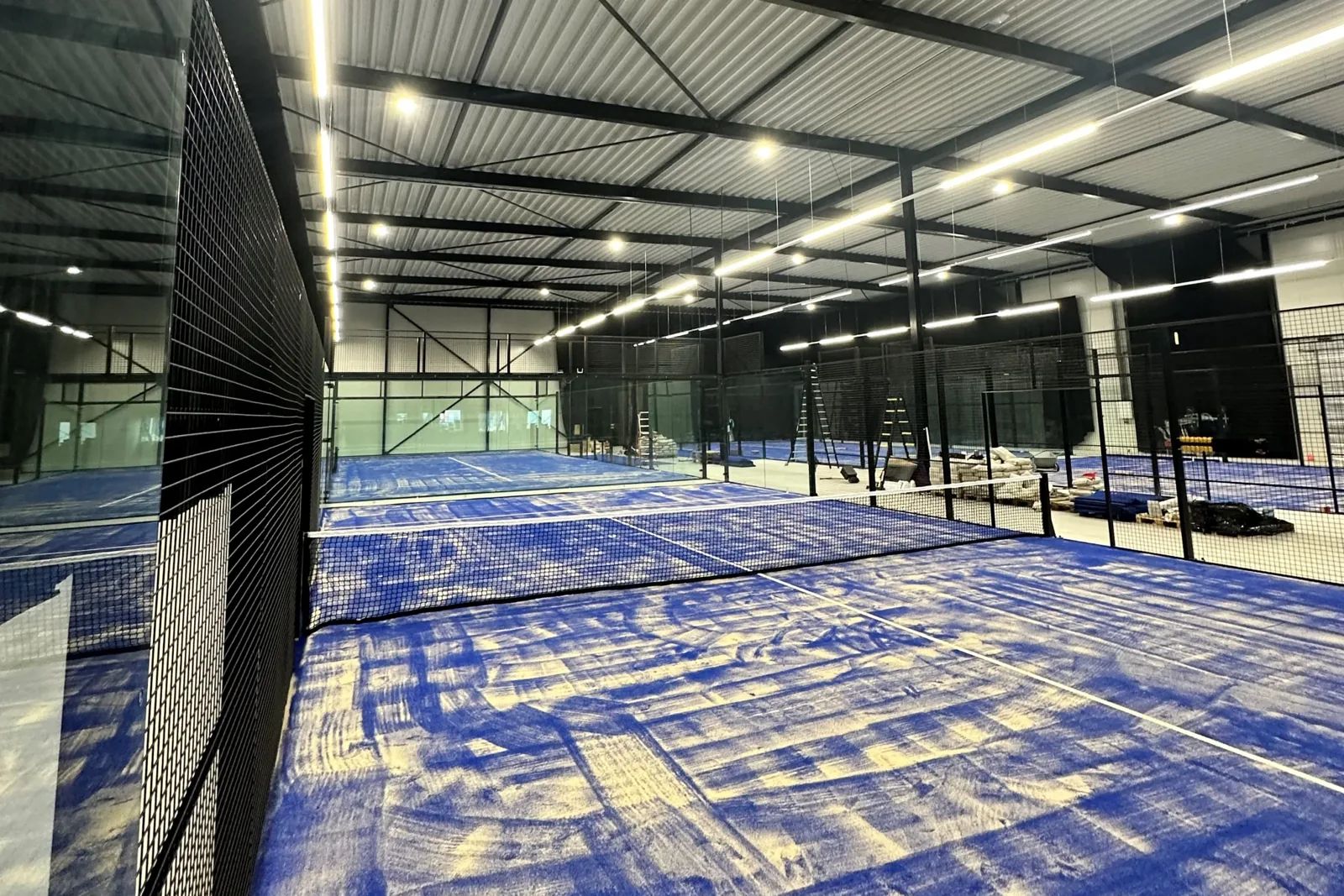
A panoramic indoor padel court differs from a standard Pro court in its use of glass on the back walls, where a Pro court uses mesh or metal panels. This gives the court a fully open, transparent character that greatly improves both the visual appearance and the amount of natural light. The result is a playing environment that looks like a professional match venue.
On a standard Pro court, the side walls and back walls are partly made of mesh. This is functional and cost-efficient, but visually less striking. The panoramic variant replaces that mesh with glass walls, so spectators can watch unobstructed and the space around the court feels visually larger.
Technically, glass places different demands on the steel structure than mesh. Glass is heavier and calls for more precise installation and stronger connections. Despite the lighter appearance of a panoramic court, heavier materials are often used in practice to meet those structural requirements. This is a point that regularly surprises buyers: the open look goes hand in hand with a more robust cage structure.
Why do clubs with a premium look specifically choose the panoramic variant?
Clubs with a premium positioning choose the panoramic variant because the court directly reinforces the look of the facility. Glass communicates quality, transparency and professionalism. Visitors who walk into a padel hall for the first time form an impression of the venue's standard within seconds. Panoramic courts contribute to a first impression that matches a premium brand promise.
On top of that, panoramic courts are excellently suited to venues where spectators play a role. Think of clubs that organise tournaments, offer corporate packages or have a hospitality area overlooking the courts. The open glass walls make the game visible from multiple angles, which enhances the experience for both players and spectators.
For clubs that actively recruit new members, the visual appeal of a panoramic court also has a practical effect. A photogenic facility performs better on social media and in marketing material, which contributes to visibility and brand awareness. In a market where clubs increasingly compete on experience, the look of the court has become a distinguishing factor.
How much more does a panoramic padel court cost compared with an enclosed variant?
As an indication, a panoramic indoor padel court generally costs slightly more than a comparable Pro court. The price difference arises from the higher material costs of glass compared with mesh, the heavier steel structure needed to support the glass correctly, and the more precise installation that glass walls require. The exact additional cost always depends on the specific design and location.
For an indoor padel court in the Pro version, the guide price is from approximately €23,000 per court, turnkey including cage structure, artificial turf, LED lighting and installation. The panoramic variant is generally above that, depending on the number of glass walls, the structural modifications and any extra options.
Would you like an accurate picture of the additional costs for your specific situation? On the page about the cost of an indoor padel court you will find a more extensive overview of the factors that determine the price. Bear in mind that economies of scale arise when building several courts at the same time, which can reduce the additional cost per court.
What structural requirements does a panoramic court place on the steel structure?
A panoramic court places higher structural demands on the steel structure than a standard Pro court. Glass is considerably heavier than mesh and needs less wind resistance, but does call for stiffer connections, more precise tolerances and a more stable cage structure to absorb the weight correctly and prevent deflection. The structure must be calculated for each location.
The following factors are relevant here:
- Wind load: although glass lets less wind through than mesh, the wind exposure of the structure changes. This requires a recalculation of the steel structure, especially for sites in open areas or with specific wind conditions.
- Weight of the glass: the posts and connections must be calculated for the weight of the glass walls, including dynamic loads from wind pressure and temperature changes.
- Installation tolerances: glass is less forgiving than mesh. The steel structure must be produced and placed with great precision to prevent tilting or glass breakage.
- Quality of the steel: hot-dip galvanised steel is standard for durability and protection, even in indoor applications where condensation can play a role.
This makes in-house production of the steel structure a relevant advantage for panoramic courts. A manufacturer that designs and fabricates the structure itself can tailor the specifications entirely to the requirements of the glass walls and the specific conditions on site, without depending on a standard imported product.
What effect does a panoramic court have on the playing experience and membership numbers?
A panoramic indoor padel court has a positive effect on both the playing experience and the membership numbers of a club. Players experience the open glass walls as more spacious and more professional, which contributes to enjoyment of the game and the perception of quality. For clubs, an attractive facility plays a direct role in recruiting and retaining members.
From the player's perspective, the panoramic variant offers a number of concrete benefits. The better natural light, especially in combination with quality LED lighting, creates a more evenly lit playing area without distracting shadows. The view of the surroundings around the court gives a sense of space that players find pleasant, especially during intensive use or tournaments.
For clubs with growth ambitions, the effect on membership numbers is hard to separate from the overall facility experience. In practice, clubs that invest in a premium look, including panoramic courts, a good hospitality area and comfortable changing rooms, see word of mouth and social media play a bigger role in membership growth. The court is a visible and tangible part of the promise the club makes to its members.
What should a club look out for when buying a panoramic indoor padel court?
When buying a panoramic indoor padel court, a club should look at the structural substantiation of the offer, the quality of the glass, the warranty terms on the steel structure and the completeness of the package. A low purchase price without clarity on these points can lead to higher costs in the long run through maintenance, replacement or structural problems.
Concrete points of attention when selecting a supplier:
- Structural calculation per location: always ask for a site-specific calculation. A standard structure that is not tailored to the wind load or floor load of your hall is a risk.
- Warranty on the steel structure: check what the supplier guarantees and for how long. A long warranty period is an indication of confidence in their own production quality.
- Quality and certification of the glass: the glass must meet the safety standards for sports applications. Ask about the specifications and certification.
- Kiwa ISA Sport inspection: for official use and matches, an inspection by Kiwa ISA Sport is mandatory. Check whether the court meets the requirements for this inspection.
- Complete package versus partial delivery: a supplier that provides everything from a single source, including foundation, artificial turf and LED lighting, offers one point of contact and one warranty. This avoids disputes about responsibility if something goes wrong.
- Dimensions and space: a padel court requires at least 21 x 11 metres of installation space. Including run-off zones, 21 x 14 metres is recommended. The clear height in the hall must be at least 6 metres.
How I-Padel helps with the realisation of a panoramic indoor padel court
We produce the steel structure of every padel court entirely in our own factory, including the heavier version that a panoramic court requires. This means we can calculate and adapt the structure for each location, without depending on a standard imported product. Every project starts with a site check and a tailor-made structural calculation.
What we offer clubs that choose a panoramic indoor padel court:
- In-house production of the steel structure, tailored to the requirements of glass walls and site conditions.
- Turnkey realisation from A to Z, including foundation, glass, artificial turf, LED lighting and installation.
- 15-year warranty on the steel structure, in accordance with our general terms and conditions.
- Structural calculation per location, including wind load and floor load.
- Support with the Kiwa ISA Sport inspection for official use.
- Sharp pricing thanks to in-house production, with no import margin or middlemen.
Are you considering a panoramic indoor padel court for your club or venue? Get in touch for an initial exploration and we will think along with you, without obligation, about the possibilities, the structural requirements and a suitable guide price for your situation.
Frequently asked questions
Can a panoramic indoor padel court also be placed outdoors, or is it only suitable for indoor use?
A panoramic court can in principle also be used outdoors, but the structural requirements for outdoor placement are even heavier because of higher wind load, temperature changes and weather influences. For premium clubs, the indoor variant is by far the most common, because the controlled environment shows the glass walls off to their best advantage and maintenance intensity is lower. If you are nevertheless considering an outdoor panoramic court, always discuss this with the supplier so that the structural calculation can be adapted accordingly.
How long does it take to realise a panoramic indoor padel court from drawing to handover?
The lead time of a panoramic indoor padel court depends on the production schedule, the complexity of the site and the necessary construction preparations such as the foundation and floor work. As a general guideline, you can count on a lead time of a few weeks to a couple of months from final order to handover. It is wise to contact the supplier early so that the schedule can be properly aligned with your opening date or the start of the season.
What are the long-term maintenance costs of a panoramic indoor padel court?
The glass back walls of a panoramic court need periodic cleaning to keep their visual appearance at its best, but with correct use and a good structure they require little maintenance. The hot-dip galvanised steel structure is corrosion-resistant and needs hardly any active maintenance in indoor applications. The biggest recurring cost item is generally the replacement of the artificial turf after five to eight years of intensive use, depending on the level of play.
Is a panoramic indoor padel court also suitable for smaller clubs with a limited budget?
The panoramic variant was developed primarily for clubs that deliberately choose a premium look and are prepared to make a higher investment for it. For clubs with a more limited budget, a standard Pro court offers excellent value for money and fully meets the requirements for official use and matches. If a club wants to scale up in the future or build a second hall, the panoramic variant can still be a logical next step.
Which floor surfaces are suitable as a base for a panoramic indoor padel court?
A panoramic indoor padel court can be placed on various floor types, including concrete floors, asphalt and other stable, level bases. What is crucial is that the floor has sufficient bearing capacity for the structure including the heavier glass walls, and that the flatness of the floor falls within the required tolerances to ensure correct installation. A site-specific assessment of the floor situation is a standard part of professional project preparation.
Can I convert an existing standard padel court to a panoramic variant later?
In theory, converting a standard Pro court to a panoramic variant is possible, but in practice it is rarely cost-efficient. The steel structure of a standard Pro court is not calculated for the weight and installation tolerances of glass walls, so a full recalculation and often also replacement of the cage structure is necessary. For a new-build project or a planned expansion, it is wiser to choose the panoramic variant straight away if that is the desired end look.
Which LED lighting is recommended for a panoramic indoor padel court and what are the requirements for official use?
For a panoramic indoor padel court, quality LED lighting is recommended with an even light distribution and a lighting level of at least 300 lux for recreational use and at least 500 lux for matches and tournaments. Flicker-free lighting with a high colour rendering index (CRI of at least 80) ensures optimal visibility and reduces fatigue among players. Specific lighting standards apply for Kiwa ISA Sport inspection; check with the supplier that the lighting package on offer meets these.


