


Building a padel court · 29 June 2026 · 10 min read
Which types of floor are suitable as a subbase for an indoor padel court?
Concrete, sports floors or Supersub? Find out which subbase is suitable for your indoor padel court and which requirements it must meet.
In this article
- What requirements does an indoor padel court place on the subbase?
- Is concrete a suitable subbase for an indoor padel court?
- Can an existing sports floor serve as a subbase for padel?
- What is the difference between drainage concrete, Supersub and ZOAB asphalt?
- Which subbase is the cheapest for an indoor padel court?
- Does the subbase have to be certified for a padel court?
- How I-Padel helps with the subbase of your indoor padel court
- Frequently asked questions
For an indoor padel court, concrete, existing sports floors and special foundation solutions such as Supersub are the most suitable subbases. The right choice depends on the condition of the existing floor, the load the steel structure places on the subbase and the requirements that apply to flatness and stability. In this article we answer the most frequently asked questions about subbases for an indoor padel court.
What requirements does an indoor padel court place on the subbase?
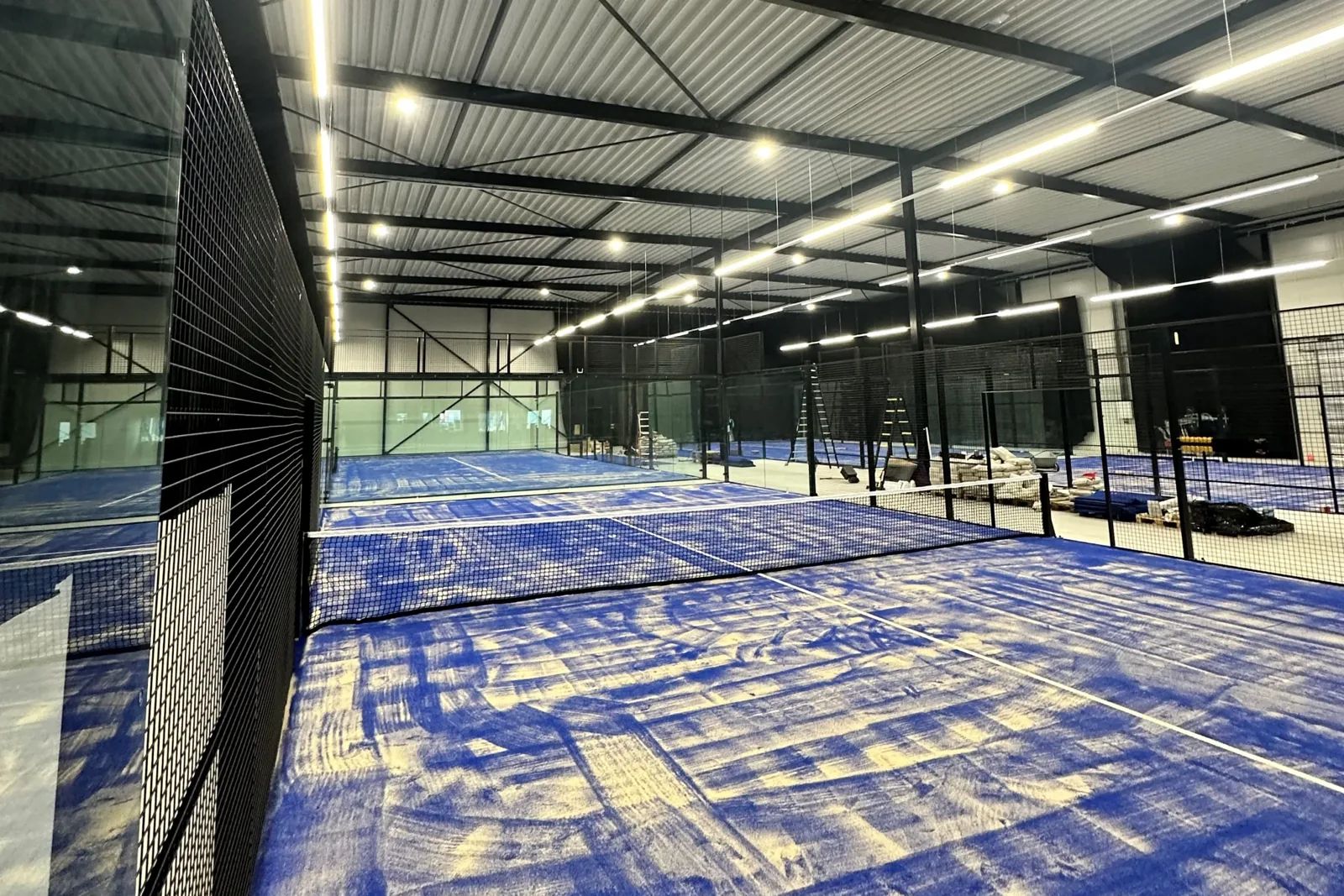
An indoor padel court places three core requirements on the subbase: sufficient load-bearing capacity, a flat surface and long-term stability. The steel structure and glass walls of a padel court bring a considerable load. Without a solid and flat subbase, there are risks of subsidence, leaning and damage to the structure.
In concrete terms, this means the following for the subbase:
- Load-bearing capacity: the floor must be able to carry the combined load of the steel structure, the glass and the artificial turf. With a padel court, the weight quickly amounts to several tonnes, distributed across the anchor points.
- Flatness: an uneven subbase leads to inconsistent ball bounce and playing problems. Professional standards set strict requirements for the maximum height differences per metre.
- Stability: the floor must not move, shrink or expand in a way that affects the structure. This is generally less of a problem at indoor locations than outdoors, but remains a point of attention with older floors.
- Anchoring: the steel structure is anchored in the floor. The subbase must be suitable for drilling and fixing anchors with sufficient pull-out strength.
With an indoor padel court in an existing hall, the condition of the current floor also plays a major role. A floor that looks good visually can still be structurally insufficient for the load of a padel court. A site check in advance is therefore always wise.
Is concrete a suitable subbase for an indoor padel court?
Yes, in most cases concrete is an excellent subbase for an indoor padel court. Concrete offers the load-bearing capacity, flatness and stability needed for a safe and durable installation. The condition is that the concrete floor is in good condition, thick enough and shows no cracks or subsidence.
For new-build projects, the concrete floor of the hall is generally already laid to the right specifications. For existing halls, it is wise to have the floor assessed in advance. Pay attention to:
- The thickness of the concrete layer, preferably at least 10 to 15 centimetres for stable anchoring.
- The compressive strength of the concrete, which determines the quality of the anchors.
- The flatness of the surface. Small height differences can be corrected with a levelling layer, but larger irregularities require a more thorough approach.
- The presence of underfloor heating or pipes, which can limit the options for anchoring.
In situations where the existing concrete floor does not meet the requirements, a foundation solution such as Supersub can be applied as a finishing layer on top of the concrete. This restores flatness and strengthens load-bearing capacity without the whole floor having to be poured again.
Can an existing sports floor serve as a subbase for padel?
An existing sports floor can in some cases serve as a subbase for an indoor padel court, but this always requires careful assessment. Not every sports floor is suitable, depending on the type of floor, the condition of the material and the structural requirements of the padel court.
There are two situations that occur regularly:
Hard sports floors on concrete
Sports halls with a hard floor on a concrete substructure are in many cases suitable as a base for a padel court. The concrete layer underneath offers the required load-bearing capacity and options for anchoring. It must, however, be assessed whether the top layer needs to be removed or whether it can be drilled through without damaging the structure.
Resilient sports floors
Resilient sports floors, such as floating wooden floors or rubber underlays, are less suitable as a direct subbase for a padel court. The structure of a padel court requires a stable, non-yielding base for the anchors. A resilient floor can cause movement in the structure, which affects the safety and lifespan of the court. In such cases it is wise to remove the floor or use an alternative foundation solution.
What is the difference between drainage concrete, Supersub and ZOAB asphalt?
Drainage concrete, Supersub and ZOAB asphalt are three different foundation solutions that each drain water in a different way and have a different technical build-up. The main difference lies in the material composition, the method of processing and the context of use. For indoor padel courts, water drainage is less relevant; for outdoor courts it is a core requirement.
Drainage concrete is a water-permeable type of concrete with an open structure. Rainwater is drained directly through the foundation into the soil. Drainage concrete has a high load-bearing capacity, a flat surface and an average lifespan of 25 to 40 years. It is often combined with a ring foundation to absorb the forces of the steel structure properly.
Supersub is a foundation solution based on foam concrete. It is lightweight, self-levelling and shock-absorbing. Supersub produces an extremely flat surface, which contributes to a consistent ball bounce. The material is fully recyclable and in many cases can be poured within a single day. For indoor applications a non-permeable variant is used; for outdoor courts a water-permeable version that can handle up to 500 millimetres of rainfall per hour.
ZOAB asphalt (open-graded asphalt concrete) is a porous asphalt variant that lets water through. It is less common for padel courts than drainage concrete or Supersub, but can be a good option in certain situations, depending on the location and the soil conditions.
The choice between these three solutions depends on the location, the use, the soil conditions and the budget. A site check and tailor-made foundation advice are always the starting point.
Which subbase is the cheapest for an indoor padel court?
For an indoor padel court, an existing concrete floor in good condition is the cheapest subbase, because no new foundation has to be built. If the floor meets the requirements for load-bearing capacity, flatness and anchoring, the padel court can be installed directly without extra foundation costs.
When the existing floor does not fully comply, the costs depend on the intervention required:
- A levelling layer or local repair is the cheapest option for minor irregularities.
- Supersub as a finishing layer is a cost-efficient solution for floors that need to be made flatter or more stable, without the whole floor having to be poured again.
- A completely new concrete floor or drainage concrete foundation is the most expensive option, but offers the most long-term certainty.
It is wise to look not only at the construction costs, but also at the total costs over the lifespan of the court. A cheaper subbase that causes problems after a few years ultimately leads to higher costs than a solid foundation from the outset. For more insight into the total investment, see our overview of the cost of an indoor padel court.
Does the subbase have to be certified for a padel court?
The subbase of a padel court does not itself have to be certified, but the materials used for the foundation and the sports floor must be inspected by Kiwa ISA Sport in the Netherlands. Kiwa ISA Sport is the recognised inspection body for sports floors and foundation components in the Netherlands. Using non-certified materials can lead to problems with permitting and with the official inspection after completion.
For padel courts used for official matches, the entire court, including the subbase and the artificial turf, must also meet the standards set by the inspection body. An inspection by Kiwa ISA Sport after completion is mandatory in that case.
In practical terms, this means the following for clients:
- Always ask about the certification of the foundation materials that will be used.
- Check whether the supplier works with products approved by Kiwa ISA Sport.
- Schedule the inspection after completion if the court is used for matches.
- Bear in mind that non-certified materials can lead to rejection or mandatory modifications during an inspection.
Inexperienced clients are not always aware of these certification requirements. It is an underestimated risk that should definitely be weighed when choosing a contractor or supplier.
How I-Padel helps with the subbase of your indoor padel court
We guide the entire process from subbase to completion, so you are not faced with surprises. Our approach is always site-specific: we assess the existing floor, draw up foundation advice and choose the solution that best fits your situation and budget. In concrete terms, we offer:
- A site check and structural assessment of the existing subbase.
- Supply and installation of all foundation types: drainage concrete, Supersub and ZOAB asphalt.
- Working exclusively with materials certified by Kiwa ISA Sport.
- A complete turnkey process, from foundation to artificial turf, LED lighting and installation.
- In-house production of the steel structure, which makes custom solutions per location possible.
Would you like to know which subbase best suits your location and what this means for the total investment? Get in touch for an initial exploration, we are happy to advise you without obligation.
Frequently asked questions
How long does it take to build a suitable subbase for an indoor padel court?
The lead time depends heavily on the type of intervention. A levelling layer or Supersub application can in many cases be applied and cured within one to two days. A completely new concrete floor takes more time, including curing, which generally takes two to four weeks. When planning your project, always allow for this curing time before the steel structure can be installed.
What happens if I do not have the subbase assessed before installation?
If you do not have the subbase assessed in advance, you run the risk that the padel court will subside after installation, lean or that the anchors will come loose. This not only leads to costly repair work, but can also endanger the safety of players. A site check in advance is a small investment that prevents big problems and extra costs afterwards.
Can I install an indoor padel court on a floor with underfloor heating?
That is possible, but requires extra care with the anchoring. Before drilling, the exact position of the heating pipes must be mapped to prevent damage. In some cases alternative anchoring methods or an extra foundation layer are used so that the anchors can be placed at the right depth without hitting the underfloor heating.
Is a Supersub subbase also suitable if the hall is later used for other sports?
Yes, Supersub is a versatile foundation solution that is also suitable as a base for other sports activities. The self-supporting, flat surface provides a good basis for a wide range of sports floors. If you want to use the hall for multiple purposes, it is wise to discuss this in advance so that the foundation build-up can be adapted accordingly.
What are the most common mistakes when choosing a subbase for an indoor padel court?
The most common mistakes are: relying on the visual condition of a floor without a structural assessment, choosing the cheapest solution without taking lifetime costs into account, and using materials not certified by Kiwa ISA Sport. Another common mistake is not checking for the presence of pipes or underfloor heating before drilling the anchor points.
How do I know whether my existing concrete floor is thick enough for a padel court?
As a rule of thumb, a minimum concrete thickness of 10 to 15 centimetres applies for stable anchoring. The exact thickness and compressive strength can be determined through a structural inspection, in which core samples are taken from the floor and analysed. A specialist party such as I-Padel can carry out this assessment as part of the site check, so that you know for certain whether your floor is suitable or which modifications are needed.
Does the choice of subbase affect the playing quality of the padel court?
Yes, the subbase has an indirect influence on playing quality. An uneven or unstable subbase leads to inconsistent ball bounce and can affect the flatness of the artificial turf. An extremely flat subbase, such as that achieved with Supersub, contributes to a consistent and professional playing surface. For courts used for official matches, a certified and flat subbase is therefore a requirement.


