


Building a padel court · 3 July 2026 · 10 min read
Which tolerances apply to the subbase when building a padel court?
Padel court subbase: max. 3 mm deviation per 3 metres. Find out which tolerances, foundation types and Kiwa requirements apply to a flat, durable court.
In this article
- What happens if the subbase is not flat enough?
- Which flatness requirements apply to a padel court subbase?
- Does the tolerance differ for an indoor and an outdoor court?
- How is the flatness of the subbase measured?
- Which foundation type produces the most accurate subbase?
- What are the Kiwa ISA Sport requirements for the subbase?
- Can an existing subbase be reused for a padel court?
- How I-Padel helps with the subbase of your padel court
- Frequently asked questions
As a general guideline for building a padel court, the subbase may not deviate by more than 3 millimetres over a measuring length of 3 metres. This is known as the flatness requirement or tolerance. A subbase that is too uneven leads directly to problems with ball bounce, the stability of the cage structure and the lifespan of the artificial turf. In this article we answer the most frequently asked questions about subbase tolerances when building a padel court.
What happens if the subbase is not flat enough?
A subbase that does not meet the flatness requirements causes uneven ball bounce, premature wear of the artificial turf and unstable fixing points for the steel structure. These are not cosmetic problems, but structural risks that directly affect playing quality and safety.
When the floor is locally too high or too low, tension and movement arise in the artificial turf surface. The turf can come loose, form wrinkles or wear unevenly. At the same time, an uneven subbase puts extra load on the steel structure, because the posts are not loaded evenly. In the long term this can lead to leaning or damage to the connection points. For a venue that has to last for decades, good flatness at the start is not a luxury but a basic requirement.
Which flatness requirements apply to a padel court subbase?
The standard for a padel court subbase is a maximum deviation of 3 mm over a measuring length of 3 metres. This requirement applies to the finished sports floor, that is, the layer on which the artificial turf is laid directly. Some certifying bodies apply a stricter standard of 2 mm over 2 metres for professional competition courts.
This tolerance is derived from international standards for sports floors and is in line with the requirements that apply to artificial turf pitches in general. The requirement applies both lengthwise and crosswise across the court. A measurement in only one direction is not sufficient. When building a padel court, flatness is therefore always checked on a grid of measuring points, so that the entire playing surface complies and no local deviations are missed.
Does the tolerance differ for an indoor and an outdoor court?
The flatness requirement itself does not differ materially between an indoor and an outdoor court. Both require a maximum deviation of approximately 3 mm over 3 metres on the finished sports floor. What does differ is how difficult it is to achieve and maintain that flatness, and which foundation build-up is needed for it.
With an indoor padel court the environment is stable. There is no frost, no precipitation and no changing temperature affecting the subbase. A carefully poured concrete floor or a well-finished Supersub layer therefore stays flat over the years.
With an outdoor court the challenges are different. Frost and thaw cause expansion and contraction in the soil. Water accumulation can cause local subsidence. The foundation must not only be flat at completion, but also stay flat under changing weather conditions. This places higher demands on the foundation build-up and the choice of materials, which partly explains why outdoor projects require a more complex and more expensive foundation.
How is the flatness of the subbase measured?
The flatness of a padel court subbase is measured with a straight edge 3 metres long and an accurate spirit level or digital measuring instrument. The straight edge is placed on the surface and the maximum deviation between the straight edge and the surface is measured. This is repeated at multiple points across the entire playing surface.
In practice, a rotating laser or digital levelling equipment that maps the entire surface is also used. This gives a more accurate picture than manual measurements, especially on larger projects with multiple courts.
The measurement always takes place after the foundation has been finished and before the artificial turf is laid. If the measurement shows that the subbase does not meet the tolerance, the floor is corrected before the artificial turf is installed. A flatness measurement afterwards, when the artificial turf is already in place, no longer makes sense.
Which foundation type produces the most accurate subbase?
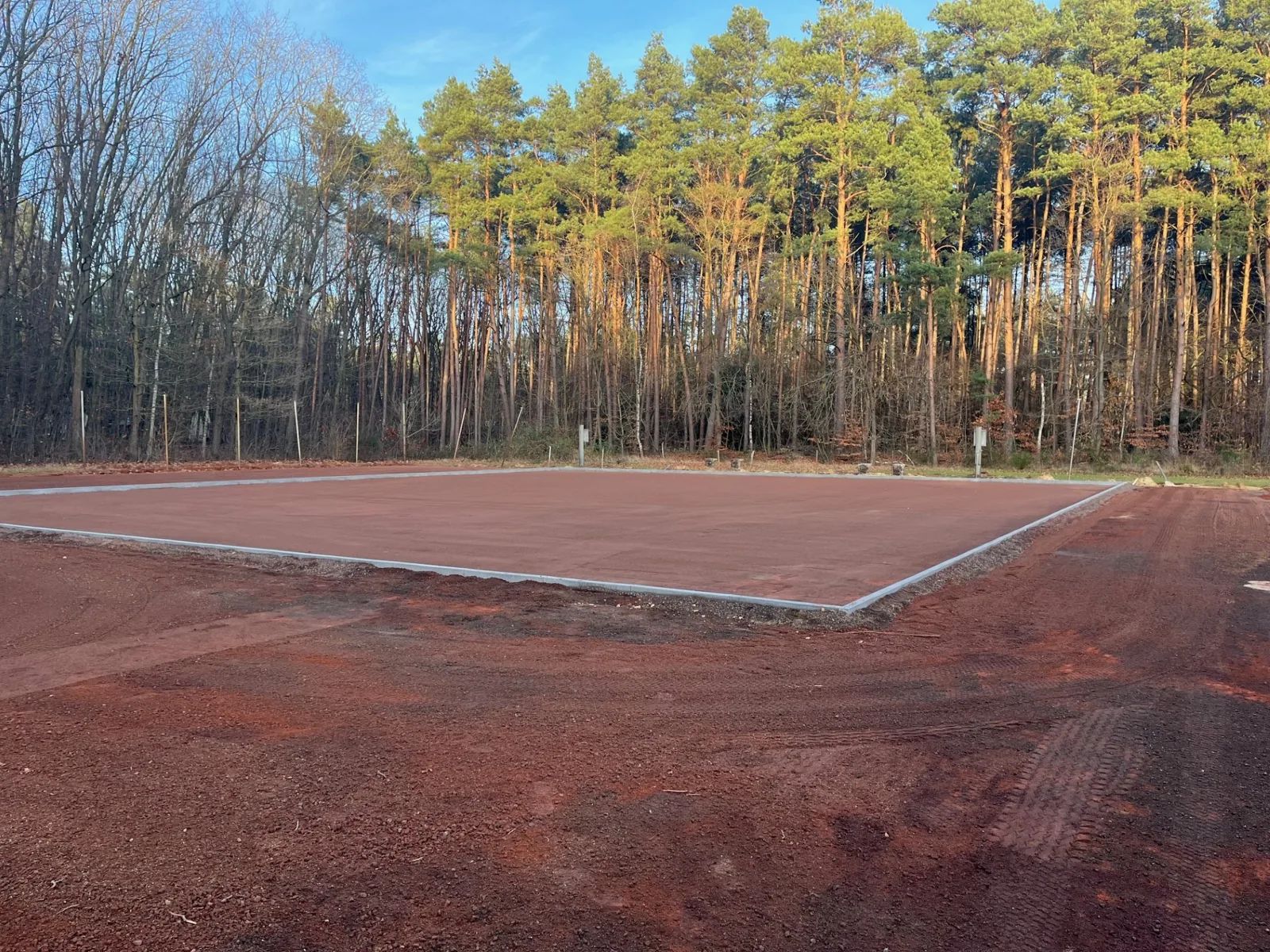
Supersub generally produces the most accurate and flattest subbase of all available foundation types. This is because Supersub, a foundation solution based on foam concrete, is self-levelling. The material flows out during pouring and levels itself automatically, resulting in an exceptionally flat finished surface.
Drainage concrete is also a reliable option and meets the flatness requirements well, but requires more craftsmanship when pouring and finishing to achieve the desired result. ZOAB asphalt, the porous asphalt variant, is less common for padel courts and requires specific expertise to guarantee a sufficiently flat surface.
The choice of foundation type depends not only on flatness, but also on soil conditions, drainage, budget and whether it is an indoor or outdoor court. A good foundation adviser always assesses the site-specific conditions before a choice is made.
What are the Kiwa ISA Sport requirements for the subbase?
Kiwa ISA Sport is the recognised inspection body for sports floors and padel courts in the Netherlands. For an official inspection by Kiwa ISA Sport, the subbase must meet the flatness standard of a maximum of 3 mm over 3 metres, and all foundation materials used must be certified and approved for use under sports floors.
Kiwa ISA Sport inspects not only flatness, but also shock absorption, deformation under load and, for outdoor courts, water permeability. All foundation components must be inspected and approved in advance. This means that when building a padel court you cannot simply use any building material. Working with certified materials is a condition for a successful inspection, which in turn is mandatory for official matches and is required by the municipality in many permit procedures.
Can an existing subbase be reused for a padel court?
An existing subbase can in some cases be reused, but this depends heavily on the condition, material and flatness of the current floor. When converting a tennis court into a padel court, reuse of the substructure is regularly possible and can save considerable costs. An inspection of the existing subbase is always the first step.
Determining factors are the age and condition of the existing floor, the presence of cracks or subsidence, the flatness relative to the applicable tolerance of 3 mm over 3 metres, and whether the load-bearing capacity is sufficient for the steel structure and glass walls of a padel court. If the existing subbase meets these requirements, a thin levelling layer or Supersub layer of approximately 10 centimetres can be applied to restore flatness and make the surface suitable for artificial turf.
If the existing subbase does not comply, a completely new foundation is the safest and most durable choice. A poor foundation as the basis for a new padel court sooner or later leads to problems that are more expensive to fix afterwards than to tackle properly up front. You can find more information about the total costs of a project in our overview of the cost of an indoor padel court.
How I-Padel helps with the subbase of your padel court
At I-Padel we assess every site on its own merits. We look at the soil conditions, the existing situation and the requirements that apply to your specific project. On that basis we advise the foundation type that fits best, whether that is Supersub, drainage concrete or another solution. What we always include:
- A site check before every foundation recommendation
- Working exclusively with materials certified by Kiwa ISA Sport
- Flatness check after finishing the foundation, before laying the artificial turf
- Advice on reusing the existing subbase for conversion projects
- Full responsibility for the end result, from foundation to completion
We are happy to advise you without obligation on the best approach for your site. Get in touch for an initial exploration and we will look at the possibilities together.
Frequently asked questions
How long does it take to have a foundation built that meets the flatness requirements?
The lead time for building a suitable foundation varies depending on the chosen material and the site conditions. For a Supersub foundation, a curing time of 24 to 48 hours generally applies before the flatness measurement can take place and the artificial turf can be laid. With drainage concrete or asphalt, weather conditions and temperature can affect curing, so the total lead time can run to several days. For outdoor projects, always allow a buffer for unforeseen weather conditions.
What does it cost to have an existing subbase inspected for suitability for a padel court?
The cost of an inspection of an existing subbase varies by provider and project size, but an initial site check by a specialist party is often available free of charge or at a low rate. A comprehensive foundation survey including flatness measurement, load-bearing capacity assessment and condition report generally costs a few hundred euros. This is almost always a worthwhile investment, because it prevents you from building an expensive foundation when reuse was possible, or conversely, from using a poor foundation as the basis.
Can frost affect the flatness of a newly built outdoor court, and how do you prevent that?
Yes, frost is one of the biggest long-term risk factors for the flatness of an outdoor court. When moisture in the soil freezes, it expands and can push the foundation up locally, leading to local deviations that exceed the 3 mm tolerance. The best prevention is a well-thought-out foundation build-up with sufficient frost-free depth, combined with a water-permeable top layer that prevents water accumulation. Always get advice on this from a specialist who knows the local soil and climate conditions.
Is a flatness measurement mandatory for every padel court, including a private court?
A formal flatness measurement by a recognised body such as Kiwa ISA Sport is mandatory when the court is used for official matches or when the municipality makes it a condition in the permit procedure.
For a private court without a competition function, an official inspection is not always formally required, but an internal flatness measurement by the contractor remains strongly recommended. After all, an uneven subbase leads to premature wear of the artificial turf and structural problems with the cage structure even for private use, regardless of the court's purpose.
What common mistakes are made when building the foundation of a padel court?
The most common mistake is underestimating the preparation: an insufficiently compacted subbase or skipping a soil investigation almost always leads to subsidence and flatness deviations later. A second common mistake is carrying out the flatness measurement only after the artificial turf has already been laid, which makes repair work impossible or very costly. Finally, some clients choose non-certified materials to save costs, which stands in the way of a successful Kiwa ISA Sport inspection and therefore of official use of the court.
How often should the flatness of a padel court be checked after completion?
There is no statutory re-inspection for flatness after completion, but for courts used for competition or rental, a periodic inspection every two to three years is sensible. For outdoor courts, an annual visual check is advisable, especially after a harsh winter.
Signs that point to flatness problems are visible wrinkles in the artificial turf, uneven ball bounce or visible subsidence along the edge of the court. Act quickly on these signs, because repair at an early stage is considerably cheaper than large-scale foundation repair later.
Can I, as the client, check myself whether the foundation meets the flatness requirements?
A rough check is possible with a straight edge of 3 metres and an accurate spirit level, which you place at multiple points across the surface and measure the maximum gap. This gives a first impression, but is no substitute for a professional measurement with a rotating laser or digital levelling equipment, which systematically maps the entire surface.
As the client, it is wise to stipulate in the contract that the contractor provides an official flatness report before the artificial turf is laid, so that you can demonstrably establish that the foundation meets the agreed tolerance.


