


Building a padel court · 21 August 2026 · 10 min read
Which artificial turf is best suited for building a padel court?
Artificial turf for a padel court: choose a 12-13 mm pile height with quartz sand. Discover which type meets Kiwa ISA Sport certification.
In this article
- What types of artificial turf are there for padel courts?
- What is the ideal pile height for artificial turf on a padel court?
- How much sand does artificial turf on a padel court need?
- What is the difference between indoor and outdoor artificial turf for padel?
- Which inspections must artificial turf for padel meet?
- How long does artificial turf on a padel court last?
- What should you look for when choosing artificial turf for a padel court?
- How I-Padel helps with choosing and laying artificial turf for your padel court
- Frequently asked questions
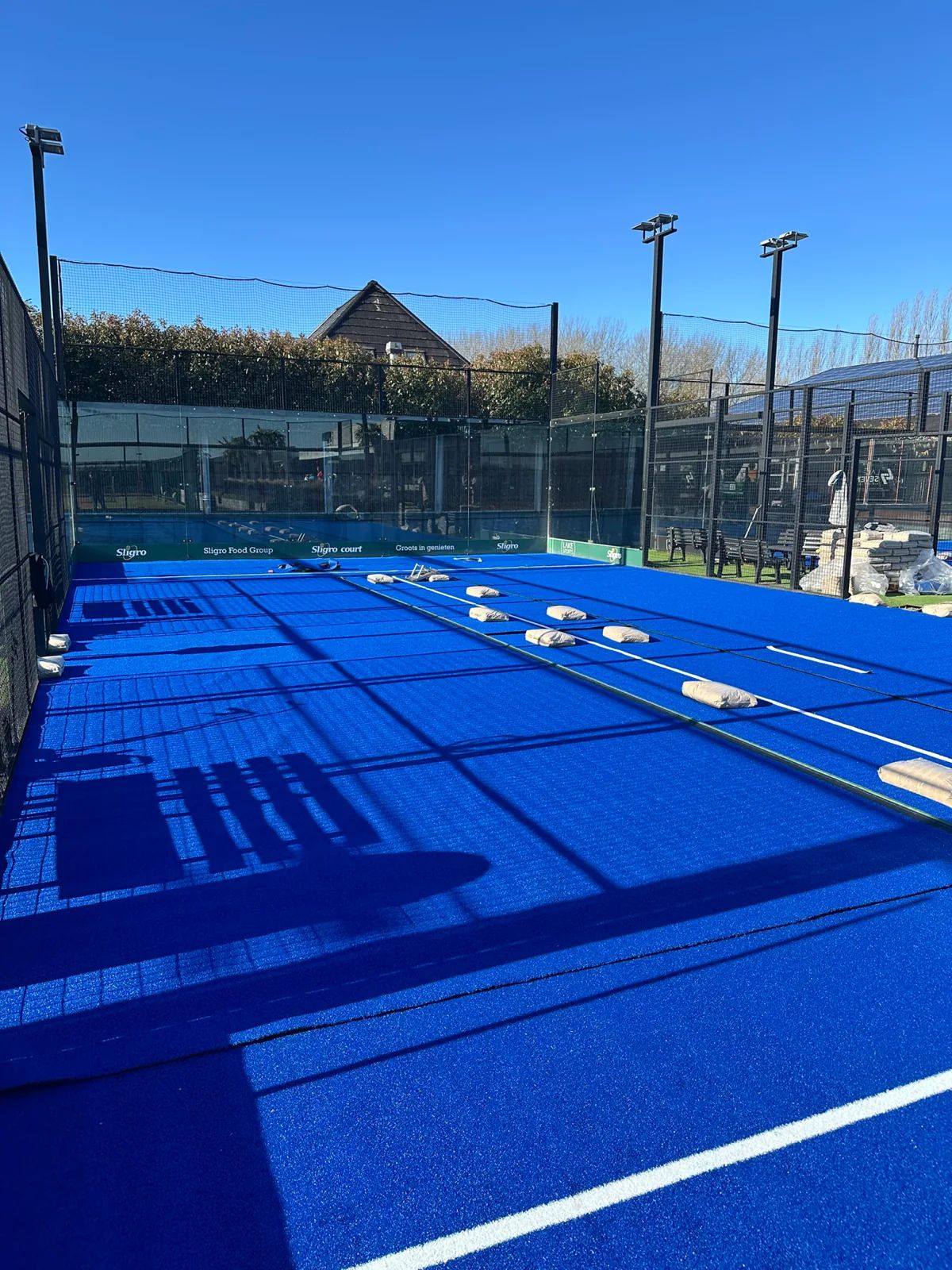
For building a padel court, artificial turf with a pile height of 12 to 13 millimetres, filled with quartz sand, is the most suitable. This type of artificial turf offers the right ball bounce, sufficient grip and playing behaviour that matches official padel standards. The choice between indoor and outdoor artificial turf, the amount of sand and the required inspections all play an important role. In this article we answer the most frequently asked questions about artificial turf for padel courts.
What types of artificial turf are there for padel courts?
Two main types of artificial turf are used for padel courts: sand-filled artificial turf and unfilled artificial turf. Sand-filled artificial turf is by far the most widely used type, for both indoor and outdoor courts. It consists of short, straight or slightly curled fibres that are filled with quartz sand to make the playing surface stable and consistent.
Unfilled artificial turf is occasionally used at indoor venues where maintenance has to be kept to a minimum. However, this type has less grip and different playing behaviour, which makes it less suitable for serious use or official matches.
Within sand-filled artificial turf there are also differences in fibre type. Monofilament fibres are smoother and harder, while fibrillated fibres feel softer and hold sand better. For padel, fibrillated artificial turf is most often recommended because of its better infill properties and consistent playing behaviour.
What is the ideal pile height for artificial turf on a padel court?
The ideal pile height for artificial turf on a padel court is between 12 and 13 millimetres. This height provides the right ball bounce and sufficient grip without slowing the ball too much or letting it shoot away too fast. A shorter pile gives a harder and faster playing surface; a longer pile slows the game and is less stable after infill.
A pile height of 12 mm is the most common and is offered as standard for padel courts by most manufacturers. With 13 mm there is slightly more room for sand infill, which can be an advantage on outdoor courts because the sand is less quickly washed or blown away. If in doubt, always choose the specifications that match the inspection guidelines of Kiwa ISA Sport, the recognised inspection body in the Netherlands for sports floors and artificial turf.
How much sand does artificial turf on a padel court need?
Artificial turf on a padel court is filled with approximately 3 to 5 kilograms of quartz sand per square metre. On a standard padel court of 20 by 10 metres (200 m²), that comes to 600 to 1,000 kilograms of sand in total. The exact amount depends on the pile height and the recommendations of the artificial turf manufacturer.
The sand serves several functions. It keeps the fibres upright, stabilises the surface, distributes the pressure of the ball evenly and ensures the right ball bounce. Too little sand leads to unstable fibres and inconsistent bounce. Too much sand flattens the fibres and makes the playing surface too hard, which also has a negative effect on the service life of the artificial turf.
Over time sand can shift or compact, especially on outdoor courts. Regular brushing and topping up where necessary is therefore part of the standard maintenance of a padel court.
What is the difference between indoor and outdoor artificial turf for padel?
The main difference between indoor and outdoor artificial turf for padel is the weather resistance of the fibres. Outdoor artificial turf is treated with UV stabilisers to prevent discolouration and degradation from sunlight. Indoor artificial turf generally lacks this treatment, because exposure to direct sunlight is not an issue.
The drainage requirement also differs. On outdoor courts the artificial turf must let water through, so that the playing surface dries quickly after rain. This places demands on both the artificial turf itself and the underlying foundation. On indoor courts, water drainage through the artificial turf plays no role, although the foundation must still be level and stable.
Another practical difference is the choice of colour. Outdoor artificial turf for padel is almost always green or blue, colours that are clearly visible in daylight and under artificial lighting. Indoor artificial turf offers slightly more freedom in colour choice, although green remains the standard. If you want to know what an indoor padel court looks like in practice, that gives a good picture of the common specifications.
Which inspections must artificial turf for padel meet?
In the Netherlands, artificial turf for padel courts must be inspected by Kiwa ISA Sport. This is the recognised body for the inspection of sports floors and artificial turf in the Dutch market. Kiwa ISA Sport tests whether the artificial turf meets the applicable standards for ball bounce, grip, shock absorption and levelness. Without this inspection the artificial turf is not suitable for official matches.
In addition to the national inspection by Kiwa ISA Sport, international standards also apply. The World Padel Tour and the Federación Internacional de Pádel (FIP) set requirements for the playing surface for official use. Anyone who wants to build courts for league play or tournaments is well advised to check that the chosen artificial turf meets both the national and international standards.
A common mistake when building a padel court is choosing artificial turf that is not certified, purely because it is cheaper. This can lead to rejection at inspection and extra costs for replacement. Always work with suppliers who demonstrably supply certified materials.
How long does artificial turf on a padel court last?
Artificial turf on a padel court lasts on average 8 to 12 years, depending on the intensity of use, the quality of the material and the level of maintenance. With intensive use at a commercial venue with several hours of play per day, the service life may come out on the shorter side. At a tennis club with limited use, the artificial turf can last longer.
The main wear indicators are fibre loss, discolouration, uneven sand distribution and reduced ball bounce. When the playing surface visibly starts to look bare or the bounce is inconsistent, replacement is due. Outdoor artificial turf generally wears faster than indoor artificial turf because of the combination of UV radiation, temperature changes and precipitation.
Regular maintenance considerably extends the service life. Brushing to keep the fibres upright, topping up sand where needed and removing leaves and dirt are the most effective maintenance steps. An annual inspection helps to spot wear early.
What should you look for when choosing artificial turf for a padel court?
When choosing artificial turf for a padel court, five factors are decisive: the pile height, the fibre type, the UV resistance, the certification and the compatibility with the foundation. Each of these factors directly affects the playing quality, the service life and the official suitability of the court.
- Pile height: choose 12 to 13 mm for the right playing behaviour and correct ball bounce.
- Fibre type: fibrillated artificial turf holds sand better and is the standard for padel courts.
- UV resistance: mandatory on outdoor courts to prevent discolouration and fibre degradation.
- Certification: always check that the artificial turf has been approved by Kiwa ISA Sport.
- Compatibility with the foundation: the artificial turf must suit the type of base, whether that is drainage concrete, Supersub or ZOAB asphalt.
It is also wise to look at the warranty terms of the artificial turf supplier. Not all warranties cover the same things, and the warranty on the artificial turf is separate from the warranty on the steel structure or other parts of the court. When requesting quotes, always ask explicitly what the warranty covers and for how long. Would you like a better picture of the total costs of a padel court? Then read more about the costs of an indoor padel court to get a complete overview.
How I-Padel helps with choosing and laying artificial turf for your padel court
At I-Padel, we supply and install the artificial turf as part of the complete package for building a padel court. We work exclusively with certified materials approved by Kiwa ISA Sport, so your court immediately meets the applicable standards for official use.
- We advise per location which type of artificial turf is most suitable, taking into account indoor or outdoor use, the foundation type and the expected intensity of use.
- We handle the complete installation, including sand bed and line markings, as part of the turnkey process.
- We also offer artificial turf replacement for existing courts, including inspection and maintenance.
- For international customers who install themselves, we supply the complete materials package, including certified artificial turf.
Would you like to know which artificial turf best suits your project and location? Get in touch for an initial exploration and we are happy to help you think it through with no obligation.
Frequently asked questions
Can I reuse existing artificial turf from a tennis court for a padel court?
No, artificial turf from a tennis court is generally not suitable for a padel court. Tennis turf usually has a longer pile and a different fibre density that does not match the padel standards for ball bounce and grip. Moreover, reused artificial turf almost never meets the inspection requirements of Kiwa ISA Sport, which makes official use impossible.
How often should I have the artificial turf on my padel court maintained?
For optimal playing quality and a long service life, it is recommended to have the artificial turf professionally brushed and inspected at least four to six times a year. With intensive commercial use a higher frequency may be needed. In addition, an annual inspection by a specialist is wise to spot wear, uneven sand distribution or damaged fibres early and correct them.
What happens if I have filled the artificial turf with too little or too much sand?
Too little sand means the fibres do not stay upright, which leads to inconsistent ball bounce and less grip for players. Too much sand flattens the fibres, makes the playing surface unnecessarily hard and accelerates fibre wear. Both situations have a negative effect on the playing quality and the service life of the artificial turf, so it is important to stick closely to the recommended amount of 3 to 5 kg per m².
Is there a difference in artificial turf for a padel court that is also used outdoors in winter?
Yes, for outdoor courts that are also in use in winter, the frost resistance of both the artificial turf and the foundation deserves extra attention. UV-resistant fibres are mandatory for outdoor use anyway, but also choose artificial turf with good drainage capacity so that standing water, which can freeze in frost and damage the fibres, is drained away quickly. Ask your supplier explicitly about the performance of the material at low temperatures.
Can I lay artificial turf on a padel court myself, or should I always outsource it?
Technically it is possible to lay artificial turf yourself, but it is strongly discouraged if you want to meet the inspection requirements of Kiwa ISA Sport. A correct installation requires accurate sand infill, level line markings and a good connection to the foundation; mistakes here are difficult to correct afterwards. For a court suitable for official use or league play, professional installation by a certified party is almost always necessary.
Which type of foundation is best suited under artificial turf for a padel court?
The most commonly used foundation types under artificial turf for padel courts are drainage concrete, Supersub and ZOAB asphalt. Drainage concrete and ZOAB asphalt offer excellent water drainage on outdoor courts, while Supersub is a popular choice because of its combination of stability and shock absorption. The choice depends on the location, the budget and the type of artificial turf; it is important that the artificial turf and the foundation are compatible for an optimal end result.
What are the costs of replacing artificial turf on an existing padel court?
The costs of artificial turf replacement vary depending on the quality of the chosen artificial turf, the condition of the existing foundation and whether additional work is needed, such as sand removal or repair of the base layer. On average, the material and labour costs for replacement are lower than for a new-build court, because the steel structure and foundation are reused. Always request an itemised quote that makes clear what is and is not included, including the warranty terms on the new artificial turf.


