


Building a padel court · 6 July 2026 · 10 min read
What sightlines does a panoramic indoor padel court offer spectators?
A panoramic indoor padel court offers 60–80% glass for clear, uninterrupted views. Discover viewing angles, lighting and space for the best spectator experience.
In this article
- How much glass is there in a panoramic indoor padel court?
- From which angle do spectators have the best view of the game?
- What is the difference between a panoramic padel court and a standard padel court for spectators?
- How does lighting affect the view for spectators at an indoor padel court?
- How much space is needed around an indoor padel court for spectator zones?
- Can sound-absorbing panels limit the view for spectators?
- How I-Padel helps with building a panoramic indoor padel court
- Frequently asked questions
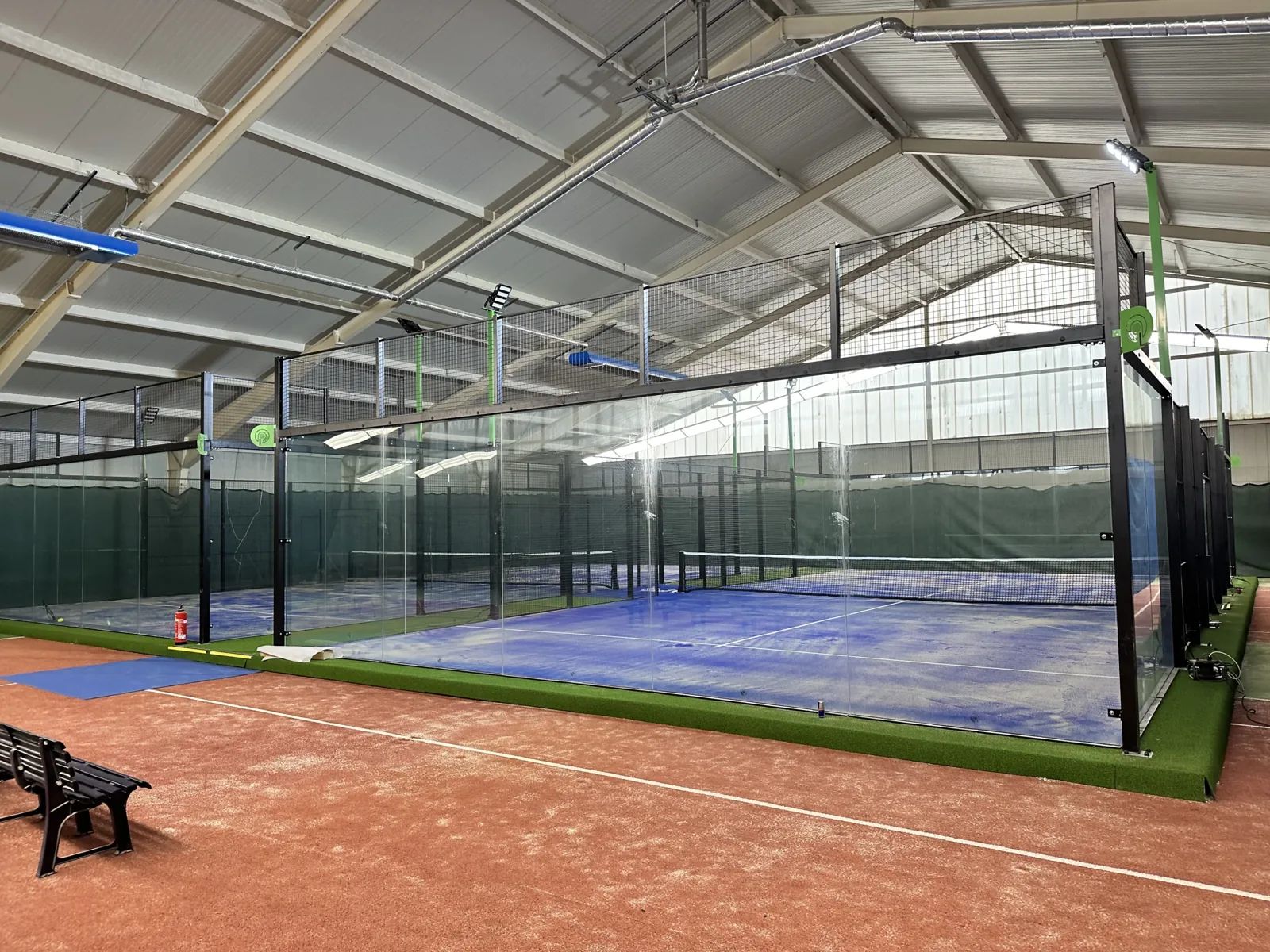
A panoramic indoor padel court gives spectators an open, unobstructed view of the entire playing area thanks to the large glass surfaces at the back and sides of the court. Where a standard padel court partly consists of mesh, a panoramic court replaces that mesh largely with glass, which considerably improves viewing comfort for the audience. The questions below go deeper into glass area, viewing angles, lighting, space and noise solutions.
How much glass is there in a panoramic indoor padel court?
A panoramic indoor padel court consists largely of glass. The entire back wall on both ends of the court is made of glass, and the side walls also consist largely of glass panels instead of mesh. In practice, the glass area of a panoramic court quickly reaches 60 to 80 percent of the total wall area, depending on the exact specification.
On a standard Pro court, a considerable part of the walls consists of steel mesh. On a panoramic court, that mesh is replaced by tempered safety glass, which creates a transparent cage around the playing area. This glass is generally 10 to 12 mm thick and meets structural and safety standards for professional use.
The large glass area is not just an aesthetic advantage. It makes the court visually more attractive to spectators and gives sponsors or venue owners more opportunities for visibility from the hall. For commercial venues, the panoramic court is therefore often the preferred choice when the audience experience matters.
From which angle do spectators have the best view of the game?
Spectators have the best view of an indoor padel court from a position behind the back wall, at right angles to the short side of the court. From that angle the entire playing area is visible, including both players at the far end and the net in the middle. The glass back wall of a panoramic court makes this perspective optimally accessible.
A secondary viewing position is along the long side of the court. From that angle you see the depth of the game well, but miss part of the overview. For larger spectator events, stands are therefore almost always placed behind the back walls, not along the sides.
On a panoramic court, the back wall is entirely glass, with no posts or mesh interrupting the view. That makes the viewing experience from that position considerably better than on a standard court, where mesh partly filters the view and causes distortions in the image.
What is the difference between a panoramic padel court and a standard padel court for spectators?
The most important difference for spectators is the degree of transparency. A standard padel court, also known as a Pro court, has side walls and upper walls that consist partly or entirely of steel mesh. Mesh filters the view and creates a grid effect, which makes the viewing experience less smooth. A panoramic court replaces that mesh with glass, so the view is clear and uninterrupted.
View and experience
Glass gives a much sharper image quality than mesh. Spectators see the ball more clearly, the players' movements are easier to follow and the overall experience is more professional. This is particularly relevant for venues that organise tournaments or want to offer a high-quality spectator environment.
Price and construction
Glass is heavier than mesh and places higher demands on the steel structure. That makes a panoramic court structurally more complex and generally slightly more expensive than a comparable Pro court. More information about the cost of an indoor padel court helps in comparing the two specifications.
How does lighting affect the view for spectators at an indoor padel court?
Good LED lighting is essential on an indoor padel court for both players and spectators. Insufficient or poorly positioned lighting causes shadows on the playing area, making the ball harder to follow from the audience. A good lighting system provides an even light intensity across the entire playing area without glare.
On panoramic courts, lighting plays an extra role. Because the walls consist largely of glass, light from outside the hall or from adjacent courts can reflect on the glass. This can be distracting for spectators looking straight through the glass. A good lighting layout takes reflections into account and positions the fixtures so that direct mirroring is minimised.
The standard for professional use is an illuminance of at least 300 lux on the playing area, with a uniformity ratio that ensures no dark corners appear. For tournament venues where camera recording also takes place, the requirements are higher. LED lighting is the norm here because of its colour rendering, energy consumption and service life.
How much space is needed around an indoor padel court for spectator zones?
An indoor padel court has a playing size of 20 by 10 metres. For installation, at least 21 by 11 metres is needed. If you also want to include spectator zones, you need considerably more space. Behind the back walls, at least 2 to 3 metres of walking space is desirable for a comfortable viewing position, and for a proper stand you need more depth.
A practical guideline for an indoor padel court with a spectator function is a total hall space of at least 21 by 16 metres per court. That provides room for run-off zones at the sides as well as a viewing zone behind the back walls. With several courts side by side, the spectator zones can be partly combined, which saves space.
The minimum clear height in the hall is 6 metres. For venues that also want to facilitate higher balls and smashes without playing restrictions, a clear height of 7 to 8 metres is recommended. The height has no direct influence on the spectator zone, but it does determine the overall playing quality that spectators get to see. Take a look at our indoor padel courts for an overview of the available specifications and dimensions.
Can sound-absorbing panels limit the view for spectators?
Sound-absorbing panels are placed on the outside of the cage structure, not on the inside. They are therefore outside the playing area and outside the glass walls. For spectators looking from behind the back wall, the panels are in most cases no obstruction, as long as they are not placed on the back wall itself.
In practice, sound-absorbing panels are mainly applied to the side walls of the court, facing the direction in which noise nuisance is greatest. This is often the side facing surrounding homes or other sensitive uses. The back walls, which form the primary viewing position for spectators, remain free of panels in those cases.
If panels are nevertheless applied in a position that restricts the view, that is always a deliberate trade-off between noise reduction and spectator experience. Moreover, an important structural condition applies: as soon as panels reduce the wind permeability of the cage, the steel structure must be structurally reinforced. The wind load on the structure increases and this requires adjustments to the posts, connections or columns. This is not an optional step, but a requirement for safety and service life.
How I-Padel helps with building a panoramic indoor padel court
We produce the steel structure of every padel court entirely in-house, including panoramic courts. That gives us the freedom to structurally calculate every site and adapt the court to the specific conditions of the hall, rather than delivering a standard product that does not always fit.
What we offer for a panoramic indoor padel court:
- Structural calculation per location, including glass load and wind load
- In-house production of the steel structure, with a 15-year warranty
- Supply and installation of the glass, artificial turf and LED lighting
- Optional integration of sound-absorbing panels, including structural reinforcement
- Fully turnkey process from design to handover, with one point of contact
- Material supply without installation for international customers
Want to know what a panoramic indoor padel court costs for your site and how much space you need for a good spectator experience? Get in touch for an initial exploration, we are happy to think along with you, without obligation.
Frequently asked questions
What type of glass is used in a panoramic indoor padel court and how safe is it?
Panoramic padel courts use tempered safety glass 10 to 12 mm thick, specially treated to break into small, blunt pieces on impact instead of sharp splinters. This glass meets the European safety standards for sports facilities and can withstand the forces released during intensive padel play. The structural calculation per location also ensures that the glass is correctly dimensioned for the specific wind load and playing conditions of your hall.
How do I start planning a panoramic indoor padel court for my site?
The first step is to map the available hall space: check that you have at least 21 by 16 metres available per court and that the clear height is at least 6 metres. After that, it is wise to bring in a specialist who makes a structural calculation based on your specific site conditions, such as floor load, wind load and the desired spectator function. A no-obligation first conversation with a supplier quickly gives you insight into feasibility and the associated costs.
What are the most common mistakes when setting up a spectator zone around an indoor padel court?
A common mistake is underestimating the space needed behind the back walls: less than 2 metres of walking space makes a comfortable viewing experience virtually impossible. Lighting is also regularly positioned wrongly, so that reflections on the glass disturb the sightlines for the audience. A third pitfall is placing sound-absorbing panels on the back wall without taking into account the impact on both the view and the structural reinforcement this requires.
Is a panoramic indoor padel court also suitable for venues without a professional tournament function?
Absolutely — a panoramic court also adds considerable value for recreational venues, because it makes the court visually more attractive and offers a better experience for both players and visitors. Commercial venues such as sports centres or fitness clubs also benefit from the extra visibility for sponsorship and branding that the large glass area offers. The higher level of investment compared with a standard Pro court often pays for itself in that context through higher court occupancy and a stronger distinguishing character.
How do I maintain the glass walls of a panoramic padel court to keep the view optimal?
Regular cleaning of the glass panels is essential to maintain a clear view: depending on use, cleaning weekly to every two weeks with a non-abrasive product and a squeegee is the recommended approach. While cleaning, also check straight away for any hairline cracks or damage in the glass, so that you can have them replaced in good time before they become a safety risk. Avoid pressure washers directly on the glass connections, as this can damage the seals and cause condensation or leakage in the structure.
Can I convert an existing standard padel court into a panoramic court later?
In principle conversion is possible, but it is not always cost-efficient. The steel structure of a standard Pro court is not always dimensioned for the higher glass load of a panoramic court, which means posts, connections and columns may need to be reinforced or replaced. It is wise to have a structural assessment carried out before you invest in the conversion, so that you can make an honest comparison between renovating and building new.
What is the effect of condensation on the glass walls and how do I prevent it?
Condensation on the glass walls occurs when there is a large temperature difference between the inside and outside temperature of the hall, which regularly happens during intensive use in winter. This can temporarily restrict the view for spectators and, in the long term, affect the seals. A good ventilation and climate control installation in the hall is the most effective measure to minimise condensation and extend the service life of both the glass and the structure.


