


Building a padel court · 27 June 2026 · 11 min read
What is a panoramic indoor padel court and what are the benefits for a club?
A panoramic indoor padel court gives clubs a better experience, a stronger look and tournament suitability. Discover costs, glass types and acoustic tips.
In this article
- What distinguishes a panoramic padel court from a standard version?
- What type of glass is used in a panoramic padel court?
- What are the benefits of a panoramic indoor padel court for a club?
- How much does a panoramic indoor padel court cost?
- What are the acoustic considerations for a panoramic padel court?
- When is a panoramic version the right choice for an indoor venue?
- How I-Padel helps you realise a panoramic indoor padel court
- Frequently asked questions
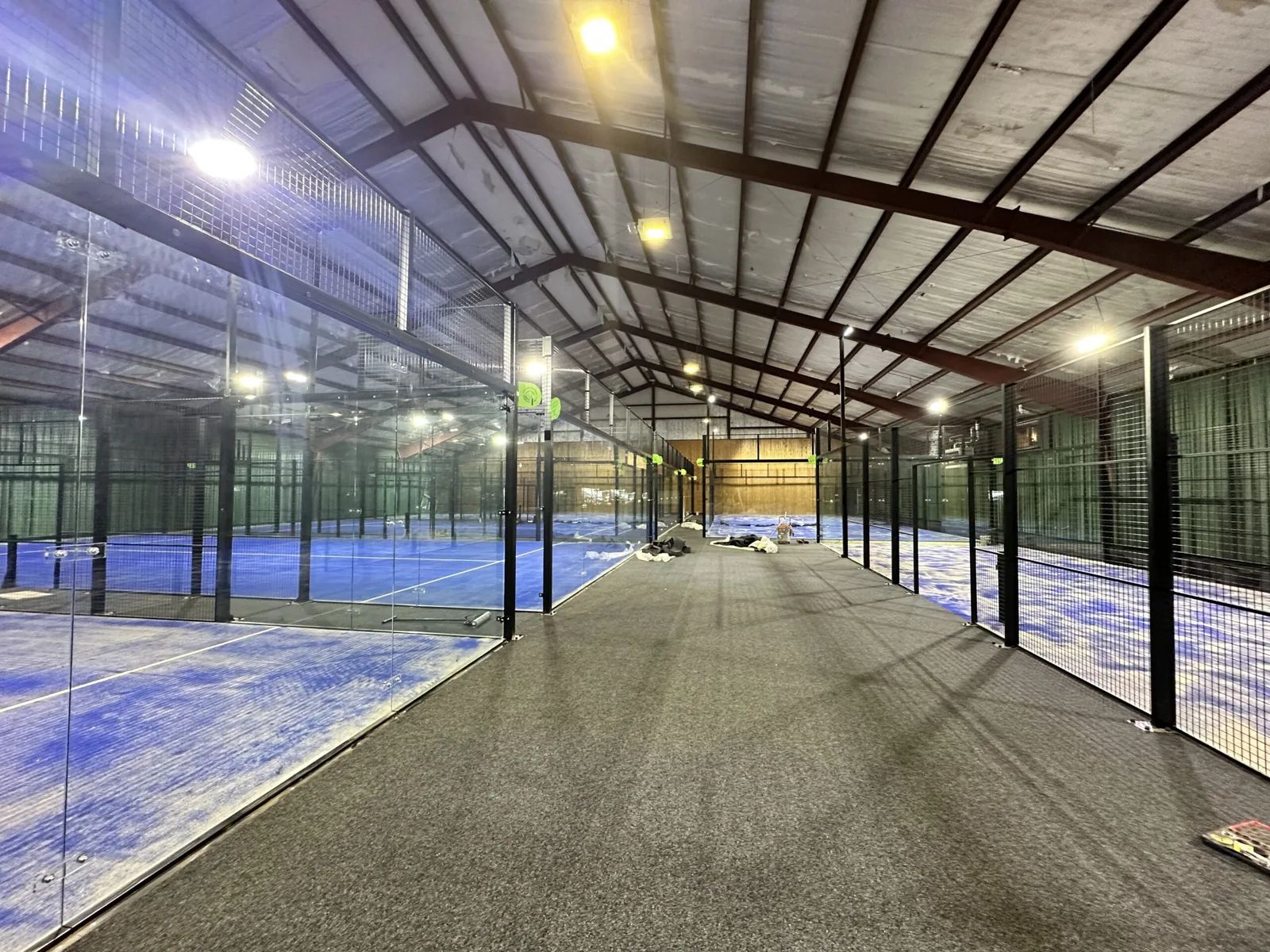
A panoramic indoor padel court is a version in which the back walls consist largely of glass instead of metal mesh. This gives the court an open, airy look and offers spectators an unobstructed view of the game. For clubs that invest in experience and appearance, this is a popular choice, one that also places specific structural requirements.
In this article we answer the most frequently asked questions about panoramic indoor padel courts: from the technical details and the costs to the acoustics and the question of when this version is the right choice for your location.
What distinguishes a panoramic padel court from a standard version?
The main difference between a panoramic padel court and a standard Pro court lies in the back walls. In a standard version the back walls consist partly of metal mesh. On a panoramic padel court the back walls are made entirely or largely of glass, which provides maximum transparency and a visually more attractive court.
This has direct consequences for the experience on and beside the court. Players experience more spaciousness, and spectators have an unobstructed view of the entire playing area. For venues that want to position padel as a premium activity or that provide space for an audience at tournaments, the panoramic version is therefore more attractive.
Despite the lighter visual character of a panoramic court, heavier materials are often used structurally. Glass has different loading characteristics than mesh, and the steel structure must be calculated and adapted accordingly. A panoramic court is therefore not a simplified version of a standard court, but a technically specific version with its own structural requirements.
What type of glass is used in a panoramic padel court?
A panoramic indoor padel court uses tempered safety glass, also known as ESG glass (Einscheiben-Sicherheitsglas). This glass is specially treated to break into small, blunt pieces rather than sharp splinters. That is a requirement for sports infrastructure where players can make direct contact with the walls.
The thickness of the glass and the method of fixing determine the safety and lifespan of the court. For padel courts, a glass thickness of 10 to 12 millimetres generally applies, depending on the position in the court and the structural calculation per location. Glass used in the back walls of a panoramic court is subject to different forces than glass in the side walls, and the structure must be specifically calculated for this.
In addition to safety, optical quality also plays a role. Clear, colourless glass provides the open look that characterises a panoramic court. Glass with a green or blue tint, as is sometimes used in standard versions, gives a different visual impression and is less suitable if you want to achieve the characteristic panoramic look.
What are the benefits of a panoramic indoor padel court for a club?
A panoramic indoor padel court offers clubs three concrete benefits: a better experience for players and audience, a stronger visual presence that sets the venue apart, and more opportunities for tournaments and events where spectators play a role.
The open look of a panoramic court makes the venue more attractive to new members and visitors. Clubs that use padel to increase membership or strengthen a commercial offering benefit from the visual appeal. A hall full of panoramic courts looks professional and inviting, which contributes to the first impression of potential members or renters.
For tournaments and events, the panoramic version offers a practical advantage: spectators can follow the game from all sides without mesh restricting the view. This improves the viewing experience and makes the court more suitable for livestreams, photography and sponsor activations. Clubs that actively organise tournaments or plan to do so benefit directly.
A third benefit is the daylight. Because the back walls consist entirely of glass, more light enters the court. In an indoor hall with good LED lighting, this reinforces the sense of space and creates a more pleasant playing environment.
How much does a panoramic indoor padel court cost?
A panoramic indoor padel court is generally somewhat more expensive than a comparable Pro court. As an indication, a standard indoor padel court in a turnkey version is possible from approximately €23,000 per court. For a panoramic version the price is higher, because more glass is used and the steel structure must be built structurally heavier.
The exact price always depends on several factors. Think of the number of courts being built (with several courts, economies of scale arise in production and installation), the accessibility of the location, the chosen quality of artificial turf and LED lighting, and any extra options such as run-off zones or sound-absorbing panels.
A common mistake is to look only at the lowest price per court. In practice, this often leads to higher costs in the long term because of lower-quality materials, limited warranty or insufficient service. A panoramic court is an investment that has to last for decades, and choosing the right structure and materials is decisive. You can find more information about the cost of an indoor padel court in our comprehensive overview.
What are the acoustic considerations for a panoramic padel court?
A panoramic padel court has more glass surface than a standard version, and glass reflects sound more strongly than metal mesh. This means the acoustics inside the hall deserve extra attention with a panoramic court. Both the playing noise for the players and the spread of sound in the hall can be noticeably different from a Pro court.
For indoor locations, noise nuisance to the surroundings is generally less of a problem than with outdoor courts, but the acoustics inside the hall itself do play a role. A hall with hard walls, a concrete floor and several panoramic courts can reach a high level of reverberation. This is unpleasant for players and staff and can negatively affect the overall experience.
There are practical solutions to this issue. Sound-absorbing ceiling panels, wall or floor coverings and the positioning of the courts in the hall contribute to a better acoustic environment. When sound-absorbing panels are placed on the outside of the cage structure, the steel structure must be reinforced, because the panels reduce wind permeability and thereby cause extra wind load. This also applies to indoor applications when the hall is open or semi-open.
It is wise to pay attention to the acoustics of the hall as a whole already in the planning phase, not only to the individual court. A good layout and the right material combinations can prevent costly modifications afterwards.
When is a panoramic version the right choice for an indoor venue?
A panoramic version is the right choice when experience, appearance and spectator comfort play a central role in the operation of the venue. This applies in particular to commercial padel centres, clubs that actively organise tournaments, and venues that want to position padel as a premium product.
For tennis clubs or venues with a limited budget where the primary focus is on realising playing capacity as efficiently as possible, a standard Pro court is often the more practical choice. The higher price of a panoramic version is justified when the extra investment is earned back through higher court rental rates, more visitors or a stronger brand position.
The hall layout also plays a role. A panoramic court requires sufficient space around the court so that the open look really comes into its own. In a cramped hall with little free space between the courts, the visual advantage of panoramic glass is less visible. The minimum installation space for a padel court is 21 by 11 metres, but for an optimal experience including run-off zones, 21 by 14 metres is the recommended size.
Finally, the minimum clear height of the hall is a point of attention. For professional use, a minimum height of 6 metres applies. The higher the hall, the better the playing quality and the more the panoramic look comes into its own.
How I-Padel helps you realise a panoramic indoor padel court
We produce the steel structure of every padel court entirely in-house. That also applies to panoramic courts, where the structure is structurally calculated per location and tailored to the specific requirements of the hall. Not a standard product from a catalogue, but a court that fits your location, your space and your objectives.
What we offer for a panoramic indoor padel court:
- Structural calculation per location, including glass load and any acoustic measures
- In-house production of the steel structure, without intermediaries or import margins
- Supply and installation of tempered safety glass
- Installation of artificial turf and LED lighting
- Optional: sound-absorbing panels, structurally integrated into the cage structure
- Fully turnkey process from design to completion, or supply of materials for customers with their own installation team
Because we deliver everything from a single source, there is one contact person, one responsibility and one warranty. We are happy to advise you without obligation on the possibilities for your location. Get in touch for an initial exploration.
Frequently asked questions
How long does the installation of a panoramic indoor padel court take?
The installation time of a panoramic indoor padel court depends on the number of courts and the condition of the hall, but allow an average of one to two weeks per court for full turnkey completion.
The preparation phase, including structural calculation, production of the steel structure and delivery of materials, generally takes six to twelve weeks. It is wise to coordinate the schedule with the supplier early, so that production and delivery line up with the completion date of the hall.
What are the most common mistakes when planning a panoramic padel court in an existing hall?
The most common mistake is underestimating the free space needed around the court. A panoramic court only really comes into its own when there is enough run-off space (at least 21 by 14 metres is recommended) and when the clear height is at least 6 metres. A second common mistake is forgetting the acoustics in the planning phase: adding sound-absorbing measures afterwards is more expensive and structurally more complex than including them in the design from the start.
Is tempered safety glass in a panoramic padel court sensitive to maintenance?
Tempered safety glass (ESG) is relatively low-maintenance, but does require regular cleaning to preserve the open, clear look. Fingerprints, dust and ball impacts can make the glass dull, which detracts from the panoramic look. When cleaning, use a non-abrasive product and a soft cloth or squeegee; aggressive cleaning agents can damage the coating or the glass edge. Also check the fixing points and rubber seals that hold the glass in the structure periodically.
Can an existing standard padel court be converted to a panoramic version?
In theory it is possible to replace the back walls of an existing court with glass, but in practice this is rarely cost-efficient. The steel structure of a standard Pro court is not always calculated for the higher load of glass walls, which means the structure also has to be modified or replaced. In most cases it is cheaper and safer to opt directly for a new panoramic court with the right structural calculation when renovating or expanding.
Which LED lighting is most suitable for a panoramic indoor padel court?
For a panoramic indoor padel court, LED lighting with a high colour rendering index (CRI ≥ 80) and a colour temperature between 4,000 and 5,700 Kelvin is preferred, which produces bright, neutral light that shows the glass and the artificial turf to their best advantage.
The illumination level at court level should be at least 300 lux for recreational play; for tournaments or livestreams, 500 lux or more is recommended. Good positioning of the fittings prevents annoying reflections on the glass surface, which is a specific point of attention for panoramic courts.
Does a panoramic padel court affect the playing characteristics of the ball?
Yes, glass and metal mesh have different rebound characteristics. Glass gives a harder, more predictable rebound than mesh, which affects the dynamics of play, particularly on shots off the back wall. This is not necessarily a disadvantage; many players appreciate the more consistent ball rebound of glass walls. It is something to take into account when communicating with players who are used to a mesh version.
How can I earn back the extra cost of a panoramic court as a club owner?
The extra cost of a panoramic version can generally be earned back via three routes: higher court rental rates thanks to the premium look, more tournament revenue thanks to the improved spectator and media experience, and stronger member recruitment because the venue stands out visually from competing clubs.
A realistic calculation of the operation, including occupancy rate and average rental price per hour, helps to determine within what period the extra investment is earned back. Preferably discuss this with the supplier in the planning phase, so that the choice of court fits the commercial objectives of the venue.


