


Building a padel court · 29 March 2026 · 11 min read
What foundation options are there for a padel court?
Which foundation suits your padel court? Discover drainage concrete, Supersub and ZOAB, with costs, requirements and tailored expert advice.
In this article
- Why is a good foundation so important for a padel court?
- Which foundation types are used for padel courts?
- What is the difference between drainage concrete, Supersub and ZOAB?
- Which foundation type is best for an outdoor court?
- What foundation requirements apply in the Netherlands for padel courts?
- What does a foundation for a padel court cost?
- How do you know which foundation is suitable for your location?
- Frequently asked questions
The foundation of a padel court is a topic that raises many questions, and rightly so. It is the base under everything, quite literally. The wrong choice can lead to subsidence, tilting and damage to the steel structure. In this article we explain the main foundation types, discuss their advantages and disadvantages and help you determine which solution best suits your location.
Why is a good foundation so important for a padel court?
A good foundation determines the stability, safety and lifespan of a padel court. Without a solid base there is a risk of subsidence, tilting and damage to the steel structure. The foundation carries not only the weight of the cage structure and the glass, but also absorbs the wind load that a padel court experiences during use.
A padel court weighs a considerable amount. The steel structure, the glass walls and the load during intensive use together create forces that the foundation must be able to absorb structurally. On top of that, outdoor courts also have to deal with rainfall, frost and temperature fluctuations. A foundation that has not been designed for this will sooner or later cause problems. In practice we see that courts without a good foundation show cracking or subsidence after just a few years, which brings expensive repairs.
Good foundation work always starts with a soil investigation (CPT sounding). Based on that data, the type of foundation suited to the location is determined. This is not a standard solution, but tailor-made work for each situation.
Which foundation types are used for padel courts?
Three permeable foundation types are most commonly used for padel courts: drainage concrete, Supersub and ZOAB asphalt. In addition, ring foundations and strong plastic panels are also common alternatives to poured concrete. Each type has its own technical properties, areas of application and cost levels.
- Drainage concrete: a permeable type of concrete in which rainwater drains directly through the foundation into the soil. Widely used for outdoor courts.
- Supersub: an innovative foundation solution based on foam concrete. Lightweight, self-levelling and shock-absorbing. Suitable for both new builds and renovations.
- ZOAB asphalt: open-graded asphalt concrete that lets water through. Less common for padel courts, but a good option in certain situations.
- Ring foundation: a concrete ring structure that anchors the posts of the cage structure. Often combined with one of the floor types above.
The choice between these types depends on the soil conditions, the use, the budget and the location. For outdoor courts, permeability is a strict requirement. For indoor courts other factors play a role, such as flatness and shock absorption.
What is the difference between drainage concrete, Supersub and ZOAB?
Drainage concrete, Supersub and ZOAB are all three permeable foundation solutions, but they differ in material composition, technical properties and area of application. The main difference lies in how they drain water, how they handle loads and what they cost to install and maintain.
Drainage concrete
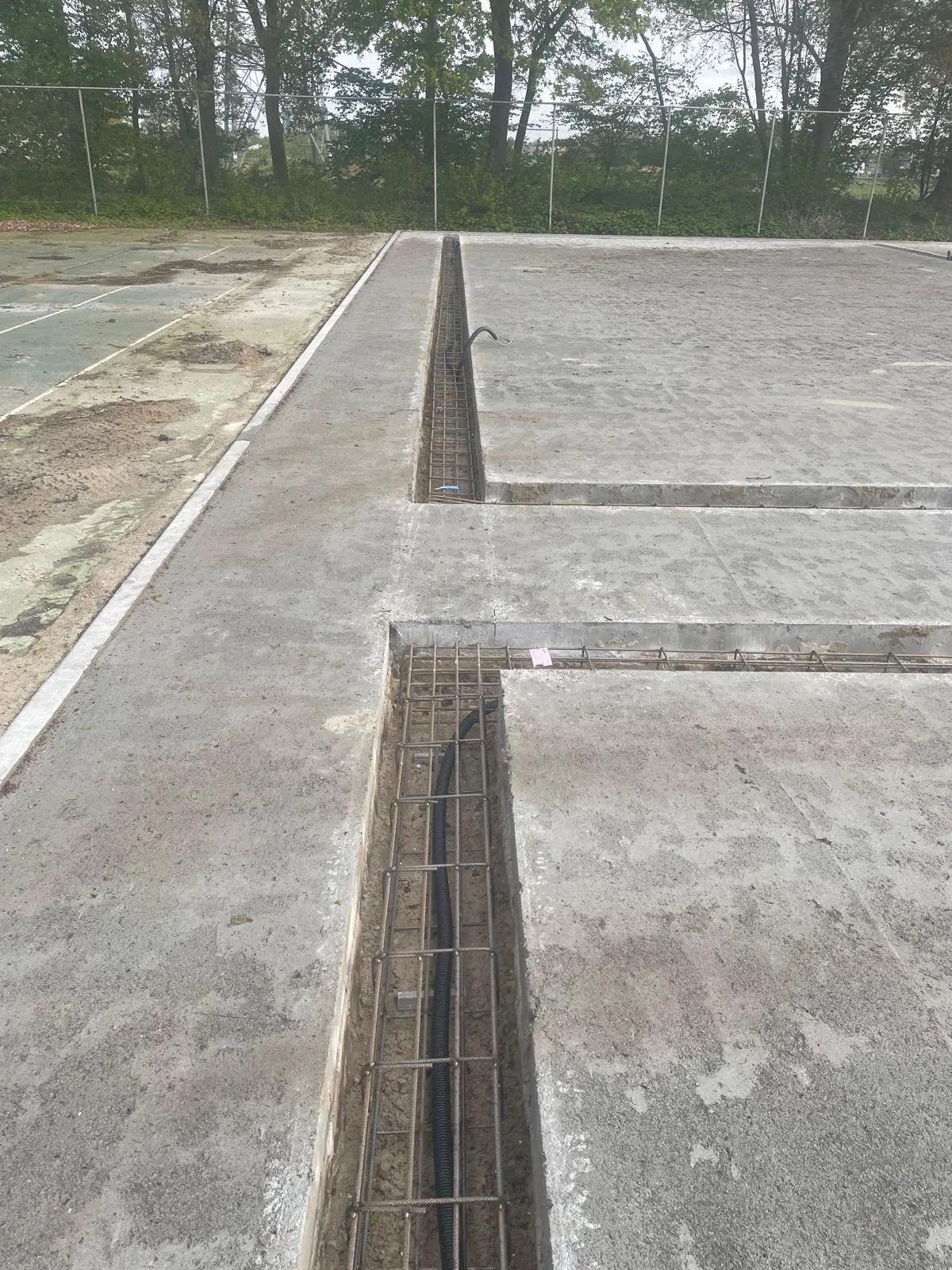
Drainage concrete is a porous type of concrete whose open structure lets rainwater pass straight through to the subsoil. It is a proven and stable solution with an average lifespan of 25 to 40 years. Drainage concrete has a high load-bearing capacity and withstands frost, heat and intensive use. On padel courts it is often combined with a ring foundation to absorb the forces of the steel structure properly.
Supersub
Supersub is a foundation solution based on foam concrete. It is lighter than traditional concrete, but highly stable. A notable property is its shock-absorbing effect: the resilient build-up distributes forces better, which contributes to playing comfort and reduces the strain on joints. Supersub is also sound-dampening and fully recyclable. The permeable variant is suitable for outdoor courts; for indoor courts a non-permeable version is available. The thickness varies from around 10 cm for renovations to 15 cm for new builds, depending on the soil conditions.
ZOAB asphalt
ZOAB stands for Zeer Open Asfalt Beton (very open asphalt concrete). It is a porous type of asphalt that lets rainwater through. ZOAB is used less often for padel courts than drainage concrete or Supersub, but it can be a good choice in specific situations, for example when an asphalt base is already present or when the location sets specific requirements.
Which foundation type is best for an outdoor court?
For an outdoor court, drainage concrete or Supersub is the best choice in most cases. Both solutions are permeable, stable and resistant to the weather conditions an outdoor court faces every day. Which type is most suitable depends on the soil conditions, the budget and the specific requirements of the location.
Drainage concrete is a solid, tried-and-tested option that performs excellently with good soil conditions. Its long lifespan of 25 to 40 years makes it a cost-efficient choice in the long term. Supersub has the added advantage that it is shock-absorbing and in many cases can be poured within a single day, which shortens the construction time.
For outdoor courts, the foundation is also always dependent on the location. Factors such as the drainage of the site, the wind load and the load-bearing capacity of the soil help determine which build-up is needed. A ring foundation around the posts is almost always necessary for outdoor courts to anchor the steel structure properly. Always get advice on this based on a CPT sounding.
What foundation requirements apply in the Netherlands for padel courts?
In the Netherlands, all foundation components for padel courts must be approved by Kiwa ISA Sport. This quality mark guarantees that materials meet the sports-technical and quality requirements that apply to professional use. Anyone who works with non-certified materials risks that the court cannot later be certified for official matches.
In addition to the material requirements, there are also structural requirements under the Dutch Building Decree (Bouwbesluit). For outdoor courts an environmental permit is almost always mandatory, for which structural calculations must be submitted. These calculations cover, among other things, the wind load on the structure and the anchoring in the foundation.
Additional requirements apply to the artificial turf surface under the quality assurance system of NOC*NSF and Kiwa ISA Sport. Artificial turf for padel courts must be included on the sports products list in order to be certified. For new builds and renovations from 2025, the most recent measurement procedures and reporting requirements apply. This affects the foundation indirectly, because the flatness of the base has a direct influence on the sports-technical performance of the artificial turf.
For official matches, an inspection by Kiwa ISA Sport after completion is mandatory. This inspection covers both the sports surface and the structure. A well-executed foundation is a precondition for passing that inspection.
What does a foundation for a padel court cost?
The cost of a padel court foundation averages between €20,000 and €40,000 per court, depending on the soil conditions, the accessibility of the location and the type of foundation. This is an indication; the exact price always depends on the specific situation and requires a tailor-made quote.
For indoor courts, foundation costs are usually lower, because no permeable build-up is needed and conditions are more predictable. For outdoor courts, the foundation is the largest cost factor of the entire project. A ring foundation combined with a permeable sports surface is the most widely used and cost-efficient solution for outdoors.
When you convert an existing tennis court into padel courts, part of the substructure can sometimes be reused. This saves costs and shortens the construction time. Whether reuse is possible depends on the condition and build-up of the existing foundation. A site check in advance will provide clarity on this.
Also bear in mind that foundation costs can be higher at more complex locations. Think of poor soil conditions, limited access for equipment or locations with an atypical water management situation. All these factors are taken into account in the foundation advice.
How do you know which foundation is suitable for your location?
You determine the right foundation for your location on the basis of a soil sounding, the site conditions and the intended use. A sounding gives insight into the load-bearing capacity of the subsoil and any risk of subsidence. Without that information, responsible foundation advice is not possible.
Besides the soil conditions, the following factors also play a role in the choice:
- Indoor or outdoor: outdoor courts require permeable foundations; indoor courts have different requirements.
- Wind load: on open terrain, coastal locations or with tall buildings nearby, the wind load is higher, which affects the foundation build-up.
- Existing base: is there already a paved surface? Then reuse may be an option.
- Budget and planning: some foundation types can be realised faster than others, which is relevant when schedules are tight.
- Noise requirements: for locations near homes, additional measures may be needed that affect the structure and therefore the foundation.
Good foundation advice combines all these factors and links them to the right solution. It is important that all materials used are certified by Kiwa ISA Sport, so that the court can be inspected without problems after completion.
At I-Padel we guide you through this entire process. We supply all foundation types, drainage concrete, Supersub and ZOAB asphalt, and advise based on your location, not on whatever we happen to have in stock. Want to know more about the foundation of your padel court? Take a look at our page on padel court foundations or get in touch for an initial exploration; we are happy to think along with you, without obligation.
Frequently asked questions
How long does it take to lay a foundation for a padel court?
The lead time depends heavily on the chosen foundation type and the site conditions. Supersub can in many cases be poured within a single day, while drainage concrete usually needs a curing time of several days. Including preparatory groundwork, soil sounding and any ring foundation, allow for a total execution time of one to two weeks per court under normal conditions.
Can I build a padel court on an existing concrete base?
That depends on the condition, thickness and build-up of the existing concrete floor. If the base is level, stable and has sufficient load-bearing capacity, it can in some cases serve as the foundation, possibly with additional adjustments for water drainage or anchoring of the posts. A site check and soil sounding are necessary to assess whether reuse is sound and meets the Kiwa ISA Sport requirements.
What happens if the foundation is not level enough? Does that affect play?
Yes, the flatness of the foundation has a direct influence on the sports-technical performance of the artificial turf and therefore on the quality of play. A base that is not level enough can lead to uneven ball bounce, an increased risk of injury for players and rejection during the mandatory Kiwa ISA Sport inspection after completion. Flatness requirements are therefore a fixed part of the foundation advice and execution.
Is an environmental permit always required when building a padel court?
For outdoor courts, an environmental permit is almost always mandatory in the Netherlands, for which structural calculations, including wind load and foundation anchoring, must be submitted. Different rules apply to indoor courts, depending on the type of building and the municipality. It is wise to check this early with the local municipality, so that permit procedures do not delay your schedule.
What common mistakes are made with the foundation of a padel court?
The most common mistakes are: not having a soil sounding carried out beforehand, choosing a standard solution without taking the specific soil conditions into account, and working with non-certified materials that later block the Kiwa ISA Sport inspection. The ring foundation around the posts is also regularly underestimated or cut from the budget, which in time leads to subsidence and damage to the steel structure.
How do you maintain a permeable foundation such as drainage concrete or Supersub?
Permeable foundations require periodic maintenance to keep their permeability up to standard. Leaves, sand and fine dust can gradually clog the pores, reducing water drainage. Regular cleaning with a high-pressure cleaner or a specialised suction machine prevents this. With drainage concrete this maintenance is simple and relatively inexpensive; Supersub, thanks to its composition, generally suffers less from clogging.
What is the difference in foundation between an indoor and an outdoor padel court?
For an outdoor padel court, permeability is a strict requirement, because rainwater must be able to drain away immediately to prevent puddles and subsidence. Indoor courts do not need a permeable foundation, which gives more freedom in the choice of materials and usually results in lower costs. However, indoor courts do have specific requirements for flatness and shock absorption, and factors such as sound insulation and the load-bearing capacity of the existing floor structure play a bigger role.


