


Building a padel court · 8 May 2026 · 12 min read
What does an outdoor padel court cost including foundation?
An outdoor padel court costs from €50,000 including foundation. Discover all cost factors, foundation types and how to request a reliable quotation.
In this article
- What does an outdoor padel court cost on average in the Netherlands?
- Why is an outdoor court more expensive than an indoor court?
- Which foundation types are there for an outdoor padel court?
- Which foundation type is best for my location?
- What are the main cost factors for an outdoor padel court?
- How are sound-absorbing panels integrated into the structure?
- How do you request a quotation for an outdoor padel court?
- Frequently asked questions
Building an outdoor padel court is a serious investment. The total padel court costs for an outdoor court start at around € 50,000 per court on average, including foundation. That is considerably more than for an indoor court, and that has everything to do with the foundation, the heavier steel structure and the permit requirements that come with an outdoor location. In this article you will read exactly where those costs come from, which foundation types exist and how to arrive at a realistic budget for your location.
What does an outdoor padel court cost on average in the Netherlands?
In the Netherlands, an outdoor padel court costs from around € 50,000 per court on average, including foundation and installation. The cage structure, excluding foundation, starts from around € 30,000. The foundation adds € 20,000 to € 40,000 on average, depending on soil conditions, accessibility and the civil works required.
That range is wide, and not without reason. Every outdoor location is different. One location has a stable sandy soil, another needs groundwork before a single anchor can go into the ground. The exact price always depends on the situation at your location, the number of courts you build and the options you add.
Frequently requested extra options that affect the price:
- Ball catchers: around € 1,200 per side
- Sliding doors or lockable entrances
- Sound-absorbing panels (priced per location)
- Additional fencing or screening around the complex
Comparing several quotations? Then look not only at the price per court, but also at what exactly is included in the price. Foundation, permit support and warranty terms are not always included as standard.
Why is an outdoor court more expensive than an indoor court?
An outdoor padel court is more expensive than an indoor padel court for three concrete reasons: the foundation is a separate and large cost item, the steel structure has to be heavier because of weather influences and wind load, and an outdoor location almost always requires an environmental permit.
With an indoor court you build in an existing hall. The floor is already there, the structure has to absorb less wind load and permits are far from always needed. Outdoors it is very different. The steel structure has to withstand wind, rain, frost and temperature fluctuations. That calls for hot-dip galvanised steel and a heavier structural build-up.
On top of that, the foundation outdoors is always custom work. Soil conditions, groundwater level, drainage and the load of the structure together determine which foundation type is needed and how deep the work has to go. That makes a fixed price for the foundation impossible without a site investigation.
Which foundation types are there for an outdoor padel court?
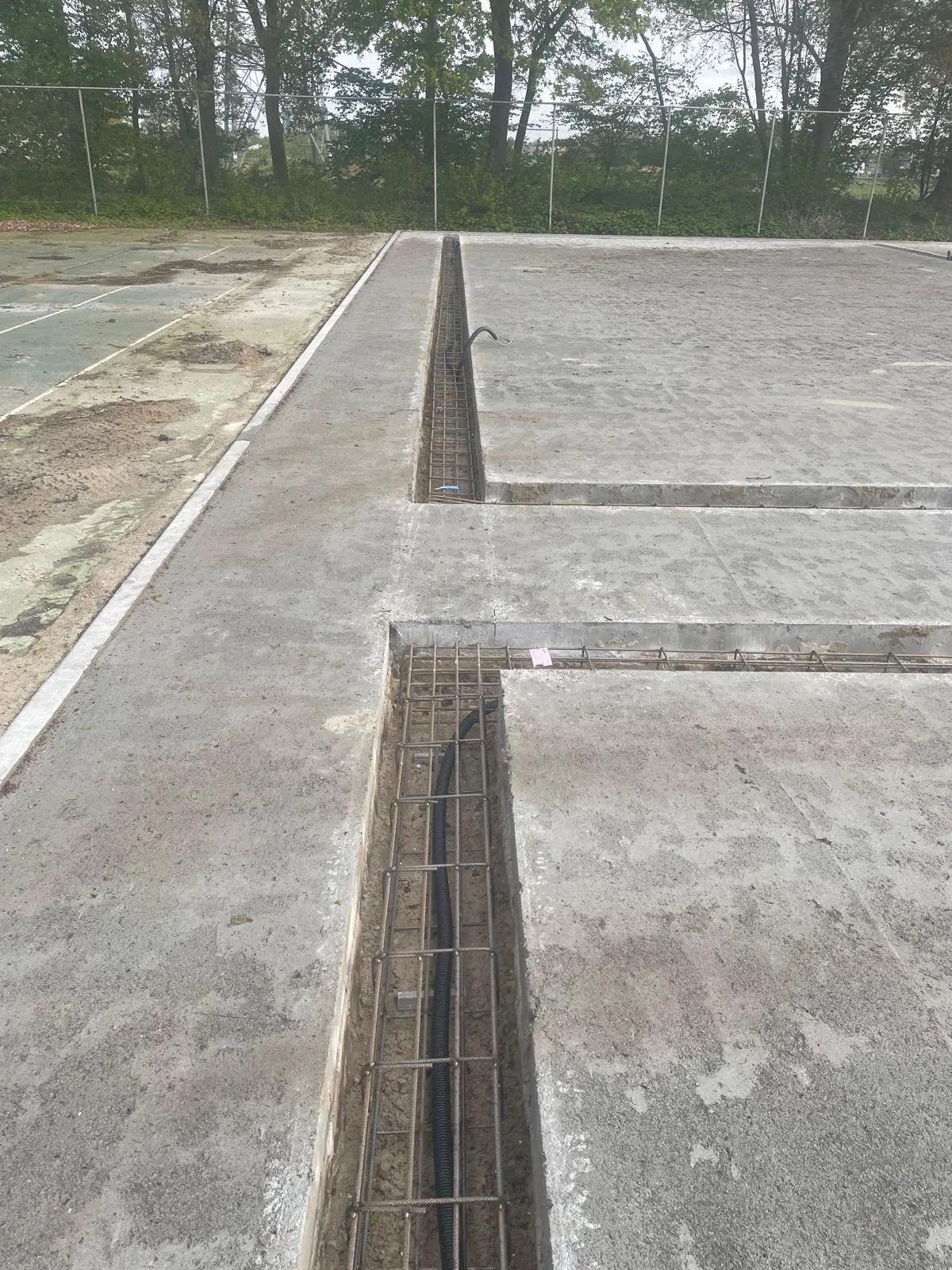
Three foundation types are common for outdoor padel courts: drainage concrete, Supersub and ZOAB asphalt. All three are water-permeable, which outdoors is necessary to prevent puddles and keep the court quickly playable after rain.
Drainage concrete
Drainage concrete is a water-permeable type of concrete with an open structure, so that rainwater drains straight through the foundation into the soil. It is a commonly used solution for outdoor padel courts because of its high stability and bearing capacity.
A drainage concrete foundation lasts 25 to 40 years on average with correct use and maintenance and is resistant to frost, heat and intensive use. For padel courts, drainage concrete is often combined with a ring foundation with steel reinforcement to absorb the forces of the steel structure and wind load properly.
Supersub
Supersub is a foundation solution based on foam concrete: a lightweight, self-levelling material that produces an extremely flat surface. That is important for a consistent ball bounce. In its outdoor version, Supersub is water-permeable, handles up to 500 mm of rainfall per hour and is fully recyclable.
Because the material is lightweight, it can in many cases be poured within one day. The thickness varies from around 10 cm for renovation to around 15 cm for new construction, always based on soil conditions and project requirements.
ZOAB asphalt
ZOAB asphalt, also known as open-graded asphalt concrete, is a porous type of asphalt that lets water through. It is used less often for padel courts than drainage concrete or Supersub, but can be a good option in certain situations, particularly at locations where asphalt infrastructure is already present or where specific requirements apply to the base.
All foundation components used in the Netherlands must be approved by Kiwa ISA Sport. If you work with a supplier who cannot demonstrate this, you run the risk that the foundation does not meet the Dutch standards for certified sports facilities.
Which foundation type is best for my location?
There is no universally best foundation type. The choice depends on soil conditions, groundwater level, expected use and budget. A good choice always starts with a cone penetration test, so that you know what you are dealing with.
As a guideline: drainage concrete is the most proven solution for outdoor padel courts at locations with good soil conditions. Supersub is a strong alternative for renovation projects, such as converting a tennis court into padel courts, because its light weight and flat finish fit well with existing substructures. ZOAB asphalt is less common, but may be preferable in specific situations.
Besides the three main types, ring foundations and strong plastic slabs are also used as an alternative to poured concrete. Which combination works best always depends on the location. Get advice based on the specific situation of your project, not on whatever a supplier happens to have in stock.
What are the main cost factors for an outdoor padel court?
The five main cost factors for an outdoor padel court are: the foundation, the steel structure, the type of court, the site conditions and any noise measures. Together they determine the largest part of the total investment.
A closer look at each factor:
- Foundation: the biggest variable. Costs average between € 20,000 and € 40,000, depending on soil conditions, groundwork and the foundation type chosen.
- Steel structure: for outdoor use the structure has to be heavier and better protected than indoors. Hot-dip galvanised steel is standard. The structure of the Outdoor Panorama is built from tubular profiles of 150 × 150 to 100 × 50 mm and withstands wind speeds of up to 258 km/h.
- Type of court: a panoramic court has a different visual appearance from a pro court and, despite the lighter look, usually requires heavier materials, which makes the price slightly higher.
- Site conditions: accessibility for equipment, distance to the public road and the amount of civil preparation required directly affect the installation costs.
- Noise measures: at locations near residential areas or with strict municipal requirements, sound-absorbing panels or a noise barrier may be needed. These are additional cost items that belong in the budget.
Do you already have an existing tennis court? Then part of the substructure can sometimes be reused, which considerably lowers the foundation costs. That makes conversion projects financially more attractive than new construction on an undeveloped site.
How are sound-absorbing panels integrated into the structure?
Sound-absorbing panels are fixed to the outside of the mesh of the cage structure. They absorb the sound of ball and racket instead of reflecting it back. But fitting panels has a direct structural consequence: the wind permeability of the cage decreases, which increases the wind load on the structure.
That means the cage structure has to be recalculated and, if necessary, reinforced. This reinforcement consists of heavier posts, additional columns or adapted connections, depending on the wind zone and the configuration of the panels. This is not an optional step, but an obligation for the safety and lifespan of the court.
The panels have been independently tested in an acoustic laboratory. The results:
- Sound absorption class: A
- Absorption value αw: 0.80
- Absorption index DLα: 8 dB
- Airborne sound insulation Rw: 22 dB
- Sound insulation index DLR: 19 dB
In practice this delivers a clearly audible noise reduction at distances of around 40 to 100 metres. The panels can be used flexibly: on one side of the court, in the lower or upper metres of the cage, on several sides or in combination with a noise barrier. They can also be retrofitted to existing courts, provided the structure is recalculated.
For locations near residential areas, an acoustic study is almost always mandatory as part of the environmental permit. Sound-absorbing panels can play a decisive role in obtaining permission for longer opening hours.
How do you request a quotation for an outdoor padel court?
A good quotation for an outdoor padel court requires more than just a price. Because foundation, wind load and site conditions vary so much, a site check and a structural calculation per location are always the basis for a reliable price. Never request a quotation without the provider looking at your specific situation.
What you can have to hand for an initial conversation:
- The available space at the location (dimensions and layout)
- Whether existing paving or a foundation is already present
- The position relative to homes or other buildings (relevant for noise and permits)
- The desired number of courts and any preference for a court type
- Whether you want a turnkey project or only a supply of materials
Also take the lead time into account. An environmental permit for an outdoor padel court takes 8 to 12 weeks on average. The production and installation of the court itself then take another 10 to 12 weeks or so. So plan your project well in advance, especially if you want to open for a particular season.
At I-Padel we produce the steel structure entirely in our own factory, with more than 40 years of experience in steel fabrication. That means no middlemen, shorter lines of communication and tailor-made work for every location. We work exclusively with materials certified by Kiwa ISA Sport, so your court meets all Dutch standards for certified sports facilities.
Want to know what the right foundation for your outdoor padel court costs and which options suit your location? Take a look at our padel court foundations and request non-binding advice. We are happy to think along with you.
Frequently asked questions
Do I always need an environmental permit for an outdoor padel court?
In almost all cases an environmental permit is required for an outdoor padel court, because it is a structure in the outdoor space. Whether the permit also requires an extensive acoustic study depends on the position relative to homes and the local municipal rules. Some municipalities apply specific noise standards for outdoor sports facilities. Make sure you are informed about this in good time, because the lead time of a permit is 8 to 12 weeks on average.
What is the difference between a panoramic court and a pro court, and which should I choose for outdoors?
A panoramic court has glass walls that give an open, visually appealing look, while a pro court uses more mesh and therefore has a more traditional appearance. For outdoor use, the panoramic court usually requires heavier materials because of the greater wind catch of the glass sections, which makes the price slightly higher. The choice depends on your budget, the look you want and site conditions such as the wind zone. If in doubt, get advice based on a structural calculation per location.
Can I convert an existing tennis court into padel courts and what savings does that bring?
Yes, converting an existing tennis court into padel courts is certainly possible and financially attractive. If the existing substructure is in good condition, part of the foundation can be reused, which considerably lowers the foundation costs compared with new construction on an undeveloped site. Supersub is often a suitable foundation solution in this case because of its light weight and the flat finish that connects well with existing substructures. Do have the existing paving inspected first before you make a final choice.
How long does an outdoor padel court last on average and what maintenance is needed?
With correct use and maintenance, an outdoor padel court has a lifespan of 20 to 30 years for the steel structure, provided it is made of hot-dip galvanised steel. The artificial turf covering needs more attention: depending on use and the quality of the carpet, replacement after around 8 to 12 years is realistic.
Regular maintenance, such as topping up the infill sand, cleaning the court and checking connections and anchors, considerably extends the lifespan. When purchasing, always ask for the supplier’s maintenance advice and warranty terms.
What are common mistakes when requesting quotations for an outdoor padel court?
A common mistake is comparing quotations purely on price per court, without checking what exactly is included. Foundation, permit support, installation and warranty terms are not always included as standard in the quotation.
Another pitfall is choosing a supplier who does not use Kiwa ISA Sport-certified materials, so that the court may not meet Dutch standards for certified sports facilities. Also make sure the quotation is based on an actual site check and structural calculation, and not on a standard price list.
Are sound-absorbing panels mandatory, or can I still add them later?
Sound-absorbing panels are not mandatory as standard, but can become a requirement as part of the environmental permit, particularly at locations near residential areas. They can also be retrofitted to existing courts, but that always requires a new structural calculation of the cage structure, because the wind load increases when the wind permeability decreases.
It is therefore wise to take the possibility of panels into account during the initial construction, so that the structure can be prepared for them if necessary. This prevents extra costs afterwards.
How much space do I need for one or more outdoor padel courts including the surrounding space?
A standard padel court has a playing area of 20 × 10 metres, but extra space is needed around the cage for safety, accessibility and any ball catchers. For one court, allow a total space of at least around 22 × 12 metres, excluding the space needed for access paths and technical installations.
With several courts side by side, it is efficient to use shared side walls, which also lowers the cost per court. Always discuss the exact space requirements with the supplier on the basis of your site drawing, so that permit requirements and escape routes are also correctly taken into account.


