


Building a padel court · 28 March 2026 · 12 min read
What does a foundation for an outdoor padel court cost on average?
An outdoor padel court foundation costs €20,000–€40,000 on average. Discover which type suits your location and save on unnecessary costs.
In this article
- What is a foundation for an outdoor padel court?
- What types of foundation are there for an outdoor padel court?
- What does a foundation for an outdoor padel court cost on average?
- What determines the price of a foundation per location?
- What is the difference between drainage concrete and Supersub?
- Does a foundation for padel have to be certified in the Netherlands?
- How do you choose the right foundation for your padel court?
- Frequently asked questions
The foundation of an outdoor padel court is often the largest and most unpredictable cost item of an outdoor court. As an indication: foundation costs average between €20,000 and €40,000, depending on the soil conditions, the chosen foundation type and the accessibility of the location. A complete outdoor project, including foundation, therefore quickly starts from around €50,000 per court. But what exactly determines that price, and which foundation type suits your situation? We explain it step by step below.
What is a foundation for an outdoor padel court?
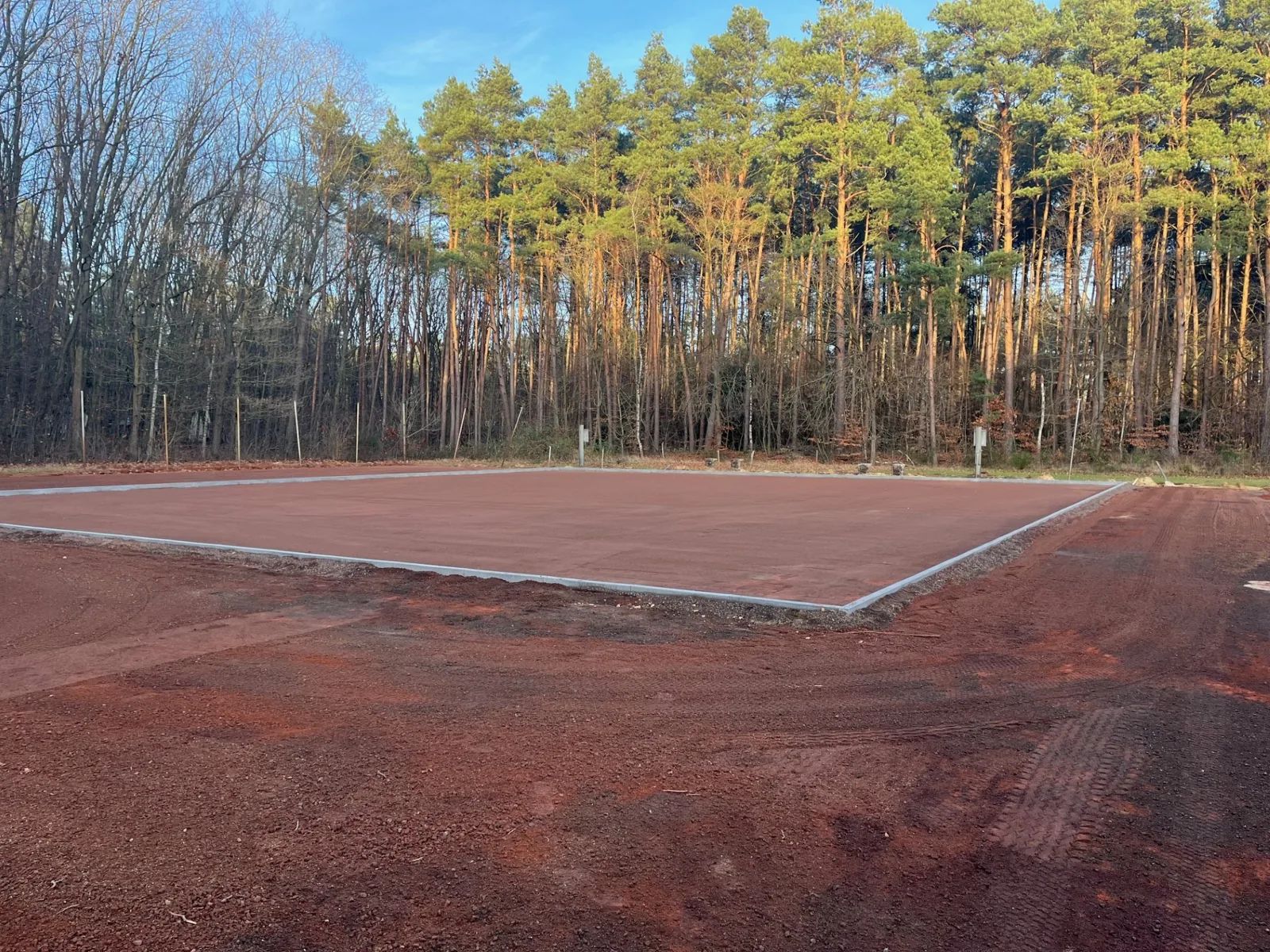
The foundation of an outdoor padel court is the load-bearing base layer on which the steel structure, the glass and the artificial turf are placed. It is the base that determines the stability and lifespan of the court. Without a properly constructed foundation, there is a risk of subsidence, tilting and damage to the structure above it.
For an outdoor court, the foundation has to meet higher requirements than for an indoor court. The base must withstand weather conditions such as frost, heat and prolonged rainfall. In addition, the foundation carries the full weight of the steel structure and glass walls, which quickly approaches five tonnes. At the same time, rainwater must be drained quickly and effectively, so that the court remains playable even after a downpour.
The foundation usually consists of two parts: the ring foundation and the sports surface. The ring foundation anchors the steel structure and absorbs wind load. The sports surface forms the level playing area on which the artificial turf is laid. Both parts are tailored to the specific location and soil conditions.
What types of foundation are there for an outdoor padel court?
Three foundation types are common for an outdoor padel court: drainage concrete, Supersub and ZOAB asphalt. Each type has its own technical properties, its own price range and suits different situations. The choice depends on the soil conditions, the use and the available budget.
Drainage concrete
Drainage concrete is a permeable type of concrete in which rainwater drains directly through the foundation into the soil. The open structure of the material prevents puddles and ensures that the court remains quickly playable even after heavy rainfall. Drainage concrete has a high load-bearing capacity, withstands frost and heat, and with correct use lasts an average of 25 to 40 years.
Supersub
Supersub is a foundation solution based on foam concrete. The material is lightweight, self-levelling and produces an extremely level surface. That is important for consistent ball bounce. Supersub is shock-absorbing, which reduces the strain on joints, and has a permeable variant for outdoor use. The material is fully recyclable and requires less transport and raw materials than traditional foundations.
ZOAB asphalt
ZOAB asphalt, also known as open-graded asphalt concrete, is a porous type of asphalt that lets water through. It is used less often for padel courts than drainage concrete or Supersub, but can be a good choice in certain situations, for example at locations with a specific subsoil or where asphalt is already present.
In addition to these three types, outdoor padel courts also use a ring foundation with steel reinforcement. This ring foundation anchors the steel structure and is needed to absorb wind load properly. The exact combination of foundation components is always determined on the basis of a site check and soil sounding data.
What does a foundation for an outdoor padel court cost on average?
Foundation costs for an outdoor padel court average between €20,000 and €40,000 per court. This is a guide price. The exact costs always depend on the soil conditions, the chosen foundation type, the accessibility of the location and any civil engineering work needed to make the base suitable.
For comparison: an outdoor padel court excluding foundation starts from around €30,000. A complete project, including foundation, steel structure, glass, artificial turf and LED lighting, therefore quickly comes to a guide price from around €50,000 per court. That is a considerable amount, but the foundation is simply the factor that determines the lifespan of the entire investment.
With existing tennis courts, part of the substructure can sometimes be reused. That can considerably reduce foundation costs. Whether reuse is possible depends on the condition and type of the existing base layer. This is always assessed on the basis of a site inspection.
What determines the price of a foundation per location?
The price of a foundation for a padel court is determined by five factors: the soil conditions, the foundation type, the civil engineering work required, the accessibility of the location and the wind load on site. No two locations are the same, which is why a fixed price cannot reliably be given without a site check.
- Soil conditions: poor load-bearing capacity or a high groundwater level calls for extra measures, such as soil improvement or a heavier foundation build-up. Soundings are used to determine what the soil can handle.
- Foundation type: drainage concrete, Supersub and ZOAB asphalt each have a different cost price. Supersub can in many cases be installed faster, which saves labour costs. Drainage concrete is a proven and durable option with a long lifespan.
- Civil engineering work: earthmoving, removal of existing material, levelling of the base and installing drainage cost extra time and money. The more groundwork is needed, the higher the total price.
- Accessibility: a location that is hard to reach for heavy equipment requires more logistical effort and increases costs.
- Wind load: locations in open areas, on the coast or near tall buildings face higher wind loads. This affects the ring foundation and the steel structure above it.
All these factors mean that a foundation quote is always tailor-made. A reliable supplier prepares the quote after a site check, not on the basis of a standard price.
What is the difference between drainage concrete and Supersub?
The main difference between drainage concrete and Supersub lies in the material and the way water is drained. Drainage concrete lets water run through the concrete layer directly into the soil via an open concrete structure. Supersub is based on foam concrete and has a permeable variant, but works via a different technical build-up in which the material itself is lighter and shock-absorbing.
In practice there are further differences that determine the choice:
- Weight and processing: Supersub is considerably lighter than traditional drainage concrete. As a result, it can in many cases be poured within a single day and requires less transport and equipment.
- Flatness: thanks to its self-levelling character, Supersub gives a very level surface. Drainage concrete also provides a level base, but requires more manual work when finishing.
- Shock absorption: Supersub has a resilient build-up that distributes forces better during play. This is more comfortable for players and reduces the strain on joints.
- Durability: drainage concrete lasts an average of 25 to 40 years. Supersub is hardly susceptible to subsidence or cracking and is fully recyclable.
- Noise: both materials have some sound-dampening effect thanks to their porous structure. This can be relevant at locations near residential areas.
Which type fits best depends on the soil conditions, the project type and the budget. When converting a tennis court into a padel court, for example, Supersub is often applied at a thickness of around 10 cm. For new builds this is usually around 15 cm. The exact thickness is always determined on the basis of a site check.
Does a foundation for padel have to be certified in the Netherlands?
Yes. In the Netherlands, all foundation components for a padel court must be approved by Kiwa ISA Sport. This is an independent inspection body that checks whether materials meet the applicable standards for sports surfaces. Without certified materials, the court does not meet the requirements for official use and competitive sport.
The certification applies to the entire sports surface, including the foundation and the artificial turf. For official use and matches, an inspection of the finished court is also mandatory, in accordance with the guidelines of NOC*NSF and Kiwa ISA Sport. Only after a successful inspection may the court be used for organised competition.
This is a point that inexperienced clients sometimes run into. Not all suppliers in the market work exclusively with certified materials, which can cause problems later at completion or inspection. It pays to always ask a supplier explicitly which materials are used and whether they are included on the sports products list of Kiwa ISA Sport.
In addition to the foundation, the steel structure must also meet structural standards in accordance with the Dutch Building Decree (Bouwbesluit). For outdoor padel courts, an environmental permit is mandatory in almost all cases. This requires, among other things, structural calculations, an acoustic study and a site plan.
How do you choose the right foundation for your padel court?
You choose the right foundation for an outdoor padel court on the basis of four factors: the soil conditions at the location, the chosen foundation type and the associated costs, the wind load on site and the desired playing comfort. Always start with a site check and soil sounding data. Without that information, a reliable choice cannot be made.
A few practical guidelines will help you on your way:
- Is the soil stable and well permeable? Then drainage concrete and Supersub are both good options. Drainage concrete is a proven choice with a long lifespan. Supersub is faster to install and shock-absorbing.
- Is it a conversion of an existing tennis court? First have it assessed whether the existing substructure can be reused. That saves costs. Supersub is often used for renovations because of the small thickness required.
- Is the location in an open area or on the coast? Then allow for higher wind load. This affects the ring foundation and the steel structure.
- Are there noise requirements from the municipality? Both drainage concrete and Supersub have some sound-dampening effect, but serious noise reduction requires additional measures.
Get advice from a party that knows all foundation types and has no interest in recommending a specific system. A good adviser looks at your location, your use and your budget, and makes a well-founded proposal on that basis. Want to know more about padel court foundations?
At I-Padel we always carry out a site check before we give foundation advice. That way you can be sure that the foundation suits the situation and that all materials meet the certification requirements of Kiwa ISA Sport. Get in touch for an initial exploration. We will then look at your location and the possibilities, without obligation.
Frequently asked questions
How long does it take to lay a foundation for an outdoor padel court?
The lead time for laying a foundation typically varies between 3 and 10 working days, depending on the foundation type, the scope of the civil engineering work and the weather conditions. Supersub has an advantage here: this material is self-levelling and can in many cases be poured within a single day, after which it cures quickly. Drainage concrete takes slightly more time for processing and finishing. Also allow for a curing time before the next construction phase can start.
Can I also build an outdoor padel court on an existing concrete or asphalt surface?
In some cases that is possible, but it always requires a thorough inspection of the existing base layer. The condition, flatness, load-bearing capacity and water drainage of the existing surface must meet the requirements for a padel court. An aged or damaged surface must first be repaired or removed before a new foundation can be laid. Always have this assessed by a specialist through a site check, so that you are not faced with unexpected extra costs.
What permits do I need before I can start building an outdoor padel court?
For almost all outdoor padel courts in the Netherlands, an environmental permit is mandatory. The application usually requires structural calculations, a site plan and an acoustic study. Depending on the municipality and the location, additional requirements may apply, such as a landscape integration plan or a traffic study. It is wise to start the permit procedure early in the process, because the lead time can vary greatly per municipality and construction may only begin once the permit has been granted.
What are the most common mistakes when laying a foundation for a padel court?
A common mistake is skipping a soil investigation (sounding), as a result of which the foundation is not matched to the actual soil conditions. This can later lead to subsidence or cracking. Another common mistake is choosing the cheapest supplier without checking whether the materials used are certified by Kiwa ISA Sport. Finally, clients regularly underestimate the impact of water drainage: a foundation with insufficient drainage causes puddles and limited playability after rain.
How do I maintain the foundation of an outdoor padel court after installation?
The foundation itself requires little active maintenance, provided it has been laid correctly. It is important, however, to check the drainage provisions regularly and keep them free of leaves, sand and other blockages, so that water drainage remains optimal. Inspect the foundation annually for cracks, subsidence or unevenness. Minor damage is easy to repair if it is spotted early; if you wait too long, small problems can grow into costly repairs.
Is an outdoor padel court also suitable for use in winter, and does that affect the foundation?
Yes, provided the foundation has been laid correctly for outdoor use. Both drainage concrete and Supersub are frost-resistant and withstand the temperature fluctuations that occur in the Netherlands. It is important, however, that the foundation is sufficiently permeable, so that no standing water forms that could freeze in frost and cause damage. In extreme frost it is recommended not to play on the court temporarily, to limit wear on the artificial turf and the structure.
Can I build several padel courts side by side on one shared foundation?
In principle it is possible to build several courts on a continuous foundation surface, which can offer economies of scale in the civil engineering work and material transport. Nevertheless, each court always gets its own ring foundation to anchor the steel structure separately and absorb wind load correctly. The exact set-up of a multi-court project is determined on the basis of the location, the distances between the courts and the local wind load requirements. Always have this worked out in an integrated project plan.


