


Building a padel court · 29 April 2026 · 10 min read
Is a soil investigation always needed for a padel court foundation?
Soil investigation for a padel court: when it is required, what it costs (€500–€2,000) and how to avoid expensive foundation mistakes. Read the full advice.
In this article
- What is a soil investigation and what is it for?
- Is a soil investigation always mandatory for a padel court?
- Which factors determine whether a soil investigation is needed?
- What are the consequences of a poor padel court foundation?
- Which foundation types are there for a padel court?
- How do you choose the right foundation without an expensive soil investigation?
- What does a soil investigation for a padel court cost?
- Frequently asked questions
A soil investigation is not always mandatory for a padel court foundation, but in many cases it is a sensible step. Whether you need one depends on the location, the ground conditions and the type of foundation you want to build. In this article we explain when a soil investigation makes sense, what the consequences of a poor foundation are and how to make the right choice for your situation.
What is a soil investigation and what is it for?
A soil investigation, also known as a cone penetration test (CPT) or ground investigation, maps the bearing capacity and composition of the soil. For a padel court foundation, it answers the question: can the ground carry the weight of the structure, the glass and the load from intensive use without settling?
In a cone penetration test, a measuring probe is pushed into the ground to measure how firm the various soil layers are. Based on this data, a structural engineer or foundation consultant draws up a foundation recommendation. That recommendation determines which type of foundation is suitable, how thick it needs to be and whether additional measures are required. Without this information, you are more or less building on guesswork.
A padel court is not a lightweight structure. The steel structure, the glass walls and the load from players and wind pressure together exert considerable force on the ground. A foundation that is not matched to the actual ground conditions can lead to tilting, cracking or instability over time.
Is a soil investigation always mandatory for a padel court?
No, a soil investigation is not always legally required for a padel court foundation. For indoor projects in an existing hall with a concrete floor, it is not needed in most cases. For outdoor padel courts it is generally strongly recommended, although the formal requirement depends on the municipality and the permit requirements.
For an environmental permit for an outdoor padel court, municipalities regularly ask for structural calculations. Those calculations can only be drawn up correctly if the ground conditions are known. In practice, this means that a cone penetration test is almost always needed for outdoor courts to complete the permit application.
Indoor locations are different. If the hall already has a solid concrete floor, an assessment of the existing floor is often sufficient. Only if there are doubts about the bearing capacity, or if new foundation work is required, is additional investigation worthwhile.
Which factors determine whether a soil investigation is needed?
Whether a soil investigation is needed for a padel court foundation depends on five factors: the location (indoor or outdoor), the ground conditions of the plot, the chosen foundation type, the requirements of the municipality and whether existing foundation data is already available.
In concrete terms, these are the situations in which a soil investigation is almost always advisable:
- Outdoor padel courts on undeveloped land or former sports fields
- Locations in peat areas, clay soil or other soft ground
- Projects that require an environmental permit
- Locations where subsidence has occurred before
- Projects with several courts side by side, where the load is greater
In areas with sandy soil, or at locations where cone penetration tests have recently been carried out for comparable projects, it can sometimes be skipped. A foundation consultant can quickly assess from the location whether existing data is sufficient or whether new investigation is needed.
What are the consequences of a poor padel court foundation?
Over time, a poor padel court foundation leads to subsidence, a tilting steel structure, damage to the glass and an uneven playing surface. These are not only costly problems to repair, but also safety risks for the players.
Subsidence occurs when the ground cannot cope with the load and slowly sinks. This pulls the structure with it, so that doors no longer close, glass starts to crack or the steel structure becomes distorted. An uneven playing surface also causes inconsistent ball bounce, which greatly reduces playing quality.
The cost of repairing foundation problems is considerably higher than the cost of good foundation advice up front. In the worst case, the entire court has to be demolished and rebuilt. A good foundation is therefore not just a technical choice, but also a financially sound decision for the long term.
Which foundation types are there for a padel court?
There are three commonly used options for a padel court foundation: drainage concrete, Supersub and ZOAB asphalt. Each type has its own technical properties and suits different situations. Besides these three, ring foundations and strong plastic plates are also used as an alternative to poured concrete.
Drainage concrete
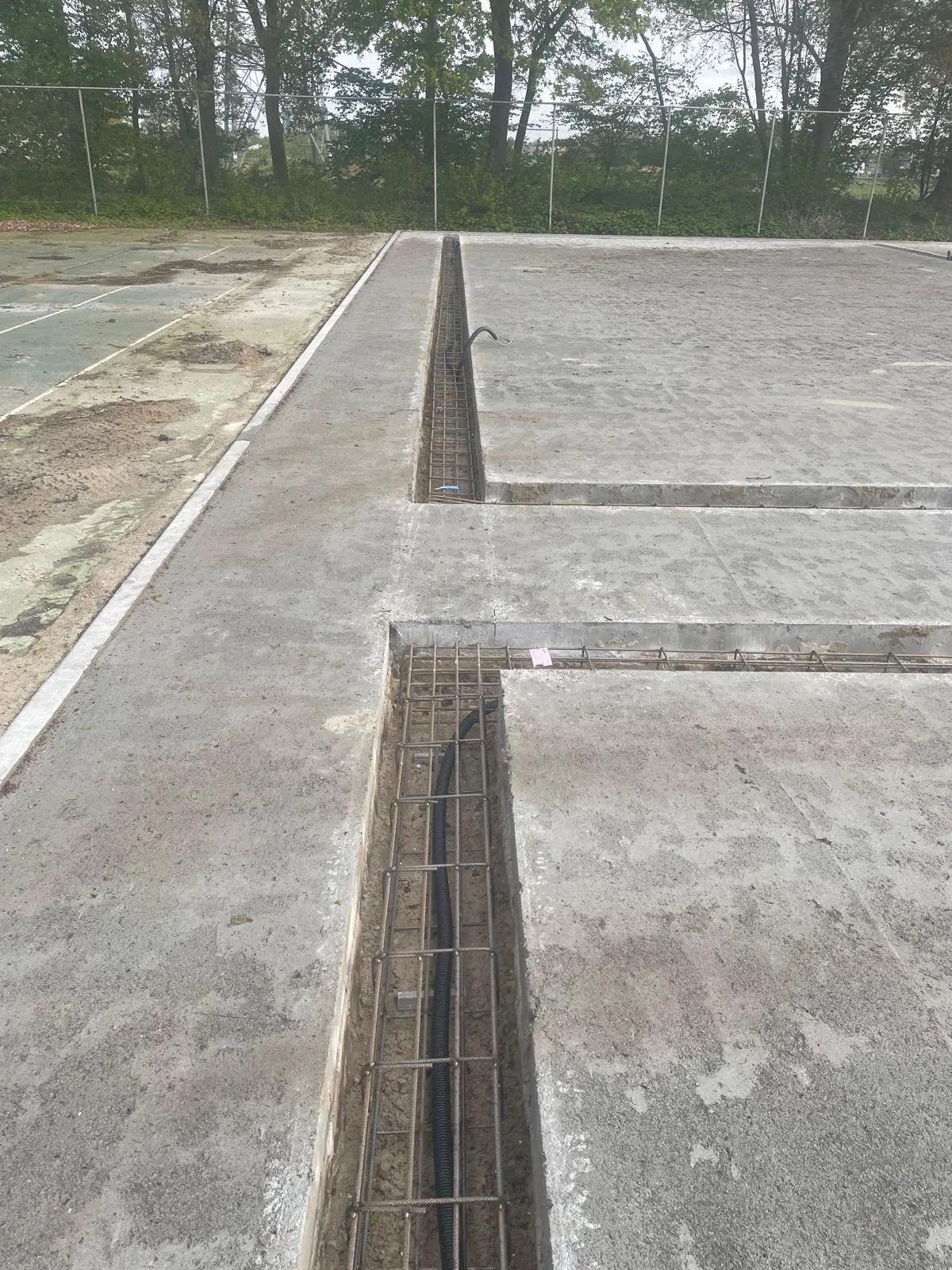
Drainage concrete is a water-permeable concrete floor in which rainwater drains straight through the foundation into the subsoil. It is one of the most widely used solutions for outdoor padel courts. The foundation has a high bearing capacity, lasts 25 to 40 years on average and requires little maintenance. Drainage concrete is often combined with a ring foundation to absorb the forces from the steel structure and wind load effectively.
Supersub
Supersub is a foundation solution based on foam concrete, a light, self-levelling type of concrete that produces an extremely flat surface. It is shock-absorbing, water-permeable (in the outdoor version) and fully recyclable. Thanks to its light weight and workability, Supersub can in many cases be poured within a single day. The thickness varies between 10 cm for renovations and 15 cm for new builds, depending on the ground conditions.
ZOAB asphalt
ZOAB asphalt, also known as porous asphalt concrete, is a porous type of asphalt that lets water through. It is used less often for padel courts than drainage concrete or Supersub, but it can be a good choice in certain situations, for example at locations where laying asphalt is logistically simpler.
Important to know: in the Netherlands, all foundation components must be approved by Kiwa ISA Sport. This is an independent certification body that checks whether materials meet the applicable sports-technical standards. Working with certified materials protects you as a client against unintended non-conformity during official inspections after completion.
How do you choose the right foundation without an expensive soil investigation?
You can choose the right foundation for a padel court without an extensive soil investigation if relevant data is already available, such as earlier cone penetration tests on the plot or known soil maps of the area. In those cases, a foundation consultant can draw up responsible advice based on that information.
In practical terms, these are the steps that help you make a good choice:
- Check whether cone penetration data is already available through the municipality or from an earlier building project on the plot
- Consult the soil map of the Netherlands, which gives general information about the soil composition per region
- Discuss the location with a foundation specialist who can make an assessment based on experience and site characteristics
- Choose the foundation type that suits the ground conditions, the intended use and the budget
If in doubt, a limited cone penetration test is quickly worth the effort. Its cost rarely outweighs the risks of choosing the wrong foundation. An adviser who knows all foundation types and can give independent advice gives you the most certainty.
What does a soil investigation for a padel court cost?
The cost of a soil investigation for a padel court foundation is typically between €500 and €2,000, depending on the number of test locations, the depth of the investigation and the accompanying foundation advice. For a single-court project, a limited investigation with two to four test locations is sufficient in most cases.
The exact cost depends on the size of the project and the complexity of the location. For a project with several courts or a hard-to-reach location, the investigation may be more extensive. Some foundation contractors include the cost of the soil investigation in their quotation for the total foundation work.
Always weigh the cost of a soil investigation against the total investment in the padel court. For an outdoor padel court where the foundation costs easily run between €20,000 and €40,000, a soil investigation of a few hundred euros is a small but valuable investment. It prevents you from building an expensive foundation that does not match the actual ground conditions.
At I-Padel, we guide the entire process from advice to completion, including the foundation choice based on your location. We work exclusively with certified materials approved by Kiwa ISA Sport and are happy to think along with you about the most suitable approach for your project. Take a look at our detailed information on padel court foundations or get in touch for an initial discussion.
Frequently asked questions
How long does a soil investigation for a padel court take and when should I schedule it?
A standard soil investigation with two to four test locations usually takes one day on site. The accompanying foundation advice is then typically available within one to two weeks. Schedule the investigation as early as possible in the process, preferably before you submit a permit application, so that the structural calculations can be based directly on the correct ground data.
Can I use an existing cone penetration test from a neighbouring plot for my padel court?
That is sometimes possible, but it depends heavily on how recent the test is, how close the neighbouring plot is to your location and whether the soil composition is comparable. In urban areas or on uniform sandy soils, a nearby test can be usable as a reference. A foundation consultant can assess whether the existing data is reliable enough, or whether additional test locations on your own plot are necessary.
What common mistakes are made with padel court foundations?
The most common mistake is choosing a foundation type on the basis of price or habit, without taking the specific ground conditions of the location into account. Other common mistakes include omitting a ring foundation for the steel structure, using non-certified materials and underestimating the drainage requirements. All of these mistakes can lead to subsidence, damage to glass and steel, and ultimately higher repair costs than if it had been done properly from the start.
Is a soil investigation also needed if I build a padel court on an existing sports field or car park?
Yes, even on an existing sports field or car park, a soil investigation is advisable in most cases. The existing paving says little about the bearing capacity of the underlying soil layers, especially if the field was previously used for other purposes. On former sports fields there may also be fill layers or organic material that negatively affect the stability of a new foundation.
Does the type of padel court (panoramic, classic or indoor) affect the foundation requirements?
Yes, the court type affects the foundation requirements. Panoramic courts with large glass walls catch more wind pressure than classic courts, which places higher demands on the ring foundation and the anchoring of the steel structure. Indoor courts on an existing concrete floor generally need less additional foundation work, provided the floor has sufficient bearing capacity. It is always wise to include the specific court type in the conversation with the foundation consultant.
What should I do if the ground turns out to be worse than expected during construction?
If soft layers, peat or other problematic soil types are unexpectedly encountered during construction, it is essential to involve the foundation consultant or contractor immediately and not to continue with the original plans. Possible adjustments include a deeper foundation, the use of piles, ground improvement or switching to a lighter foundation type such as Supersub. Intervening in good time prevents a foundation being built that causes problems later on.
How do I maintain my padel court foundation to maximise its lifespan?
A good foundation requires little active maintenance, but regular inspection is important. Check annually for cracks in the concrete surface, uneven subsidence or puddles that do not drain away, as the latter can indicate blocked drainage.
Also make sure the drainage around the court works properly and that no heavy machinery drives over the foundation. For drainage concrete or Supersub, cleaning the pores every two to three years is recommended to keep the water permeability at the right level.


