


Building a padel court · 22 August 2026 · 10 min read
Is a panoramic indoor padel court suitable for hosting tournaments?
A panoramic indoor padel court is tournament-ready if certified. Discover the requirements, the benefits and the costs from €23,000.
In this article
- What makes a padel court suitable for tournaments?
- What is the difference between a panoramic padel court and a standard court?
- Does a panoramic padel court meet the official tournament requirements?
- What benefits does a panoramic court offer when hosting tournaments?
- Are there any disadvantages of a panoramic court for tournament use?
- How does the foundation affect the tournament suitability of an indoor court?
- What does it cost to have an indoor panoramic padel court built?
- How I-Padel helps you realise a tournament-ready panoramic court
- Frequently asked questions
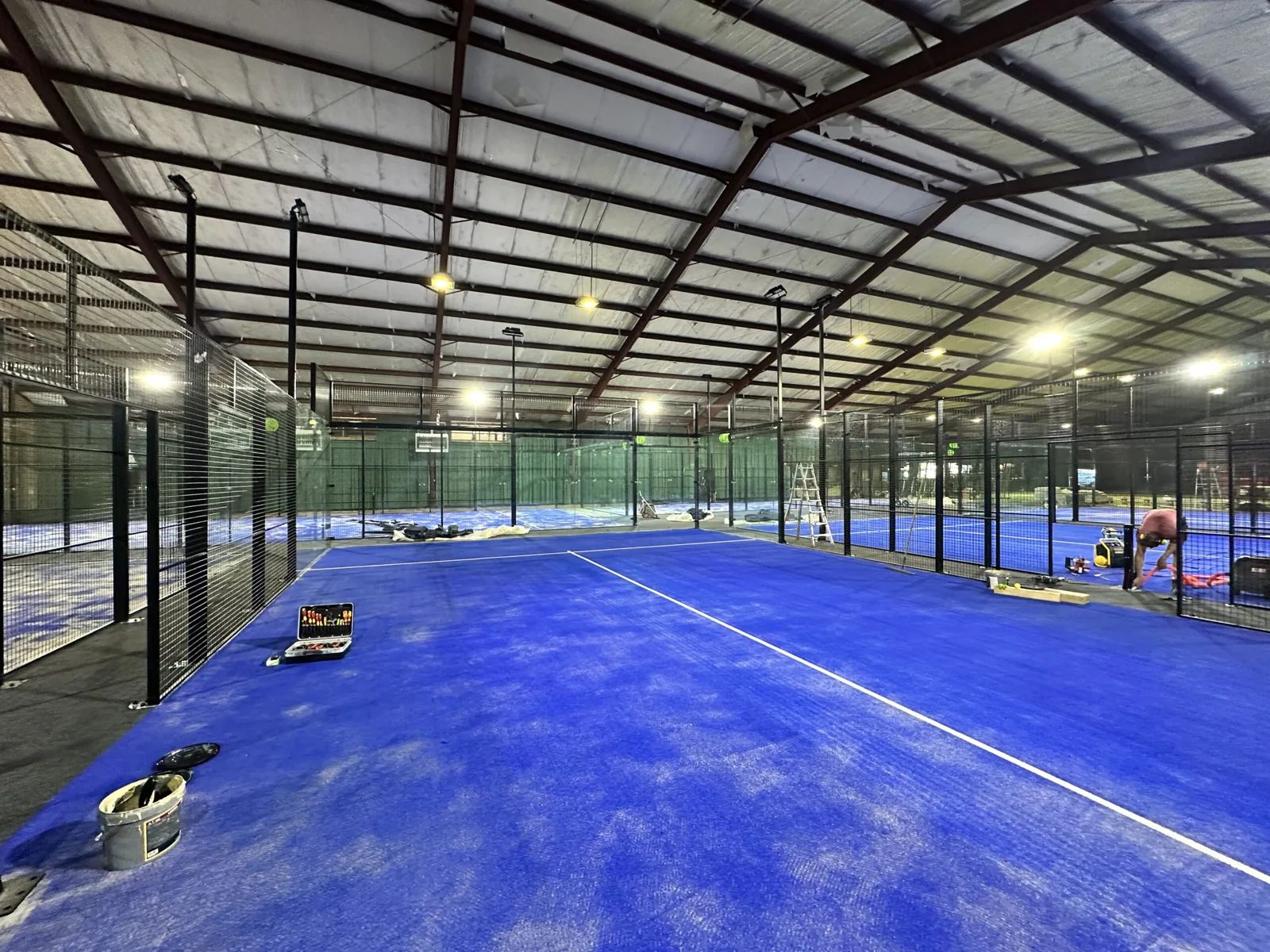
A panoramic indoor padel court is suitable for hosting tournaments, provided the court meets the official dimensions and structural requirements. The open design with larger glass surfaces makes panoramic courts popular with tournament organisers and spectators. Below we answer the most frequently asked questions about tournament suitability, construction and costs.
What makes a padel court suitable for tournaments?
A padel court is suitable for tournaments when it meets the official dimensions of 20 by 10 metres, contains certified materials and has been inspected by a recognised body such as Kiwa ISA Sport. In addition, playing quality, lighting and safety play a decisive role.
Specific requirements apply to official matches. The steel structure must be structurally calculated and stable. The artificial turf must meet the standards for professional use, with the right sand infill and line markings. The LED lighting must provide sufficient lux for match play, so that players and referees are not troubled by shadows or uneven lighting.
The clear height of the hall is also a factor. A minimum clear height of 6 metres is recommended. For professional tournaments, the higher the hall, the better the playing quality and the smaller the chance of balls hitting the ceiling.
What is the difference between a panoramic padel court and a standard court?
The main difference between a panoramic padel court and a standard Pro court lies in the amount of glass. A panoramic court has larger glass surfaces at the back and sometimes at the sides too, which makes the court look visually more open. A Pro court combines glass with mesh or metal grids on the top metres.
Despite the lighter, more transparent look, panoramic courts often use heavier materials to meet the structural requirements. More glass means more wind catchment and a different distribution of forces in the steel structure. The structure must be calculated for this, which generally makes the panoramic court slightly more expensive than a comparable Pro court.
For tournament use, the panoramic design offers a clear advantage: spectators have an unobstructed view of the game, which improves the experience and makes the venue more attractive for events and livestreams.
Does a panoramic padel court meet the official tournament requirements?
Yes, a panoramic padel court can fully meet the official tournament requirements, provided the court is built to the right dimensions, contains certified materials and has been inspected by Kiwa ISA Sport. The type of court, panoramic or Pro, is in itself no obstacle to tournament use.
Inspection by Kiwa ISA Sport is mandatory for official matches. During that inspection, a check is made that the structure is safe, the dimensions are correct, the artificial turf meets the standards and the lighting is adequate. Courts that are built with certified materials and correctly installed generally pass this inspection without problems.
It is important, however, that the steel structure is structurally calculated for the specific location. A panoramic court with large glass surfaces requires an accurate calculation of wind load and force distribution. When this has been done correctly, nothing stands in the way of tournament use.
What benefits does a panoramic court offer when hosting tournaments?
At tournaments, a panoramic indoor padel court offers several practical advantages over a standard Pro court. The open design enhances the experience for spectators, makes the court more attractive for camera coverage and gives the venue a professional look.
- Better view for spectators: large glass surfaces provide an unobstructed view from all corners of the hall.
- Attractive for livestreams and media: the transparent design makes it easier to capture good-quality footage.
- Professional look: panoramic courts are associated with higher quality and attract players and sponsors.
- More light penetration: at indoor venues with daylight or extra lighting, light spreads more evenly across the court.
- Higher occupancy value: a visually appealing court attracts more players and renters, also outside tournament periods.
Are there any disadvantages of a panoramic court for tournament use?
A panoramic padel court also has a few points of attention for tournament use. The larger glass surfaces raise the purchase price, place higher demands on the steel structure and call for good maintenance to keep the playing quality up to standard.
Glass that is dirty or damaged affects playability and the visual appearance of the venue. At tournaments, a well-maintained court is essential, both for the playing experience and for the impression the venue leaves on participants and visitors.
In addition, the structural calculation for a panoramic court is more complex than for a Pro court. More glass means less wind permeability, which calls for extra attention at outdoor venues or halls with large openings. This matters less at indoor venues, but the structure must always be calculated for the specific situation. A court that has not been structurally calculated for the location risks instability, which can be both dangerous and costly.
How does the foundation affect the tournament suitability of an indoor court?
The foundation of an indoor padel court determines the stability, the levelness of the playing surface and the service life of the court. An inadequate foundation leads to subsidence, tilting of the steel structure and irregular ball bounce, which directly undermines tournament suitability.
For indoor venues, the foundation is matched to the soil conditions and the use. Supersub, a foundation solution based on foam concrete, is also used in indoor applications. The material is extremely flat, shock-absorbing and ensures consistent ball bounce. The latter is essential at tournaments: players expect predictable playing behaviour, and an uneven surface disrupts that.
Drainage concrete is another widely used foundation solution, with an average service life of 25 to 40 years. At indoor venues water permeability is less relevant, but levelness and load-bearing capacity are decisive here too. All foundation materials used for padel courts must have been inspected by Kiwa ISA Sport. Working with certified materials is not only a quality requirement but also a condition for official tournament inspection.
What does it cost to have an indoor panoramic padel court built?
As an indication, an indoor padel court is possible turnkey from around €23,000 per court. For a panoramic court the price is generally slightly higher than for a standard Pro court, because of the heavier structural requirements and the larger glass surfaces.
The exact price always depends on several factors:
- The type of court and the specification (panoramic or Pro, with or without extra options).
- The number of courts (with several courts there are economies of scale in production and installation).
- The accessibility and logistics of the location.
- The choice of artificial turf and LED lighting (different quality levels).
- Any extras such as run-off zones or sound-absorbing panels.
A common mistake is looking only at the lowest price. In practice this often leads to higher costs in the long term through lower material quality, limited warranty or technical limitations. An overview of the costs of an indoor padel court helps you draw up a realistic budget and make the right comparison.
How I-Padel helps you realise a tournament-ready panoramic court
We produce the steel structure of every padel court entirely in our own factory. That means we can structurally calculate every court for the specific location, including the extra requirements that a panoramic design brings. Not an off-the-shelf solution from a catalogue, but a court that fits your hall and your use exactly.
What we offer for tournament-ready indoor panoramic courts:
- Structural calculation per location, tailored to dimensions, height and use.
- Complete turnkey package: steel structure, glass, artificial turf, LED lighting and installation.
- Certified materials that meet the requirements of Kiwa ISA Sport.
- 15-year warranty on the steel structure.
- One point of contact, one responsibility from design to handover.
- Sharp prices thanks to our own production, structurally below the Dutch market average.
Would you like to know what a panoramic indoor padel court costs for your location and what is needed to build it tournament-ready? Get in touch for an initial exploration, we are happy to help you think it through with no obligation.
Frequently asked questions
How long does it take to build an indoor panoramic padel court?
The construction time of an indoor panoramic padel court depends on the complexity of the location, the number of courts and the preparation time for the foundation. On average, once the foundation is finished, you can expect an installation time of a few days to two weeks per court. Good planning in advance, including structural calculation and material delivery, prevents unnecessary delays.
Which permits are needed for an indoor panoramic padel court?
For installing an indoor padel court inside an existing hall, an environmental permit is needed in many cases, depending on the municipality and the nature of the changes to the building. It is wise to check this in good time with your local municipality, so that the permit procedure does not delay the construction schedule. Your contractor or court developer can advise you on this based on the specific situation.
How often does an indoor panoramic padel court need maintenance to remain tournament-ready?
Regular maintenance is essential for tournament suitability. The artificial turf should be brushed periodically and the sand infill must be kept at the right level. The glass surfaces must be clean and undamaged, and the LED lighting should be checked regularly for failures or reduced light output. An annual professional inspection helps keep the court in optimal condition and prevents problems at a re-inspection by Kiwa ISA Sport.
Can an existing standard Pro court be converted into a panoramic court?
Converting a Pro court into a panoramic court is technically possible, but requires a thorough structural recalculation. The steel structure of a Pro court is not always suitable for absorbing the extra wind load and the weight of larger glass surfaces. In many cases, completely replacing the steel structure is more cost-efficient than a partial conversion. Always have this assessed by a specialist before you make a decision.
What is the minimum hall size needed for an indoor panoramic padel court?
An official padel court measures 20 by 10 metres, but the hall must be larger to provide sufficient run-off space, safety margins and accessibility. Around the court, at least 2 to 3 metres of free space is generally kept. The minimum clear height is 6 metres, but for tournament use 7 to 8 metres is recommended. With several courts, also allow sufficient space in between for players and spectators.
How do I choose the right LED lighting for a tournament-ready padel court?
For tournament use, a minimum illuminance of 500 lux on the playing surface applies, where uniformity of the light is at least as important as the total light output. Choose LED lighting developed specifically for sports facilities, with a high colour rendering index (CRI) and minimal glare for players. Have the lighting calculation carried out by a specialist and check that the chosen fittings meet the requirements of Kiwa ISA Sport for official matches.
What are the most common mistakes when planning an indoor panoramic padel court for tournament use?
The most common mistakes are: choosing the cheapest supplier without paying attention to material quality and certification, insufficient attention to the foundation and structural calculation, and reserving too little space around the court for run-off zones and spectators. The Kiwa ISA Sport inspection is also sometimes overlooked, even though it is mandatory for official tournaments. An integrated approach in which all parts of the court are planned as a whole avoids most of these pitfalls.


