


Building a padel court · 17 July 2026 · 10 min read
How to prevent glare for players on an indoor padel court
Prevent glare on your indoor padel court: learn about the right lux values, UGR standards and fitting placement. Make smart lighting choices for a new build or renovation.
In this article
- Which light sources cause glare on an indoor padel court?
- What is the recommended lux value for an indoor padel court?
- How does the placement of LED fittings prevent glare?
- Which LED fittings are most suitable for padel courts?
- Does the glass structure play a role in glare on an indoor padel court?
- What are the most common mistakes in the lighting of an indoor padel court?
- How I-Padel helps with lighting on an indoor padel court
- Frequently asked questions
You prevent glare for players on an indoor padel court first and foremost by placing the LED lighting at the right height and at the right angle, outside the players' direct field of view. The lux value, the type of fitting and the reflective properties of the glass also play an important role. In this article we answer the most frequently asked questions about lighting and glare on an indoor padel court, so that you make the right choices in a new-build project or renovation.
Which light sources cause glare on an indoor padel court?
On an indoor padel court there are two main causes of glare: direct light from poorly placed fittings and indirect light reflected via glass walls. Both forms disturb the players' view of the ball, which not only reduces enjoyment of the game but also brings safety risks.
Direct glare occurs when fittings hang too low or are mounted at an angle that falls straight into the players' field of view. This is most disruptive with high balls and smashes, when players look up. Indirect light is more subtle but at least as annoying: glass walls reflect light beams back onto the playing area, especially when fittings are positioned close to the glass or have a wide beam angle.
A third factor that is often underestimated is the contrast between lit and unlit zones. When the lighting is unevenly distributed, players' eyes have to adapt constantly to changing light levels. This tires the eyes and increases the likelihood of glare effects.
What is the recommended lux value for an indoor padel court?
For a recreational indoor padel court, the recommended illuminance is at least 300 to 500 lux, measured at floor level. For competition level the standard is higher: official tournaments require at least 500 lux, and for television broadcasts even stricter requirements of 750 lux or more apply.
Lux is a measure of the amount of light that falls on a surface. A lux value that is too low makes it hard to follow the ball, while a value that is too high, without a good choice of fitting, can cause glare. So it is not only about the amount of light, but also about its uniformity across the entire playing area.
A good rule of thumb is that the illuminance at any point on the court may not deviate more than 30 percent from the average. This prevents the dark corners and bright spots that players find disturbing. When designing an indoor padel court, it is wise to have a lighting plan drawn up in which the lux distribution is calculated per zone.
How does the placement of LED fittings prevent glare?
Glare from LED lighting on an indoor padel court is prevented first and foremost by placing fittings outside the players' field of view. In concrete terms, this means: mounting fittings at the sides of the court rather than above the centre, and directing the light beam downwards with a limited beam angle.
The most effective approach combines three principles:
- High mounting position: fittings are preferably mounted at a height of at least 6 metres, so that they fall well outside the normal field of view. The minimum clear height for a padel hall is 6 metres, which is also the lower limit for a good lighting solution.
- Asymmetric light beam: fittings with an asymmetric distribution pattern light the court in a targeted way, without wasting light towards the players' eyes or the ceiling.
- Side mounting: by placing fittings along the long sides of the court instead of directly above the playing area, the risk of direct glare with high balls is greatly reduced.
The distance to the glass is also relevant. Fittings that hang too close to the glass walls cause reflections that are perceived as glare. A minimum distance of 50 to 80 centimetres from the glass is recommended, depending on the type of fitting and the beam angle.
Which LED fittings are most suitable for padel courts?
The most suitable LED fittings for an indoor padel court are sports-field-specific fittings with a high IP rating, a low UGR value (Unified Glare Rating) and an asymmetric light pattern. This combination provides sufficient illuminance without glare.
When selecting fittings, the following technical characteristics are decisive:
- UGR value: the UGR indicates how glaring a fitting is. For sports fields a maximum UGR of 22 applies. The lower the value, the less glare. Fittings with a UGR below 19 are ideal for intensive use.
- IP rating: for indoor padel courts an IP65 rating is recommended. This protects the fitting against dust and splashing water, which greatly extends its lifespan.
- Colour temperature: a colour temperature of 4000 to 5000 Kelvin (neutral to cool white) is optimal for sports fields. This improves contrast and the visibility of the ball.
- Light efficiency: choose fittings with a high lumens-per-watt efficiency to keep energy costs low without compromising lighting quality.
Fittings designed specifically for padel and tennis generally deliver better results than generic industrial lighting, because they are optimised for the specific height-to-width ratio of a playing area.
Does the glass structure play a role in glare on an indoor padel court?
Yes, the glass structure plays a direct role in glare on an indoor padel court. Glass reflects light, and depending on the angle of the fittings and the position of the players, this reflected light can be perceived as disturbing or glaring. Laminated or tempered glass with a low reflection coefficient reduces this effect.
Standard padel courts use tempered safety glass that is 10 to 12 millimetres thick. This glass naturally has a certain degree of reflection. A good lighting design takes this into account by positioning the fittings so that the light beam does not fall directly on the glass at an angle that bounces back towards the playing area.
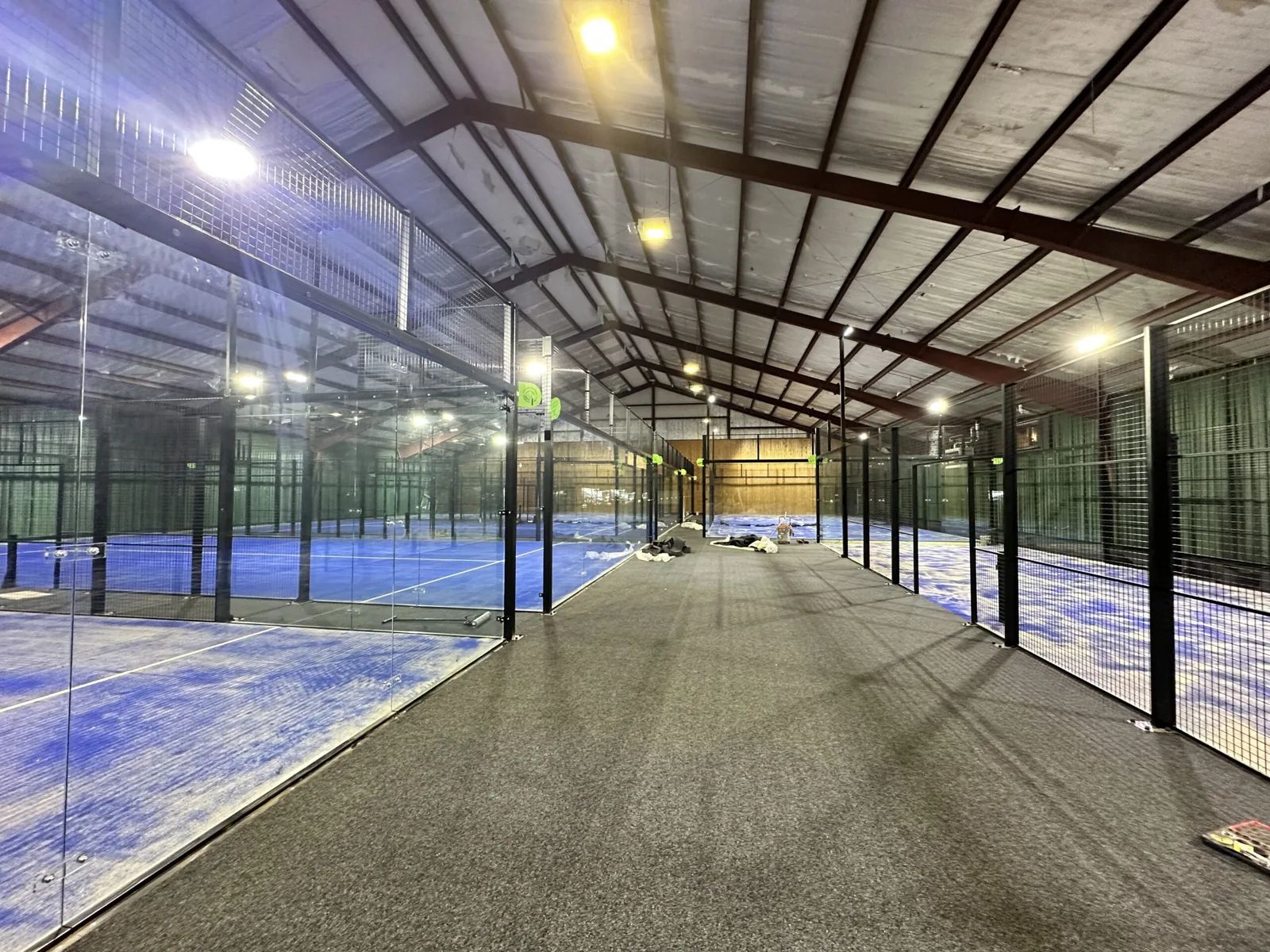
A practical point of attention is the back glass wall. Players regularly look towards the back wall while playing, and if fittings on the opposite side of the court reflect via this glass, a glare effect arises that is hard to avoid without adjusting the fitting position. This is a reason to regard lighting design and glass placement as a whole, not as two separate parts of a construction project.
What are the most common mistakes in the lighting of an indoor padel court?
The most common mistakes in the lighting of an indoor padel court are the use of generic industrial lighting, mounting fittings too low or too centrally above the playing area, and the lack of a lux calculation in advance. These mistakes almost always lead to glare, uneven lighting or high energy costs.
An overview of the most common mistakes:
- No tailor-made lighting plan: many clients choose fittings based on price or availability, without a calculation of the lux distribution per zone. The result is a court with dark corners and bright spots.
- Fittings mounted too low: in halls with a clear height of exactly 6 metres, the temptation is great to hang fittings lower for more light output. However, this considerably increases the risk of direct glare.
- Not taking glass reflection into account: the position of the fittings is determined without analysing how light is reflected via the glass walls. This is one of the most underestimated causes of glare.
- Wrong colour temperature: warm lighting (below 3000 Kelvin) reduces contrast and makes it harder to follow the ball, especially during fast exchanges.
- No dimming function: a court without dimmable lighting cannot be adjusted to the intensity of use, which leads to unnecessarily high energy costs and wear on the fittings.
Good preparation, including a professional lighting plan, prevents all these mistakes. The cost of a good design is far outweighed by the cost of reinstalling afterwards. Want to know more about the total investment? Then also read our information on the cost of an indoor padel court.
How I-Padel helps with lighting on an indoor padel court
At I-Padel we supply and install LED lighting as part of our complete package for indoor padel courts. We work with sports-field-specific fittings that are matched to the dimensions and height of a padel court, and when placing them we take glass reflection and the players' viewing angles into account.
What we concretely do:
- We draw up a lighting plan per location, including a lux calculation per zone.
- We select fittings with the right UGR value, IP rating and colour temperature for your specific hall.
- We mount the fittings in the optimal position, tailored to the glass structure and the height of the hall.
- We supply the complete installation as part of the turnkey package, so you can play straight after completion.
Whether you are fitting out a new hall or want to improve an existing venue, we are happy to think along with you, without obligation. Get in touch for an initial exploration of the possibilities.
Frequently asked questions
How many fittings do I need for a standard indoor padel court?
The number of fittings needed depends on the wattage, the light efficiency (lumens per watt) and the mounting height. For a standard padel court of 10 by 20 metres, 6 to 10 sports-field-specific LED fittings are usually sufficient to achieve uniform lighting of 300 to 500 lux. A professional lighting plan with a lux calculation per zone gives the most accurate indication for your specific hall and choice of fitting.
Can I adapt the existing lighting on my padel court to reduce glare, or do I have to replace everything?
In many cases a complete replacement is not necessary. Sometimes repositioning existing fittings, adding shields or adjusting the beam angle is enough to reduce glare significantly. However, if the current fittings have a UGR value that is too high or are not suitable for sports fields, replacing them with sports-field-specific LED fittings is the most effective and durable solution.
What is the difference between UGR 19 and UGR 22, and do I really notice it as a player?
Yes, the difference is noticeable in practice, especially during intensive play in which players frequently look up. UGR 22 is the maximum permitted value for sports fields, but at this value players can still experience discomfort during smashes or high balls. Fittings with UGR 19 or lower provide a considerably more comfortable playing experience and are particularly recommended for courts that are used intensively for several hours a day.
Is dimmable lighting on a padel court really worth it, and what does it deliver?
Dimmable lighting is definitely worth it, both financially and practically. By adjusting the light intensity to the use, for example lower during training and higher during matches, you structurally save on energy costs and extend the lifespan of the fittings. Modern LED systems with a DALI or 0-10V dimming function are easy to integrate and pay for themselves through lower energy bills, usually within two to four years.
Does the colour of the floor or walls affect lighting and glare?
Yes, the reflectance of floor and wall materials influences the distribution of light in the hall. A light floor colour reflects more light and contributes to higher uniformity, but with incorrect fitting placement it can also contribute to indirect glare. When drawing up a lighting plan, the reflective properties of all surfaces (floor, walls and glass) are included in the lux calculation for an optimal result.
Are there official standards or certifications that the lighting of an indoor padel court must meet?
For recreational padel courts there are no legally mandatory certifications, but the international sports bodies do apply guidelines. The World Padel Tour and the International Padel Federation (FIP) set requirements for illuminance, uniformity and glare limitation for official matches. For courts that want to organise tournaments, it is wise to have the lighting design tested against these guidelines, so that the court can also be certified for competitive use.
How long do LED fittings last on an intensively used padel court, and when should I replace them?
Good-quality sports-field LED fittings have an average lifespan of 50,000 to 100,000 burning hours, which at daily use of 8 hours amounts to 17 to 34 years. In practice, replacement is needed sooner when the light output drops noticeably, usually after 70 percent of the nominal lifespan, also known as L70. Regular maintenance and keeping the fittings clean extends their lifespan and keeps the lux values up to standard.


