


Building a padel court · 19 August 2026 · 11 min read
How thick should the foundation be for a padel court?
Padel court foundation: 10-15 cm of Supersub or drainage concrete? Discover the right thickness, foundation types and costs for your location.
In this article
- Why is the foundation of a padel court so important?
- How thick should the foundation of a padel court be?
- Which foundation types are there for a padel court?
- What is the difference between drainage concrete and Supersub for a padel court?
- Which foundation is suitable for an outdoor court versus an indoor court?
- What are the costs of the foundation for a padel court?
- Which certifications must the foundation of a padel court have?
- Frequently asked questions
The foundation of a padel court is not a detail, it is the basis on which everything stands or falls. Literally. Anyone who pays too little attention to the thickness and type of foundation risks subsidence, tilting and damage to the steel structure.
The right thickness depends on the foundation type, the soil conditions and whether the court will be indoors or outdoors. As a general guideline, with Supersub you can count on 10 to 15 cm, and with drainage concrete on a comparable layer thickness, but always on the basis of site-specific advice.
In this article we answer the most frequently asked questions about the foundation of a padel court, from the basic principles to the choice between foundation types and the associated costs. That way you know exactly what to look out for before you make a decision.
Why is the foundation of a padel court so important?
The foundation of a padel court determines the stability, service life and playing quality of the court. A faulty foundation leads to subsidence, an uneven surface and ultimately damage to the steel structure and the artificial turf. A properly built foundation keeps the court level, stable and playable for decades.
A padel court is not a light structure. The steel structure, including glass walls, carries considerable weight. Drainage concrete as a foundation type, for example, is certified for loads of up to approximately 5 tonnes. On top of that comes the wind load on the cage structure, which loads the foundation laterally. Without a foundation calculated for those forces, problems arise over time that are much more expensive to repair than to prevent.
The soil conditions play a major role here. Soft or weak ground requires a different approach from a firm, well-bearing base. That is why a site check is carried out on every project and probing data is used as the basis for the foundation advice. A foundation that works well elsewhere is not necessarily the best choice at your location.
How thick should the foundation of a padel court be?
The thickness of the foundation for a padel court depends on the chosen foundation type and the situation on site. For Supersub the guideline is approximately 10 cm when renovating an existing sports court and approximately 15 cm for new construction. For drainage concrete and ZOAB asphalt, the exact layer thickness is determined on the basis of soil conditions, use and wind load.
There is no universal standard for the foundation thickness of a padel court. The Dutch standards for sports floors, as laid down in the quality assurance system of Sportinfrastructuur (part of NOC*NSF), prescribe that the layer thickness of the foundation is measured and reported at certification. This applies to both bitumen-bound and cement-bound foundations. A foundation that is too thin does not meet the requirements and is rejected at inspection.
What are the consequences of a foundation that is too thin?
A foundation that is too thin offers insufficient load-bearing capacity for the steel structure and the glass walls. Under the load of the court and wind forces, the foundation can crack or subside over time. This leads to an uneven playing surface, which not only reduces playing quality but also poses a safety risk. In addition, a foundation that is too thin does not meet the certification requirements for official use.
Which foundation types are there for a padel court?
There are three commonly used foundation types for padel courts: drainage concrete, Supersub and ZOAB asphalt. Each type has its own technical properties, its own field of application and its own price level. Besides these three, ring foundations and strong plastic plates are also used as an alternative to poured concrete.
- Drainage concrete is a water-permeable type of concrete in which rainwater drains straight through the foundation into the ground. It has a high load-bearing capacity and an average service life of 25 to 40 years.
- Supersub is a foundation solution based on foam concrete. It is light, self-levelling and shock-absorbing. The material is fully recyclable and requires less transport than traditional foundations.
- ZOAB asphalt (open asphalt concrete) is a porous asphalt variant that lets water through. It is used less often for padel courts, but can be a good choice in specific situations.
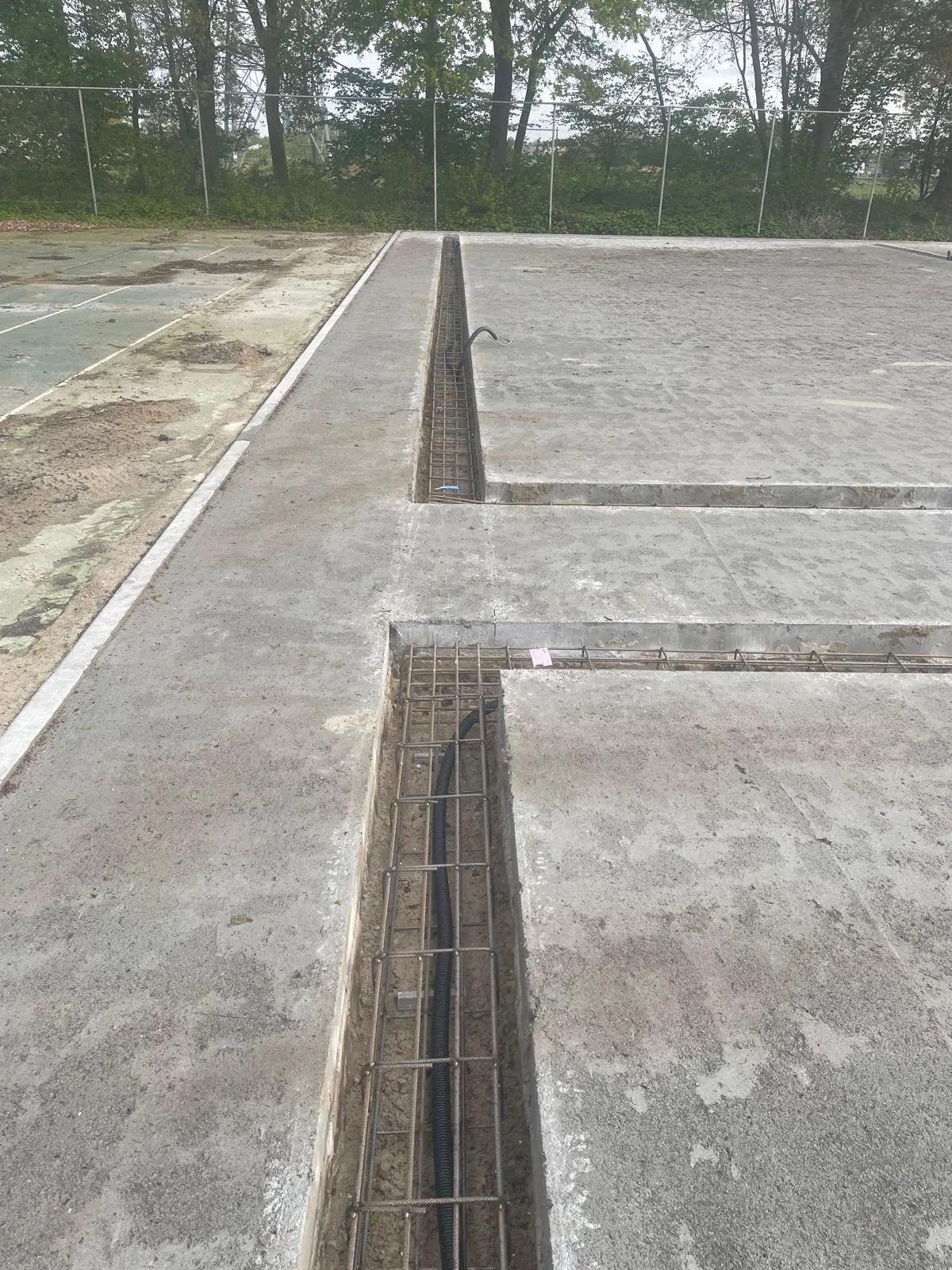
- Ring foundation is often combined with one of the sports floor solutions above. The ring foundation absorbs the forces from the steel structure and the wind load.
The choice of foundation type is always tailor-made. Factors such as soil conditions, location (indoor or outdoor), available budget and the desired service life determine which type is most suitable.
What is the difference between drainage concrete and Supersub for a padel court?
The main difference between drainage concrete and Supersub is the material composition and the installation process. Drainage concrete is an open concrete construction with a high load-bearing capacity and a proven service life of 25 to 40 years. Supersub is a lighter foam concrete product that can be applied faster, in many cases within one day, and also has a shock-absorbing effect.
Both types are water-permeable in their outdoor version and provide a level, stable playing surface. Where drainage concrete scores mainly on load-bearing capacity and long-term durability, Supersub offers advantages in installation speed, weight and sustainability in the sense of lower CO₂ emissions during production and transport.
In practice, drainage concrete is often combined with a ring foundation with steel reinforcement, to absorb the forces from the steel structure and wind load properly. Supersub is popular for renovation projects, such as the conversion of a tennis court into a padel court, because the layer thickness of approximately 10 cm requires less invasive civil works.
Another difference is indoor application. Supersub is also supplied in a non-water-permeable version, tailored to the indoor environment. Drainage concrete is primarily an outdoor solution. For indoor padel courts different foundation requirements apply, because water drainage through the foundation itself is not needed there.
Which foundation is suitable for an outdoor court versus an indoor court?
For an outdoor court, a water-permeable foundation such as drainage concrete or the outdoor version of Supersub is the obvious choice. For an indoor court a different logic applies: water drainage through the foundation is not needed and the focus is on a level, stable and shock-absorbing surface. Supersub in the non-water-permeable version or an existing concrete floor with the right properties are then suitable options.
On outdoor courts, wind load plays a bigger role. The foundation must absorb the forces that the wind exerts on the cage structure. This makes the ring foundation almost always part of the total foundation build-up on outdoor courts. The soil conditions at the location then determine how heavy that ring foundation must be.
On indoor courts, an existing concrete floor is often used as the base. In that case the question is not so much which foundation type you choose, but whether the existing floor is sufficiently level and load-bearing. A levelness requirement of less than 3 mm per 3 metres is the starting point for good-quality ball bounce and a safe playing surface.
What are the costs of the foundation for a padel court?
The foundation costs for a padel court average between €20,000 and €40,000 per court for outdoor projects. This depends heavily on the soil conditions, the accessibility of the location and the civil works required. For indoor courts the foundation costs are generally lower, because an existing floor can often be used.
For existing tennis courts, part of the substructure can sometimes be reused. This saves costs, but always requires an assessment of the current condition of the foundation. Reusing a poor or worn substructure is not a saving, it is a risk that later translates into higher repair costs.
It is wise to always have the foundation costs budgeted separately. For outdoor padel courts they are a significant cost item that varies strongly per location. An indicative price for a complete outdoor project, including foundation, starts from approximately €50,000 per court, but the exact price always depends on the specific situation.
Which certifications must the foundation of a padel court have?
In the Netherlands, all foundation components for padel courts must be inspected by Kiwa ISA Sport. This is a recognised inspection body that assesses sports floors and foundations on sports-technical and material-technical properties. Working with non-certified materials is not permitted and leads to rejection of the court at inspection.
The certification requirements for padel courts are laid down in the quality assurance system of Sportinfrastructuur, part of NOC*NSF. This system prescribes that both the sports floor and the foundation meet measurable requirements for levelness, elevation, layer thickness and structural properties. From 2025, tightened requirements apply to renovation and new-build projects.
For official matches, inspection of the completed court by Kiwa ISA Sport is mandatory. This means the foundation must not only be built correctly, but must also demonstrably meet the applicable standards. Anyone who works with non-certified materials or with a contractor who is unaware of these requirements risks the court not being approved for official use.
If you have a padel court built, it is wise to check beforehand that the contractor works exclusively with certified materials and is aware of the current certification requirements. This protects you as a client against unintended non-conformity and the extra costs that come with it.
Would you like to know which foundation best suits your location and project? At I-Padel we guide you from start to finish in realising the right padel court foundation, including site-specific foundation advice based on probing data. We are happy to help you think through the best approach for your situation, with no obligation.
Frequently asked questions
How long does it take to build a foundation for a padel court?
The lead time for building a foundation varies by foundation type and site conditions. Supersub can in many cases be applied within one day, while drainage concrete requires more preparation and curing time. For a complete outdoor project including civil works, such as groundwork and drainage, allow on average one to two weeks of execution time before the steel structure can be placed.
Can I use an existing concrete floor as the foundation for an indoor court?
That is possible, but only if the existing floor meets the applicable levelness and load-bearing requirements. The levelness requirement is less than 3 mm per 3 metres, and the floor must be structurally sound with no cracks or subsidence. Always have the existing floor professionally assessed before deciding to reuse it; an unsuitable subfloor leads over time to playing problems and possibly to rejection at certification.
What are the most common mistakes when building a padel court foundation?
The most common mistakes are: applying too thin a layer without site-specific advice, working with non-certified materials, and skipping or underestimating the ring foundation on outdoor courts. Reusing a worn substructure in renovation projects without prior inspection is also a common and costly mistake. All these mistakes can lead to rejection of the court at the mandatory Kiwa ISA Sport inspection.
Is a padel court foundation also suitable for use in winter?
Water-permeable foundations such as drainage concrete and the outdoor version of Supersub are designed for use in all seasons, including winter. Thanks to the open structure, rainwater is drained quickly and there is less risk of frost damage from water accumulating in the foundation. It is important, however, that the foundation has been built correctly and meets the set requirements; a faulty foundation is particularly vulnerable to the alternating load of frost and thaw.
What happens if the soil conditions at my location are poor?
With soft or poor soil conditions, additional measures are needed, such as a heavier ring foundation, a greater layer thickness or ground improvement before construction. Probing data is used to determine which approach is needed for your specific location. This can increase the costs, but it is absolutely necessary to prevent subsidence and damage to the steel structure in the long term.
How do I know whether a contractor works with certified foundation materials?
Ask the contractor explicitly for the certificates of the foundation materials being used, and check that they have been approved by Kiwa ISA Sport. A reliable contractor can provide you with the relevant certification documents without difficulty and is aware of the current requirements from the quality assurance system of Sportinfrastructuur (NOC*NSF). If a contractor is vague about this or cannot provide documentation, that is a clear warning sign.
Can I limit the foundation costs by having the groundwork done myself?
In theory it is possible to have the groundwork carried out by your own contractor, but this carries risks. The groundwork must be carried out accurately and meet the specifications set by the foundation contractor; deviations in height, levelness or load-bearing capacity of the base directly affect the quality of the foundation. It is wise to coordinate this well in advance and to make written agreements about responsibilities, so that in the event of problems you do not fall between two parties.


