


Building a padel court · 18 August 2026 · 11 min read
How does your choice of artificial turf affect padel court wear?
Artificial turf determines how long a padel court lasts. Discover which quality, fibres and maintenance limit wear and save costs.
In this article
- Which types of artificial turf are used on padel courts?
- How does the quality of artificial turf affect the lifespan of a padel court?
- Which factors accelerate the wear of padel artificial turf?
- What is the difference between indoor and outdoor artificial turf for padel?
- How often does artificial turf on a padel court need to be replaced?
- Which maintenance extends the lifespan of padel artificial turf?
- How do you choose the right artificial turf for a new padel court?
- How I-Padel helps with choosing and installing artificial turf
- Frequently asked questions
Your choice of artificial turf has a direct impact on the wear of a padel court. Higher-quality artificial turf wears more slowly, keeps a consistent ball bounce for longer and needs maintenance less often. For anyone planning to build a padel court, choosing the right artificial turf is therefore one of the most decisive decisions for the court's total lifespan. Below, we answer the most common questions about artificial turf and wear.
Which types of artificial turf are used on padel courts?
Padel courts almost exclusively use short-pile artificial turf filled with quartz sand. The fibre is usually made of polyethylene (PE) or polypropylene (PP), with PE fibres feeling softer and wearing down less quickly. The pile height is typically between 10 and 13 millimetres, which provides the right ball bounce and enough grip for players.
Within that category, there are clear differences in quality. The fibre density, the thickness of the fibres and the way they are anchored in the backing largely determine how long the turf lasts. Cheaper artificial turf often has thinner fibres that flatten more quickly, whereas high-quality artificial turf keeps its structure for years. The quality of the backing also plays a role: a sturdy, water-resistant backing prevents the fibres from coming loose under intensive use or on outdoor courts exposed to rain.
How does the quality of artificial turf affect the lifespan of a padel court?
Higher-quality artificial turf extends the lifespan of a padel court considerably. High-grade fibres keep their resilience for longer, so the ball bounce stays consistent and the playing surface feels professional. With lower-quality artificial turf, the fibres flatten more quickly, the sand infill loses its even distribution and playing quality noticeably deteriorates within a few years.
This also affects the total investment. Cheap artificial turf that has to be replaced after four years costs more in the long run than quality turf that lasts eight to ten years. Especially at commercial venues or tennis clubs with a high occupancy rate, choosing quality artificial turf directly saves on replacement costs and downtime.
In addition, the quality of the artificial turf influences player safety. Worn or uneven artificial turf increases the risk of tripping and injury. Good quality therefore contributes not only to playing enjoyment, but also to the operator's liability position.
Which factors accelerate the wear of padel artificial turf?
Intensive use is the main factor that accelerates the wear of artificial turf on a padel court. The more hours a day a court is played on, the faster the fibres flatten and the sand infill shifts. But besides the intensity of use, other factors also play a role.
- Insufficient maintenance: Artificial turf that is not brushed regularly loses its resilience more quickly. The sand clumps together and the fibres stay flat.
- Exposure to UV radiation: On outdoor courts, sunlight gradually degrades the fibres. Artificial turf without UV stabilisers ages faster and becomes more brittle.
- Moisture and temperature fluctuations: Freezing and thawing on outdoor courts can damage the backing if drainage is not properly arranged.
- Wrong footwear: Players wearing unsuitable shoes, such as studded football boots, damage the fibres and the backing faster than padel or tennis shoes do.
- Poor foundation: An uneven or subsided base causes localised overloading of the artificial turf, leading to faster local wear.
What is the difference between indoor and outdoor artificial turf for padel?
Indoor and outdoor artificial turf for padel courts differ mainly in their resistance to outdoor conditions. Outdoor artificial turf contains UV stabilisers that protect the fibres against discolouration and ageing caused by sunlight. In addition, the backing of outdoor artificial turf is generally more water-resistant and better able to withstand temperature fluctuations.
Indoor artificial turf does not have to meet those requirements, but it does have to perform well under artificial light and at a constant temperature. In practice, indoor artificial turf often has a slightly softer fibre, which contributes to a pleasant playing feel on hard floors. Using outdoor artificial turf indoors is technically possible, but not optimal: the UV stabilisers are superfluous and the fibres are sometimes a little stiffer than necessary.
For indoor padel courts, the base is also less variable than outdoors, which means the artificial turf has to withstand less moisture and frost. That generally makes indoor artificial turf less expensive than its outdoor equivalent, without compromising playing quality.
How often does artificial turf on a padel court need to be replaced?
Artificial turf on a padel court lasts between six and ten years on average, depending on the quality of the material, the intensity of use and the maintenance. At commercial venues with a high occupancy rate, replacement may be necessary after as little as five years. For well-maintained courts with average use, ten years or more is achievable.
The signs that replacement is needed are easy to recognise: the fibres stay permanently flat, the ball bounce has become irregular, the sand infill has visibly shifted or the backing is starting to come loose. At that point maintenance is of little use and replacement is the only effective solution.
It is wise to factor in the replacement costs of the artificial turf when purchasing a new padel court. This allows a more realistic calculation of the total operating costs. Want to know how those costs relate to the total investment? Then also read our article on the cost of an indoor padel court.
Which maintenance extends the lifespan of padel artificial turf?
Regular brushing is the most effective maintenance measure for extending the lifespan of artificial turf on a padel court. Brushing the turf periodically stands the fibres upright and distributes the sand infill evenly. This prevents the turf from being flattened prematurely and the ball bounce from becoming irregular.
Besides brushing, there are other maintenance steps that considerably extend its lifespan:
- Topping up the sand infill: Quartz sand gradually disappears through use and cleaning. Topping it up regularly ensures the right playing characteristics and protects the fibres.
- Removing leaves and debris: Organic material left lying on the turf promotes the growth of moss and algae, which damages the backing and the fibres.
- Cleaning the surface: Periodic cleaning with water removes fine dust and caked-on dirt that stiffen the fibres.
- Checking the seams: Seams between turf sections can come loose under intensive use. Repairing them early prevents greater damage.
How often maintenance is needed depends on the intensity of use. At commercial venues, weekly brushing is recommended. With lower use, monthly maintenance is usually sufficient.
How do you choose the right artificial turf for a new padel court?
Choosing the right artificial turf for a new padel court depends on three factors: the location (indoor or outdoor), the expected intensity of use and the available budget. Start from those three points and let yourself be advised on that basis about the right fibre density, pile height and backing.
A number of practical guidelines help with the choice:
- Choose certified artificial turf: Artificial turf for padel courts must meet the applicable standards. In the Netherlands, this is checked by Kiwa ISA Sport, the recognised inspection body for sports surfaces. Use only certified materials to avoid non-conformity.
- Match the quality to the use: A court that is played on ten hours a day requires heavier artificial turf than a court that is used twice a week.
- Think in total costs: Cheaper artificial turf has a lower purchase price, but higher replacement costs in the long term. Calculate both scenarios for a fair comparison.
- Ask for technical specifications: A reliable supplier provides insight into fibre density, pile height, UV stabilisation and the warranty conditions of the artificial turf.
For outdoor courts, the foundation also plays a role in the choice of artificial turf. A water-permeable foundation such as drainage concrete or Supersub (a foundation solution based on foam concrete) works best in combination with artificial turf that is also water-permeable, so that rainwater is drained away quickly and puddles are prevented.
How I-Padel helps with choosing and installing artificial turf
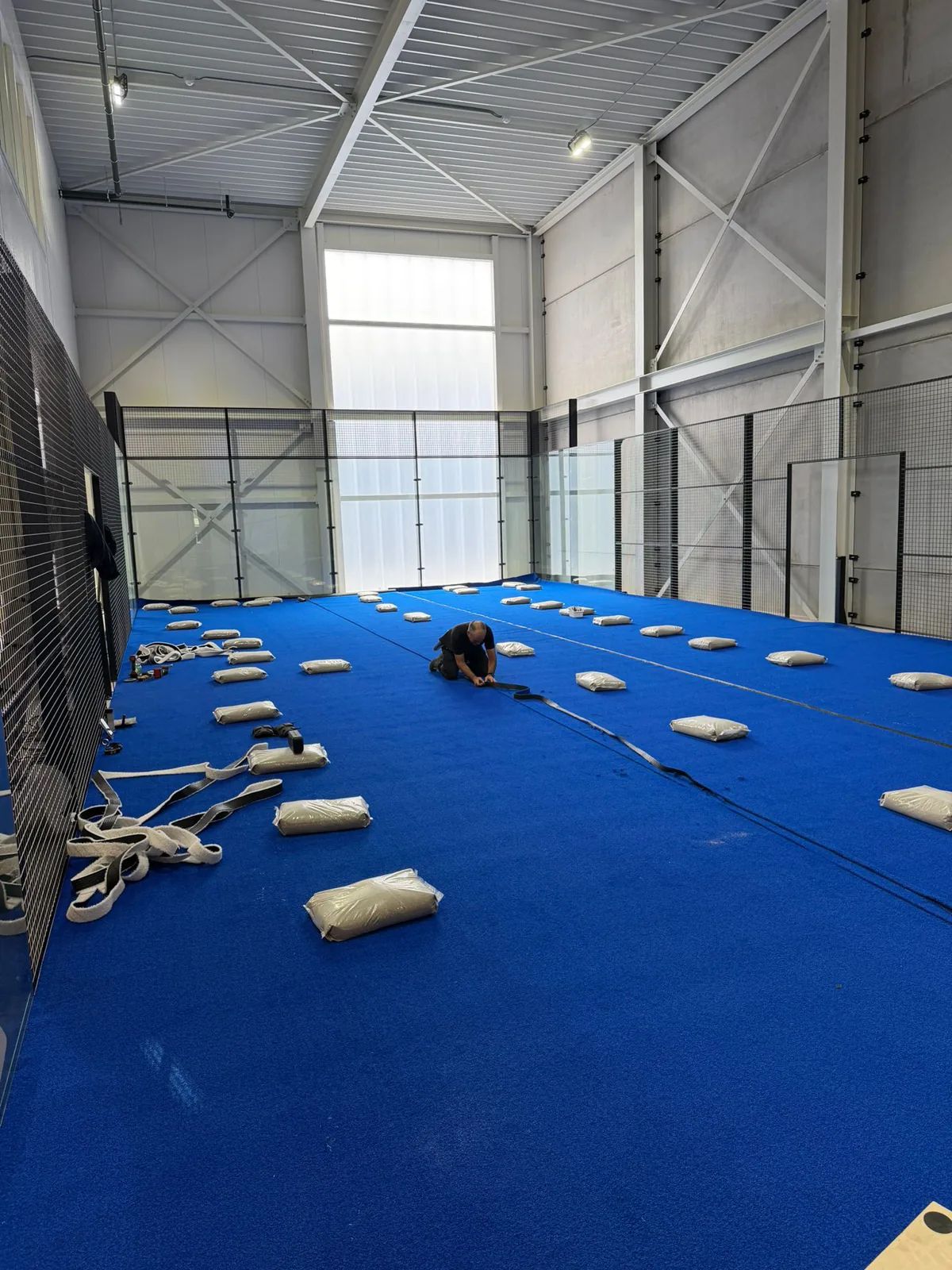
We supply and install artificial turf as part of a complete padel court, tailored to the specific situation of each location. That means we do not work with one standard product, but match the choice of artificial turf to the use, the foundation and the location.
- We advise on the right type of artificial turf for indoor and outdoor padel courts, based on intensity of use and site characteristics.
- We work exclusively with certified materials that meet the requirements of Kiwa ISA Sport.
- When building a padel court, we take care of the entire process: from foundation to artificial turf, steel structure, glass and LED lighting, all from a single source.
- We also replace artificial turf on existing courts and, if desired, combine this with an inspection of the foundation and structure.
- Our steel structures come with a 15-year warranty, so you can be sure that the base of your court will comfortably outlast the lifespan of the artificial turf.
Want to know which artificial turf best suits your location, or is it time to replace the turf on an existing court? Get in touch for an initial exploration, we are happy to think along with you, without obligation.
Frequently asked questions
Can I have the existing artificial turf on my padel court renovated instead of fully replaced?
In some cases partial renovation is possible, for example if only the seams are coming loose or the sand infill needs topping up. But if the fibres are structurally flattened or the backing is damaged, renovation is not a lasting solution and full replacement is more cost-efficient in the long term. Have an inspection carried out to determine which option makes the most sense in your situation.
What is the difference between monofilament and fibrillated artificial turf fibres for padel courts?
Monofilament fibres are single, smooth fibres that offer a softer playing experience and keep their shape for longer — this type is the most recommended for padel courts. Fibrillated fibres split into smaller strands during use, which provides more grip but also faster wear. For padel, monofilament PE is generally the better choice thanks to its combination of durability and playing comfort.
How do I know whether the artificial turf on my padel court is certified and meets the standards?
Certified artificial turf for padel courts in the Netherlands carries an approval from Kiwa ISA Sport, the recognised inspection body for sports surfaces. Always ask the supplier for the certificate document with the specific product name and the approval number. If you are taking over or buying an existing court, you can ask the original installer about the certification or verify it directly via Kiwa ISA Sport.
Does it matter which brand or type of quartz sand I use to top up the sand infill?
Yes, the quality and grain size of the quartz sand affect the playing characteristics and the lifespan of the artificial turf. Always use washed, rounded quartz sand with the grain size recommended by the artificial turf manufacturer — usually between 0.3 and 0.8 mm. Sharp or unwashed sand can damage the fibres and impede drainage.
Can I, as a private owner, carry out the maintenance of my padel court myself, or is professional maintenance necessary?
Basic maintenance such as brushing, removing leaves and checking the seams can be carried out yourself, as a private owner or manager, with the right brushing machine. For more in-depth maintenance, such as professionally topping up the sand infill or cleaning with a specialised machine, it is advisable to engage a professional maintenance service periodically. At commercial venues with intensive use, professional maintenance is recommended at least once or twice a year.
Does the colour of the artificial turf affect wear or playing quality?
The colour itself has no direct influence on wear or playing quality, but darker colours absorb more heat on outdoor courts, which can make the playing surface hotter on warm days. More important is that the colourant is well anchored in the fibre: high-quality artificial turf keeps its colour for years, whereas cheaper variants discolour faster under UV radiation. Discolouration is also a sign that the UV stabilisers in the fibres are losing their effectiveness.
What should I do if puddles remain on my padel court after heavy rainfall?
Puddling points to a drainage problem, which can be caused by the artificial turf as well as by the underlying foundation. First check whether the sand infill has become clogged with fine dirt or algae growth, as this impedes the permeability of the turf. If the foundation is the problem — for example due to subsidence or blocked drainage — professional intervention is necessary, because long-standing water damages the backing and considerably shortens the lifespan of the artificial turf.


