


Building a padel court · 17 June 2026 · 11 min read
How does an uneven base affect the glass panels of a padel court?
An uneven base quickly damages the glass panels of a padel court. Find out which foundation prevents cracks and breakage.
In this article
- What happens to the glass panels if the foundation of a padel court settles?
- Which foundation types are most susceptible to settlement?
- How do you spot damage to glass panels caused by a poor base at an early stage?
- Can an existing padel court be corrected if the base is uneven?
- What flatness requirements does a padel court place on the base?
- How do you prevent glass problems by choosing the right foundation?
- How I-Padel helps with a stable foundation and damage-free glass
- Frequently asked questions
An uneven base directly affects the glass panels of a padel court. When the foundation settles or is loaded unevenly, the steel structure shifts with it and the glass panels come under stress. This leads to cracks, loose panels or, in serious cases, breakage. The quality of the foundation is therefore decisive for the safety and lifespan of the glass. Below, we answer the most frequently asked questions on this subject.
What happens to the glass panels if the foundation of a padel court settles?
If the foundation of a padel court settles, the steel structure moves out of plumb. The glass panels, which are fitted precisely into the steel profiles, are then loaded at points they were not designed for. This causes stress concentrations in the glass, which eventually result in cracks or breakage.
The glass panels in a padel court are made of toughened safety glass. This material is strong under uniform loading, but vulnerable to point loads or torsion. As soon as the structure tilts by even a few millimetres due to uneven settlement, the distribution of forces changes completely. The panels are then either clamped too tightly or sit too loosely, depending on the direction of settlement.
Besides direct damage to the glass, indirect problems also arise. Connections between steel profiles start to move, bolts come loose and the overall stability of the structure decreases. On outdoor courts, wind load adds to this, which further increases the risk of damage once the foundation is no longer level.
Which foundation types are most susceptible to settlement?
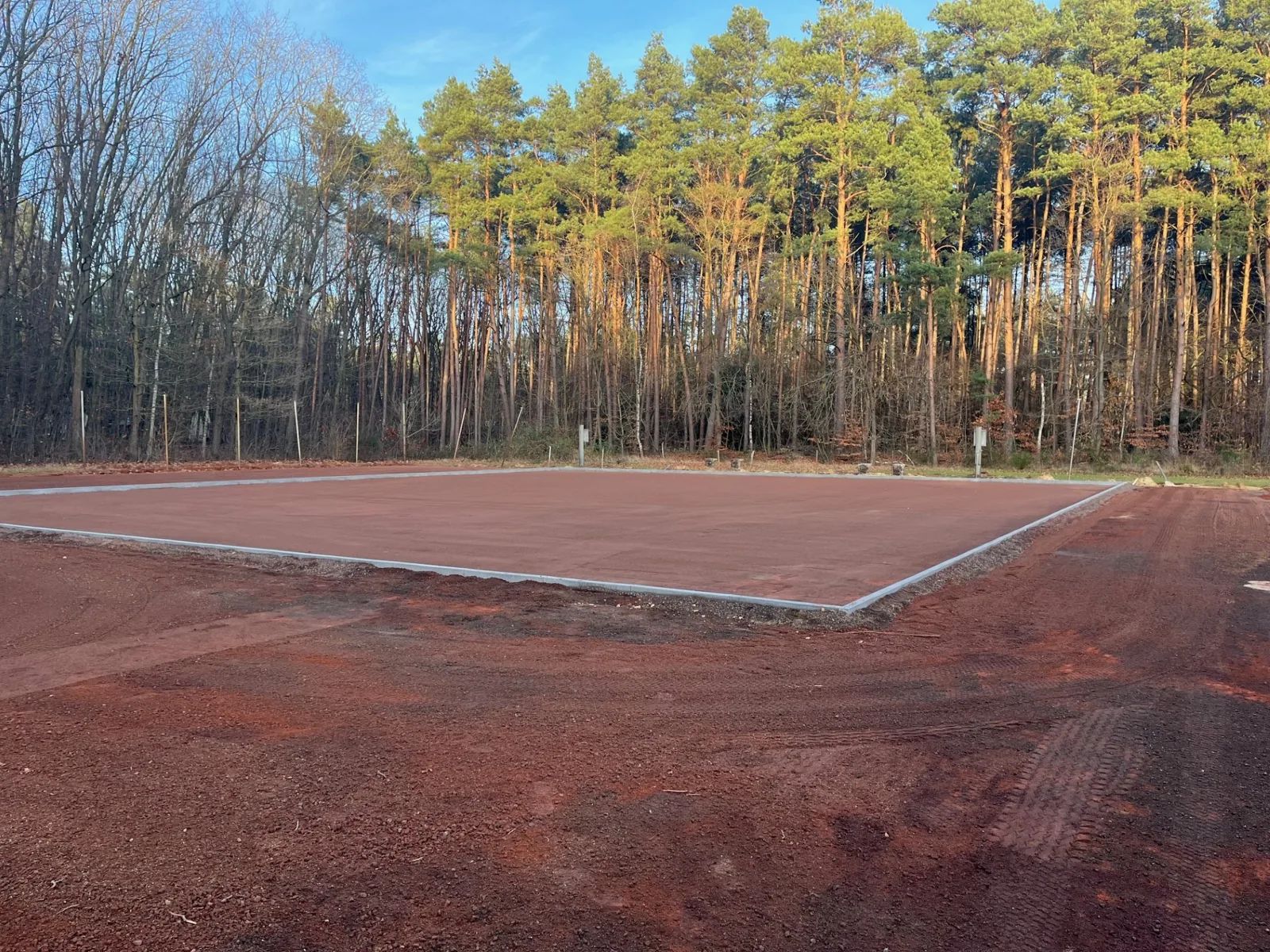
Traditionally poured concrete without proper reinforcement or drainage is the most susceptible to settlement. When rainwater is not drained away properly, the subsoil is slowly washed out, causing uneven settlement. Foundations laid without a preceding soil investigation also carry an increased risk.
Drainage concrete, Supersub and ZOAB asphalt are all three water-permeable foundation solutions developed specifically for sports applications. They actively handle rainwater and thus prevent water from accumulating beneath the foundation. Even so, susceptibility differs per type:
- Drainage concrete is a water-permeable type of concrete in which rainwater drains straight through the foundation into the ground. It is stable and has good bearing capacity, but requires good soil conditions as a basis. On sites with soft or uneven subsoil, extra reinforcement or a ring foundation is necessary.
- Supersub is a foundation solution based on foam concrete. It is light, self-levelling and hardly susceptible to cracking or settlement. Thanks to its low weight, it puts less pressure on the soil beneath, which makes it particularly suitable for sites with ground of lower bearing capacity.
- ZOAB asphalt (porous asphalt concrete) is a porous type of asphalt. It is less common for padel courts, but in certain situations a good choice. Its susceptibility to settlement depends heavily on the underlying foundation and the soil conditions on site.
Choosing the right foundation type always starts with a cone penetration test of the soil. Without insight into the bearing capacity of the subsoil, every foundation is a gamble.
How do you spot damage to glass panels caused by a poor base at an early stage?
Early signs of foundation problems are visible on the glass panels themselves and on the steel structure around them. Regular inspections let you limit the damage before it becomes dangerous or costly.
Watch out for the following warning signs:
- Hairline cracks in the glass, particularly in the corners of the panels. These are the weakest points under torsional load.
- Gaps between the glass and steel profiles that are growing or uneven. This points to a shift in the structure.
- Loose or jammed panels that do not move during normal use, but now vibrate or creak.
- Visible tilt of the structure, which you can check with a spirit level on the posts or the beams above.
- Cracks or settlement in the floor around the legs of the steel structure. This is often the first visible sign of foundation problems.
Inspect the court at least twice a year, and always after a period of extreme rainfall or frost. Frost is a particular risk on outdoor courts: water that freezes in small cracks expands and quickly makes the damage worse.
Can an existing padel court be corrected if the base is uneven?
Yes, an existing padel court can be corrected if the base is uneven, but the approach depends on the severity of the settlement and the type of foundation. In mild cases, adjusting the structure is enough. With structural foundation problems, a more thorough intervention is necessary.
In the case of small irregularities, the steel structure can be raised or adjusted via the anchors or levelling bolts. The glass panels are then refitted. This is a relatively limited intervention that prevents most damage if carried out early enough.
In the case of more serious settlement, it is sometimes necessary to temporarily dismantle the structure, repair or replace the foundation and then rebuild everything. This is costly, but in many cases the only lasting solution. A half-hearted repair in which only the glass is replaced without addressing the cause almost always leads to the damage recurring.
When building an indoor padel court, it is wise to have the flatness of the existing floor assessed in advance. Even small differences in height in an existing hall can be enough to cause problems if they are not corrected before installation.
What flatness requirements does a padel court place on the base?
A padel court places strict requirements on the flatness of the base. The maximum permitted deviation is generally 3 millimetres, measured over a length of 3 metres. This sounds small, but it is decisive for both structural integrity and playing quality.
This requirement applies to the floor on which the structure is placed, but also to the playing surface itself. An uneven playing surface leads to irregular ball bounce, which directly affects the playing experience and is not permitted for professional use.
In addition to flatness, there are also requirements for the bearing capacity of the subsoil. Together, the steel structure and the glass walls of a padel court can represent a considerable weight. Drainage concrete, for example, is suitable for loads of up to approximately 5 tonnes, which is sufficient for a standard padel court, but on soft or uneven ground the foundation build-up must be adapted accordingly.
For official tournaments, an inspection by Kiwa ISA Sport is mandatory. Kiwa ISA Sport is the recognised body that checks whether a padel court meets the applicable standards, including the flatness of the playing surface. All foundation components we use are certified and meet these requirements.
How do you prevent glass problems by choosing the right foundation?
Glass problems caused by a poor base can largely be prevented by having a soil investigation carried out before the start of the project and choosing the right foundation type on that basis. The foundation is the basis of everything: an investment here pays off in a longer lifespan for the court and lower maintenance costs.
A number of concrete measures that prevent glass problems:
- Always have a cone penetration test carried out before the foundation is laid. A cone penetration test provides insight into the bearing capacity and composition of the soil at different depths.
- Choose a water-permeable foundation for outdoor courts. Drainage concrete or Supersub prevents water from accumulating beneath the structure, which is one of the main causes of settlement.
- Combine the foundation with a ring foundation on sites with higher wind load or weaker soil. A ring foundation with steel reinforcement distributes the forces of the structure better across the subsoil.
- Check the flatness after construction and before the structure is installed. Correct any differences in height before the steel structure is placed.
- Schedule periodic inspections after completion, especially in the first few years and after extreme weather conditions.
The cost of a good foundation far outweighs the cost of replacing glass, repairing the structure or, in the worst case, a complete rebuild. You can find more information about the financial side of a project in our overview of the cost of an indoor padel court.
How I-Padel helps with a stable foundation and damage-free glass
We guide the entire process from groundwork to handover, including the choice of foundation that suits your site. That starts with a site check and a structural calculation for each situation, so that the foundation is not chosen based on what happens to be available, but on what the soil and the intended use require.
What we offer in concrete terms in the area of foundations and structure:
- Soil advice based on cone penetration test data
- Supply and construction of drainage concrete, Supersub and ZOAB asphalt
- Ring foundations with steel reinforcement for heavier situations
- In-house production of the steel structure, tailored to the specific site
- Structural recalculation when adding sound-absorbing panels
- 15-year warranty on the steel structure
All the materials we use are certified by Kiwa ISA Sport, so that after handover you immediately meet the standards for professional use. Would you like to know which foundation solution suits your site best? Get in touch for an initial exploration; we are happy to think along with you, without obligation.
Frequently asked questions
How long does it take for foundation problems to become visible on the glass panels?
Foundation problems sometimes develop over months, sometimes over years, depending on the soil conditions and the amount of rainfall. In many cases, the first signs, such as small gaps or a slight tilt, are already visible within one to two years of construction if the foundation was not properly executed. That is precisely why inspections in the first years after handover are so important: intervening early prevents small settlements from growing into structural damage.
Does it matter whether a padel court is indoor or outdoor when it comes to foundation requirements?
Yes, there are relevant differences. On outdoor courts, water drainage plays a much greater role, so water-permeable foundation solutions such as drainage concrete or Supersub are strongly preferred. In addition, outdoor courts are exposed to wind load and frost, which places higher demands on the bearing capacity and reinforcement of the foundation. For indoor courts, the existing floor is the starting point; here it is mainly about flatness and bearing capacity, and differences in height in the hall must be corrected beforehand.
As an operator, can I check the flatness of the base myself, or do I need a specialist?
You can carry out a rough check yourself with a long spirit level or a rotating laser: place it on the floor in several spots and measure whether the deviation stays within the permitted 3 millimetres per 3 metres. For an official measurement, for example if you suspect settlement or for a Kiwa ISA Sport inspection, you need a certified party. If you are unsure about the result of your own measurement, call in a specialist before you take any further steps.
What are the average costs of foundation repair on an existing padel court?
The cost of foundation repair varies widely, depending on the severity of the settlement and the type of repair chosen. A limited correction using levelling bolts and refitting of glass panels can be carried out for a few hundred euros. In the case of structural foundation problems where the structure has to be dismantled and the foundation completely replaced, the costs can run up to tens of thousands of euros. This underlines why investing in a good foundation during construction is always cheaper than carrying out repair work afterwards.
Isn't toughened safety glass simply strong enough to absorb small foundation irregularities?
This is a common misconception. Toughened safety glass is indeed very strong under uniform, flat loading, which is exactly what it was designed for. But under point loads or torsion, such as arise from a crooked structure, the glass is in fact vulnerable. Even a settlement of a few millimetres can completely disrupt the distribution of forces in the panels. The glass then does not break from a hard impact, but from the constant stress acting on the material day and night.
How often should a padel court be professionally inspected to prevent foundation-related damage?
A minimum inspection frequency of twice a year is recommended, preferably at the start of spring and after winter. Always add an extra inspection after periods of extreme rainfall, prolonged drought or severe frost, because these weather conditions put the most pressure on the foundation. Record the results of each inspection in writing, so that you can compare any changes over time and act in good time.
Does the warranty on the steel structure lapse if it turns out the foundation does not meet the requirements?
In most cases it does, and this applies not only to I-Padel but to virtually all suppliers. Warranties on the steel structure assume that the foundation has been laid according to the specifications. If damage is demonstrably the result of a defective or unapproved foundation, warranty coverage generally lapses in whole or in part. Always make sure the foundation is approved and documented before installation, so that in the event of any claims you can demonstrate that everything was carried out in accordance with the standards.


