


Building a padel court · 28 June 2026 · 10 min read
How does a panoramic version improve the look of an indoor padel venue?
Panoramic padel court: more glass, a better experience and a premium look. Discover costs, structural requirements and when it is the right choice.
In this article
- What distinguishes a panoramic version from a standard padel court?
- How does more glass affect the experience of players and spectators?
- What requirements does a panoramic structure place on the steel structure?
- Is a panoramic version also suitable for outdoor courts?
- What does a panoramic padel court cost compared with a standard version?
- When is a panoramic version the right choice for a padel venue?
- How I-Padel helps you choose a panoramic padel court
- Frequently asked questions
A panoramic version improves the look of an indoor padel venue by fitting the cage structure with larger glass surfaces on the back walls, making the court look more open and spacious. The result is a more modern, more prestigious venue that offers both players and spectators a better experience. In this article we answer the most frequently asked questions about the panoramic version, from structural requirements to costs and areas of application.
What distinguishes a panoramic version from a standard padel court?
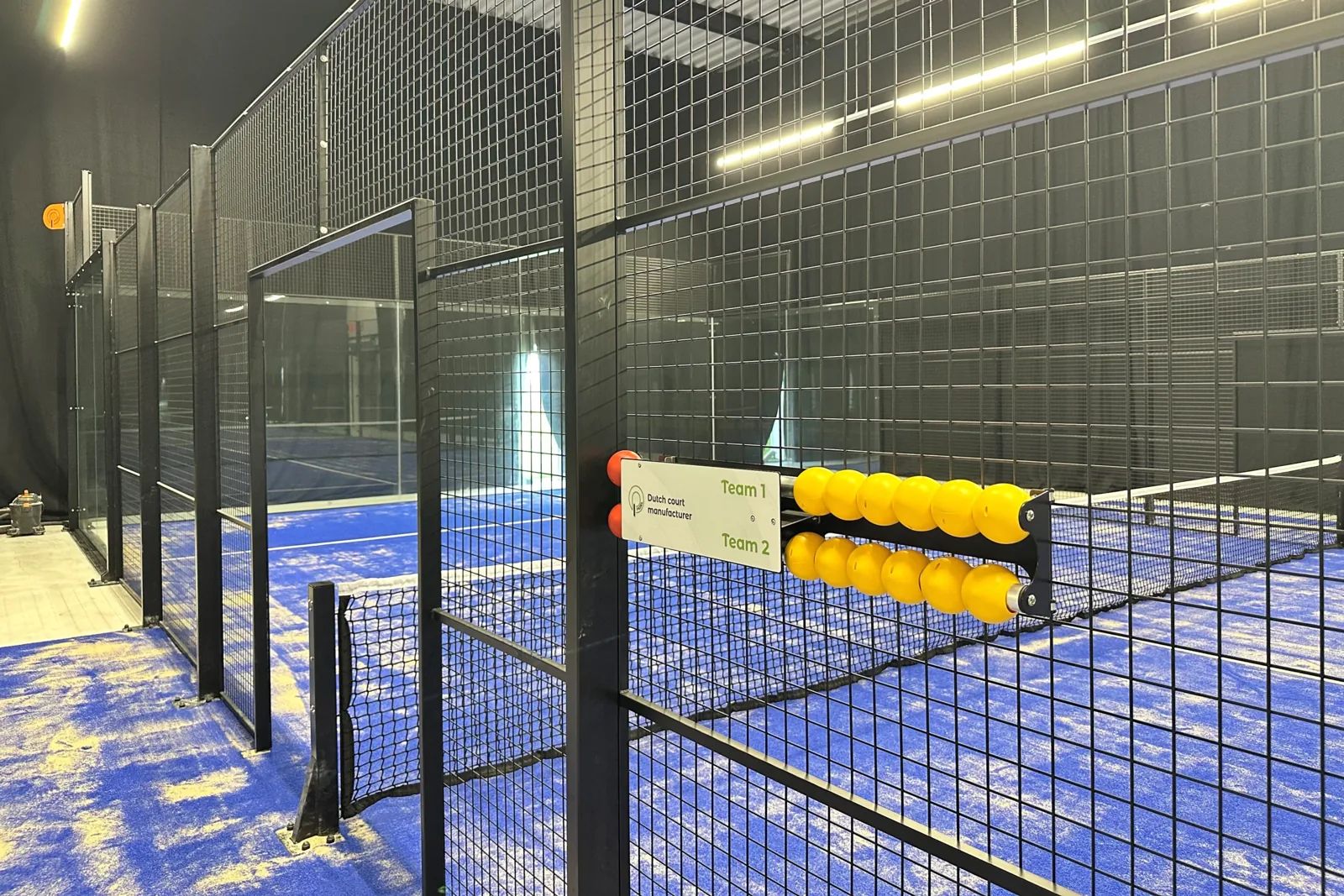
A panoramic version differs from a standard padel court through the use of larger glass surfaces, particularly on the back walls of the court. Where a standard Pro court uses a combination of glass and metal mesh, the panoramic version replaces a larger part of that mesh with glass. This gives the court an open, transparent character and a clearly different visual profile.
In practice, this means the back walls consist entirely or largely of glass from floor to top. Depending on the chosen variant, the side walls can also contain more glass. The result is a court that is completely see-through from the outside, which greatly improves the experience for spectators and gives the venue as a whole a premium look.
For commercial venues and sports halls that want to position padel as an attractive and modern sports offering, the panoramic version is a logical choice. The visual impact is immediately apparent and contributes to the recognisability and appearance of the venue.
How does more glass affect the experience of players and spectators?
More glass in a padel court increases the sense of space for players and makes the court considerably easier for spectators to follow. Players experience fewer visual barriers, which contributes to a more pleasant playing environment. Spectators can follow the game unobstructed from all sides, which benefits the atmosphere at the venue.
From the player's perspective, the open structure provides more daylight, less shadowing and a more spacious feel on the court. This is particularly noticeable with indoor padel courts in halls where daylight is limited. The glass walls reflect the light of the LED lighting more efficiently, which improves the overall light quality on the court.
For spectators, the panoramic version offers an unobstructed view of the game. Where metal mesh partly blocks the view, glass offers a clear and uninterrupted picture. This makes the panoramic version particularly suitable for venues that organise matches, offer clinics or use padel as a social activity where watching is part of the experience.
What requirements does a panoramic structure place on the steel structure?
A panoramic version places higher demands on the steel structure than a standard padel court. Glass is heavier than metal mesh and has a different sensitivity to wind. The cage structure must therefore be calculated and dimensioned for the specific loads that larger glass surfaces bring, including wind pressure and the weight of the glass panels themselves.
In practice, this means the posts and connections of a panoramic court are generally heavier than on a comparable Pro court. This is not an aesthetic choice, but a structural necessity. An underestimated or incorrectly calculated structure can lead to deformation, glass breakage or, in the worst case, structural damage.
In addition, fixing the glass panels requires specific profiles and clamping structures that hold the glass panels securely in place, even under wind load. At indoor locations the wind load is generally lower than outdoors, but even indoors air currents and temperature differences can affect the structure. A correct structural calculation per location is therefore always necessary, regardless of whether the court is indoors or outdoors.
Is a panoramic version also suitable for outdoor courts?
A panoramic version can technically also be used on outdoor courts, but the structural requirements are considerably heavier than for indoor applications. Outdoors, the wind load is higher and more variable, which makes larger glass surfaces extra vulnerable. The steel structure must be calculated and dimensioned for this, which increases the cost and the complexity of the project.
With outdoor padel courts, the panoramic version is used less often than with indoor courts. The combination of wind, precipitation and temperature changes places high demands on both the glass and the fixing structure. Safety glass of the right thickness and certification is mandatory, and the structure must be able to withstand the wind zones that apply to the specific location.
For locations that nevertheless choose a panoramic court outdoors, an extensive structural calculation based on site-specific data is indispensable. Wind load, soil conditions and the surroundings of the site together determine which structure is necessary. There is no standard solution here.
What does a panoramic padel court cost compared with a standard version?
A panoramic padel court is generally more expensive than a standard Pro court. The higher price is a direct result of the heavier steel structure and the larger amount of glass required. As an indication, a panoramic version of an indoor padel court comes in slightly above the starting point of approximately €23,000 for a standard indoor court, but the exact price always depends on the specific situation.
The cost differences are determined by a number of concrete factors.
- The amount of glass: more glass surface means higher material costs and heavier installation work.
- The heavier steel structure: larger profiles and extra connections increase production costs.
- The number of courts: with several courts, economies of scale arise in production and installation, which lowers the price per court.
- The location: accessibility, hall layout and any modifications to the existing infrastructure affect the total price.
For an accurate comparison between a standard and a panoramic version, a tailor-made quotation is necessary. You can find more background on how the costs of an indoor court are built up in our overview of the cost of an indoor padel court.
When is a panoramic version the right choice for a padel venue?
A panoramic version is the right choice when appearance, experience and visibility of the game take priority over the lowest possible investment. This applies in particular to commercial padel venues, sports halls that want to position padel as a premium offering and venues where spectators play a central role in the experience.
Specific situations in which the panoramic version is a logical choice.
- Commercial venues that want to stand out with a modern and prestigious look.
- Venues that organise matches or events where spectators need to be able to follow the game well.
- Sports halls with sufficient height and space, where the open look of the panoramic court really comes into its own.
- Projects in which several courts are built and economies of scale partly offset the premium for the panoramic version.
A standard Pro court remains an excellent choice for venues where budget is the primary consideration or where the surroundings place less emphasis on visual presentation. The choice between the two versions is ultimately a trade-off between investment, target group and the desired positioning of the venue.
How I-Padel helps you choose a panoramic padel court
We advise venues every day on the choice between a standard and a panoramic version. Because we produce the steel structure entirely in-house, we can calculate every court structurally for the specific requirements of the location. That also applies to panoramic courts, where the structure is always tailored to the glass load, the wind zone and the layout of the hall.
What we offer with a panoramic version.
- Structural calculation per location, including glass load and wind pressure.
- In-house production of the steel structure, tailored to the specific requirements of the panoramic variant.
- Complete supply of glass, artificial turf and LED lighting as part of the total package.
- Full installation from foundation to completion, including one point of contact and one warranty.
- Supply of materials without installation for locations that build themselves, including for international customers.
Would you like to know what a panoramic version means for your location and budget? Get in touch for an initial exploration, we are happy to advise you without obligation.
Frequently asked questions
What type of glass is used in a panoramic padel court and does it meet safety standards?
A panoramic padel court uses only tempered or laminated safety glass that complies with the applicable European standards for sports and building glass. This glass is designed to break into small, blunt fragments rather than sharp splinters, which considerably increases player safety. The exact glass thickness and certification are determined per project based on the dimensions of the glass surfaces, the structural load and the location (indoor or outdoor).
How much extra maintenance does a panoramic version require compared with a standard padel court?
A panoramic version requires slightly more attention when it comes to cleaning, because larger glass surfaces show dirt and fingerprints more quickly than metal mesh. Regular cleaning with a suitable glass cleaner and a soft cloth is sufficient in most cases. Structurally, maintenance is comparable to a standard court, provided the glass fixings and profiles are checked periodically for wear or connections coming loose.
Can an existing standard padel court be converted to a panoramic version?
In most cases a full conversion of an existing standard court to a panoramic version is not practically feasible, because the steel structure must be dimensioned fundamentally differently to carry the extra glass load. Replacing mesh with glass without adapting the structure entails serious safety risks. For venues that want to upgrade, it is generally wiser to approach the new panoramic court as a completely new project and have a structural calculation carried out.
What is the minimum clear height a sports hall must have for a panoramic padel court?
For an indoor padel court, a minimum clear height of 8 to 9 metres generally applies, and this also applies to the panoramic version. The exact minimum height depends on the specific cage structure and the chosen glass surface, but a lower hall limits not only the playing space but also the visual impact that makes the panoramic version so attractive. It is advisable to always discuss the hall layout and height with the supplier before making a final choice of version.
Does the panoramic version affect the acoustics in a sports hall?
Yes, larger glass surfaces can affect the acoustics in a sports hall because glass reflects sound more strongly than metal mesh. In halls with several panoramic courts, this can lead to more reverberation and a higher noise level during play. It is wise to take acoustic measures into account in the hall planning, such as sound-absorbing ceiling panels or wall coverings, so that the playing experience and communication on the court remain optimal.
Are there subsidies or tax benefits available when purchasing a panoramic padel court?
Depending on the operator's legal form and the nature of the investment, tax benefits may apply, such as the small-scale investment deduction (kleinschaligheidsinvesteringsaftrek, KIA) or depreciation options on business assets. Municipal or provincial subsidies for sports infrastructure are sometimes available, but this varies greatly by region and project type. It is advisable to consult a tax adviser or the local municipality to determine which schemes apply to your specific situation.
How long does the installation of a panoramic padel court take and what should I take into account in the planning?
The installation time of a panoramic padel court depends on the number of courts, the condition of the subbase and the complexity of the location, but you should generally allow an installation period of a few days to a week per court, including foundation and finishing.
Also take into account in the planning the delivery time of the steel structure and the glass, which for custom work can run to several weeks. Good coordination with the supplier on the construction schedule, hall accessibility and any other work in the hall prevents unnecessary delay.


