


Building a padel court · 4 July 2026 · 10 min read
How does a panoramic padel court differ from a standard court during construction?
Panoramic vs. standard padel court: discover the structural differences, the extra cost and which court type suits your location and budget.
In this article
- What are the structural differences between the two court types?
- How much glass does a panoramic padel court contain compared with a standard court?
- How much more does a panoramic padel court cost than a standard court?
- Which court type is more suitable for indoor versus outdoor locations?
- How does the court type affect the required foundation?
- Which type of padel court should you choose for a commercial location?
- How I-Padel helps you choose between a panoramic and a standard padel court
- Frequently asked questions
A panoramic padel court differs from a standard court (also called a Pro court) on one defining point: the amount of glass in the structure. A panoramic padel court has more glass walls, which makes the court look more open and lets in more daylight. That difference in design has direct consequences for the structure, the cost and the suitability for certain locations. Below we answer the most frequently asked questions about both court types.
What are the structural differences between the two court types?
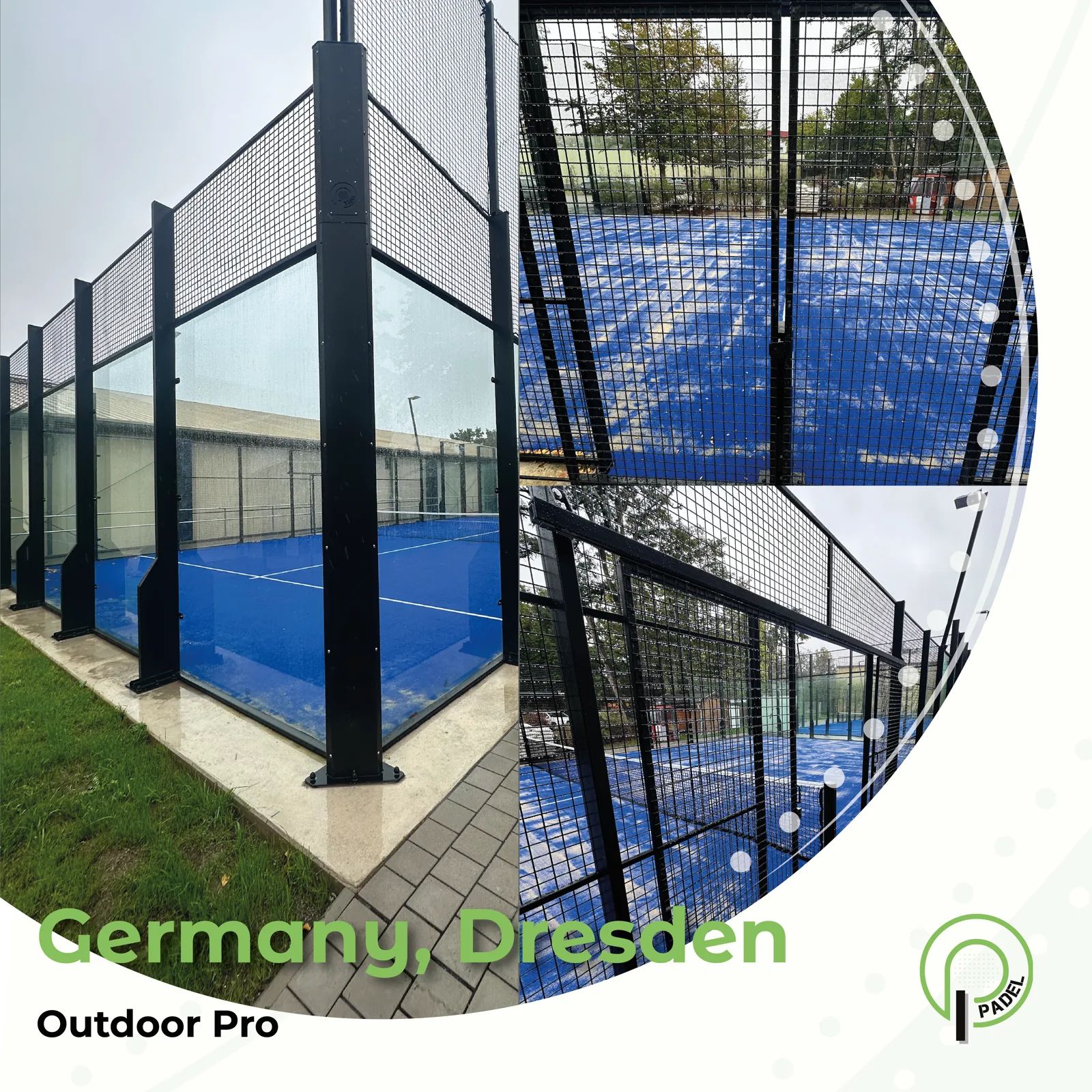
The fundamental structural difference between a panoramic padel court and a standard Pro court lies in the ratio of glass to mesh. On a Pro court, the cage structure consists largely of steel mesh, with glass only on the back and side walls at playing height. A panoramic padel court replaces a considerable part of that mesh with glass, making the court transparent all around.
That sounds like a purely aesthetic choice, but it has structural consequences. Glass is heavier than mesh and catches wind differently. The steel structure of a panoramic padel court must therefore be calculated for the extra load caused by the glass walls.
In practice, this means the posts and connections are made heavier, even though the court looks lighter and more elegant than a Pro court. When building a padel court, it is therefore important to realise that a panoramic version is not a simplification of the structure, but rather a technically more complex variant.
How much glass does a panoramic padel court contain compared with a standard court?
A standard Pro court has glass on the back walls and the lower metres of the side walls. The rest of the cage structure consists of steel mesh. On a panoramic padel court the glass area is considerably larger: the entire back walls and a large part of the side walls are made of glass, so the total amount of glass per court can be two to three times as much as on a Pro court.
That extra amount of glass has practical consequences for construction. More glass means more weight in the structure, a longer installation time and higher transport costs. At the same time, it offers an attractive playing experience: players and spectators have an unobstructed view of the game from every angle, which makes a panoramic padel court popular in commercial environments where experience and appearance count.
How much more does a panoramic padel court cost than a standard court?
As an indication, a panoramic padel court generally costs somewhat more than a comparable Pro court, because of the higher material costs for glass and the heavier steel structure needed to carry that extra glass area. The exact price difference depends on the number of courts, the location and the chosen specification.
For an indoor padel court in a panoramic version you need to allow for a price premium compared with the standard variant. That premium is not the result of higher profit margins, but of real cost differences in materials and construction. More glass means higher purchasing costs, heavier steel and more labour hours during installation. If you want an accurate picture of the costs for your specific situation, read more about the cost of an indoor padel court or request a tailor-made quotation.
Important to know: with multiple courts, economies of scale arise in production and installation, so the premium per court becomes relatively smaller the larger the project is.
Which court type is more suitable for indoor versus outdoor locations?
For outdoor locations, a Pro court is in most cases structurally more robust and more practical than a panoramic padel court. The reason is wind load: a panoramic padel court has a larger closed surface because of the extra glass, so the structure catches more wind. On open sites, coastal locations or locations with tall buildings nearby, that can make a significant difference to the structural strength required and therefore to the cost.
For indoor courts, things are different. Indoors, wind load is not a factor, so the choice between a Pro court and a panoramic padel court can be made purely on the basis of appearance, experience and budget. Panoramic padel courts are popular indoors because they make the space look larger, let in more light and give a high-quality look that suits commercial padel venues.
In short: for outdoor projects, a Pro court is preferable, unless the location specifically calls for the panoramic look and the structure is calculated accordingly. For indoor projects, a panoramic padel court is an excellent choice when appearance and experience are the priority.
How does the court type affect the required foundation?
The court type in itself, whether a Pro court or a panoramic padel court, has no direct influence on the type of foundation required. The foundation is determined by the location: soil conditions, water management, wind load and use. What does play a role is the weight and wind exposure of the cage structure, and that is where a panoramic padel court differs from a standard court.
Because a panoramic padel court has a heavier structure due to the extra glass and the associated steel reinforcement, the forces transferred to the foundation can be greater. When building a padel court, a structural calculation is always made per location, with the weight of the cage structure and the wind load as input. For a panoramic padel court at an outdoor location, this can mean the foundation has to be heavier or deeper than for a comparable Pro court.
The most commonly used foundation types are drainage concrete (a water-permeable concrete layer that drains rainwater directly into the soil), Supersub (a foundation solution based on foam concrete, lightweight and self-levelling) and ZOAB asphalt (open-graded asphalt concrete that lets water through). Which type fits best depends on soil conditions, use and budget. All foundation components must be inspected by Kiwa ISA Sport in the Netherlands.
Which type of padel court should you choose for a commercial location?
For commercial padel venues, such as sports halls, padel centres or multifunctional sports facilities, a panoramic padel court is often the most attractive choice. The open, transparent look enhances the experience for players and spectators, makes the venue visually more appealing and strengthens the premium image of the facility. That contributes to higher court occupancy and a stronger commercial presence.
At the same time, the Pro court is by no means an inferior choice for commercial locations. At sites where several courts are built side by side, the Pro court offers excellent value for money and the structure has proven to be robust. For outdoor commercial locations, such as outdoor sports parks or tennis clubs adding padel courts, the Pro court is often the better choice because of its lower wind exposure and structural simplicity.
Ultimately, the decision depends on three factors:
- Location: indoor or outdoor, wind load, space available.
- Budget: panoramic courts cost more, while Pro courts are more efficient in larger numbers.
- Target group and positioning: a premium padel centre is more likely to choose panoramic, while a club with a limited budget is more likely to choose Pro.
How I-Padel helps you choose between a panoramic and a standard padel court
We help you make the right choice for your location, budget and objective. Because we produce the steel structure entirely in-house, we can deliver both court types as custom solutions without depending on standard sizes or import schedules. That gives us the freedom to calculate every court structurally for the specific requirements of your location.
What we can do for you:
- Make a structural comparison between a Pro court and a panoramic padel court for your specific location.
- Advise on the most suitable foundation type based on soil conditions and use.
- Deliver a complete package, from groundwork and foundation through to artificial turf, glass and LED lighting.
- Supply materials for locations abroad that handle the installation themselves.
- Sound-absorbing panels integrated structurally when the location requires it.
Would you like to know which court type best fits your plans? Get in touch for an initial exploration, we will be happy to advise you without obligation.
Frequently asked questions
Can I later convert a panoramic padel court into a Pro court, or the other way around?
In most cases a full conversion is neither practical nor cost-efficient, because the steel structure of the two court types is calculated differently. The posts and connections of a panoramic padel court are heavier to carry the extra glass load, whereas a Pro court has a lighter structure. It is wiser to make the right choice up front based on location, budget and objective, rather than counting on a later modification.
How long does the glass of a panoramic padel court last, and what are the maintenance costs?
The glass used in padel courts is tempered safety glass that withstands the impact of padel balls and weather conditions. With normal use and proper maintenance this glass lasts many years without replacement. The main maintenance costs lie in regular cleaning of the glass surfaces and periodic inspection of the fixing points and rubber seals, so that minor wear is spotted early.
Does a panoramic padel court have special lighting requirements compared with a Pro court?
Not necessarily, but the higher light transmission of a panoramic padel court can mean that at indoor locations you need less artificial light, which is favourable for operating costs. For outdoor courts this matters less, because daylight is equally available to both court types. Good LED lighting that meets the standards for competitive play is advisable for both court types, and can be integrated structurally into the cage structure.
Is a panoramic padel court also suitable for use in an area with a lot of noise nuisance, such as a residential neighbourhood?
Glass absorbs sound less well than steel mesh, so in theory a panoramic padel court lets through somewhat more noise than a Pro court. For locations in residential neighbourhoods or other noise-sensitive environments, it is advisable to integrate sound-absorbing panels structurally into the court, regardless of the court type. A structural calculation per location that takes the acoustic requirements into account is the best way to comply with local noise standards.
Which permits do I need to build a padel court, and does that differ per court type?
The permit requirement depends on the municipality, the location and the dimensions of the structure, not specifically on the court type. For both a Pro court and a panoramic padel court you will in most cases need an environmental permit, especially for outdoor locations or new builds. It is wise to contact the municipality in advance and include the permit application in the project planning, so that it does not cause delays.
How long does the installation of a panoramic padel court take compared with a Pro court?
The installation time of a panoramic padel court is generally longer than that of a Pro court, because of the larger amount of glass that has to be placed and sealed and the heavier steel structure that has to be assembled more precisely. As an indication you can allow for extra installation days per court compared with a standard Pro court, depending on the complexity of the site and the number of courts. With larger projects of several courts, economies of scale arise, so the extra installation time per court becomes relatively smaller.
Can I also place a panoramic padel court in an existing sports hall or building?
Yes, that is certainly possible, but there are a number of practical points to consider. The clear height of the space must be at least 6 to 7 metres for a full-size padel court, and the floor load must be checked against the extra structural weight of a panoramic version. In addition, there must be enough space around the court for safety and playing comfort. A structural survey of the existing situation is always the first step before a tailor-made quotation can be prepared.


