


Building a padel court · 4 August 2026 · 11 min read
How do you ensure even lighting when building an indoor padel court?
Even lighting for an indoor padel court? Discover the right lux values, fitting placement and LED standards for optimal playing comfort.
In this article
- How many lux do you need for an indoor padel court?
- Which factors determine whether lighting is evenly distributed?
- What is the difference between LED fittings and traditional lighting for padel?
- How do you calculate the number of fittings for an indoor padel court?
- Which mistakes cause shadow spots or glare on the padel court?
- Does the lighting of a padel court have to meet specific standards?
- How I-Padel helps with lighting when building a padel court
- Frequently asked questions
Even lighting when building an indoor padel court starts with the right lux values, well-thought-out fitting placement and LED lighting matched to the dimensions of the court. Without that combination, shadow spots, glare or an uncomfortable playing experience arise that players notice immediately. In this article we answer the most common questions about padel court lighting, from standards to common mistakes.
How many lux do you need for an indoor padel court?
For recreational use, a minimum illuminance of 300 to 500 lux at court level applies. For competitive play and matches this rises to 500 to 750 lux, with the lighting also having to be evenly distributed vertically. The exact requirement depends on the level of use and the applicable standard.
Lux is a measure of the amount of light falling on a surface. The higher the lux value, the brighter the playing area. In padel this is especially relevant because the ball moves fast and players also look upwards, towards the back wall and the glass. A lux value that is too low makes the ball hard to follow, while an uneven distribution causes glare or dark corners.
For locations that want to organise official competitions, an inspection by Kiwa ISA Sport is mandatory. Among other things, that inspection tests whether the illuminance meets the requirements. It is wise to take these standards into account when building an indoor padel court, so that you do not have to make changes afterwards.
Which factors determine whether lighting is evenly distributed?
Even light distribution on an indoor padel court is determined by four factors: the height of the fittings, the spacing between fittings, the beam angle of the fittings and the reflective properties of the walls and ceiling. A mistake in any one of these factors immediately leads to light and dark zones on the court.
The height of the fittings is crucial. If they are mounted too low, hard circles of light appear with dark areas in between. The recommended clear height for a padel hall is at least 6 metres, and fittings are preferably mounted higher so that the light can spread widely. The higher the fitting, the larger the area lit per lamp, but also the more lux output is needed to reach the desired level at court level.
The beam angle determines how widely the light is emitted. Fittings with a narrow beam angle concentrate light on a single point. For padel courts, fittings with a wider beam and asymmetric light distribution are more suitable, because they spread the light over a larger area without causing glare for players looking upwards.
Finally, the surfaces in the hall play a role. Dark walls absorb light, light walls reflect it back. When designing the lighting installation, the reflectance coefficients of the surroundings must be taken into account, so that the lighting plan matches the actual situation.
What is the difference between LED fittings and traditional lighting for padel?
LED lighting is the standard for new padel courts, and rightly so. Compared with traditional lighting such as halogen or metal halide lamps, LED lighting offers higher efficiency, a longer service life, better colour rendering and immediate use without warm-up time. For padel these are not luxury advantages, but practical requirements.
Traditional lighting sometimes has a warm-up time of several minutes before full brightness is reached. LED lighting burns at full strength immediately, which is relevant for locations that rent out courts in quick succession. LED lighting also uses significantly less energy for the same lux output, which quickly shows on the energy bill when there are several courts.
Another difference is colour temperature and colour rendering. A colour temperature of 4,000 to 5,700 Kelvin is recommended for padel courts, which amounts to neutral to cool white light. This gives a sharp contrast between the ball and the background. The colour rendering index (CRI) should preferably be above 80, so that the colours of the court, the artificial turf and the ball are perceived realistically.
LED lighting is also dimmable and can be linked to timers or sensor-controlled systems, which reduces energy consumption further. For commercial locations that operate several indoor padel courts, this is a relevant saving on an annual basis.
How do you calculate the number of fittings for an indoor padel court?
The number of fittings needed for an indoor padel court is calculated on the basis of the desired lux value, the output and beam angle of the fittings, the mounting height and the dimensions of the court. A playing area of 20 by 10 metres generally requires four to eight fittings, depending on the type and output.
The calculation is done via a lighting simulation, also known as a lighting design calculation or DIALux calculation. In such a simulation the fittings are placed virtually and the lux distribution at court level is calculated. This gives insight into the evenness (uniformity) of the lighting, expressed as the ratio between the minimum and average lux value. A uniformity value of 0.7 or higher is considered good for recreational use.
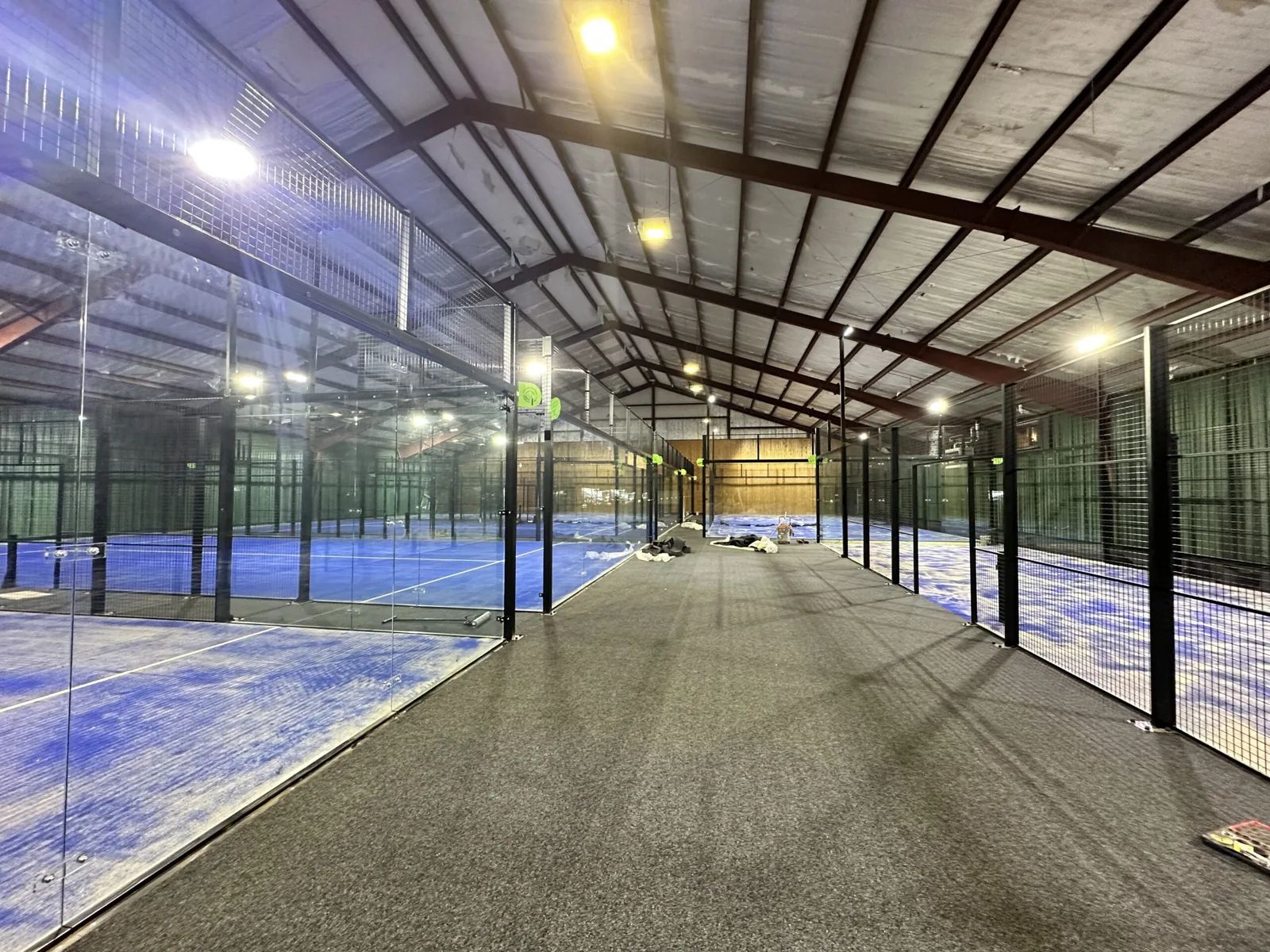
In addition to the number of fittings, placement is decisive. On padel courts, fittings are often placed along the sides of the court, on the structure or on the ceiling of the hall, with the light beam aimed at the playing area. Symmetrical placement on both sides prevents one-sided shadows. For a court with a clear height of 6 metres or more, placement at a height of 5 to 6 metres is common.
It is strongly recommended to have the lighting calculation carried out by a supplier or installer with experience in sports lighting. A calculation on paper is no guarantee of the end result, but it does provide the best basis for an installation that meets the standards from the outset.
Which mistakes cause shadow spots or glare on the padel court?
The most common mistakes in padel court lighting are: too few fittings for the area, a beam angle that is too narrow, fittings that shine straight down without any spread, and placement that is not matched to the height of the hall. Each of these mistakes leads to shadow spots, harsh contrasts or direct glare for players.
Glare occurs when fittings are in players’ line of sight, particularly when serving or with high balls. This is also known as direct glare. To prevent it, fittings are fitted with shielding hoods or placed outside the direct line of sight. A fitting with an asymmetric light beam can direct the light so that the playing area is well lit without players looking directly into the light source.
Shadow spots almost always arise from too great a distance between fittings, combined with a beam angle that is too narrow. The circles of light then overlap insufficiently, creating dark zones on the court. This can be prevented by having the lighting simulation carried out in advance and optimising the placement on the basis of the calculated uniformity value.
Another common mistake is using fittings that are not suitable for sports environments. Standard industrial fittings are designed for static work environments, not for the dynamic movements and high ceilings of a padel hall. Sports-specific LED lighting has different optics and is resistant to vibrations and impacts, which benefits its service life.
Does the lighting of a padel court have to meet specific standards?
Yes, the lighting of a padel court must meet specific standards, both for safety and for official use. The relevant European standard is EN 12193, which sets lighting requirements for sports facilities. Within it, padel is subject to class divisions based on the level of use, from recreational to international competitive.
The EN 12193 standard distinguishes three classes. Class III applies to recreational use and requires an average horizontal illuminance of at least 300 lux. Class II applies to competitive club play and requires at least 500 lux. Class I, for national and international matches, sets the highest requirements for illuminance as well as uniformity and vertical illumination.
For locations that want to organise official competitions, an inspection by Kiwa ISA Sport is mandatory. That inspection tests whether the installation meets the applicable standards. It is wise to take the desired class into account already in the design phase when building an indoor padel court, so that the lighting installation meets the right requirements from the start and an inspection holds no surprises.
In addition to the sports standard, municipalities or landlords may impose additional requirements on light nuisance to the surroundings. This plays less of a role for indoor courts than for outdoor situations, but for halls with large windows or transparent facades, light emission can be a point of attention in the permit process.
How I-Padel helps with lighting when building a padel court
At I-Padel we supply and install LED lighting as part of the complete package for indoor padel courts. That means the lighting installation is not ordered separately from another party, but is structurally and technically matched to the court, the hall and the desired level of use. Specifically, we do the following:
- Lighting advice based on the hall dimensions, clear height and intended use (recreational or competitive).
- Lighting design calculation to optimise fitting placement for evenness and lux values in line with EN 12193.
- Supply of sports-specific LED lighting, matched to the steel structure of the court.
- Full installation, including cabling and connection, as part of the turnkey handover.
- Support with the Kiwa ISA Sport inspection, where applicable.
Want to know what a complete indoor padel court including LED lighting costs for you? Request a no-obligation quote and we will be happy to think along with you about the best solution for your location.
Frequently asked questions
How long do LED fittings last on an indoor padel court and when should I replace them?
High-quality sports-specific LED fittings have an average lifespan of 50,000 to 100,000 burning hours, which with normal use amounts to 15 to 25 years. In practice you notice replacement is needed when the light output noticeably decreases (lumen depreciation) or when a lighting measurement shows that you no longer meet the required lux values. Schedule a lighting measurement every 3 to 5 years to be sure the installation still meets the standards.
Can I reuse the existing lighting in my hall for a new padel court?
That depends on the type of fittings, the mounting height, the output and the beam angle of the existing installation. Standard industrial or warehouse lighting is rarely suitable for sports use, because the optics are not matched to the dynamic movements and viewing angles of padel. Always have a lighting design calculation carried out on the existing situation before you decide to reuse it — that way you avoid having to invest in a complete replacement afterwards.
What does a complete lighting installation for a single indoor padel court cost on average?
The cost of a complete lighting installation for a single indoor padel court generally varies between €3,000 and €8,000, depending on the number of fittings needed, the quality level of the LED fittings and the complexity of the cabling and installation. For competitive classes (class I or II) the costs are higher because more fittings and a higher light output per fitting are needed. A turnkey approach in which the lighting is integrated into the overall court package is often more cost-effective than tendering the lighting installation separately.
Is dimmable lighting worthwhile for a commercial padel location with several courts?
Yes, dimmable LED lighting is certainly worthwhile for commercial locations. You can adjust the light level per court to the use — dim lower during training or quiet hours, and switch to full output during matches or busy evening hours. Linked to a booking system or timer, this can deliver a significant annual saving on the energy bill, without sacrificing playing comfort when it really matters.
What should I do if my hall has a low clear height of less than 6 metres?
A clear height below 6 metres makes it harder to distribute light evenly without causing glare, but it is not impossible. In that case fittings with an extra wide and asymmetric beam angle are necessary, so that the light is emitted broadly without players looking directly into the light source.
An accurate lighting simulation is especially important in this situation to determine whether the desired lux values and uniformity are achievable, and which EN 12193 class is realistic for your hall.
How do I avoid problems at the Kiwa ISA Sport inspection of my lighting installation?
The best preparation for a Kiwa ISA Sport inspection is to have a professional lighting design calculation carried out before installation, based on the right standard class for your intended use. Make sure the lighting installation is carried out by a party with demonstrable experience in sports lighting, and ask for documentation on the fittings used, including photometric data. After installation, have a preliminary lighting measurement carried out so that any deviations can be corrected before the official inspection takes place.
Does the colour of the walls and ceiling of my hall really affect the lighting quality?
Absolutely — the reflectance coefficients of walls, ceiling and floor have a direct effect on the effective illuminance and evenness at court level. Light walls and ceilings (reflectance coefficient of 70% or higher) can reflect light back considerably and contribute to a higher and more even lux distribution, so that you achieve the same result with fewer fittings or a lower output.
If you have the opportunity to decorate or paint the hall, it is worth including this in the lighting design — it can directly affect the investment in fittings.


