


Building a padel court · 15 August 2026 · 11 min read
Can you install an indoor padel court in a riding hall or former warehouse?
Indoor padel court in a riding hall or warehouse? Discover dimensions, costs (from €23,000), permits and structural requirements. Request a free site check.
In this article
- What minimum dimensions must a riding hall or warehouse meet for a padel court?
- What happens to the foundation if the floor is already there?
- Which structural modifications are needed for the steel structure?
- Do you need a permit to install a padel court in an existing building?
- What does an indoor padel court in a riding hall or warehouse cost?
- What are the advantages of a padel court in an existing building compared to new construction?
- How I-Padel helps with realising an indoor padel court in an existing building
- Frequently asked questions
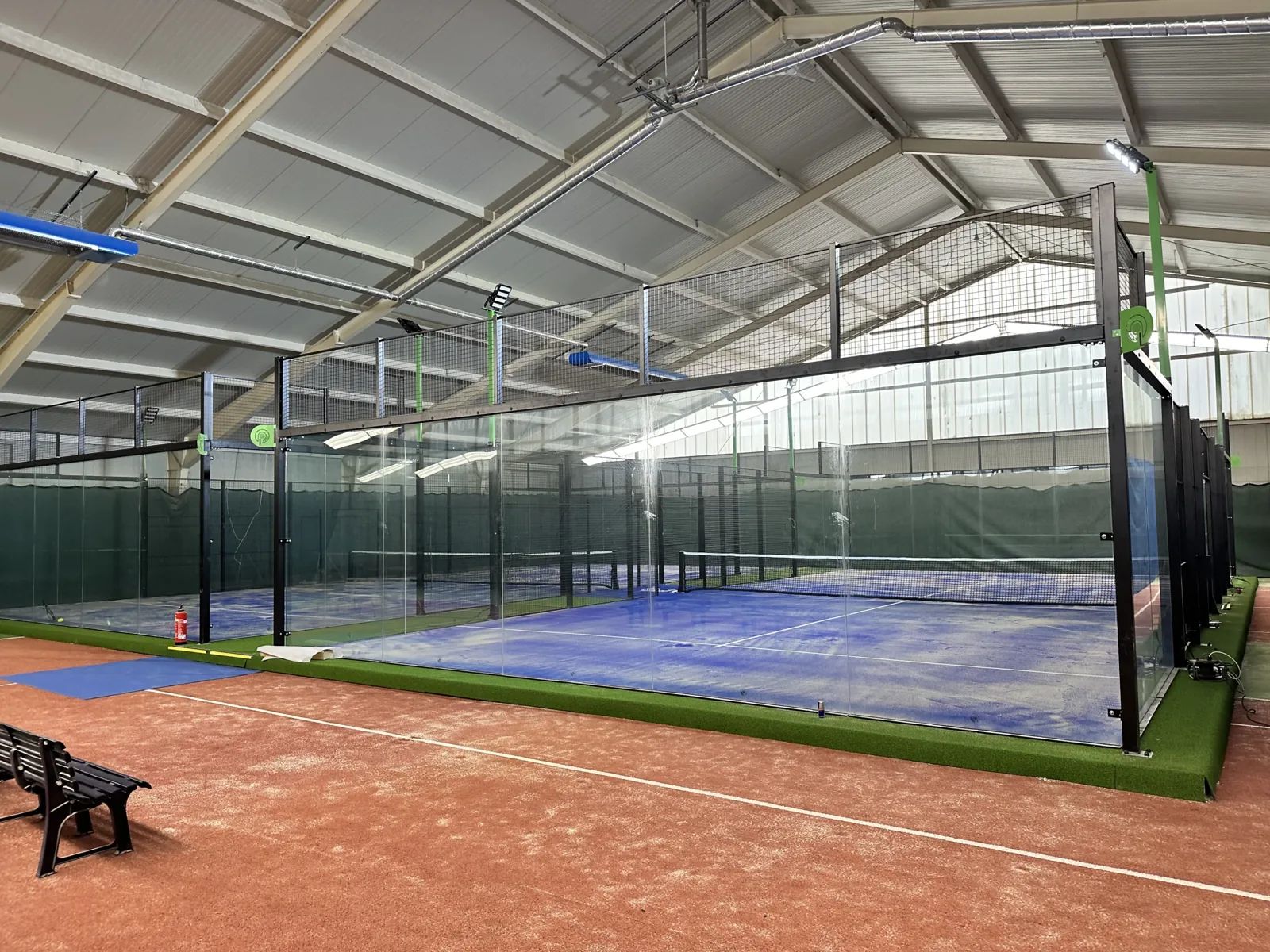
Yes, installing an indoor padel court in a riding hall or former warehouse is entirely possible. In fact, existing halls often offer excellent conditions for padel, provided the space meets a number of minimum requirements regarding dimensions, height and floor construction. In this article, we answer the most common questions about realising an indoor padel court in an existing building.
What minimum dimensions must a riding hall or warehouse meet for a padel court?
A riding hall or warehouse must offer at least 21 by 11 metres of clear floor area per padel court, with a clear height of at least 6 metres. The official playing size of a padel court is 20 by 10 metres, but working space is needed around the cage structure for installation and safety. For a pleasant playing experience, a recommended space of 21 by 14 metres applies, including run-off zones.
Height is a point that is regularly underestimated. With a clear height of less than 6 metres, play is noticeably restricted: balls that are hit high strike the structure or the roof, which greatly reduces playing quality. The higher the hall, the better. With riding halls this is generally not a problem, but always check the exact clear height, including any roof beams, light fittings or technical installations that are already present.
If you want to place several courts side by side, the required width adds up quickly. Two courts side by side require a width of at least 22 metres, with a shared gap of approximately 2 metres. When planning a larger location, it pays to calculate the layout carefully in advance, so you get the maximum number of courts out of the available space.
What happens to the foundation if the floor is already there?
If a concrete floor is already present in the hall, it can in many cases be used as the base for the padel court. The cage structure is then anchored directly to the existing floor using chemical anchors or embedded plates. No complete new foundation is needed, which saves costs and lead time. The floor does have to be assessed for flatness, load-bearing capacity and state of maintenance.
A concrete floor laid for moving machinery or storage is generally sturdy enough for a padel court. The steel structure and glass walls impose a load of approximately 5 tonnes, distributed over the anchor points. A floor that shows cracks, is very uneven or already shows signs of subsidence requires an additional assessment before building can begin.
If the existing floor is unsuitable or there is no floor, there are several options. Supersub (a lightweight, self-levelling foam concrete) can be poured quickly and can also be used in a covered environment. Drainage concrete is also an option, although its water-permeable property is less relevant for indoor use. The choice depends on the condition of the subsoil, the desired playing comfort and the available budget.
Which structural modifications are needed for the steel structure?
In an enclosed hall, the structural requirements for the steel structure are generally less demanding than for an outdoor court. Wind load barely plays a role, which means the cage structure does not have to be dimensioned for high wind pressure. Even so, there are location-specific factors that can influence the structure, such as the anchoring in the existing floor and the space available around the court.
When sound-absorbing panels are used, the situation changes. Panels are fixed to the outside of the mesh of the cage structure and reduce the wind permeability of the structure. Even in a covered hall this can affect the distribution of forces. The structure must then be recalculated and, in some cases, reinforced with heavier posts or additional connections. This is a technical step that must not be skipped.
Deviating hall dimensions can also require modifications. Think of a limited width where the run-off zones turn out narrower, or a low roof edge that affects the height of the cage structure. In those cases, custom work on the structure is necessary. A standard court that is simply fitted in without taking the specific hall into account almost always causes problems.
Do you need a permit to install a padel court in an existing building?
For an indoor padel court in an existing building, a separate environmental permit is not always needed, but this depends heavily on the situation. If no structural modifications are made to the building itself and the hall already has a sports designation, installation may in some cases be permit-free. Even so, the rules on fire safety and use always apply, and a check with the municipality is mandatory.
Factors that can still make a permit mandatory:
- Modifications to the load-bearing structure or facade of the building
- A change of designation (from warehouse to sports venue)
- Installation of new LED lighting affecting the surroundings
- Noise that escapes through the facade or roof and may reach local residents
For riding halls being converted from agricultural or industrial use to a sports venue, a zoning plan amendment is often necessary. This process takes longer on average than a regular permit application. It is wise to find this out early in the process, so the schedule is not caught out by a longer lead time at the municipality. Never build without the required permission: the municipality can halt a project or even require the structure to be removed.
What does an indoor padel court in a riding hall or warehouse cost?
As an indication, an indoor padel court in an existing building is possible turnkey from approximately €23,000 per court, including steel structure, glass, artificial turf, LED lighting and installation. This is a guide price for a standard indoor court where the existing floor is suitable and no major modifications are needed. The exact price always depends on the specific situation.
Factors that influence the price:
- Condition and suitability of the existing floor (with or without extra foundation work)
- Accessibility of the location for transport and installation
- Number of courts (with several courts, economies of scale arise)
- Type of court (Pro or Panorama) and desired quality level of artificial turf and LED lighting
- Any sound-absorbing panels or other additional options
When the existing floor does not meet requirements and a new subsurface still has to be laid, foundation costs are added. The amount of those costs depends on the chosen solution and the scope of the work. It is therefore wise to always request a tailored quote based on the actual situation on site, rather than assuming a standard amount.
What are the advantages of a padel court in an existing building compared to new construction?
Realising a padel court in an existing building offers several practical advantages over new construction. The biggest advantages are the lower total costs and the shorter lead time. No new hall is needed, no building permit for a new building and no lengthy construction process. The court can often be realised faster because the building envelope is already in place.
Other concrete advantages:
- No weather influences during construction, which makes the schedule more reliable
- No heavy steel structure needed for wind load, which reduces material costs
- Existing utilities (electricity, water) are often already present
- Less permit risk than with a hall that has to be newly built
- Faster commissioning, which is relevant for the payback period
On the other hand, an existing building can also impose limitations. The layout is not always optimal for padel, the height may be too low or the floor may require extra work. It is therefore no guarantee that an existing building always works out cheaper than new construction. An honest comparison based on the actual situation is always the starting point.
How I-Padel helps with realising an indoor padel court in an existing building
We guide the entire process from initial exploration to completion, including when the location is a riding hall, former warehouse or other existing building. Specifically, that means:
- A site check in which we assess the floor, height, layout and accessibility
- A structural calculation per location, tailored to the specific circumstances
- Production of the steel structure in our own factory, without dependence on import lead times
- Supply and installation of glass, artificial turf and LED lighting as a complete package
- Support with the permit process, including consultation with the municipality where needed
- The option of integrating sound-absorbing panels, including the associated structural recalculation
We offer a 15-year warranty on the steel structure and work exclusively with certified materials that meet the requirements of Kiwa ISA Sport. This way you can be sure the court is also suitable for official use.
Want to know what makes an indoor padel court feasible in your hall and what it costs? Get in touch for an initial exploration and we will think along with you, without obligation.
Frequently asked questions
How long does it take on average to install an indoor padel court in an existing building?
The installation time of an indoor padel court in an existing hall is generally shorter than for new construction. When the floor is suitable and all materials are available, the actual installation time is often only a few days per court. For the entire process — from initial exploration to completion — allow a lead time of a few weeks to a couple of months, depending on any permit procedures and the condition of the location.
Can I install a padel court in a hall with a slightly sloping floor?
A slightly sloping floor is not necessarily a deal-breaker, but it does require extra attention. With a slope of more than 1%, playing comfort is noticeably affected and the cage structure cannot easily be anchored without corrections. In that case, a levelling layer, such as self-levelling foam concrete, is necessary to create a flat and safe subsurface before the court is installed.
What should I do if my hall has too little clear height for a standard padel court?
If the clear height of your hall is less than 6 metres, a standard padel court is technically not optimal. In some cases custom work is possible, in which the cage structure is adapted to the available height, but this always comes at the expense of playing quality and official playability. It is wise to discuss this early with a specialist, so you can make a well-considered choice between modifying the hall, custom work or looking for an alternative location.
What common mistakes should I avoid when planning an indoor padel court in an existing building?
The most common mistakes are: underestimating the clear height by not counting roof beams or installations, planning too little run-off space around the court, and finding out the permit situation too late in the process. Another common mistake is assuming a fixed guide price without taking into account the actual condition of the floor or location-specific modifications. A thorough site check in advance prevents costly surprises afterwards.
Is an indoor padel court in a riding hall also suitable for official matches and tournaments?
Yes, provided the court meets the official dimensions, the right materials have been used and the lighting meets the lux values required for match play. Certification via Kiwa ISA Sport is an important quality mark here, showing that the court meets the international standards. When purchasing, always check whether the supplier provides certified materials and whether the court is suitable for official use, if that is relevant to you.
How many courts can I fit at most in a standard riding hall of 40 by 20 metres?
A riding hall of 40 by 20 metres has room for one padel court with sufficient run-off zones around it. For two courts side by side, a width of at least 22 metres is needed, which is not feasible in this case. If you want to place two courts one behind the other, you need a length of at least 42 metres including the gap between them. It is best to have an efficient layout calculated based on the exact dimensions of your hall, including columns, doors and other obstacles.
Are there subsidies or tax benefits available for installing an indoor padel court in an existing building?
Depending on the type of location and its designation, tax benefits or subsidies may apply. For instance, investments in sports facilities may in some cases qualify for the Energie-investeringsaftrek (EIA, energy investment allowance) when energy-efficient LED lighting is used, or for municipal sports funds in the case of a publicly accessible location. It is advisable to consult a tax adviser or your municipality about the options available specifically for your situation and region.


