


Building a padel court · 15 May 2026 · 12 min read
Can the existing foundation of a tennis court be reused for a padel court?
Reusing a tennis court foundation for padel? Find out when it works, what it costs and which foundation types are suitable. Read the full advice.
In this article
- What are the differences between a tennis court foundation and a padel court foundation?
- When is an existing tennis court foundation suitable for padel?
- How is an existing foundation assessed for suitability?
- What are the most commonly used foundation types for a padel court?
- Can a tennis court with asphalt or concrete be converted to padel?
- What does it cost to make a tennis court foundation suitable for padel?
- When is a completely new foundation the better choice after all?
- Frequently asked questions
For many clubs and facility managers, converting a tennis court into a padel court is a logical step. But what do you do with the existing foundation? In many cases part of the substructure can be reused, which saves considerably on costs. Whether that is possible depends on the type of foundation, the condition of the surface and the requirements a padel court sets. Below you will find a practical overview of everything you need to know before you make a decision.
What are the differences between a tennis court foundation and a padel court foundation?
The foundation of a tennis court and that of a padel court place different demands on the surface and the subsoil. The biggest difference lies in the forces acting on the structure: a padel court has a steel structure with glass walls that absorb wind load, whereas a tennis court has no cage structure. The foundation of a padel court must be able to carry those extra forces.
With a tennis court, the foundation is primarily intended to provide a flat, stable playing surface. With a padel court there is an extra dimension: the legs of the steel structure are anchored in the foundation or in separate foundation blocks. Those anchoring points must be strong enough to absorb wind load and the weight of the cage structure, sometimes up to around 5 tonnes per court.
Another difference is water drainage. Padel courts are almost always built with a water-permeable top layer, such as artificial turf on a water-permeable base. If the existing tennis court foundation consists of dense concrete and has no drainage provision, that does not meet the requirements for a padel court. That does not automatically mean you have to demolish everything, but it does call for a proper assessment of the situation.
When is an existing tennis court foundation suitable for padel?
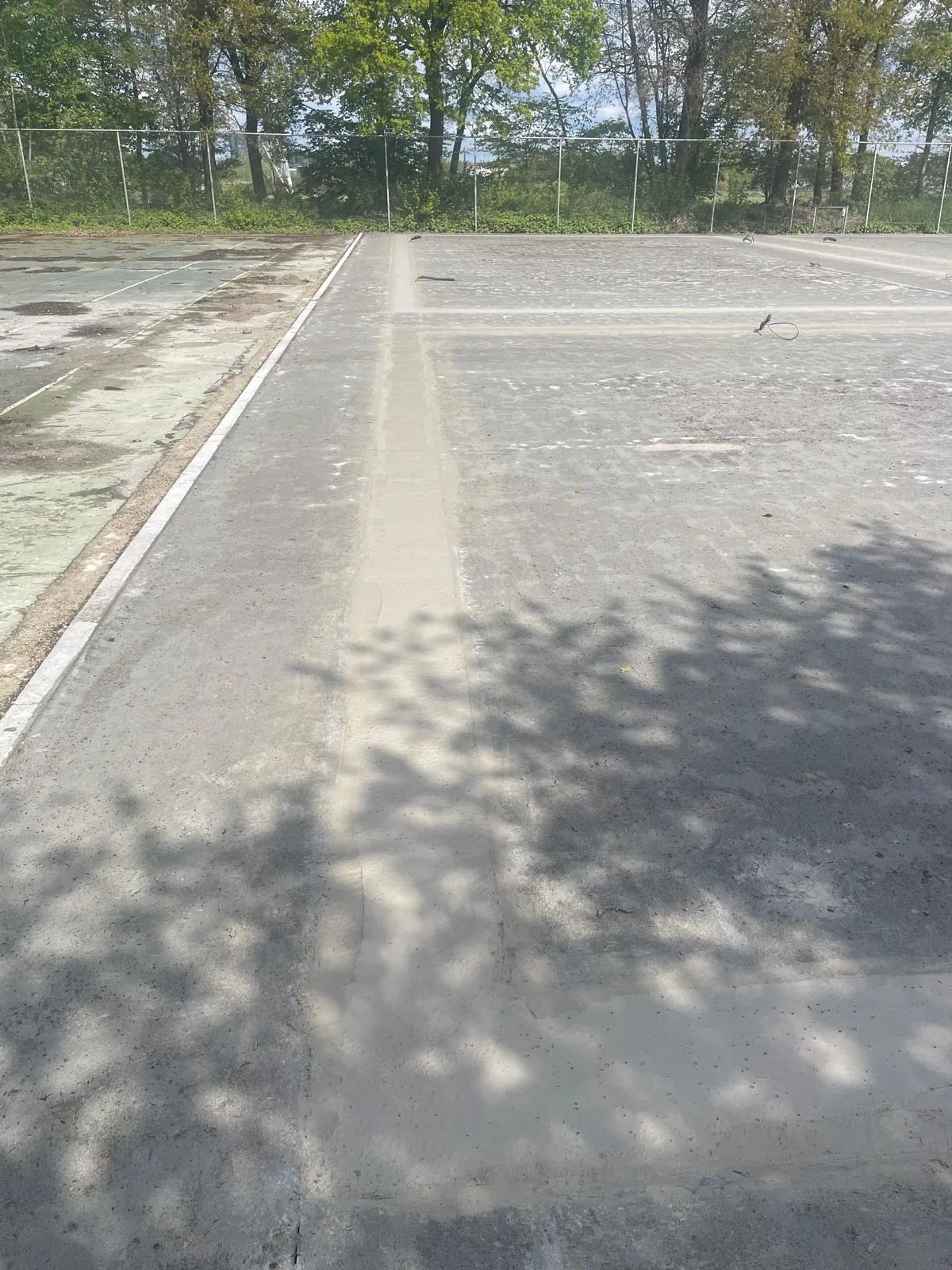
An existing tennis court foundation is suitable for padel if the surface is flat and stable, the water drainage works adequately and the structure is able to carry the anchoring points of the steel structure. If all three conditions are met, a large part of the existing substructure can be reused.
In practice there are a number of situations in which reuse works well. An asphalt court in good condition, without significant cracks or subsidence, is often an excellent base. The same applies to courts with a concrete sub-floor that is still level and has no structural damage. The top layer, such as gravel or hard court coating, is in all cases removed and replaced by padel-specific artificial turf.
Reuse is less obvious when the existing foundation is already older and shows signs of wear, when there is uneven subsidence or when the drainage structurally does not work. In those cases it is cheaper in the long term to replace the foundation than to have to carry out repair work afterwards.
How is an existing foundation assessed for suitability?
An existing foundation is assessed on the basis of a visual inspection, height measurements and in many cases a cone penetration test of the soil. The inspection looks at cracks, subsidence, drainage and the condition of the top layer. Based on that data, foundation advice is drawn up that indicates whether reuse is possible and which adjustments are needed.
Height measurements are important here. A padel court sets strict requirements for the flatness of the playing surface, because the ball bounce must be consistent across the whole court. Unevenness that is acceptable in tennis can cause problems in padel. Kiwa ISA Sport, the recognised inspection body in the Netherlands, applies specific standards for level and flatness when inspecting an artificial turf padel sports surface.
In addition to flatness, the load-bearing capacity of the subsoil is also examined. The legs of the steel structure are anchored at fixed points. If the soil at those points has insufficient load-bearing capacity, extra foundation blocks or a ring foundation must be installed, regardless of the condition of the existing surface.
What are the most commonly used foundation types for a padel court?
The three most commonly used foundation types for a padel court are drainage concrete, Supersub and ZOAB asphalt. Each type has its own characteristics and is suitable for specific situations. Besides these three, a ring foundation combined with strong plastic plates is also used as an alternative to poured concrete.
Drainage concrete
Drainage concrete is a water-permeable type of concrete where rainwater drains straight through the foundation into the subsoil. It is one of the most widely used solutions for outdoor padel courts. The average lifespan is between 25 and 40 years with correct use and maintenance. Drainage concrete is often combined with a ring foundation to absorb the forces of the steel structure properly.
Supersub
Supersub is a foundation solution based on foam concrete. It is lightweight, self-levelling and creates a flat and stable base. Supersub is shock-absorbing, which contributes to playing comfort and less strain on the joints. For renovations, such as converting a tennis court, a layer of around 10 cm is applied. For new builds this is usually 15 cm. A great advantage is that Supersub can in many cases be poured within one day.
ZOAB asphalt
ZOAB asphalt, also known as open asphalt concrete, is a porous type of asphalt that lets water through. It is less common than drainage concrete or Supersub for padel courts, but can be a good option in certain situations, for example when the location already has a ZOAB base layer that is still in good condition.
All foundation components must be approved by Kiwa ISA Sport in the Netherlands. Working with certified materials is not only a quality requirement, but also protects you against unintended non-conformity. This regularly happens with inexperienced buyers who source materials themselves without checking this.
Can a tennis court with asphalt or concrete be converted to padel?
Yes, both an asphalt and a concrete tennis court foundation can in many cases be converted into a padel court. The existing paving is then used as a base, on which a new top layer and, if necessary, an additional foundation layer are applied. Whether this is possible depends on the condition and flatness of the existing surface.
With an asphalt court in good condition, the approach is relatively simple. The existing top layer, such as a hard court coating or gravel, is removed. It is then assessed whether the asphalt is flat enough and whether the water drainage is adequate. If so, artificial turf can be laid directly after the steel structure has been installed. If there are minor unevennesses, a thin levelling layer or a Supersub layer of around 10 cm can be poured to correct the surface.
For a concrete base, much the same applies. Dense concrete without drainage provision requires extra attention to water drainage. This can be solved by applying a water-permeable top layer or by installing drainage around the court. A fully sealed concrete floor is technically less ideal for an outdoor padel court, but indoors it is a perfectly good base.
What is always needed in both cases: the anchoring points for the steel structure must be drilled or milled and fitted with the right anchoring mortar or foundation blocks. Regardless of the type of existing foundation, this is always part of the conversion.
What does it cost to make a tennis court foundation suitable for padel?
The cost of making an existing tennis court foundation suitable for padel varies widely and always depends on the location. As a guide, reusing an existing foundation in good condition is considerably cheaper than building a completely new foundation. You can think of a saving of several thousand euros per court.
The exact costs depend on the following factors:
- The condition of the existing foundation (cracks, subsidence, flatness)
- The type of foundation already present (asphalt, concrete, gravel)
- The adjustments needed for water drainage
- The thickness and type of additional foundation layer required
- The soil conditions at the anchoring points of the steel structure
- The accessibility of the location for equipment and transport
If the existing foundation is in good condition and only needs a new top layer, the foundation costs are relatively limited. If larger corrections are needed, the costs rise. For a completely new foundation for an outdoor padel court, costs average between €20,000 and €40,000 per court, depending on the situation. Reusing an existing substructure can reduce that amount considerably.
It is wise never to look only at the lowest price when choosing a foundation. A foundation that lasts 25 to 40 years, such as drainage concrete, pays for itself through lower maintenance costs and stable playing quality throughout the entire lifespan of the court.
When is a completely new foundation the better choice after all?
A completely new foundation is the better choice when the existing substructure has structural defects, the water drainage fundamentally does not work or the flatness of the surface can no longer be corrected with an additional layer. In those cases reuse causes more problems in the long term than it saves.
Specific situations in which a new foundation is advisable:
- Visible subsidence or uneven differences in height across the playing field
- Structural cracks in the concrete or asphalt that point to underground movement
- Chronic puddling after rain, which indicates failing drainage
- A foundation older than 25 to 30 years without recent maintenance
- Groundwork in the surrounding area that has affected the soil conditions
Also when you want to go from gravel or sand to a solid base, a new foundation is necessary. Gravel and sand bases are not suitable as a base for a padel court and cannot be reused.
A new foundation also gives more freedom in the choice of foundation type. You can then choose the type that best suits the location, the use and the budget, instead of having to compensate for the limitations of an existing substructure. That produces a court that is properly set up from the base, with a longer lifespan and less chance of problems afterwards.
At I-Padel we assess every location on its own merits. We take an honest look at what can be reused and what is better replaced, so you don't pay for more than necessary, but also not for less than is responsible.
Are you planning to convert a tennis court into a padel court and want to know more about the foundation options? Then take a look at our page about padel court foundations or get in touch for an initial exploration. We are happy to think along with you, without obligation.
Frequently asked questions
How long does it take to convert a tennis court into a padel court?
The lead time of a conversion depends heavily on the condition of the existing foundation and the adjustments required. If the foundation can be reused and only needs a new top layer, the conversion can be completed in a few days. If additional foundation work is needed, such as pouring a Supersub layer or installing drainage, you should allow for one to two weeks including curing time.
Do I need to apply for a permit to convert a tennis court into a padel court?
In many cases an environmental permit is required, mainly because the steel structure with glass walls is regarded as a structure. Whether and which permit is needed differs per municipality and depends on the location, the zoning plan and the dimensions of the structure. It is wise to check this with your municipality before the project, so you don't run into surprises during or after construction.
Can I convert one tennis court into two padel courts side by side?
In many cases that is possible, because a standard tennis court (23.77 x 10.97 metres) offers enough area for two padel courts of 20 x 10 metres each. You do have to allow for the free space needed around each court for the steel structure and safety margins. A good survey and drawing in advance is essential to determine whether the layout is technically feasible at your location.
What happens if the soil conditions under the anchoring points are insufficient?
If the soil at the anchoring points of the steel structure has insufficient load-bearing capacity, extra foundation blocks or a ring foundation are installed. This is a standard solution that is independent of the condition of the rest of the surface and is always part of a professional installation. Ignoring insufficient load-bearing capacity at these points can lead to subsidence or shifting of the structure, which is dangerous and requires costly repair work.
What maintenance work is needed on the foundation after the conversion?
A well-built foundation of drainage concrete or Supersub requires little active maintenance. It is important, however, to check the water drainage regularly and to make sure that drains and drainage channels stay free of leaves and dirt. It is also wise to visually inspect the anchoring points of the steel structure annually for movement or corrosion. The artificial turf top layer itself requires more regular maintenance and has an average lifespan of 8 to 12 years, depending on use and maintenance.
Is it possible to build an indoor padel court on an existing concrete tennis court floor?
Yes, an existing concrete floor is an excellent base for a padel court indoors. Because water drainage plays no role with an indoor court, a dense concrete floor without drainage provision is no obstacle. The floor does have to be flat and stable and meet the flatness standards applied by Kiwa ISA Sport. In many cases it is enough to level the existing floor and lay artificial turf directly, which considerably limits the conversion costs.
How do I choose the right contractor for converting my tennis court to padel?
Choose a contractor with demonstrable experience in padel court construction who works with Kiwa ISA Sport-certified materials. Always ask for reference projects and written foundation advice based on an inspection of your location, not on a standard quote. A reliable party will advise honestly on what can be reused and what must be replaced, instead of proposing a completely new foundation by default or downplaying all the risks.


