


Building a padel court · 20 July 2026 · 12 min read
6 reasons why a level foundation is crucial when building a padel court
A poor foundation under your padel court costs you far more than you think. Discover 6 reasons why a level base is essential.
In this article
- What a poor foundation really costs you
- 1: Artificial turf stays flat and playable for longer
- 2: The steel structure stands stable and safe
- 3: Drainage works as intended
- 4: Certification and inspection go smoothly
- 5: Sound-absorbing panels hang correctly
- 6: Maintenance costs stay low in the long term
- How to approach the foundation of your padel court properly
- How I-Padel helps with the foundation of your padel court
- Frequently asked questions
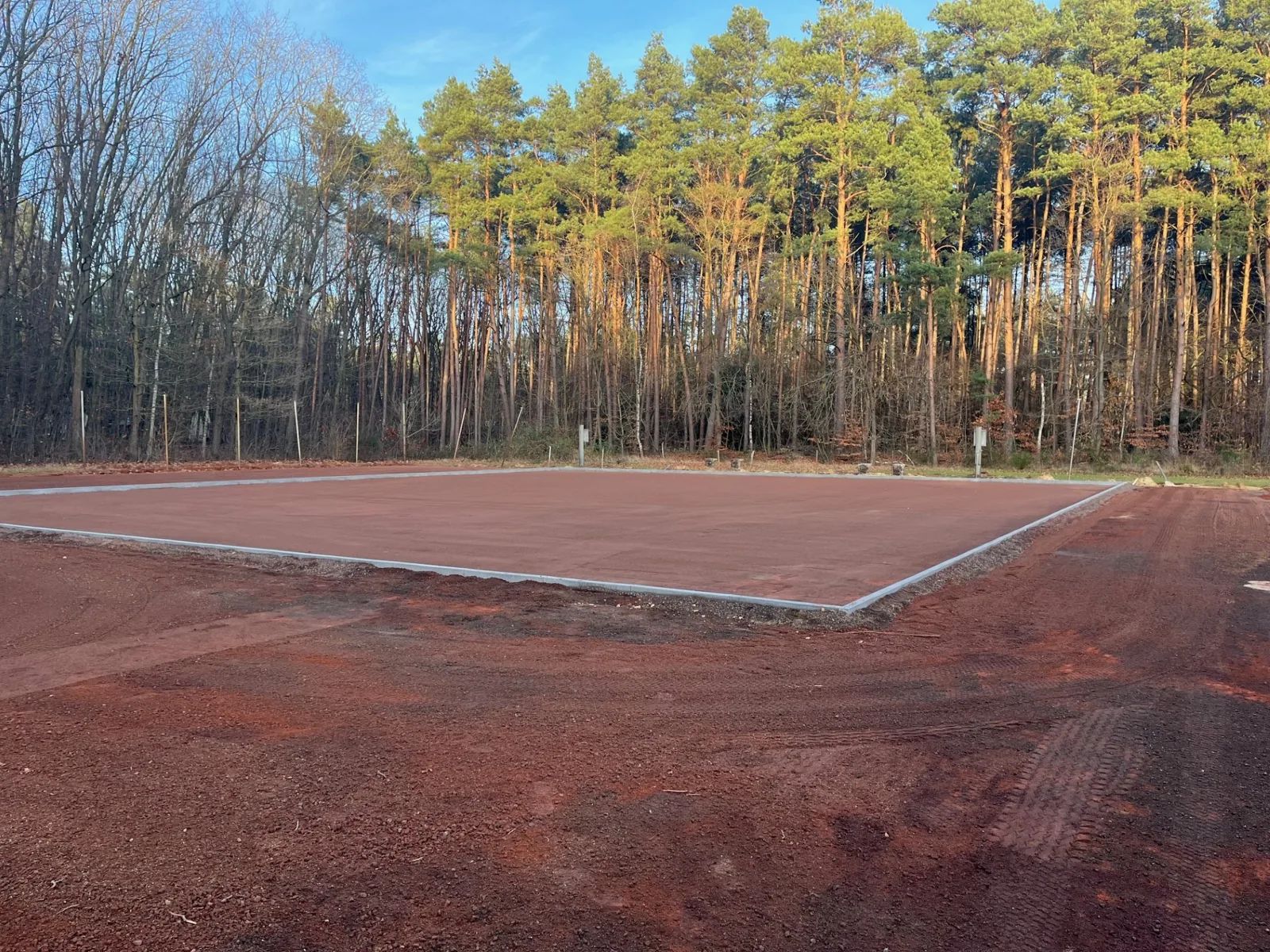
When building a padel court, most attention often goes to the steel structure, the glass and the artificial turf. The foundation literally disappears below the surface, but it largely determines how long your court lasts and how well it plays. A level, stable base is not a luxury, it is the basis of everything. Below you will read six concrete reasons why a good foundation is essential, followed by a practical overview of how to approach it.
What a poor foundation really costs you
A foundation that is not up to standard only becomes noticeable when it is too late. Settlement, a tilting steel structure, puddles on the playing surface or problems at inspection: these are not theoretical risks, but common consequences of careless construction. And by the time you see those problems, the repair costs are usually many times what a good foundation would have cost at the outset.
Anyone who only looks at the lowest price per court misses an important part of the total investment. For outdoor padel courts the foundation is the biggest cost factor and also the factor with the greatest impact on the lifespan of the whole. A good foundation protects your investment in the long term. The six reasons below make clear why.
1: Artificial turf stays flat and playable for longer
A padel court stands or falls with the quality of the playing surface. If the base sinks, shifts or becomes uneven, the artificial turf moves with it. Seams start to open, the sand infill distributes unevenly and the ball bounce becomes unpredictable. For recreational players that is annoying, for competition players it is unacceptable.
Foundation solutions such as Supersub (a light, self-levelling foam concrete) and drainage concrete are specifically designed to achieve an extremely flat surface. Supersub is even sound-dampening and shock-absorbing, which contributes to playing comfort and less strain on joints. Drainage concrete has an average lifespan of 25 to 40 years when used correctly, which means the artificial turf can be replaced several times in that period without the base having to be rebuilt.
For venues whose courts are played on intensively, such as commercial padel centres or tennis clubs that run several hours a day, a flat and stable foundation is immediately noticeable in the maintenance of the artificial turf. Fewer corrections, fewer replacements and more consistent playing behaviour over the years.
2: The steel structure stands stable and safe
The steel structure of a padel court exerts considerable forces on the base. Wind load, the weight of glass walls and the dynamic load during play call for a foundation that absorbs this without moving. Drainage concrete has a load-bearing capacity of up to approximately 5 tonnes, which is sufficient for the heaviest steel structures including glass walls.
A foundation that settles or moves pulls the steel structure with it. Connections come under stress, glass can crack and the safety of the court is compromised. For outdoor padel courts, drainage concrete is therefore often combined with a ring foundation with steel reinforcement, so that the forces from the structure and the wind load are well distributed across the ground.
For locations with specific soil conditions, such as soft clay or sites near water, a site-specific structural calculation is indispensable. The foundation is then tailored to the actual conditions, not to a standard solution that is the same everywhere. That is exactly where customisation makes the difference.
3: Drainage works as intended
Standing water on a padel court is not just annoying, it damages the artificial turf, accelerates wear and makes the court unplayable after rain. For outdoor padel courts, drainage is therefore one of the most critical functions of the foundation. Both drainage concrete and Supersub (in the water-permeable outdoor variant) are designed to drain rainwater straight through the foundation into the ground.
Drainage concrete has an open structure through which water penetrates immediately, even in heavy rainfall. Supersub can handle up to 500 mm of rainfall per hour, which is more than sufficient in Dutch climate conditions. Puddle formation is prevented and the court dries quickly, so the playing schedule does not depend on the weather.
Anyone who chooses a foundation without proper drainage notices it after the first heavy downpour. Remedial work on an existing foundation is costly and disruptive. It is one of the most avoidable problems when building a padel court, provided the right choices are made at the outset.
4: Certification and inspection go smoothly
For official matches and competition, an inspection by Kiwa ISA Sport is mandatory. Kiwa ISA Sport is the recognised body that tests padel courts for safety, dimensions and playing quality. A court that does not meet the standards is not approved and cannot be used for official purposes. The foundation plays a direct role in this: an uneven playing surface or unstable structure leads directly to rejection.
All foundation components used for padel courts in the Netherlands must be inspected by Kiwa ISA Sport. That applies to drainage concrete, Supersub and ZOAB asphalt (open-graded asphalt concrete, a porous asphalt variant that lets water through). Anyone who works with non-certified materials runs the risk of the court being rejected at inspection, with all the delays and extra costs that entails.
For tennis clubs and commercial venues that want to use their courts for competition, this is no detail. An inspection that goes smoothly starts with the right choice of materials and a correctly built foundation package. That is a reason to work exclusively with certified materials when building a padel court, and with a party that demonstrably knows about this.
5: Sound-absorbing panels hang correctly
Noise nuisance is one of the biggest hurdles in realising padel courts near residential areas. Sound-absorbing panels offer a proven solution: they are placed on the outside of the cage structure and absorb the sound instead of reflecting it back. But these panels have a direct influence on the wind exposure of the structure, and thus on the load the foundation must absorb.
When panels reduce the wind permeability of the cage, the wind load on the structure increases. The steel structure must then be structurally reinforced, with heavier posts, additional columns or adapted connections. That reinforced structure in turn places higher demands on the foundation. A foundation calculated for a standard court without panels may not be suitable for a court with sound-absorbing panels.
This is an aspect that is regularly underestimated in practice. A level and stable foundation that is matched to the actual load of the structure, including the influence of sound-absorbing panels, ensures that the panels hang correctly, the structure remains stable and the noise reduction stays effective in the long term. A site-specific structural calculation is not an unnecessary luxury here, but a requirement.
6: Maintenance costs stay low in the long term
A well-built foundation is an investment that pays for itself. Drainage concrete has a lifespan of 25 to 40 years with correct use and maintenance. Supersub is hardly sensitive to settlement or cracking and is fully recyclable. Both solutions require little maintenance and are easy to repair if needed.
A poor foundation, on the other hand, leads to a chain of problems that each require separate repair work: artificial turf that has to be pulled tight again, connections in the steel structure that have to be retightened, water problems that damage the playing surface. All those interventions cost time, money and closure of the court. For a commercial venue, closure means an immediate loss of revenue.
The choice of the right foundation when building a padel court has a direct influence on the total operating costs over the lifespan of the court. Anyone who invests in a solid base at the outset pays less over the years. That is a calculation that holds for every location, whether it concerns an indoor padel court in a sports hall or an outdoor court at a tennis park.
How to approach the foundation of your padel court properly
A good foundation starts with good preparation. The choice of the right foundation type depends on several factors: the soil conditions at the location, the expected drainage, the use of the court, the budget and any noise requirements from the municipality. There is no universal answer, every location requires its own assessment.
The three most commonly used foundation types for padel courts are:
- Drainage concrete: a water-permeable concrete that drains rainwater directly through the foundation. Widely used for outdoor padel courts, high stability and load-bearing capacity, lifespan of 25 to 40 years.
- Supersub: a foundation solution based on foam concrete. Self-levelling, shock-absorbing, water-permeable (outdoor) and sound-dampening. In many cases it can be poured within one day.
- ZOAB asphalt: open-graded asphalt concrete that lets water through. Less common for padel, but in certain situations a suitable option depending on the location and use.
In addition to the type of foundation, the site-specific structural calculation is essential. Wind load, soil conditions and any sound-absorbing panels together determine the requirements the foundation must meet. A cone penetration test (CPT) report of the subsoil is the starting point for this. Without that data, foundation advice is no more than an estimate.
For a complete picture of the costs involved in a project, including the foundation, it is also useful to look at the cost of an indoor padel court as a reference point for the total investment.
How I-Padel helps with the foundation of your padel court
We guide the entire foundation process, from the first site check through to the delivery of a certified base. In concrete terms, that means:
- Analysis of the soil conditions based on cone penetration test data.
- Advice on the most suitable foundation type for your location and use: drainage concrete, Supersub or ZOAB asphalt.
- Site-specific structural calculation, including the influence of sound-absorbing panels or specific wind load.
- Supply and installation of certified foundation materials only, inspected by Kiwa ISA Sport.
- Full integration of the foundation into the complete package, so that one party is responsible for the whole.
Whether you want to realise a single court or a complete padel venue with multiple courts, we are happy to think along with you, without obligation, about the best approach for your situation. Find out everything about the foundation for padel courts and receive tailor-made advice.
Frequently asked questions
On average, how much does a good foundation for a padel court cost?
The cost of a foundation varies greatly by location, foundation type and soil conditions. As a rule of thumb, the foundation is the biggest cost factor within the total project for outdoor padel courts. Drainage concrete and Supersub each have a different price level, but both pay for themselves through low maintenance costs over a lifespan of 25 to 40 years. An exact cost estimate is only possible after a site check and a cone penetration test report.
Can I reuse an existing foundation if I want to build a padel court on a site that has been built on before?
That depends entirely on the condition, type and load-bearing capacity of the existing foundation. An existing concrete floor or asphalt layer by no means always meets the requirements for a padel court, think of water permeability, flatness and a load-bearing capacity of approximately 5 tonnes. A cone penetration test report and inspection of the existing base are necessary to assess whether reuse is justified or whether a new foundation is the better choice.
What is the difference between drainage concrete and Supersub, and how do I choose the right type for my situation?
Drainage concrete is a proven, robust solution with a high load-bearing capacity and a lifespan of 25 to 40 years, ideal for locations with heavy structures or intensive use. Supersub is a lighter foam concrete solution that is self-levelling, shock-absorbing and sound-dampening, and can often be poured within one day. The choice depends on factors such as soil conditions, planning, budget and whether sound-absorbing panels are used. A site-specific structural calculation determines which type is most suitable.
How long does it take to build a foundation for a padel court?
The lead time differs per foundation type and site conditions. Supersub can in many cases be poured within one day, after which a curing time applies before the next construction phase can start. Drainage concrete usually takes somewhat longer because of the construction of the foundation package and the ring foundation with steel reinforcement. Also allow time for preparatory work such as groundwork, drainage and processing the cone penetration test report.
What happens if I have the foundation built by a party that does not work with Kiwa ISA Sport-certified materials?
Then you run a serious risk that the court will be rejected at inspection, which means the court may not be used for official competition or matches. Besides the delay, this entails extra costs for remedial work or rebuilding (part of) the foundation. In the Netherlands, inspection by Kiwa ISA Sport is mandatory for official use, and all foundation components must be demonstrably certified.
Do I have to commission a new cone penetration test report for every additional padel court at the same location?
Not always, but it is wise to assess this case by case. If courts at the same location are built under the same soil conditions, an existing cone penetration test report can sometimes be reused. For an extension on a different part of the site, or when soil conditions may vary locally, an additional test is advisable. A cone penetration test report is the basis for reliable foundation advice and prevents unpleasant surprises during or after construction.
What common mistakes should I avoid when planning the foundation of my padel court?
The most common mistakes are: choosing the cheapest option without considering the total operating costs, not commissioning a cone penetration test report and assuming a standard solution, forgetting that sound-absorbing panels place extra demands on the foundation, and working with non-certified materials. In addition, drainage is regularly underestimated, resulting in puddles and damage to the artificial turf. All these mistakes are avoidable with good preparation and a party that guides the entire process.


