


Building a padel court · 8 August 2026 · 12 min read
5 things you need to know about the ground before building a padel court
The wrong ground can cost you thousands of euros. Discover the 5 essentials of padel court foundations before you sign a quote.
In this article
- Why the ground makes or breaks your investment
- 1: Every location requires a different foundation solution
- 2: What are the differences between drainage concrete, Supersub and ZOAB?
- 3: Outdoor courts require a heavier and more expensive foundation
- 4: Kiwa ISA Sport certification is mandatory, not optional
- 5: Ring foundation and plastic plates as an alternative to poured concrete
- Have the foundation calculated before you accept a quote
- How I-Padel helps with the foundation of your padel court
- Frequently asked questions
The foundation of a padel court often gets less attention during the planning phase than the steel structure, the glass or the LED lighting. Yet the ground is the base on which everything rests, both literally and figuratively.
The wrong choice leads to subsidence, tilting and premature damage to the structure. Anyone who wants to build a padel court is well advised to take the ground seriously before a quote is signed. In this article we list five essential things you need to know about the ground.
Why the ground makes or breaks your investment
A padel court is a substantial investment. The foundation largely determines how long that investment lasts and how much maintenance you will need along the way. Without a stable, well-designed base, problems arise that cannot simply be fixed: subsidence that pulls the structure out of line, moisture problems that damage the artificial turf or waterlogging that makes the court unplayable after rain.
What many clients underestimate is that the foundation is not separate from the rest of the project. The ground conditions, the wind load at the location, the use of sound-absorbing panels and the choice between an indoor or outdoor court all have a direct influence on what needs to be done beneath the court. Anyone who discovers this only after the quote has been accepted will face unexpected extra costs.
The five points below will help you ask the right questions and make the right choices before work begins.
1: Every location requires a different foundation solution
There is no universal foundation solution that works at every location. Ground conditions differ from place to place: clay, sand, peat and mixed soil types each call for a different approach. What works perfectly well at a sports park in the west of the Netherlands can cause problems at a location in the north or on a former industrial site.
That is why a cone penetration test (sondering), a ground investigation in which the load-bearing capacity of the soil is measured, is an indispensable step before any foundation advice. Based on the test data, it is determined which foundation type is suitable, how deep the foundation needs to go and whether additional measures are required. Without this investigation, any foundation advice is a gamble.
In addition to the ground conditions, the wind load at the location, the proximity of buildings and the presence of sound-absorbing panels also play a role. Panels reduce the wind permeability of the cage structure, which increases the wind pressure on the foundation. This must be taken into account structurally in the design. Anyone who ignores this builds a court that works on paper but falls short in practice.
2: What are the differences between drainage concrete, Supersub and ZOAB?
The three most commonly used foundation types for padel courts are drainage concrete, Supersub and ZOAB asphalt. Each has its own properties, field of application and cost profile. It is important to understand what sets them apart so that you can make an informed choice.
Drainage concrete
Drainage concrete is a water-permeable type of concrete in which rainwater is drained directly through the foundation into the ground. The open structure of the material makes this possible. It is a proven solution for outdoor padel courts where fast water drainage, high stability and a long service life are key.
Drainage concrete has an average lifespan of 25 to 40 years with correct use and maintenance, and is resistant to frost, heat and intensive use. For padel courts, drainage concrete is often combined with a ring foundation with steel reinforcement to properly absorb the forces from the steel structure and the wind load.
Supersub
Supersub is an innovative foundation solution based on foam concrete, a light and self-levelling type of concrete that provides a flat and stable base. The material is shock-absorbing, water-permeable in the outdoor version, and in many cases can be poured within a single day.
Supersub is also suitable for renovation projects, such as converting a tennis court into a padel court, where a thickness of around 10 cm is sufficient. For new builds the standard thickness is around 15 cm. An additional advantage is sustainability: the material is fully recyclable and requires considerably less transport and raw material than traditional foundations.
ZOAB asphalt
ZOAB asphalt, also known as porous asphalt, is a porous type of asphalt that lets water through. It is less common as a foundation solution for padel courts than drainage concrete or Supersub, but can be a good option in specific situations, depending on the location, the budget and the technical requirements. An advisor who knows all three types and can advise independently will help you make the trade-off that suits your situation.
3: Outdoor courts require a heavier and more expensive foundation
If you compare an indoor padel court with an outdoor padel court, you will quickly notice that the cost differences are considerable. A large part of that difference lies in the foundation. With an outdoor court, the foundation has to cope with weather, temperature changes, precipitation and wind load, which hardly play a role, if at all, in a covered location.
The steel structure of an outdoor court must be built heavier and better protected, as standard with hot-dip galvanised steel. This has direct consequences for the requirements of the foundation: it must be able to absorb the higher load. Moreover, the foundation build-up for an outdoor court depends heavily on the location, which makes it difficult to give a fixed price. As an indication, the foundation costs for an outdoor padel court average between €20,000 and €40,000, depending on ground conditions, accessibility and the civil works required.
With existing tennis courts, part of the sub-base can sometimes be reused, which saves costs. Whether this is possible depends on the condition and type of the existing foundation. A site check in advance gives clarity on this. You can find more background on the total cost of a padel court in our extensive overview.
4: Kiwa ISA Sport certification is mandatory, not optional
All foundation components used for padel courts in the Netherlands must be certified by Kiwa ISA Sport. This is not a non-binding recommendation, but an obligation for locations that want to organise official competitions or that fall under Dutch building regulations. Kiwa ISA Sport is the recognised body that assesses sports surfaces and foundation solutions for safety, performance and durability.
In practice, this means that as a client you need to check whether the materials a contractor proposes are actually certified. Not all providers are equally transparent about this. Inexperienced buyers run the risk of accepting materials that do not meet Dutch standards, with the result that the court is later not approved for official use or that a dispute arises over liability in the event of damage.
Ask explicitly about the certification of the foundation materials in every quote. A reliable provider can demonstrate this immediately and works exclusively with certified products. This applies to all foundation types: drainage concrete, Supersub and ZOAB asphalt all fall under the inspection requirement.
5: Ring foundation and plastic plates as an alternative to poured concrete
In addition to the three common foundation types, there are also alternative methods that in certain situations offer a better or more cost-efficient solution. Two of these are the ring foundation and strong plastic plates.
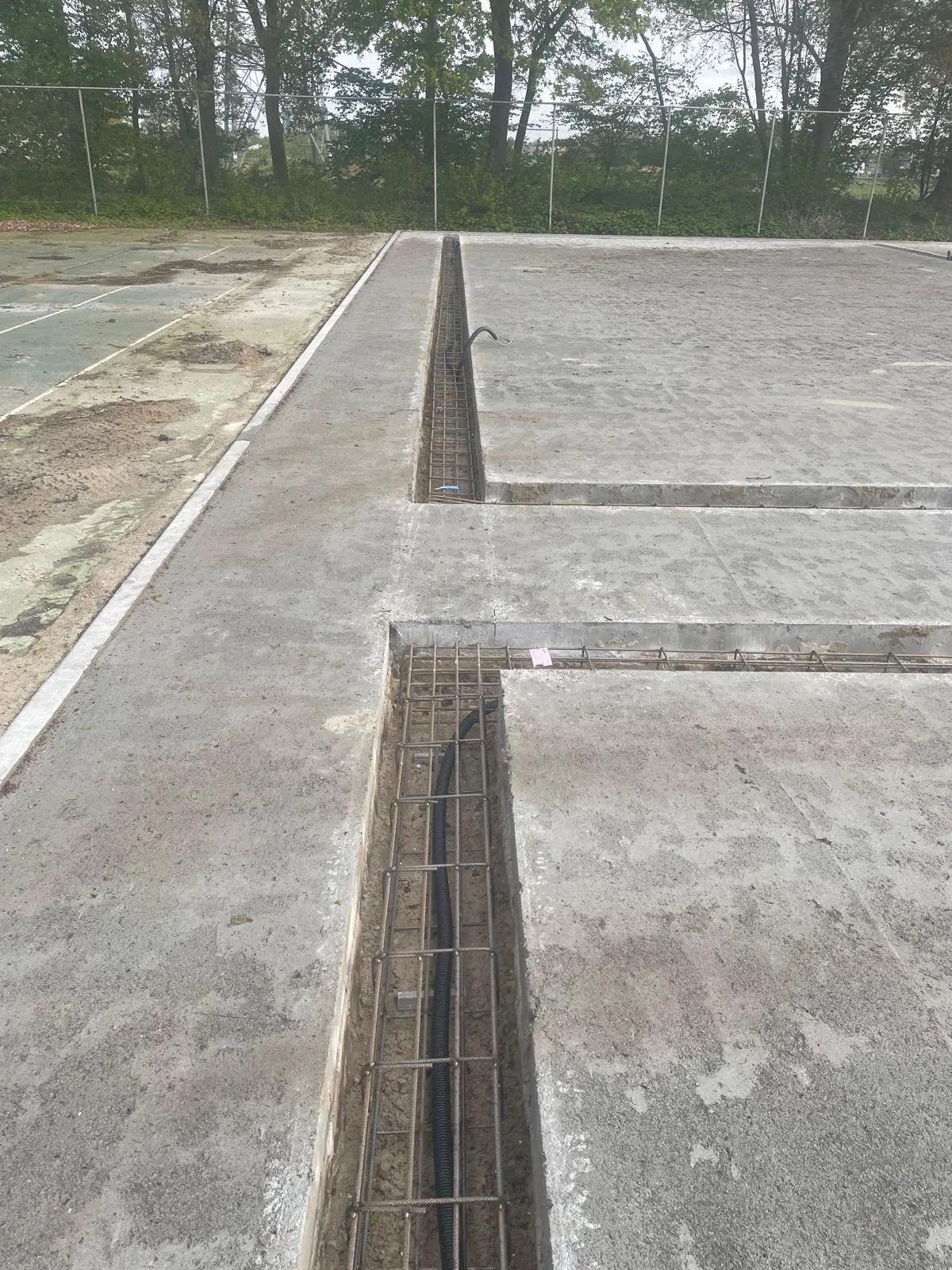
A ring foundation is a concrete foundation that is placed only under the legs of the steel structure, instead of a full concrete slab across the entire playing area. This method is often combined with a water-permeable sports surface as the top layer. The advantage is that less concrete is needed, which saves costs and reduces the ecological impact. The ring foundation must, however, be fitted with steel reinforcement to properly distribute the forces from the structure and the wind load.
Plastic plates are another alternative used in specific situations, for example at locations where pouring concrete is difficult or where a lighter solution is desired. They provide a stable base without the logistical complexity of a poured concrete slab. Whether this method is suitable for a specific location depends on the ground conditions and the structural requirements of the court.
Neither alternative is a standard solution that can always be applied. They call for careful consideration based on site data, use and budget. Tailored structural foundation advice is the only responsible route here too.
Have the foundation calculated before you accept a quote
The foundation is the least visible part of a padel court, but the most decisive for the service life and stability of the entire installation. Anyone who treats the foundation as an afterthought or has it calculated only afterwards risks extra costs, delays or technical problems that are difficult to correct later.
Good foundation advice starts with a site check and cone penetration test data. Only then can a responsible choice be made for the right foundation type, the right thickness and the right combination with the steel structure. This applies to new courts as well as to renovation projects where an existing base is reused or replaced.
How I-Padel helps with the foundation of your padel court
We guide the entire foundation process, from the first site advice through to handover. Because we produce the steel structure ourselves, we can calculate and coordinate the foundation and the structure as a single whole. This prevents the interface mismatches that arise when the foundation and the structure are supplied by different parties.
- We work with all three common foundation types: drainage concrete, Supersub and ZOAB asphalt.
- We advise based on your location, ground conditions and use, not on what we happen to have in stock.
- We work exclusively with Kiwa ISA Sport-certified materials.
- We recalculate the structure when sound-absorbing panels are used, so that the wind load is correctly accounted for.
- We take care of the complete package: from groundwork and foundation to steel structure, glass, artificial turf and LED lighting.
Want to know which foundation solution best suits your location? Get in touch for an initial exploration, we are happy to think along with you, no obligation.
Frequently asked questions
On average, how long does it take to build a foundation for a padel court?
The lead time depends on the chosen foundation type and the site conditions. Supersub can in many cases be poured within a single day, while a traditional drainage concrete slab, including curing, usually takes two to five working days. Also allow for preparatory work such as groundwork, cone penetration testing and any drainage, which can extend the total construction time.
What does a cone penetration test cost and is it really necessary if the ground looks stable?
A cone penetration test costs between €300 and €800 on average, depending on the number of measuring points and the location. It is absolutely necessary, even if the ground looks stable: clay and peat layers can be present at depth without being visible at the surface. Without test data, any foundation advice is an assumption, and the cost of a failed foundation far exceeds that of a cone penetration test.
Can I reuse an existing concrete slab, for example from an old tennis park, as a foundation for a padel court?
That is sometimes possible, but it always requires a technical inspection of the existing base. The assessment looks at whether the slab has sufficient load-bearing capacity, is free of cracks or subsidence and whether its dimensions match the padel court. In renovation projects where a tennis court is converted, a layer of around 10 cm on top of the existing sub-base is often sufficient when Supersub is used, which saves considerable costs.
What happens if sound-absorbing panels are added later to a padel court that has already been built?
Adding sound-absorbing panels to an existing structure afterwards is technically risky if the foundation was not calculated for it. Panels reduce the wind permeability of the cage structure, which significantly increases the wind pressure on the legs and the foundation. It is strongly advisable to take this possibility into account in the initial foundation calculation, so that any later extension does not cause structural problems.
Which foundation type is most suitable if sustainability and environmental impact are a priority?
Supersub scores best in this respect: the material is fully recyclable, requires considerably less transport than traditional concrete and has a lower CO₂ footprint thanks to its lower material weight. The ring foundation is also a more sustainable choice than a full concrete slab, because less concrete is used. Discuss this preference explicitly with your advisor, so that sustainability goals are taken into account in the choice of foundation.
How do I recognise a quote in which the foundation has not been sufficiently worked out or has been undervalued?
Be alert if a quote states a fixed foundation price without a site check or cone penetration test having taken place, or if the foundation type is not specifically named. Other warning signs are the absence of a reference to Kiwa ISA Sport certification and no separate mention of the ring foundation or reinforcement. A reliable provider always specifies the foundation type, the thickness, the certification and the rationale for the choice explicitly in the quote.
What are the most common mistakes when building a padel court foundation and how do you avoid them?
The most common mistakes are: not having a cone penetration test carried out before construction, choosing the cheapest foundation type without weighing up the location, and not recalculating the wind load when sound-absorbing panels are used. These mistakes lead to subsidence, tilting and premature damage that are costly to repair afterwards. You avoid them by having the foundation and steel structure calculated as an integrated whole by a single party, based on current site and ground data.


