Noise nuisance from padel is a much-discussed topic, but there are also many misconceptions about it. Padel noise is often considered more problematic than it actually is, while other aspects, such as the structural consequences of noise reduction measures, are underestimated. Which assumptions are incorrect, and what is the technical reality? The seven questions below provide you with a clear and well-founded picture.
Does a padel court really produce more noise than a tennis court?
Yes, a padel court produces more noise on average than a tennis court. The sound power level of a padel court is estimated at approximately 91 dB, which is roughly 10 dB more than tennis. This difference is not negligible: an increase of 10 dB is perceived by the human ear as approximately twice as loud.
The reason for this difference lies in the way padel is played. In padel, the ball does not only bounce on the artificial turf, but also regularly hits the glass walls and the fencing of the enclosure structure. These contact moments produce short, sharp sound peaks, also known as impulse noise. The enclosed structure of the court acts as a resonance box, amplifying the sound and directing it outward.
This does not automatically mean that every padel court causes nuisance. The degree of disturbance depends strongly on the distance to homes, the surroundings of the sports park, the number of people playing and the times at which games are played. At a well-designed location with sufficient distance from nearby residents, padel noise can remain within acceptable limits. However, it is a factor that must be taken into account during the planning process.
Is noise nuisance from padel always a problem for local residents?
No, noise nuisance from a padel court is not automatically a problem for local residents. Whether noise is perceived as disturbing depends on several factors that can vary significantly from one location to another. Distance, background noise, site layout and playing times all play a role.
A padel court in an urban environment with a lot of existing background noise is less likely to be perceived as disruptive than a court in a quiet location on the edge of a residential area. The orientation of the court in relation to homes also makes a difference: a court whose short sides face towards homes distributes sound differently from a court positioned parallel to the buildings.
Municipalities assess noise nuisance based on applicable standards and the specific circumstances of the surroundings. An independent acoustic consultancy can calculate the expected noise level at the nearest noise-sensitive locations. This calculation is generally part of the permit process. More about how this works in practice can be found on our page about acoustic solutions for padel.
Do noise barriers really help reduce padel noise?
Noise barriers can contribute to limiting noise nuisance, but they are not a universal solution. A freestanding noise barrier blocks and absorbs sound that spreads towards homes, but its effectiveness depends strongly on its height, length, position and the distance from the sound source.
A noise barrier works best when it directly screens the sound between the source and the receiver. For padel courts, this means that the barrier must be high enough to also intercept sound that escapes upwards. In practice, heights of 6 to 8 metres are used, sometimes over lengths of several tens of metres. This requires a structural calculation, soil investigation data and, in almost all cases, an environmental permit.
A noise barrier is also a transmission-path solution: it addresses the sound after it has left the source. This is a fundamental difference from a source-control measure, which addresses the sound at the court itself. Which approach is most suitable varies by project and location.
What is the difference between a noise barrier and sound-absorbing panels?
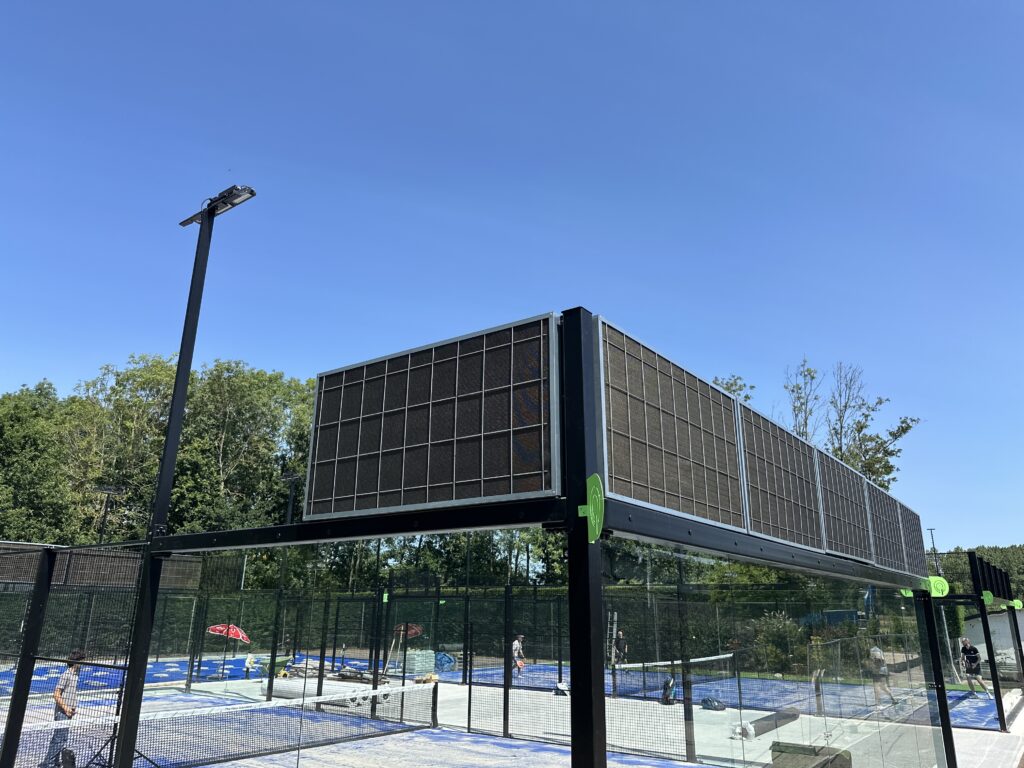
A noise barrier is a freestanding structure placed next to or around the padel court that blocks sound on its way towards the surroundings. Sound-absorbing panels are attached directly to the enclosure structure of the padel court and address the sound at the source, before it spreads. This is the fundamental difference.
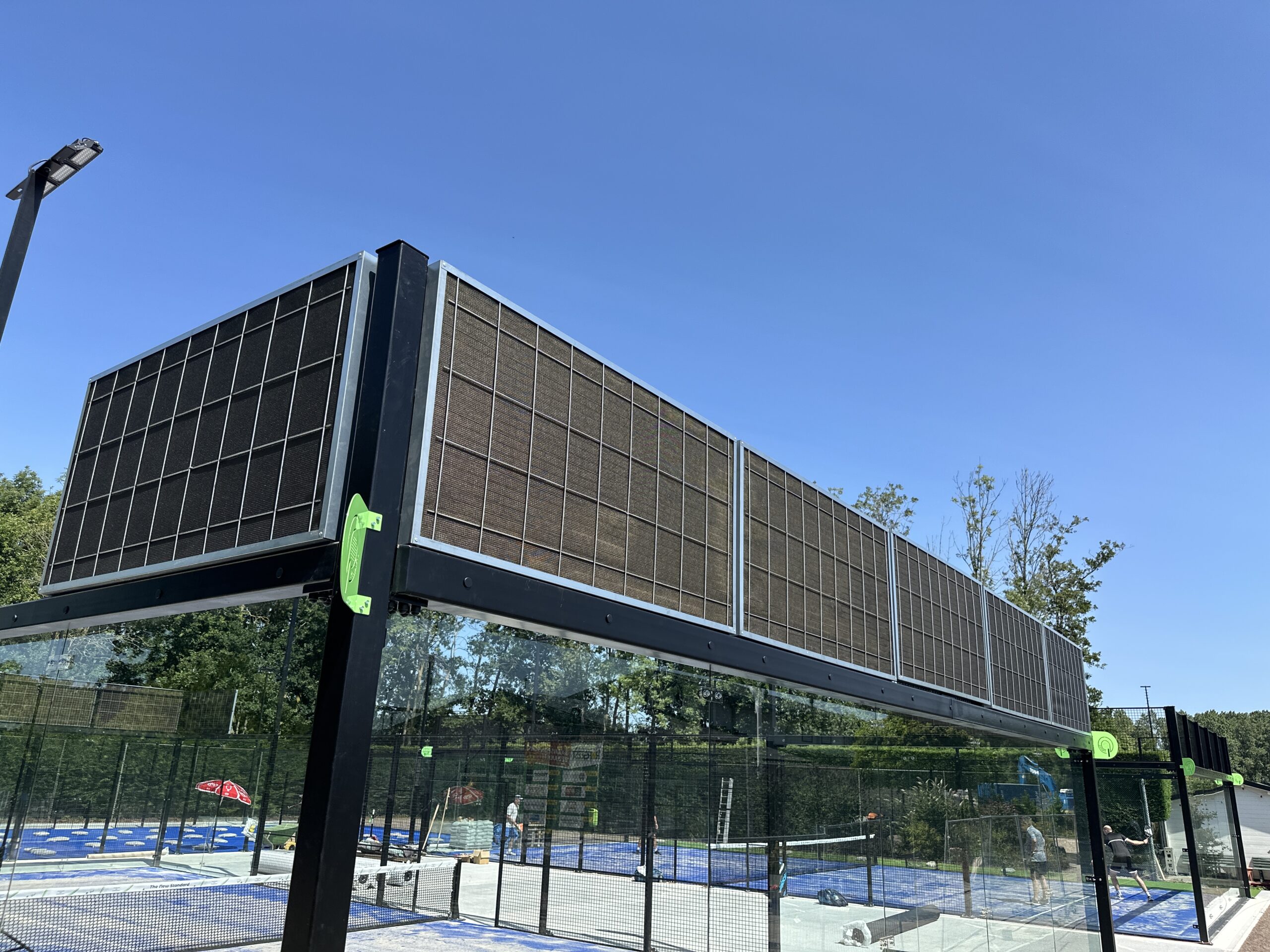
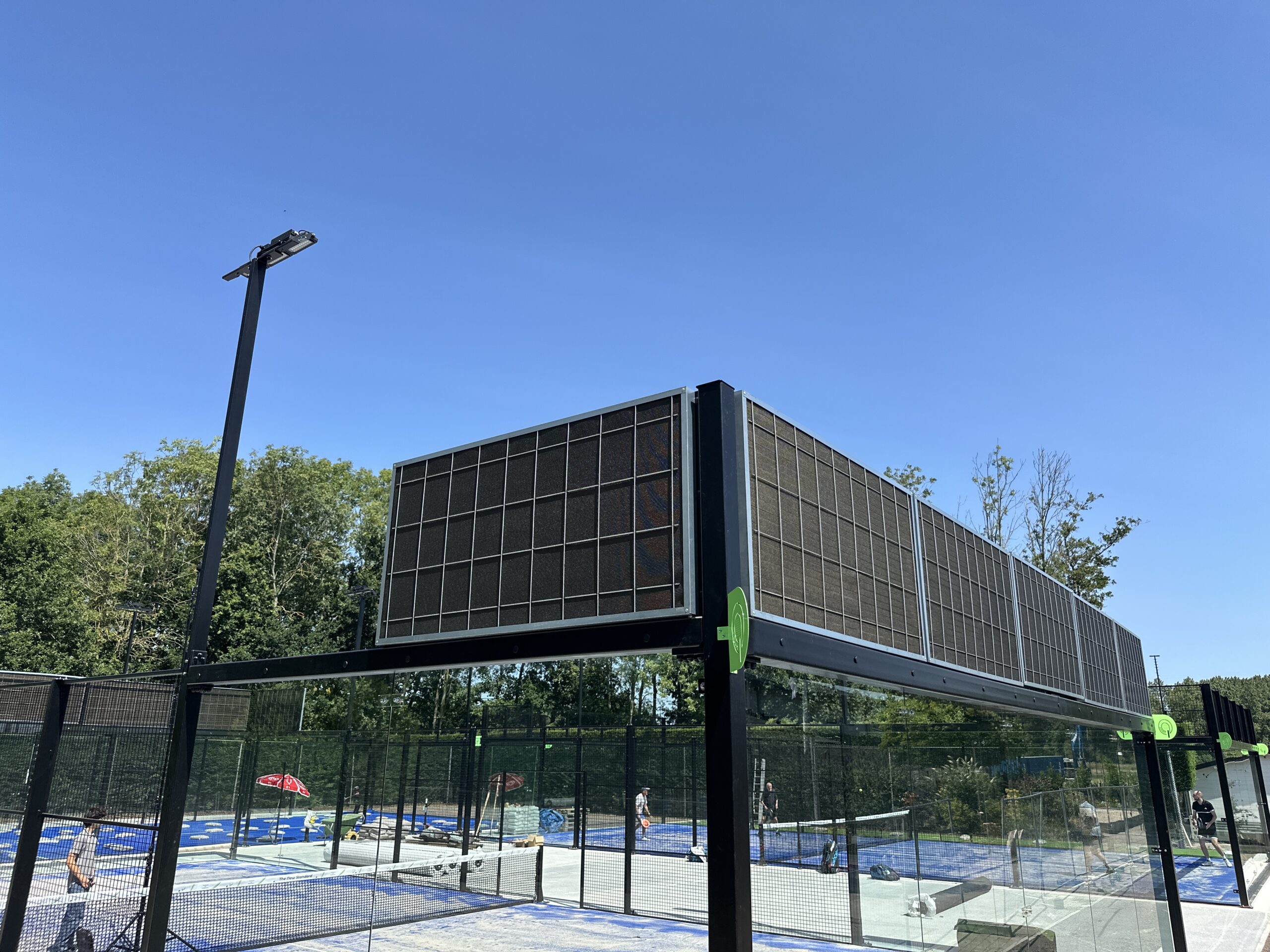
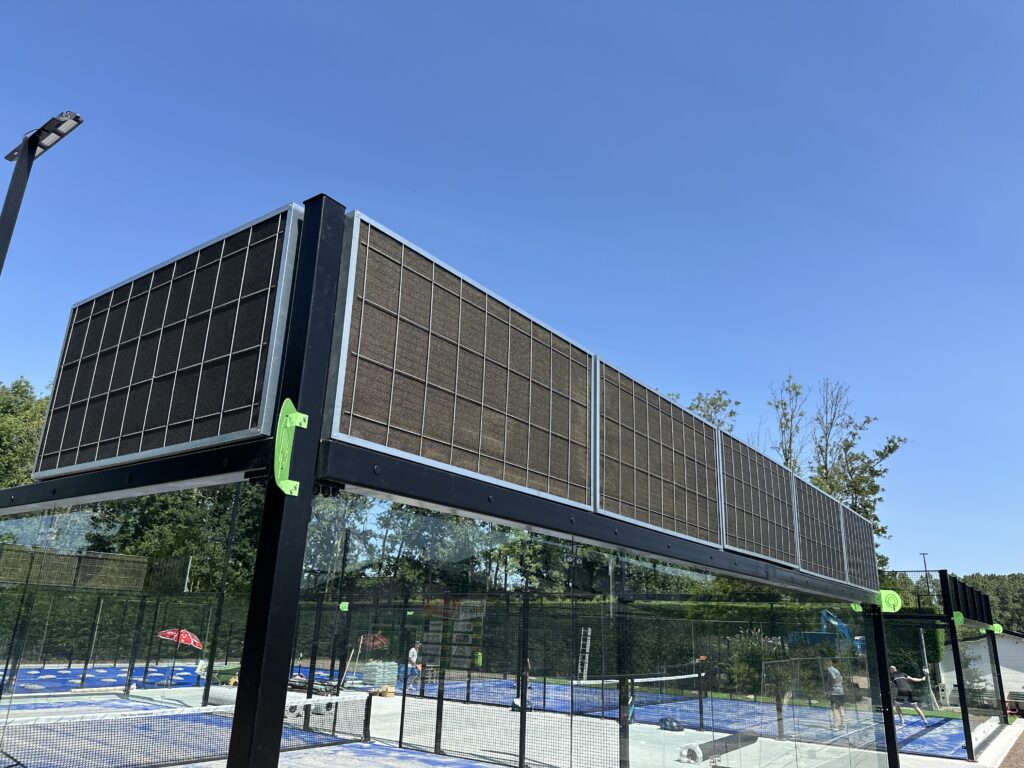
Sound-absorbing panels are what is known as a source-control measure. They are mounted on the outside of the mesh or fencing of the enclosure structure and absorb part of the sound energy released during play. The material used for this, such as rock wool, has an open fibre structure that partially absorbs sound waves instead of reflecting them.
A noise barrier works differently: it forms a physical barrier between the court and the surroundings. The sound leaves the court, but is blocked or absorbed by the barrier on its way towards the homes. In situations where the distance to homes is limited or the site layout does not provide space for a barrier, panels can be a more compact and practically feasible solution.
In some projects, a combination of both measures is used. Panels reduce the noise at the source, after which a noise barrier further limits the remaining sound. In certain situations, this can mean that the barrier can be constructed at a lower height, which both saves costs and can simplify the permitting process. More information about freestanding barriers can be found on our page about noise embankments around padel courts.
Do sound-absorbing panels affect the structure of the court?
Yes, sound-absorbing panels always affect the structure of the padel court. This is a technical fact that is regularly underestimated in practice. When panels are attached to the enclosure structure, they reduce the wind permeability of the structure. As a result, the wind load on the court increases.
An open enclosure structure allows most of the wind to pass through. As soon as part of these openings is closed off with panels, the structure behaves more like a solid surface. The wind force acting on that surface is considerably greater than with an open structure. If the steel structure has not been designed for this, risks to the stability and safety of the court can arise.
This means that the structure must be recalculated when sound-absorbing panels are used. Depending on the outcome, reinforcement may be necessary in the form of heavier posts, additional columns or modified connections. This applies both to new courts and to existing courts to which panels are added afterwards.
Because we manufacture the steel structure ourselves, we can incorporate these modifications during the engineering phase. This ensures that the structure is immediately adapted to the specific situation, including the additional load caused by the panels.
Is an acoustic study mandatory for an outdoor padel court?
An acoustic study is not legally mandatory in all cases, but in practice it is almost always part of the permit process for outdoor padel courts located next to homes or other noise-sensitive locations. The municipality determines which studies are required when assessing a permit application.
Whether an acoustic study is required depends on the distance to homes, the location of the site and the applicable rules in the zoning plan or environmental vision of the municipality. For locations in or near residential areas, a municipality will in most cases request an acoustic report before granting a permit.
An acoustic study is carried out by an independent acoustic consultancy. The consultancy calculates the expected noise level in the surrounding area and assesses it against the applicable standards. Based on these results, it can be determined whether additional measures are required and which measures are most appropriate for the specific situation.
We do not conduct acoustic studies ourselves, but we do provide the technical product specifications, structural data and engineering that an acoustic consultant needs to make accurate calculations. More about the permit process and the required documents can be found on our page about obtaining a permit for a padel court.
Can a padel court never be permitted if local residents object?
No, objections from local residents do not automatically mean that a permit will be refused. Municipalities assess permit applications based on objective criteria such as noise standards, spatial integration, structural safety and applicable regulations. Objections are taken into consideration, but they are not decisive if the project technically and legally complies with the requirements.
In practice, a well-substantiated application with a sound acoustic study and appropriate measures results in a stronger position during an objection procedure. If the study shows that the noise level remains within the applicable standards, or that measures are being taken to achieve this, the municipality has a substantive basis for granting the permit despite objections that have been submitted.
Objections from local residents are, however, a signal that communication and local support deserve attention. In many projects, early consultation with the neighbourhood helps to address concerns and allows the permit process to proceed more smoothly. A transparent approach in which technical measures are explained contributes to greater acceptance.
It is also good to know that an objection procedure takes time. A permit process already takes an average of 8 to 12 weeks, and objections can extend this further. A well-prepared application with all required documents, including structural calculations, an acoustic study and a site plan, reduces the likelihood of delays.
Are you unsure whether outdoor padel is feasible at your location?
We are happy to think along with you about the court configuration, structural preparation and possible noise reduction measures. Together with your acoustic consultant, we can assess which solution is technically feasible and suitable for the project. Contact us to discuss the possibilities.
Frequently Asked Questions
How early in the planning process should I consider noise reduction measures?
Noise reduction measures should be considered at the earliest stage of project development, preferably before the location has been finalised. The orientation of the court, the distance to homes and the site layout are all factors that are difficult to adjust afterwards. By involving an acoustic consultant and a structural engineer at an early stage, you can prevent costly modifications later on or avoid encountering a permit refusal.
What are the most common mistakes when applying for a permit for a padel court with noise reduction measures?
A common mistake is submitting a permit application without a complete acoustic report or without structural calculations that take into account the additional wind load of sound-absorbing panels. The orientation of the court in relation to local residents is also regularly overlooked, even though this has a major influence on sound distribution. An incomplete application almost always leads to delays and sometimes to rejection.
Can I add sound-absorbing panels to an existing padel court afterwards?
This is technically possible, but it always requires a new structural calculation of the existing enclosure structure. Because panels reduce wind permeability and thereby increase the wind load, it must be determined whether the current steel structure can withstand this additional load. In some cases, reinforcements are necessary, such as heavier posts or additional connections, which affects the costs and lead time.
Which standards are used in the Netherlands for noise from sports facilities such as padel courts?
In the Netherlands, noise from sports facilities is generally assessed according to the guidelines in the VNG publication ‘Companies and Environmental Zoning’ and, depending on the situation, according to the standards of the Activities Decree or the Environment Act. The permitted noise levels vary depending on the time of day: more lenient standards apply during the day than during the evening and night. An independent acoustic consultancy assesses the calculated noise level against the specific standards applicable to your location and municipality.
Does it make a difference whether the padel court is covered or fully outdoor in terms of noise issues?
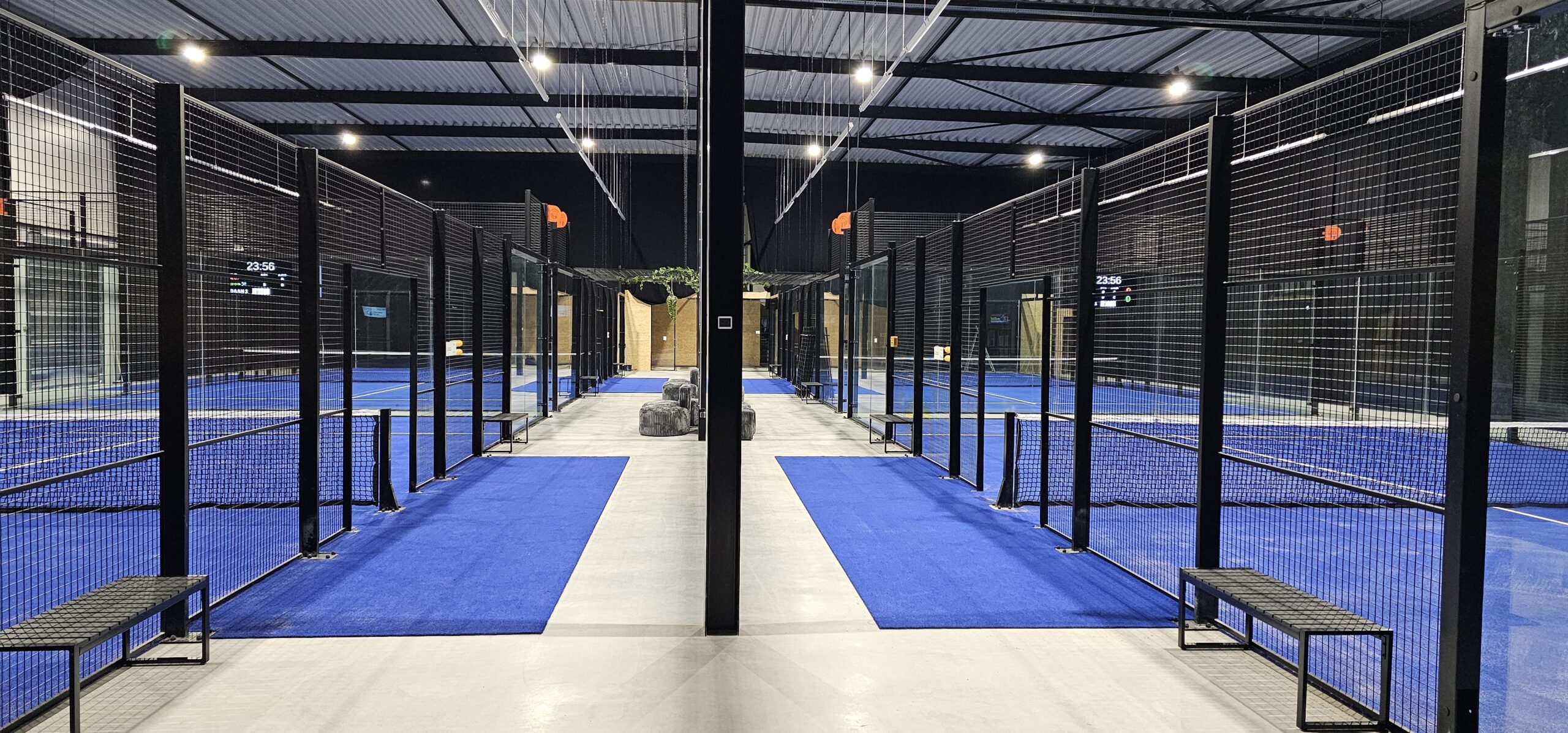
Yes, this makes a significant difference. A covered padel court with enclosed side walls can partially contain the sound, limiting its spread to the surrounding area — provided that the acoustics inside the hall are also properly addressed. With a fully outdoor court, the sound spreads freely in all directions, increasing the need for targeted measures such as barriers or panels. The choice between a covered or outdoor setup therefore has direct consequences for both the noise reduction approach and the permit process.
How much noise reduction can I realistically expect from sound-absorbing panels?
The exact reduction depends on the material used, the installation and the extent of the coverage, but in practice, high-quality sound-absorbing panels achieve a reduction of approximately 3 to 6 dB on the source side. This may sound modest, but a reduction of 3 dB is already perceived as a noticeable difference in sound intensity. In combination with a noise barrier, the overall effect can be considerably greater, which in some cases can reduce the required barrier height — and therefore the costs.
What can I do myself to create support among local residents before submitting the permit application?
Early and transparent communication is the most effective approach. Inform local residents about the plans before the permit application is submitted, explain which noise reduction measures will be implemented and give them the opportunity to ask questions. Sharing the results of a preliminary acoustic study — even if it is not yet final — shows that you take their concerns seriously. Local residents who feel that they have been heard are less likely to object and contribute to a smoother permit process.