
What misconceptions exist regarding noise nuisance at padel?
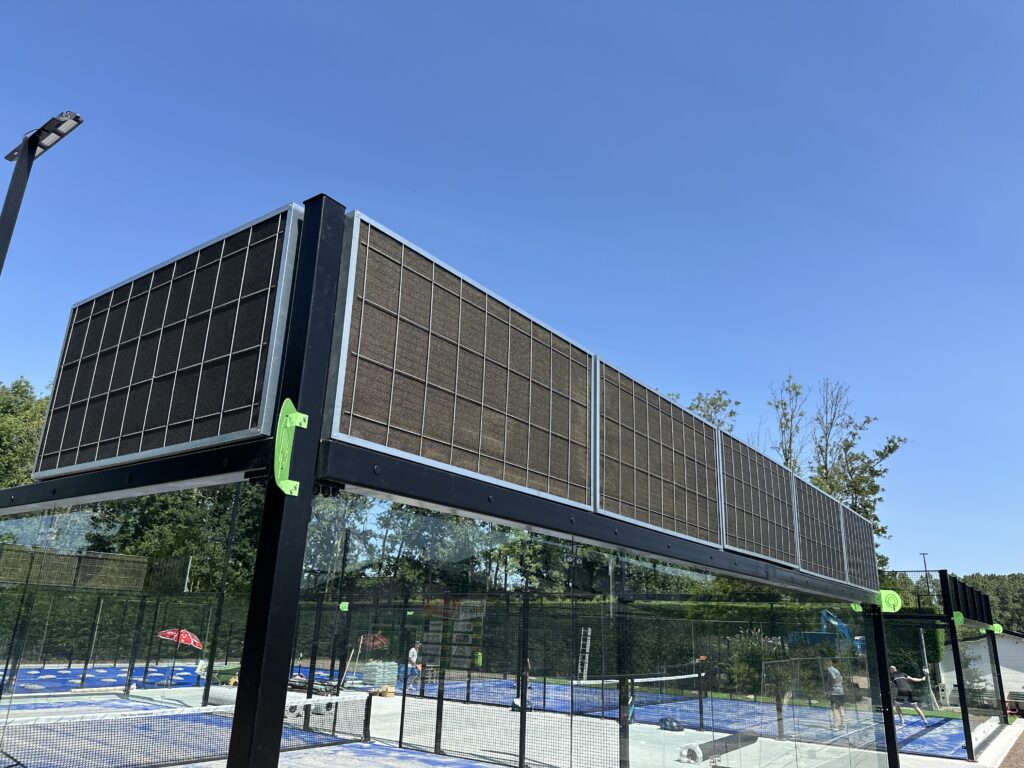
Noise nuisance from padel is a much-discussed topic, but there are also many misconceptions about it. Padel noise is often considered more problematic than it actually is, while other aspects, such as the structural consequences of noise reduction measures, are underestimated. Which assumptions are incorrect, and what is the technical reality? The seven questions below provide you with a clear and well-founded picture. Does a padel court really produce more noise than a tennis court? Yes, a padel court produces more noise on average than a tennis court. The sound power level of a padel court is estimated at approximately 91 dB, which is roughly 10 dB more than tennis. This difference is not negligible: an increase of 10 dB is perceived by the human ear as approximately twice as loud. The reason for this difference lies in the way padel is played. In padel, the ball does not only bounce on the artificial turf, but also regularly hits the glass walls and the fencing of the enclosure structure. These contact moments produce short, sharp sound peaks, also known as impulse noise. The enclosed structure of the court acts as a resonance box, amplifying the sound and directing it outward. This does not automatically mean that every padel court causes nuisance. The degree of disturbance depends strongly on the distance to homes, the surroundings of the sports park, the number of people playing and the times at which games are played. At a well-designed location with sufficient distance from nearby residents, padel noise can remain within acceptable limits. However, it is a factor that must be taken into account during the planning process. Is noise nuisance from padel always a problem for local residents? No, noise nuisance from a padel court is not automatically a problem for local residents. Whether noise is perceived as disturbing depends on several factors that can vary significantly from one location to another. Distance, background noise, site layout and playing times all play a role. A padel court in an urban environment with a lot of existing background noise is less likely to be perceived as disruptive than a court in a quiet location on the edge of a residential area. The orientation of the court in relation to homes also makes a difference: a court whose short sides face towards homes distributes sound differently from a court positioned parallel to the buildings. Municipalities assess noise nuisance based on applicable standards and the specific circumstances of the surroundings. An independent acoustic consultancy can calculate the expected noise level at the nearest noise-sensitive locations. This calculation is generally part of the permit process. More about how this works in practice can be found on our page about acoustic solutions for padel. Read more about noise reduction solutions Do noise barriers really help reduce padel noise? Noise barriers can contribute to limiting noise nuisance, but they are not a universal solution. A freestanding noise barrier blocks and absorbs sound that spreads towards homes, but its effectiveness depends strongly on its height, length, position and the distance from the sound source. A noise barrier works best when it directly screens the sound between the source and the receiver. For padel courts, this means that the barrier must be high enough to also intercept sound that escapes upwards. In practice, heights of 6 to 8 metres are used, sometimes over lengths of several tens of metres. This requires a structural calculation, soil investigation data and, in almost all cases, an environmental permit. A noise barrier is also a transmission-path solution: it addresses the sound after it has left the source. This is a fundamental difference from a source-control measure, which addresses the sound at the court itself. Which approach is most suitable varies by project and location. What is the difference between a noise barrier and sound-absorbing panels? A noise barrier is a freestanding structure placed next to or around the padel court that blocks sound on its way towards the surroundings. Sound-absorbing panels are attached directly to the enclosure structure of the padel court and address the sound at the source, before it spreads. This is the fundamental difference. Sound-absorbing panels are what is known as a source-control measure. They are mounted on the outside of the mesh or fencing of the enclosure structure and absorb part of the sound energy released during play. The material used for this, such as rock wool, has an open fibre structure that partially absorbs sound waves instead of reflecting them. A noise barrier works differently: it forms a physical barrier between the court and the surroundings. The sound leaves the court, but is blocked or absorbed by the barrier on its way towards the homes. In situations where the distance to homes is limited or the site layout does not provide space for a barrier, panels can be a more compact and practically feasible solution. In some projects, a combination of both measures is used. Panels reduce the noise at the source, after which a noise barrier further limits the remaining sound. In certain situations, this can mean that the barrier can be constructed at a lower height, which both saves costs and can simplify the permitting process. More information about freestanding barriers can be found on our page about noise embankments around padel courts. Read more about noise embankments Do sound-absorbing panels affect the structure of the court? Yes, sound-absorbing panels always affect the structure of the padel court. This is a technical fact that is regularly underestimated in practice. When panels are attached to the enclosure structure, they reduce the wind permeability of the structure. As a result, the wind load on the court increases. An open enclosure structure allows most of the wind to pass through. As soon as part of these openings is closed off with panels, the structure behaves more like a solid surface. The wind force acting on that surface is considerably greater than with an open structure. If the steel structure has not