
What misconceptions exist regarding noise nuisance at padel?
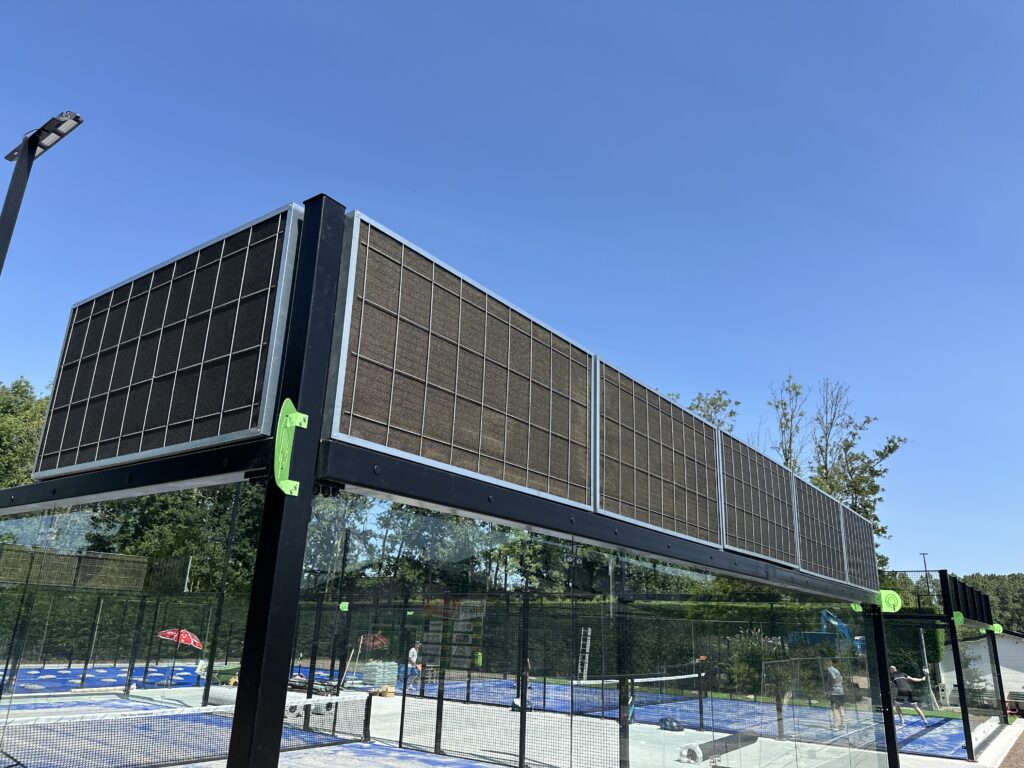
Noise nuisance from padel is a much-discussed topic, but there are also many misconceptions about it. Padel noise is often considered more problematic than it actually is, while other aspects, such as the structural consequences of noise reduction measures, are underestimated. Which assumptions are incorrect, and what is the technical reality? The seven questions below provide you with a clear and well-founded picture. Does a padel court really produce more noise than a tennis court? Yes, a padel court produces more noise on average than a tennis court. The sound power level of a padel court is estimated at approximately 91 dB, which is roughly 10 dB more than tennis. This difference is not negligible: an increase of 10 dB is perceived by the human ear as approximately twice as loud. The reason for this difference lies in the way padel is played. In padel, the ball does not only bounce on the artificial turf, but also regularly hits the glass walls and the fencing of the enclosure structure. These contact moments produce short, sharp sound peaks, also known as impulse noise. The enclosed structure of the court acts as a resonance box, amplifying the sound and directing it outward. This does not automatically mean that every padel court causes nuisance. The degree of disturbance depends strongly on the distance to homes, the surroundings of the sports park, the number of people playing and the times at which games are played. At a well-designed location with sufficient distance from nearby residents, padel noise can remain within acceptable limits. However, it is a factor that must be taken into account during the planning process. Is noise nuisance from padel always a problem for local residents? No, noise nuisance from a padel court is not automatically a problem for local residents. Whether noise is perceived as disturbing depends on several factors that can vary significantly from one location to another. Distance, background noise, site layout and playing times all play a role. A padel court in an urban environment with a lot of existing background noise is less likely to be perceived as disruptive than a court in a quiet location on the edge of a residential area. The orientation of the court in relation to homes also makes a difference: a court whose short sides face towards homes distributes sound differently from a court positioned parallel to the buildings. Municipalities assess noise nuisance based on applicable standards and the specific circumstances of the surroundings. An independent acoustic consultancy can calculate the expected noise level at the nearest noise-sensitive locations. This calculation is generally part of the permit process. More about how this works in practice can be found on our page about acoustic solutions for padel. Read more about noise reduction solutions Do noise barriers really help reduce padel noise? Noise barriers can contribute to limiting noise nuisance, but they are not a universal solution. A freestanding noise barrier blocks and absorbs sound that spreads towards homes, but its effectiveness depends strongly on its height, length, position and the distance from the sound source. A noise barrier works best when it directly screens the sound between the source and the receiver. For padel courts, this means that the barrier must be high enough to also intercept sound that escapes upwards. In practice, heights of 6 to 8 metres are used, sometimes over lengths of several tens of metres. This requires a structural calculation, soil investigation data and, in almost all cases, an environmental permit. A noise barrier is also a transmission-path solution: it addresses the sound after it has left the source. This is a fundamental difference from a source-control measure, which addresses the sound at the court itself. Which approach is most suitable varies by project and location. What is the difference between a noise barrier and sound-absorbing panels? A noise barrier is a freestanding structure placed next to or around the padel court that blocks sound on its way towards the surroundings. Sound-absorbing panels are attached directly to the enclosure structure of the padel court and address the sound at the source, before it spreads. This is the fundamental difference. Sound-absorbing panels are what is known as a source-control measure. They are mounted on the outside of the mesh or fencing of the enclosure structure and absorb part of the sound energy released during play. The material used for this, such as rock wool, has an open fibre structure that partially absorbs sound waves instead of reflecting them. A noise barrier works differently: it forms a physical barrier between the court and the surroundings. The sound leaves the court, but is blocked or absorbed by the barrier on its way towards the homes. In situations where the distance to homes is limited or the site layout does not provide space for a barrier, panels can be a more compact and practically feasible solution. In some projects, a combination of both measures is used. Panels reduce the noise at the source, after which a noise barrier further limits the remaining sound. In certain situations, this can mean that the barrier can be constructed at a lower height, which both saves costs and can simplify the permitting process. More information about freestanding barriers can be found on our page about noise embankments around padel courts. Read more about noise embankments Do sound-absorbing panels affect the structure of the court? Yes, sound-absorbing panels always affect the structure of the padel court. This is a technical fact that is regularly underestimated in practice. When panels are attached to the enclosure structure, they reduce the wind permeability of the structure. As a result, the wind load on the court increases. An open enclosure structure allows most of the wind to pass through. As soon as part of these openings is closed off with panels, the structure behaves more like a solid surface. The wind force acting on that surface is considerably greater than with an open structure. If the steel structure has not
When is padel noise perceived as a nuisance?
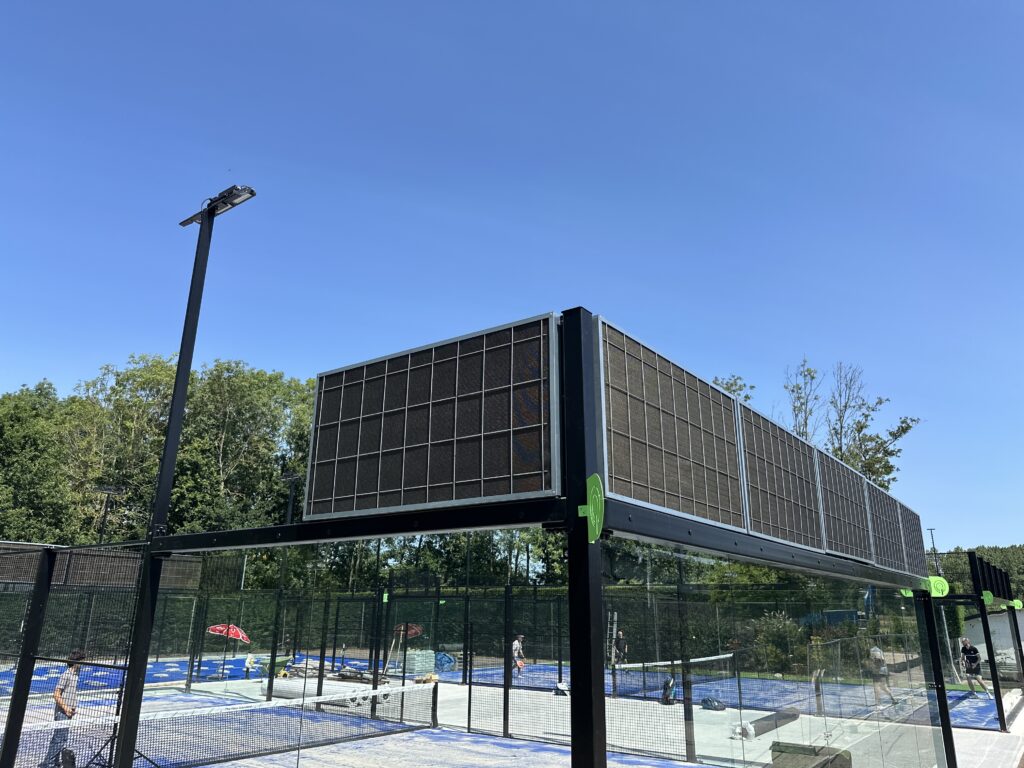
Padel noise is considered a nuisance as soon as it regularly and unexpectedly enters the living environment of nearby residents, particularly during the evening or at quiet times. The combination of impulse sounds, such as the loud impact of a ball against glass, and the sound-amplifying effect of the cage structure makes padel acoustically different from most other outdoor sports. The questions below provide a clear picture of when padel noise becomes problematic, which standards apply and which measures may be considered. How loud is a padel court actually? A padel court produces an average sound power level of approximately 91 dB during active play. That is about 10 dB more than a tennis court. The difference may sound small, but in acoustics, 10 dB is equivalent to a doubling of the perceived loudness. Padel is therefore objectively a louder sport than tennis, even though the game may look visually similar. The sound is generated in two ways. First, there is the direct source sound of the racket hitting the ball. Second, and acoustically the more significant factor, is the impact sound of the ball hitting the glass and steel fencing. The cage structure acts as a sound box: the enclosed nature of the court amplifies and disperses the sound into the surrounding area. It almost always concerns impulse noise, short and loud peaks that are clearly distinguishable above the background noise. This characteristic plays a major role in how nearby residents experience the noise, which we explain further below. When does padel noise exceed the statutory noise limits? Whether padel noise exceeds the statutory limits depends on the distance to residential properties, the time at which games are played and the applicable noise standards in the zoning plan or environmental permit. There is no fixed national threshold that applies to every situation. Municipalities generally apply the standards from the Activities Decree or set location-specific requirements through the permit. In practice, noise limits for sports activities at residential properties are typically 50 dB(A) during the day, 45 dB(A) in the evening and 40 dB(A) at night, measured at the façade of the nearest dwelling. Whether a padel court exceeds these limits depends on the distance, the site layout, the presence of sound-reflecting surfaces and the number of courts in use. Because padel produces impulse noise, the peak limit may also play a role. Peaks may generally not exceed 70 dB(A) during the evening period. An independent acoustic consultancy can calculate whether a specific location falls within the limits and which measures may be required. We provide the relevant technical product specifications and structural data for this purpose, but the assessment itself is carried out by the acoustic consultant. Why do nearby residents experience padel noise as more disturbing than other sports noise? Nearby residents experience padel noise as more disturbing than many other sports noises because it consists of repeated, sharp impulse peaks that are difficult to ignore. Human hearing is particularly sensitive to sudden changes in sound. Every change in rally, every hard hit against the glass, unconsciously draws attention, even if the average sound level itself is not extremely high. In addition, padel is generally played during the evening, when background noise is low and the surroundings are quiet. A padel court that is barely noticeable during the day can be experienced as disruptive in the evening because the contrast with the surrounding silence is greater. The cage structure reinforces this effect. Glass and steel reflect sound, and the enclosed structure of the court directs the sound in certain directions. As a result, the noise may still be clearly audible at a greater distance, while it may seem less noticeable at close range. This makes it difficult to assess noise nuisance without an acoustic study. At what distance from residential properties can a padel court be permitted? There is no legally established minimum distance at which a padel court can always be permitted. Whether it can be permitted is determined by a combination of the actual noise impact at the façade of nearby residential properties, the applicable noise standards and the measures taken. A padel court 30 metres from residential properties may be permitted with the right noise mitigation measures, while a court 80 metres away may cause problems without measures if the circumstances are unfavourable. Factors affecting whether a court can be permitted include the orientation of the court in relation to residential properties, the presence of sound-reflecting buildings, the number of courts, opening hours and the nature of the surroundings. A location in an open polder behaves acoustically differently from a location in a built-up residential area. Municipalities assess applications for a permit for a padel court based on an acoustic study. This study calculates the expected noise impact at the relevant residential properties and assesses it against the applicable standards. Based on the results, it can be determined whether additional measures are required and, if so, which ones. Read more about permits Which factors determine whether a location will experience noise problems? Whether a location will experience noise problems is determined by a combination of technical, spatial and usage-related factors. The distance to residential properties is the most decisive factor, but certainly not the only one. Even at greater distances, noise can be problematic if the circumstances are unfavourable. The main factors are: Distance to the nearest residential properties: the shorter the distance, the higher the noise impact at the façade. Orientation of the court: the direction of the glass and open sides partly determines where the noise is distributed most strongly. Presence of reflecting surfaces: buildings, walls and hard surfaces in the surrounding area can reflect sound back towards residential properties. Wind direction and wind zone: wind can strengthen noise in a particular direction. The geographical wind zone of a location is also relevant to the structural load, particularly when noise-reducing panels are applied. Number of courts and intensity of use: more courts and longer opening hours result in a higher cumulative noise
Does an indoor padel court cause noise nuisance to the surrounding area?
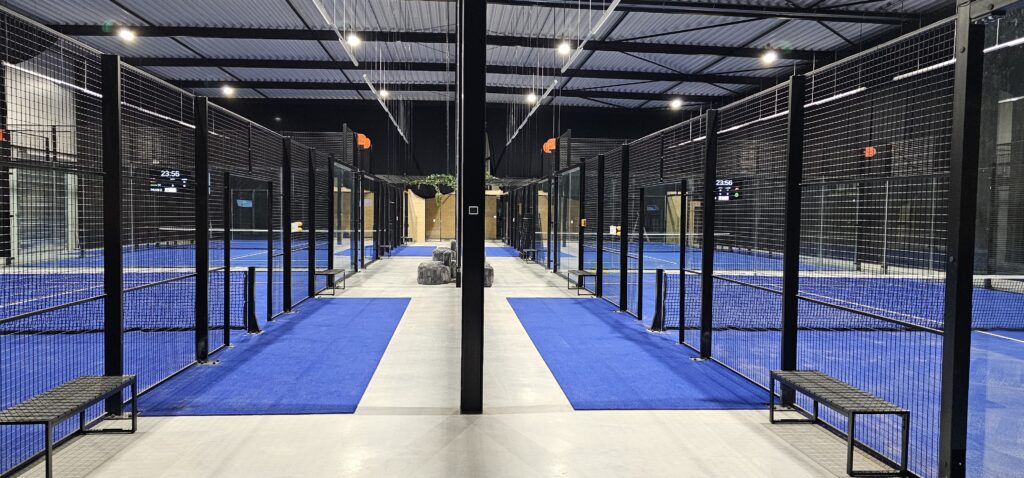
Noise nuisance is one of the most frequently asked questions when installing a padel court, and that’s understandable. Padel is a loud sport: the combination of a hard ball, glass walls, and a steel cage construction produces a recognizable sound that can carry far. Still, the situation with an indoor padel court is fundamentally different from an outdoor court. In this article we explain how much noise an indoor padel court produces, what the rules are, and which measures you can take to prevent noise complaints. How much noise does an indoor padel court produce? A padel court produces an average sound power of approximately 91 dB. That is roughly 10 dB more than a tennis court. The noise arises from two sources: the contact of the racket with the ball, and the contact of the ball with the glass and mesh of the cage construction. That second type of noise, the contact noise, is responsible for the largest part of the perceived nuisance. The cage construction amplifies this effect. Glass and steel reflect sound rather than absorbing it, which means the court functions as a kind of resonance chamber. With an indoor padel court, the hall itself also plays a role: the walls, ceiling, and floor partly determine how the sound spreads and whether it is audible outside the hall. Important to know: 91 dB is the source power at the court itself. At greater distances, the sound decreases quickly. Whether nearby residents experience nuisance from an indoor padel court depends heavily on the insulation value of the hall, the distance to homes, and the construction of the court. What are the legal noise standards for padel courts in the Netherlands? In the Netherlands, padel courts fall under the rules of the Activities Decree (Activiteitenbesluit milieubeheer) for environmental management. For sports activities, limit values apply for the long-term average assessment level (LAr,LT) and the maximum sound level (LAmax). The exact standards depend on the surroundings: stricter requirements apply in a residential area than in an industrial zone. As a guideline, the government applies the following limit values for sports facilities, measured at the facade of nearby homes: Daytime (07:00 to 19:00): maximum 50 dB(A) long-term average Evening (19:00 to 23:00): maximum 45 dB(A) long-term average Night (23:00 to 07:00): maximum 40 dB(A) long-term average For an indoor padel court in an existing, well-insulated hall, meeting these standards is often realistic without extra measures. For a new hall or a poorly insulated space, an acoustic study is almost always advisable and in many cases also required as part of the permit application. The municipality assesses per situation whether additional measures are needed. What is the difference in noise nuisance between indoor and outdoor padel courts? Indoor padel courts generally cause less noise nuisance for the surroundings than outdoor padel courts. The hall acts as a natural sound buffer: walls, roof, and insulation contain a large part of the sound. With an outdoor padel court, the sound spreads freely in all directions, without any damping from a building.
What noise control measures are mandatory for an outdoor padel court?
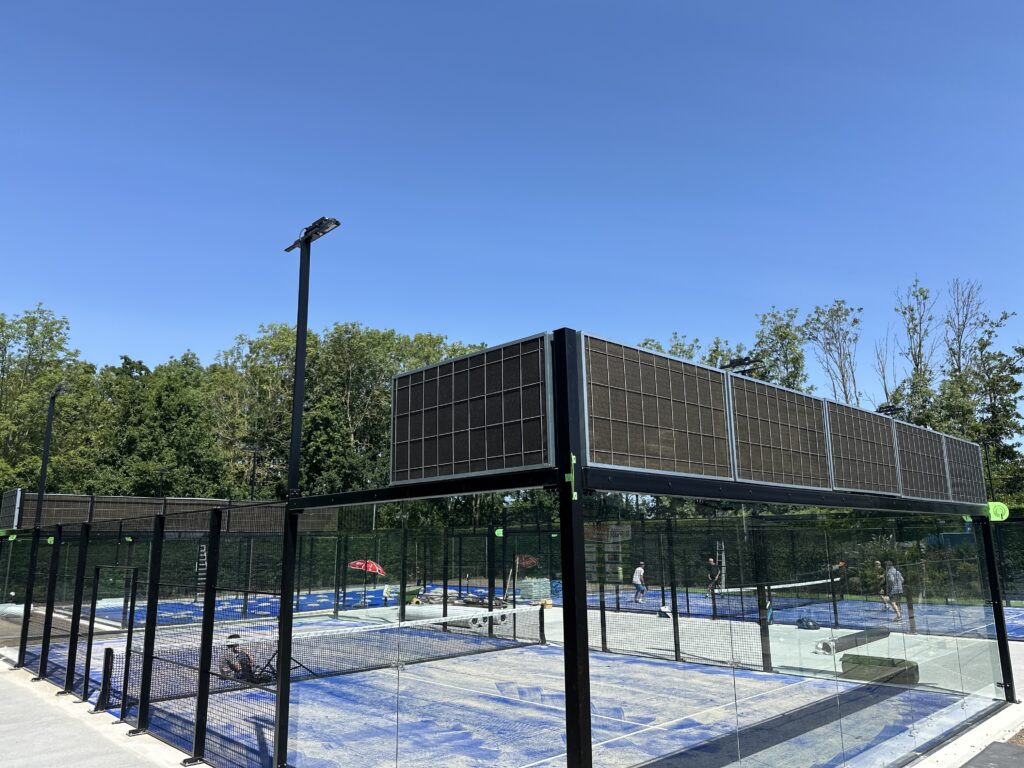
Noise nuisance at an outdoor padel court is one of the most common reasons why permit applications are delayed or rejected. The noise from a padel court is measurably louder than that of a tennis court, and municipalities are setting increasingly strict requirements for new outdoor courts. In this article we explain where that noise comes from, which standards apply, when you need a permit, and which measures you can take to limit noise nuisance. Why does an outdoor padel court cause noise nuisance? An outdoor padel court produces more noise than a tennis court, because the steel-and-glass cage structure functions as a sound box. The noise of the ball hitting the glass walls and the steel mesh is reflected back instead of being absorbed. That makes padel considerably louder than outdoor sports where no hard walls are present. The average sound power of a padel court is around 91 dB. By comparison, a tennis court produces on average about 10 dB less. That sounds like a small difference, but in acoustics 10 dB equals a doubling of perceived loudness. Two sound sources play a role here: The source noise of the racket hitting the ball The impact noise of the ball hitting the glass and mesh That second type of noise is responsible for the largest part of the experienced nuisance. The hard, reflective surfaces of the cage structure cause the sound to carry far, especially in open areas without natural shielding. An outdoor court also has no hall to absorb the sound. That makes the choice of location and the surrounding environment decisive for the degree of nuisance experienced by local residents. Which legal noise standards apply to an outdoor padel court? In the Netherlands, outdoor padel courts fall under the noise standards of the Activities Decree for Environmental Management (Activiteitenbesluit milieubeheer). For sports activities at clubs and commercial operators, limit values apply that depend on the time of day: during the day (07:00 to 19:00) higher noise levels are permitted than in the evening or at night. The municipality assesses whether the court meets these standards at the facade of the nearest home. The exact limit values are determined by the designated use of the location and the zoning plan (bestemmingsplan). A padel court at a sports park in an outer district has different standards than a court bordering a residential neighborhood or a quiet street. Municipalities use the guidelines of the VNG (Association of Netherlands Municipalities) for businesses and environmental zoning as a reference framework. Because padel is on average louder than most other outdoor sports, courts without measures exceed the applicable standards in many situations. This means that when applying for an environmental permit, you almost always have to submit an acoustic study. That study demonstrates whether the court meets the standards and which measures are needed if it does not. When is an environmental permit mandatory for a padel court? An environmental permit is almost always mandatory for an outdoor padel court. In the Netherlands, a padel court is considered a structure (bouwwerk), which means building regulations apply to it. Installing one without a permit is not an option: the municipality can halt the project, impose a fine, or even require the structure to be removed. A permit is mandatory in any case if: The padel court is placed outdoors Structural work takes place Noise or lighting affects the surroundings The location is within or near residential buildings For an indoor padel court in an existing hall without structural modifications, a separate building permit is not always required, but fire safety and usage rules still apply. For outdoor courts, the situation is almost always different: the spatial impact, the noise, and the lighting make a permit necessary. The average processing time for a permit application is 8 to 12 weeks, depending on the municipality and the complexity of the project. Prepare well: for the application you typically need structural calculations, an acoustic study, a lighting study, and a site plan. Sometimes the municipality also asks for an ecological or archaeological study. Read more about permits Which noise measures are permitted and effective? There are two proven measures to limit noise nuisance at an outdoor padel court: sound-absorbing panels attached to the cage structure, and freestanding noise barriers placed next to or around the court. Both measures are permitted and are recognized by municipalities as effective solutions, provided they demonstrably deliver sufficient reduction. Sound-absorbing panels Panels are placed on the outside of the mesh of the cage structure. They absorb the sound at the source instead of reflecting it back. The court remains visually open and the play dynamics do not change. Independently tested in an acoustic laboratory, the panels achieve sound absorption class A, with an absorption value of 0.80 and a sound insulation index of 19 dB. In practice this leads to a clearly audible reduction at distances of 40 to 100 meters. Noise barriers A noise barrier is a freestanding, noise-blocking structure placed next to the court that shields sound in the direction of homes. Barriers can be built up to 6 to 8 meters high and dozens of meters long. They are effective at greater distances and can be planted with climbing plants on coconut fiber or green mesh, which increases acceptance by the municipality and local residents. In many cases, a combination of panels and a noise barrier is the most effective. The panels reduce the noise at the source. The barrier blocks the remaining noise in the direction of the homes. Thanks to that combination, a noise barrier can sometimes be built lower, which saves costs and makes the permit process easier. Important to know: both measures must be structurally calculated and fit within the permit process. They are not standard solutions that can be applied without further consideration. Read more about sound solutions What is the difference between a noise screen and sound-absorbing panels? The main difference is the position relative to the court. Sound-absorbing panels are
Is a permit always required for a padel court?
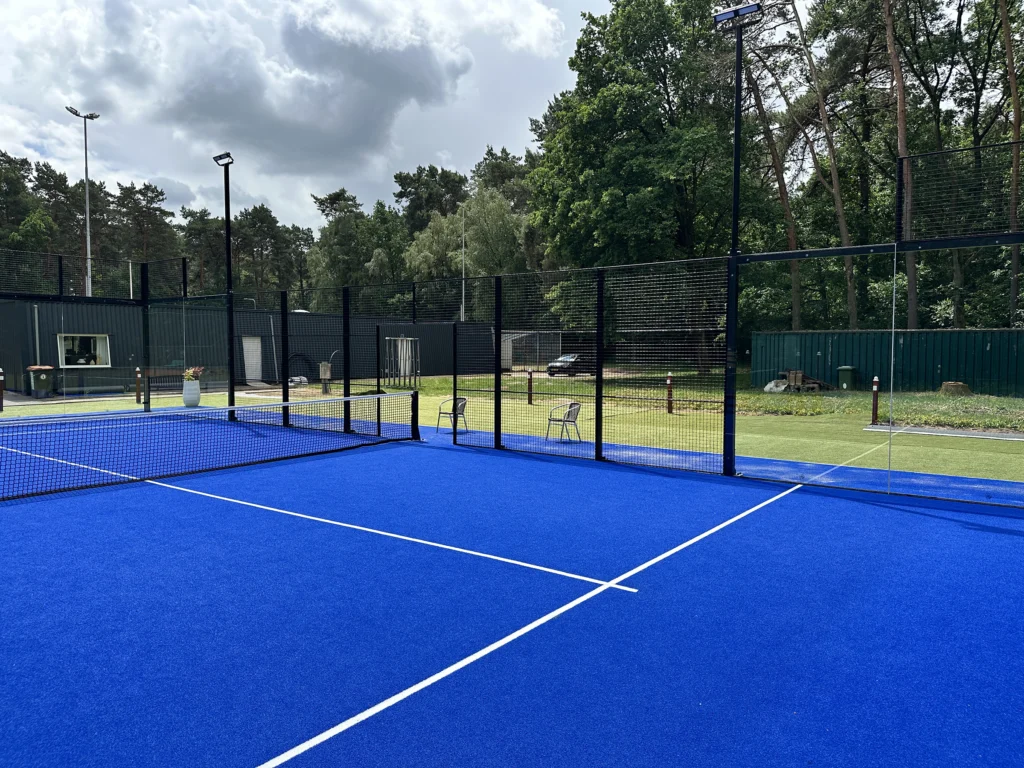
Installing a padel court may sound simple, but the permit process comes as a surprise to many entrepreneurs, associations and municipalities. The short version: for an outdoor padel court, you need an environmental permit in almost all cases. For an indoor padel court in an existing hall, it depends on the situation. In this article, we explain what applies to each situation, which documents you need and how to go through the process as smoothly as possible. Do you always need a permit for a padel court? No, not always, but in most cases you do. In the Netherlands, a padel court is considered a structure and therefore falls under building regulations. Whether a permit is mandatory depends on the location, the type of court and the impact on the surroundings. For outdoor padel courts, an environmental permit is almost always mandatory. For indoor installation in an existing hall, without structural modifications, this is not necessarily the case. The fact that padel courts so often require a permit is related to three factors: noise, lighting and spatial impact. Padel produces more noise than tennis. Hitting the ball against glass and steel, combined with the cage structure that acts as a sound box, results in an average sound power level of approximately 91 dB. That is about 10 dB more than tennis. Municipalities want to have control over this, and that starts with the permit application. In short: do not assume that you can start without a permit. Building without a permit when one is required can lead to work being stopped, fines, or even an obligation to remove the cage structure. It is always advisable to check this with the municipality in advance. When is an environmental permit required for a padel court? An environmental permit is required when the padel court is installed outdoors, when structural work is carried out, or when noise and lighting affect the surroundings. In practice, this applies to virtually all outdoor padel courts and to indoor projects where the existing hall is structurally modified. Specifically, these are the situations in which you definitely need an environmental permit: The padel court is installed outdoors, regardless of the location. Structural work is carried out, such as installing a foundation. The padel court is located near or within residential development. LED lighting is installed that affects the surroundings. Noise barriers or other large structures are installed next to the court. If in doubt: always contact the municipality before applying for anything or placing an order. Many municipalities offer a preliminary consultation in which you can have the plans assessed. This saves time and prevents surprises later in the process. Are there situations in which you do not need a permit? Yes, there are. An indoor padel court in an existing sports hall or existing building does not always require a separate building permit, provided that no structural modifications are made to the building. The court is then installed within the existing space, without changing the load-bearing structure or the exterior shell of the building. Please note: even without a building permit, you still have to comply with other regulations. These include fire safety, use regulations and any notification requirements. And if the hall is extended or renovated to accommodate the padel courts, permit requirements will still apply. The zoning plan also plays a role. Even if a building permit is not required, the use of the space must comply with the permitted zoning designation. Converting an office building into a padel facility may conflict with the zoning designation, even if you do not change anything structurally. Always check this in advance. What rules apply to an outdoor versus an indoor padel court? Stricter and more extensive rules apply to an outdoor padel court than to an indoor court. Outdoors, you always have to deal with an environmental permit, noise requirements, a lighting study and structural requirements related to wind loads. Indoors, in an existing hall without modifications, the requirements are more limited and mainly concern fire safety and use regulations. Outdoor padel courts An outdoor padel court involves several disciplines. The steel structure must be designed more heavily due to wind loads. The Netherlands is divided into three wind areas, and each court is structurally calculated for the applicable wind area. The foundation also plays a major role: soil conditions, water drainage and load-bearing capacity determine which type of foundation is required. Lighting is also an important consideration. LED lighting on outdoor padel courts affects the surroundings, especially when used in the evening. Municipalities may impose requirements regarding light intensity, the direction of the lighting and the times at which the courts may be illuminated. Indoor padel courts Indoors, in an existing hall, the permit process is considerably simpler. There is no wind load or precipitation, the foundation is generally less complex, and noise is largely absorbed by the hall itself. Nevertheless, it is advisable to inform the municipality here as well, especially if the hall is used intensively or is located close to residential properties. How do you apply for a permit for a padel court? You apply for a permit for a padel court through the Omgevingsloket (omgevingsloket.nl). You submit an application to the municipality where the court will be installed. The application must be supported by a number of mandatory documents, depending on the location and the type of project. The documents you generally need: Structural calculations in accordance with the Building Decree An acoustic study (almost always mandatory when located near residential properties) A lighting study for outdoor courts with LED lighting A site plan of the location An ecological study in some cases (for locations with protected flora or fauna) The processing time for a permit application is on average 8 to 12 weeks, depending on the municipality and the complexity of the project. Take this into account in your planning. If you want to open in spring, you therefore need to submit the application well before winter. A preliminary consultation
What sound solutions are available for a padel location?
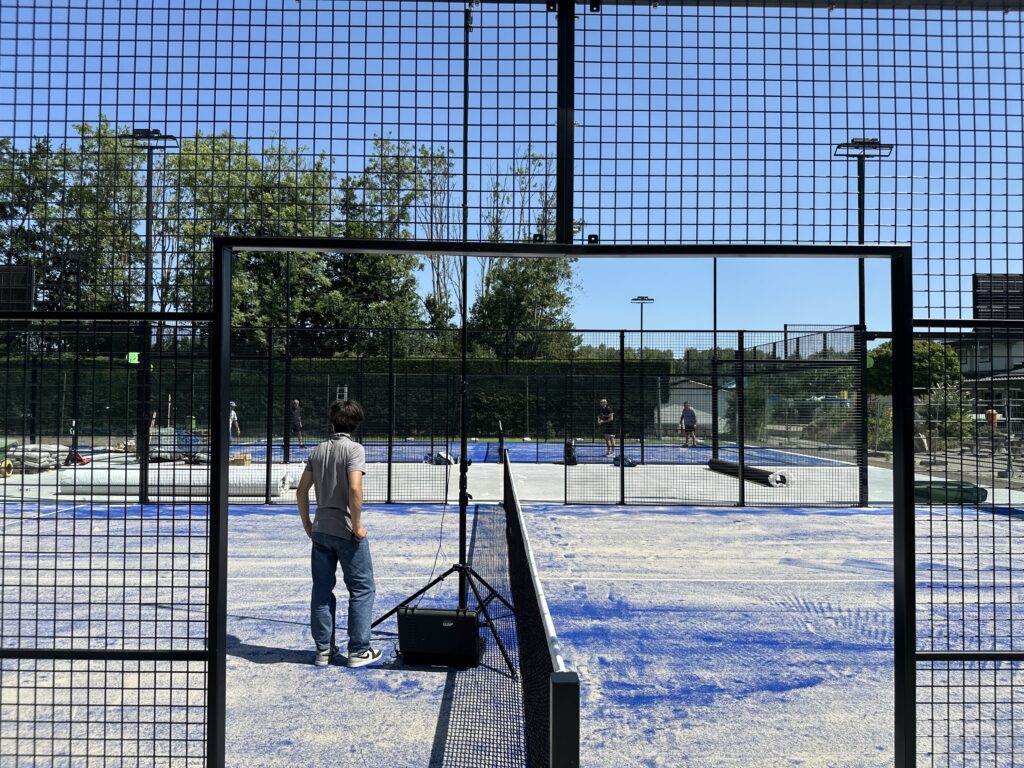
Noise pollution is one of the biggest obstacles when developing a padel location. Municipalities are imposing increasingly strict requirements, local residents are more likely to complain, and an acoustic study is almost always mandatory for outdoor courts. Fortunately, there are proven solutions that can help you comply with noise standards and create support among both the municipality and the local community. In this article, we answer the most frequently asked questions about noise pollution at padel courts and the available solutions. Why does a padel court cause so much noise pollution? A padel court produces more noise than a tennis court because the cage structure acts as a sound box. Hitting the ball against glass and steel reflects the sound in all directions. The average sound power level of a padel court is around 91 dB, which is approximately 10 dB more than tennis. There are two main sources of noise in padel. The first is the source noise generated when the racket hits the ball. The second, and larger, source is the impact noise of the ball against the glass and mesh of the cage structure. The glass walls reflect the sound instead of absorbing it, and the steel structure amplifies this effect. The closer the court is to residential properties, the greater the chance of complaints and mandatory measures imposed by the municipality. What sound solutions are available for a padel court? There are two main solutions for noise pollution at a padel court: sound-absorbing panels that are attached directly to the cage structure and freestanding noise barriers that are placed next to or around the court. In many situations, a combination of both is the most effective. Sound-absorbing panels Panels are installed on the outside of the mesh of the cage structure. They absorb the sound at the source instead of reflecting it. The court remains visually open and the dynamics of play do not change. Panels can be applied on one side, on multiple sides, or only in the lower or upper sections of the cage. They can also be installed afterwards on existing courts. Noise barriers A noise barrier is a freestanding structure placed next to or around the padel court. A noise barrier works over a greater distance and shields the noise in the direction of residential properties. Barriers can be up to 6 to 8 metres high and tens of metres long. They can also be constructed using coconut fibre or green fabric, on which climbing plants can grow. This creates a more natural appearance and increases the likelihood of acceptance by the municipality and local residents. Combination of panels and barrier In practice, a combination of sound-absorbing panels and a noise barrier is often the most effective approach. Because of the panels, the noise barrier can sometimes be lower, which saves costs and makes the permit process easier. Read more about sound solutions How do sound-absorbing panels work at a padel court? Sound-absorbing panels are attached to the outside of the mesh of the cage structure. They absorb the sound that would otherwise be reflected by glass and steel. Independently tested in an acoustic laboratory, they achieve sound absorption class A, with an absorption value of 0.80 and a sound insulation index of 19 dB. In practice, this results in a clearly audible reduction in noise at distances of approximately 40 to 100 metres. The panels can be used flexibly: on one side of the court facing residential properties, on multiple sides, or in the lower and/or upper sections of the cage. They can also be combined with glass walls or other noise-control measures. An important point to take into account: as soon as panels reduce the wind permeability of the cage structure, the wind load on the structure increases. The steel structure must then be structurally reinforced in accordance with the applicable wind zone. This means heavier posts, additional columns or modified connections. This is not an optional step, but a safety requirement. When are sound-absorbing panels mandatory at a padel location? Sound-absorbing panels are not automatically mandatory, but in practice they are often necessary when a padel court is located near residential properties and an acoustic study shows that the noise standards are being exceeded. The municipality determines this based on the acoustic report submitted with the permit application. For outdoor courts, an acoustic study is almost always mandatory if the location is near residential buildings. If the study shows that the noise standards are being exceeded, the municipality imposes conditions on the permit. Sound-absorbing panels may then be a measure required by the municipality, or one that you proactively implement to comply with the standards. In some cases, a noise barrier is sufficient; in other cases, panels are necessary; and sometimes a combination of both is the only workable solution. Which measure is required always depends on the specific location and the outcome of the acoustic study. What is the difference between an indoor and outdoor court in terms of noise? An indoor court produces just as much noise as an outdoor court, but the noise pollution for the surrounding area is generally much lower at indoor locations. The hall acts as a sound barrier. At outdoor courts, the noise spreads freely into the surrounding area, which directly results in more complaints and stricter requirements from the municipality. For indoor padel courts in existing halls, a separate environmental permit is not always required, depending on the structural modifications and fire safety requirements. An acoustic study is less frequently mandatory for indoor locations, although this may vary by municipality. For outdoor courts, the situation is different: an environmental permit is almost always required, and an acoustic study is normally part of the permit application. For the sound experience inside the hall itself, panels can also be useful. They reduce reverberation and improve playing comfort, which players and visitors experience as pleasant. This is not a legal requirement, but a quality consideration that is increasingly being taken into account when
When is a permit for a padel court required?
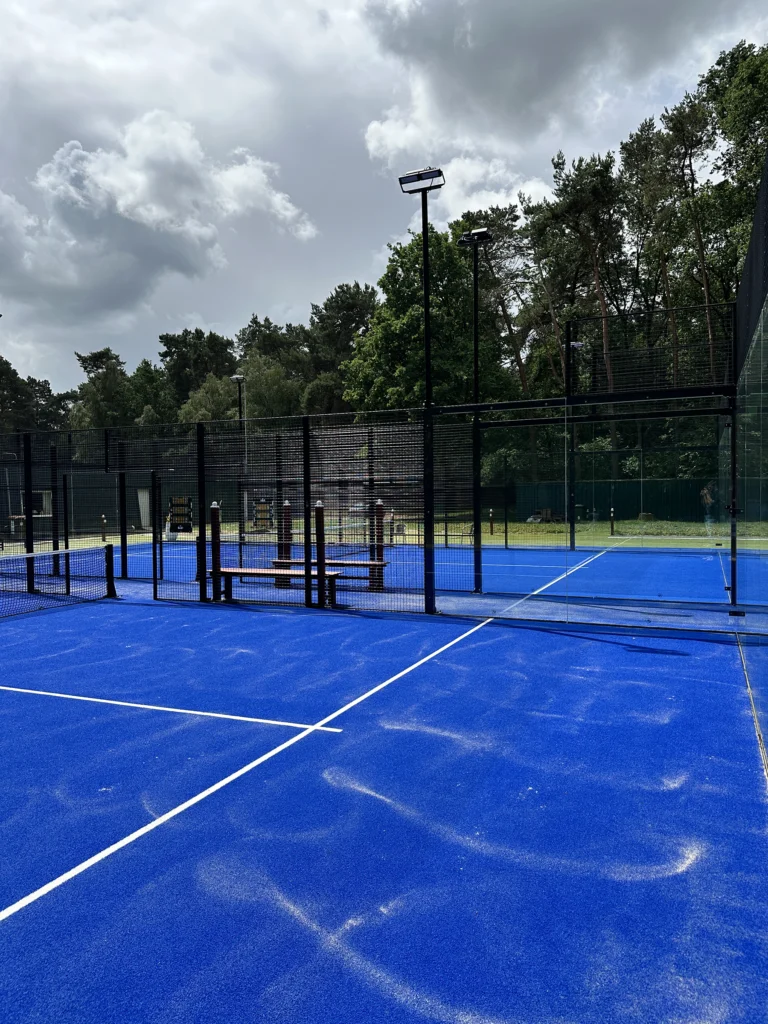
Building a padel court often starts with one question that determines everything: do I need a permit for this? In most cases, the answer is yes, especially if the court will be built outdoors. For an indoor court in an existing building, the situation may be different, but regulations still apply. In this article, we explain when a permit for a padel court is required in each situation, which documents you need, and what you can expect from the application process. What is an environmental permit and what does it have to do with padel? An environmental permit is an official authorization from the municipality to build, renovate, or change the use of a location. In the Netherlands, a padel court is considered a structure, which means that in most cases you need such a permit before you even break ground. Padel is more than just a sport. A padel court is a permanent structure consisting of a steel frame, glass walls, artificial turf, LED lighting, and in many cases a drain concrete or Supersub foundation. Taken together, these components make it a structure in the eyes of the law. The municipality must be able to assess whether the structure is safe, whether it complies with the zoning plan, and whether it will cause nuisance to the surrounding area. The last point is especially relevant for padel. Padel produces more noise than tennis. The sound of the ball striking glass and steel, combined with the cage structure acting as a resonance chamber, results in a sound power level of approximately 91 dB on average. That is roughly 10 dB higher than tennis. Municipalities are becoming increasingly aware of this and are therefore imposing more requirements regarding noise mitigation measures and playing hours during the permitting process. Which factors determine whether your padel court requires a permit? Whether a padel court requires a permit depends on four factors: the location (indoor or outdoor), the nature of the structure, the impact of noise and lighting, and the proximity of residential properties. An outdoor court almost always requires an environmental permit. For an indoor court in an existing building, it depends on the specific situation. Outdoor court An outdoor padel court almost always requires an environmental permit. The structure is permanent, the foundation is substantial, and the court has a visible impact on its surroundings. In addition, outdoor LED lighting requires a lighting assessment, and noise from outdoor play travels further than it does in an enclosed building. If the location is adjacent to a residential area or situated in an open environment, a permit requirement is virtually certain. Indoor court For a padel court in an existing building, without structural modifications to the building itself, a separate building permit is not always required. However, regulations still apply, including fire safety requirements, usage regulations, and sometimes adjustments to ventilation systems or emergency exits. Always check with the municipality whether a notification or permit is required, even if you believe it is a straightforward installation. Proximity to residential properties Is the location close to residential housing? If so, an acoustic assessment is almost always required as part of the application. The municipality wants to know how much noise the court generates at the façades of nearby homes and whether this remains within the legal noise limits. This applies to both outdoor and indoor courts if the building borders a residential area. How do you apply for a permit for a padel court? You apply for a padel court permit through the municipality’s Environmental Permit Portal (Omgevingsloket). You submit an application with a set of mandatory documents, after which the municipality assesses it against the zoning plan, the Dutch Building Decree, and local policy regulations. The application must be complete. Missing documents almost always result in delays. The documents required depend on the location and the type of court. For most projects, the following documents are required: Structural calculations in accordance with the Dutch Building Decree Acoustic assessment (noise levels at surrounding building façades) Lighting assessment (for outdoor LED lighting) Site plan of the location Ecological assessment where applicable (for locations in or near protected natural areas) Archaeological assessment where applicable (for groundworks at certain locations) Good preparation starts with a zoning plan check. Verify whether padel as a sport is permitted at the intended location. If it is not, you will need not only an environmental permit but also a deviation from the zoning plan, which significantly extends the process. If you have any doubts, always contact the municipality before submitting a formal application. An informal preliminary consultation can save time and prevent unnecessary costs. Requesting a permit What are the noise requirements for a padel court and how do they affect the permit? Noise requirements for a padel court are based on the Dutch Environmental Management Act (Wet milieubeheer) and the Activities Decree (Activiteitenbesluit). The municipality assesses whether the noise produced by the court at the façades of nearby homes remains within the applicable limit values. These are generally 50 dB(A) during the daytime, 45 dB(A) during the evening, and 40 dB(A) at night. If these limits are exceeded, the permit may be refused or additional conditions may be imposed. Because padel produces more noise than most other outdoor sports, an acoustic assessment is almost always mandatory as part of the permit application for an outdoor court. The assessment determines how much noise the court generates at various distances and whether additional mitigation measures are required. Examples include sound-absorbing panels on the outside of the cage structure or a freestanding noise barrier alongside the court. Noise mitigation measures can also improve the likelihood of obtaining a permit. Municipalities are more likely to approve an application if the applicant demonstrates that active consideration has been given to reducing noise. Independent acoustic laboratory testing has shown that panels installed in the cage structure achieve a sound absorption coefficient of 0.80 (Class A) and a sound insulation index of 19 dB. This results in a
What are the dimensions of a padel court compared to a tennis court?
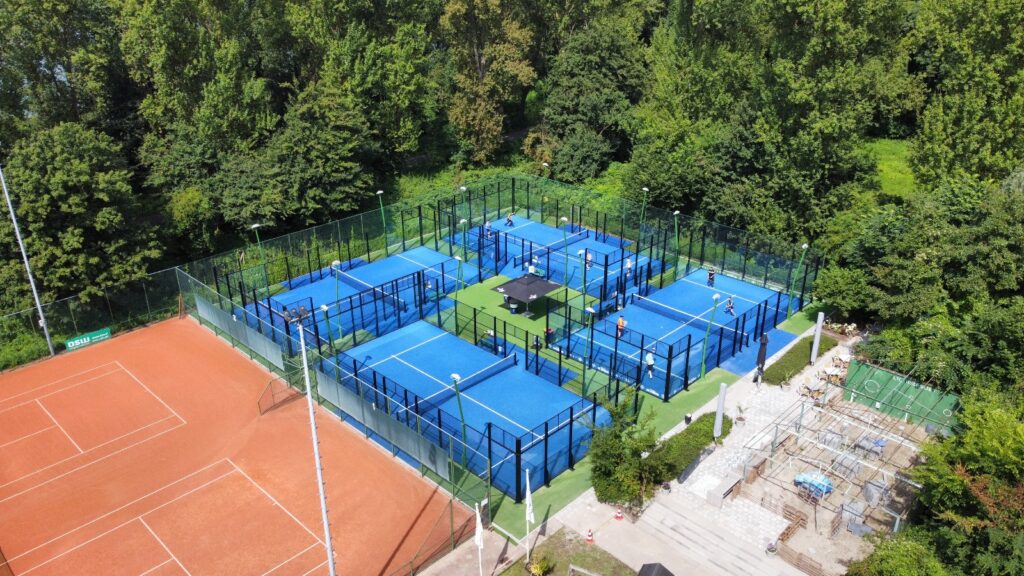
A padel court and a tennis court may look similar at first glance, but their dimensions differ considerably. A padel court measures 20 by 10 meters; a tennis court is roughly twice as large. That difference has major practical consequences, especially if you’re considering converting a tennis court into padel courts. Below you’ll find all the measurements at a glance, including the space, foundation, and custom work you’ll need. What are the official dimensions of a padel court? An official padel court measures 20 meters long and 10 meters wide. These are the international playing dimensions that apply to both competitive matches and recreational use. The playing field is enclosed by a cage structure of glass and mesh, which is part of the game itself. Besides the playing dimensions, there’s also an important distinction between the net playing area and the total space needed for the structure itself. The cage structure takes up slightly more room than just the playing field. For assembly and safety, you should plan for a minimum outer dimension of 21 by 11 meters. The cage’s standard height is 4 meters on the sides, with glass up to 3 meters high at the back wall, and the light mast reaches 6 meters at its highest point. For indoor padel courts, the hall’s clear height also plays a role. The minimum recommended clear height is 6 meters. The higher the hall, the better the playing quality, and the fewer restrictions players face on high balls. Read more about building padel courts How big is the difference between a padel court and a tennis court? A padel court has a playing surface of 200 m² (20 x 10 meters). A tennis court for doubles covers more than 260 m² of playing surface, but including the mandatory run-off zones, the total area quickly exceeds 600 m². The difference in required space is therefore two to three times as large in padel’s favor. This difference is exactly why padel is so appealing to tennis clubs and locations with limited space. In the space of one tennis court, multiple padel courts can fit, meaning you can achieve more playing capacity with the same amount of ground area. That translates directly into more playing hours, more members, and better utilization of the facility. Besides surface area, the playing experience also differs. Padel is played in an enclosed cage, where the walls are an active part of the game. Tennis is an open court without an enclosing structure. That fundamental difference in gameplay also explains why the courts differ so much in size. How much space do you need to build a padel court? To build one padel court, you need a minimum of 21 by 11 meters. This is the minimum assembly space including the cage structure. For an optimal playing experience with sufficient run-off space on the sides, 21 by 14 meters is recommended. That extra space on the sides, known as the run-off zones, is not only pleasant for players but also important for safety. At busy locations or for competitive use, sufficient space between two adjacent courts is also a point of attention. For indoor locations, the clear height also matters. A minimum of 6 meters is needed, but more is always better. When planning, also take into account access paths, emergency exits, and any technical spaces for lighting or electrical equipment. A thorough site assessment beforehand prevents surprises during construction. Can multiple padel courts fit in the space of one tennis court? Yes, two padel courts fit in the space of one tennis court, sometimes even more, depending on the exact dimensions of the tennis court and the available space around the field. This makes converting a tennis court into padel courts an attractive option for clubs looking to increase their capacity. A standard tennis court including run-off zones quickly covers 36 by 18 meters, which amounts to approximately 648 m². Two padel courts including run-off zones together take up approximately 21 by 28 meters, so 588 m². That fits in theory within the space of one tennis court, although the exact layout always depends on the location. When converting a tennis court to padel courts, the existing foundation also plays a role. In some cases, part of the substructure can be reused, which saves costs. Whether that’s possible depends on the condition of the existing foundation, the soil conditions, and the requirements set for the new courts. A structural assessment on site is always the first step in determining that. Converting 2 tennis courts into 4 padel courts — read about the possibilities here: Converting a tennis court into a padel court | I-Padel What are the dimensions of a padel court for custom work or special locations? The official playing dimensions of a padel court are fixed and always measure 20 by 10 meters. What can vary are the structural solutions around that fixed size: the height of the cage, the weight of the steel structure, the layout of glass and mesh, and the run-off zones. At special locations — such as a hall with a low ceiling height, a narrow strip of land, or a location with specific wind loads — the structural calculations are adjusted to the local conditions. Think of a coastal location with higher wind loads, or an indoor location with limited height where the light masts are configured differently. Sound-absorbing panels also require structural customization. When panels are attached to the outside of the cage, wind permeability decreases. The cage structure then needs to be reinforced with heavier uprights, additional columns, or adapted connections. This applies both to new courts and to existing courts where panels are added afterward. Without that adjustment, the structure is neither safe nor durable. In short: the playing dimensions are fixed, but the structure around those dimensions is always custom work per location. Read more about custom padel courts What type of foundation suits the dimensions and location of a padel court? The choice of
What does the Kiwa ISA Sport inspection for padel courts entail?
If you want to build a padel court for official use, sooner or later you’ll come across the name Kiwa ISA Sport. This is the body in the Netherlands responsible for the inspection and certification of padel court materials and sports surfaces. Without a valid Kiwa ISA Sport certificate, a padel court may not be used for official KNLTB (Royal Dutch Tennis Federation) competitions. Below we explain exactly what the certification involves, which components are assessed, and how you, as a client, can be sure you’re getting a Kiwa-certified padel court. What is the Kiwa ISA Sport certification for padel courts? The Kiwa ISA Sport certification is an independent product certification for sports surfaces and foundation components of padel courts in the Netherlands. Kiwa ISA Sport assesses whether materials meet the technical requirements of NOC*NSF and the KNLTB. Only products included on the official list of approved sports products may be used for courts intended for competition use. The certification focuses on the sport-technical properties of the court, such as the quality of the artificial turf, the foundation structure, and ball bounce. It is therefore not a general construction inspection, but specifically addresses whether the court meets the standards for fair and responsible play. Kiwa ISA Sport carries out these certifications as a recognized, independent body, separate from manufacturers or builders. Why is the Kiwa ISA Sport certification mandatory in the Netherlands? The Kiwa ISA Sport certification is mandatory because the KNLTB only permits official competitions on courts whose sports surface and foundation have been certified and included on the list of approved sports products. This applies to both new courts and renovated courts as of February 1, 2024. Without a certificate, a court cannot be registered for competition use. The requirement exists to safeguard the quality of play and to prevent courts with substandard materials from being used for official competitions. A padel court with poor ball bounce, insufficient flatness, or an unstable surface has a direct impact on playing quality and player safety. By making certification mandatory, the KNLTB ensures that all courts used for competition meet the same minimum standards. The requirement also protects clients. If a builder supplies materials that haven’t been certified, you, as an association or operator, run the risk that your court will not be approved afterward for official use. That’s a costly mistake you can easily avoid by checking in advance whether all materials are on the list of approved sports products. Which parts of a padel court need to be certified? The Kiwa ISA Sport certification primarily focuses on the sports surface and the foundation structure of a padel court. Specifically, this concerns the artificial turf including the infill material, the foundation on which the turf lies, and the combination of both layers. The steel structure itself falls outside the scope of this specific certification, but must still meet the structural requirements of the Dutch Building Decree (Bouwbesluit). Artificial turf and infill material A padel court uses sand-filled artificial turf: a short-pile, polymeric turf fiber with an effective length of 11 to 15 mm, filled with stabilization material to at least 75% of the fiber length. This applies to both indoor and outdoor courts. The turf is tested for sport-technical properties such as shock absorption, ball bounce, flatness, and friction. Only turf that meets these requirements and is included on the list of approved sports products may be used. Foundation The foundation is assessed as part of the overall system. Foundation components must be certified by Kiwa ISA Sport in the Netherlands before they may be used for a certified padel court. This applies to all commonly used foundation types, such as drainage concrete, Supersub, and ZOAB asphalt (porous asphalt). Each foundation variant has its own technical properties and is assessed separately for suitability for padel. How does the certification process for padel court materials work? The certification process for padel court materials runs through a licensing process at Kiwa ISA Sport. A manufacturer or supplier submits samples of the turf and foundation. These are tested in a laboratory according to international standards, including ISO and EN standards. If a product meets all sport-technical requirements, it is added to the list of approved sports products. Samples of sand-filled artificial turf are conditioned in advance: after filling with infill material, the mat is spread using a rake or brush, so that the test conditions match real-world practice. The measurement methods are laid down in international standards and NOC*NSF measurement methods. For every measurement result, the average must meet the specified requirements, and each individual measurement result must also fall within the standards. As a client, you don’t need to go through this process yourself. Your responsibility is to check whether the materials used by your supplier are already certified and included on the list of approved sports products. Always ask about this explicitly when requesting a quote, and don’t settle for vague assurances. What are the risks of a padel court without Kiwa ISA Sport certification? A padel court without Kiwa ISA Sport certification may not be used for official KNLTB competitions. This means an association or operator can still use the court for recreational purposes, but competitive players may not play official matches on it. For tennis clubs and associations that want their members to take part in competitions, this is a serious problem. Besides the loss of competition opportunities, there are also financial risks. If it turns out afterward that the materials used were not certified, it may be necessary to replace the sports surface or foundation in order to still meet the requirements. Those costs come on top of the investment already made. In the worst case, a newly built court may have to be partially demolished and rebuilt. There is also a safety aspect. The Kiwa ISA Sport standards are not only meant to ensure fair play, but also to protect players. A sports surface that doesn’t meet the shock absorption or friction standards increases the risk
What is the minimum height for a padel hall?
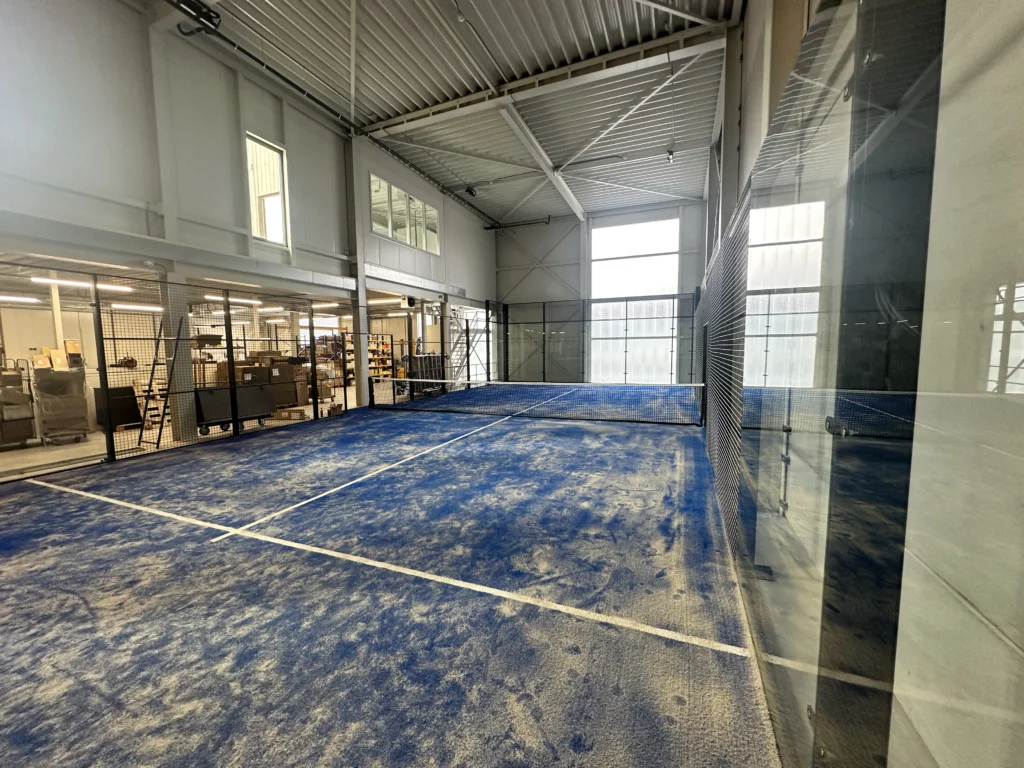
The minimum clear height for a padel hall is 6 meters. That is the minimum needed to play padel responsibly, without the ball constantly bouncing off the ceiling. For professional use, matches, or a more comfortable playing experience, the rule is: the higher, the better. Do you have a hall in mind and want to know if it’s suitable? Then the dimensions of the padel court are the starting point of every good plan. In this article we answer the most frequently asked questions about the height and dimensions of a padel hall, so you know exactly what to pay attention to when planning your location. Does the same minimum height apply to every spot in the hall? The minimum clear height of 6 meters applies to the entire playing field, including the space directly above the court. This concerns the clear height: the distance from the floor to the lowest obstruction above the playing field, such as a roof beam, a light fixture, or an installation pipe. That 6 meters must be achieved everywhere above the playing surface. In practice, we see that halls with steel structures often have roof beams or purlins that hang lower at regular intervals. So it is not enough to only measure the ridge or the highest point of the hall. Always check the lowest point above the playing field itself. If in doubt, an on-site measurement is the only reliable way to be certain. Also take the LED lighting above the court into account. The light masts of a padel court are standard 6 meters high. If the lighting is integrated into the roof structure, there must be enough room for both the fixtures and the clear playing space beneath them. A hall of exactly 6 meters is tight in that case and requires custom lighting arrangements. What happens if the hall just falls short of the minimum height? If the clear height comes in just under 6 meters, recreational play is sometimes still possible, but professional use and official matches are then not allowed. A court that does not meet the height requirements cannot receive certification from Kiwa ISA Sport, which is mandatory for competition use under the KNLTB. That has concrete consequences. Without valid certification, the court may not be used for official competition. For commercial operators or clubs wanting to organize matches, that is a serious limitation. Tenants or buyers who later still want to apply for certification then run into a wall. Practically speaking, solutions are sometimes possible depending on the exact situation. Think of lowering the floor, adjusting the roof structure, or choosing a different court layout within the hall. But these are drastic and costly adjustments. The wisest approach is to always check the height of a hall first, before making further plans. What other dimensions are required for an indoor padel court? Besides the minimum height of 6 meters, fixed dimensions apply for the playing field and the necessary space around it. The playing surface of a padel court is always 20 x 10 meters. For assembly of the cage structure you need at least 21 x 11 meters. The recommended space, including run-off zones, is 21 x 14 meters. Those run-off zones exist for a reason. They ensure the safety of players who end up behind the court and noticeably improve the playing experience. In a hall with multiple courts side by side, those extra meters add up quickly, so factor them into your space planning. Playing field: 20 x 10 meters Minimum assembly space: 21 x 11 meters Recommended space including run-off zones: 21 x 14 meters Minimum clear height: 6 meters For a hall with multiple courts, you add up the width per court, including the space between courts. An aisle of at least 1 to 2 meters between two courts is common and also advisable from a safety standpoint. When planning, always take emergency exits, escape routes, and local fire department requirements into account. What is the difference between an indoor and outdoor padel court in terms of construction requirements? The biggest difference lies in the steel structure. An outdoor padel court is exposed to wind, rain, frost, and sunlight. That requires a heavier steel structure, better protection of the steel, and a foundation calculated for wind load and weather influences. With an indoor padel court, a large part of those requirements no longer applies, because the hall protects the court. Concretely, this means outdoor courts are standardly built with hot-dip galvanized steel as protection against rust and corrosion. The structure is also dimensioned more heavily to absorb wind forces, especially in open areas or coastal regions. This is not necessary for indoor courts, which makes the structure simpler and cheaper. The foundation also differs. For outdoor courts, the foundation is a major and location-dependent cost item. Drainage concrete and Supersub are commonly used foundation types for outdoor use, where rainwater is drained directly through the foundation. For indoor courts, water drainage through the foundation is less relevant, and the build-up is tailored to the indoor environment. The exact foundation choice always depends on the soil conditions and the specific location. Finally, permits play a different role. An indoor padel court in an existing hall does not always require a separate building permit, depending on the situation. An outdoor padel court requires an environmental permit in almost all cases due to noise, lighting, and spatial impact. How much does it cost to have an indoor padel court built? As an indication, a standard indoor padel court, including cage structure, glass, artificial turf, LED lighting, and installation, may be possible from approximately €23,000 per court. The exact price always depends on the type of court, the number of courts, the accessibility of the location, and the chosen specification. A common mistake is looking only at the lowest price. In practice, this often leads to higher costs in the long run, due to lower-quality materials, limited warranty, or technical limitations that are