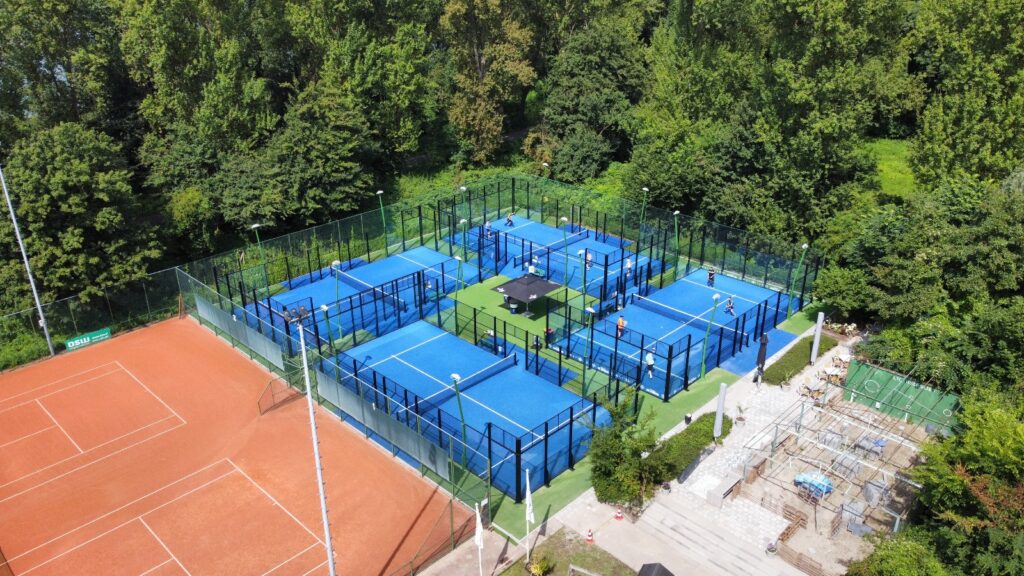
A padel court and a tennis court may look similar at first glance, but their dimensions differ considerably. A padel court measures 20 by 10 meters; a tennis court is roughly twice as large. That difference has major practical consequences, especially if you’re considering converting a tennis court into padel courts. Below you’ll find all the measurements at a glance, including the space, foundation, and custom work you’ll need.
What are the official dimensions of a padel court?
An official padel court measures 20 meters long and 10 meters wide. These are the international playing dimensions that apply to both competitive matches and recreational use. The playing field is enclosed by a cage structure of glass and mesh, which is part of the game itself.
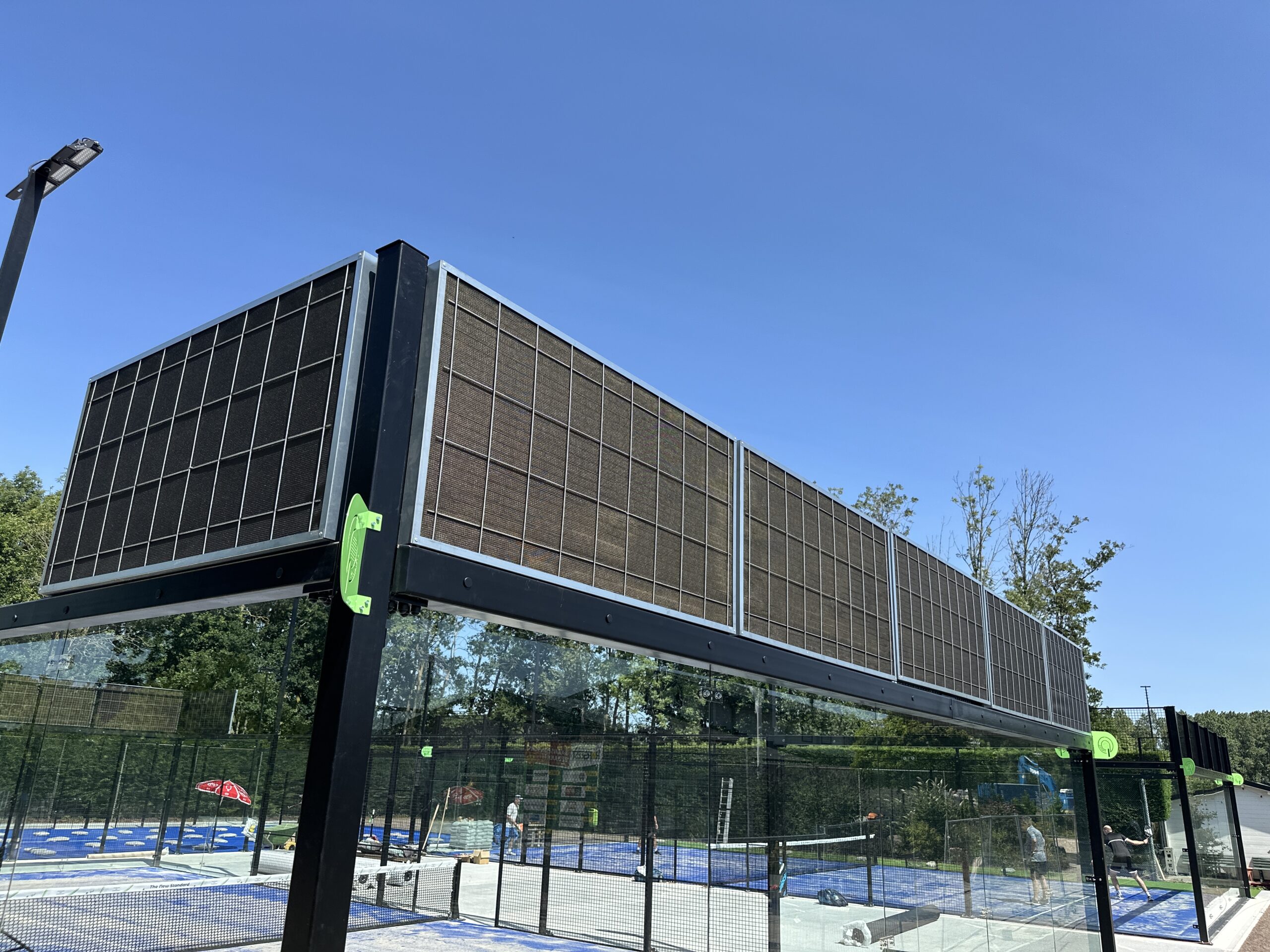
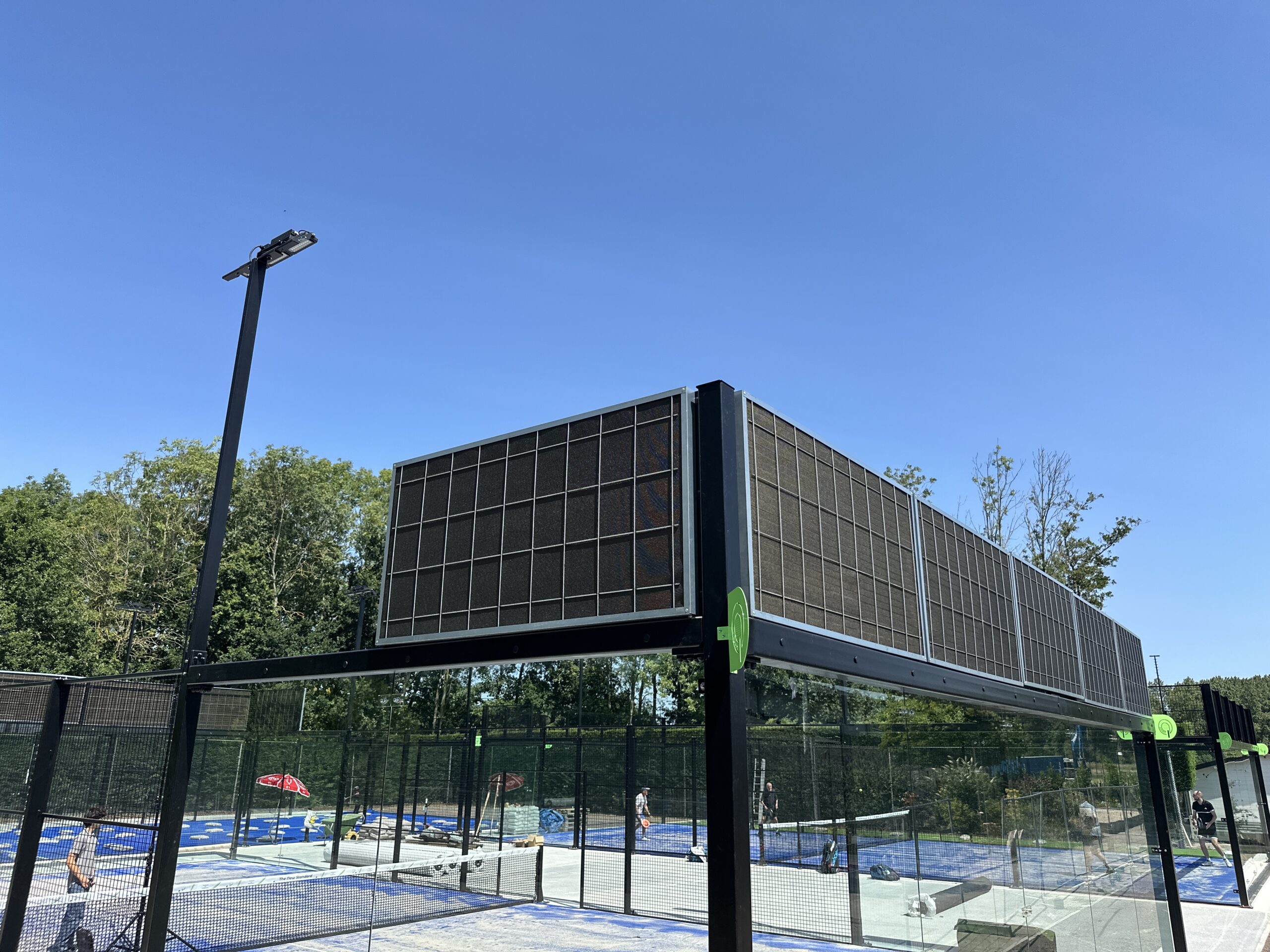
Besides the playing dimensions, there’s also an important distinction between the net playing area and the total space needed for the structure itself. The cage structure takes up slightly more room than just the playing field. For assembly and safety, you should plan for a minimum outer dimension of 21 by 11 meters. The cage’s standard height is 4 meters on the sides, with glass up to 3 meters high at the back wall, and the light mast reaches 6 meters at its highest point.
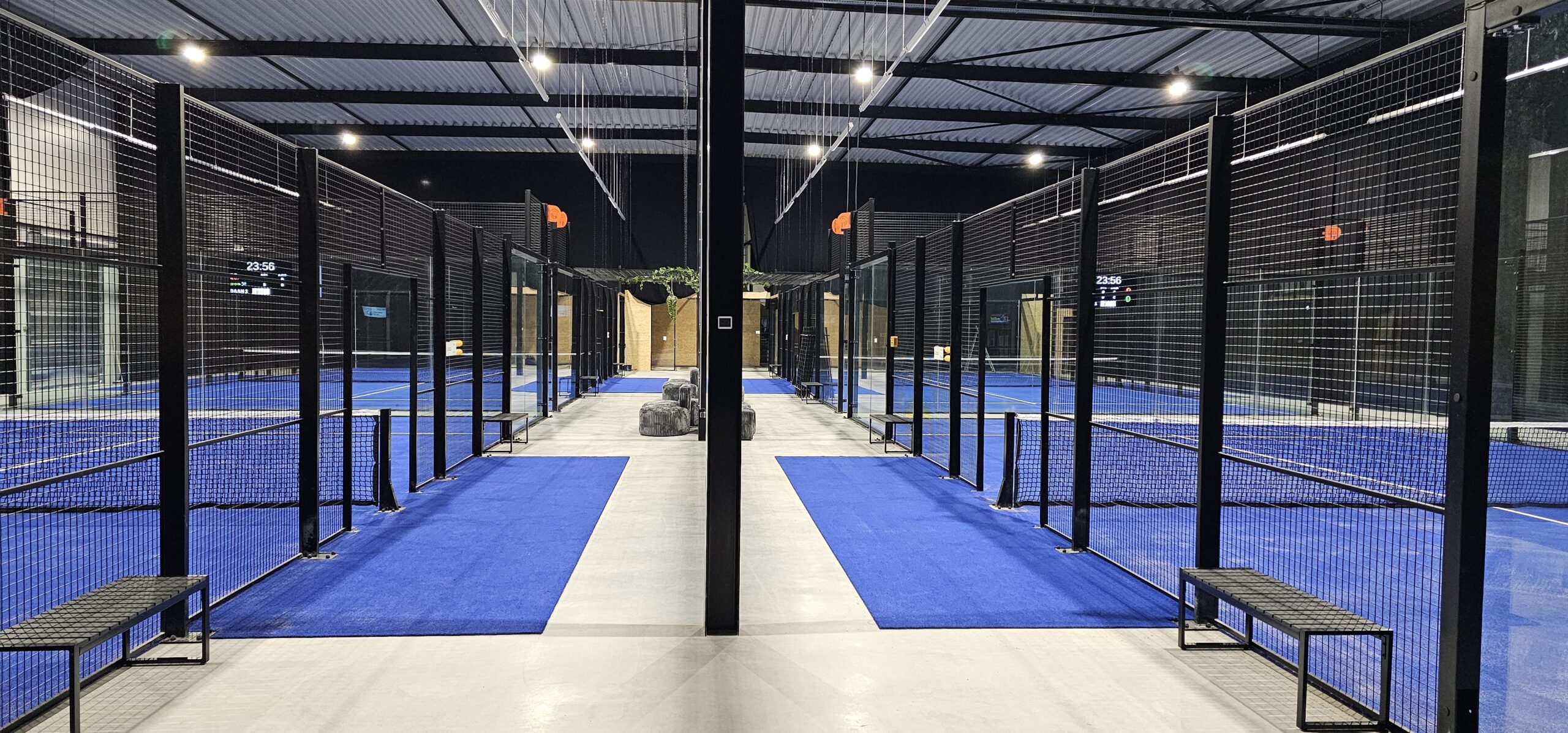
For indoor padel courts, the hall’s clear height also plays a role. The minimum recommended clear height is 6 meters. The higher the hall, the better the playing quality, and the fewer restrictions players face on high balls.
How big is the difference between a padel court and a tennis court?
A padel court has a playing surface of 200 m² (20 x 10 meters). A tennis court for doubles covers more than 260 m² of playing surface, but including the mandatory run-off zones, the total area quickly exceeds 600 m². The difference in required space is therefore two to three times as large in padel’s favor.
This difference is exactly why padel is so appealing to tennis clubs and locations with limited space. In the space of one tennis court, multiple padel courts can fit, meaning you can achieve more playing capacity with the same amount of ground area. That translates directly into more playing hours, more members, and better utilization of the facility.
Besides surface area, the playing experience also differs. Padel is played in an enclosed cage, where the walls are an active part of the game. Tennis is an open court without an enclosing structure. That fundamental difference in gameplay also explains why the courts differ so much in size.
How much space do you need to build a padel court?
To build one padel court, you need a minimum of 21 by 11 meters. This is the minimum assembly space including the cage structure. For an optimal playing experience with sufficient run-off space on the sides, 21 by 14 meters is recommended.
That extra space on the sides, known as the run-off zones, is not only pleasant for players but also important for safety. At busy locations or for competitive use, sufficient space between two adjacent courts is also a point of attention.
For indoor locations, the clear height also matters. A minimum of 6 meters is needed, but more is always better. When planning, also take into account access paths, emergency exits, and any technical spaces for lighting or electrical equipment. A thorough site assessment beforehand prevents surprises during construction.
Can multiple padel courts fit in the space of one tennis court?
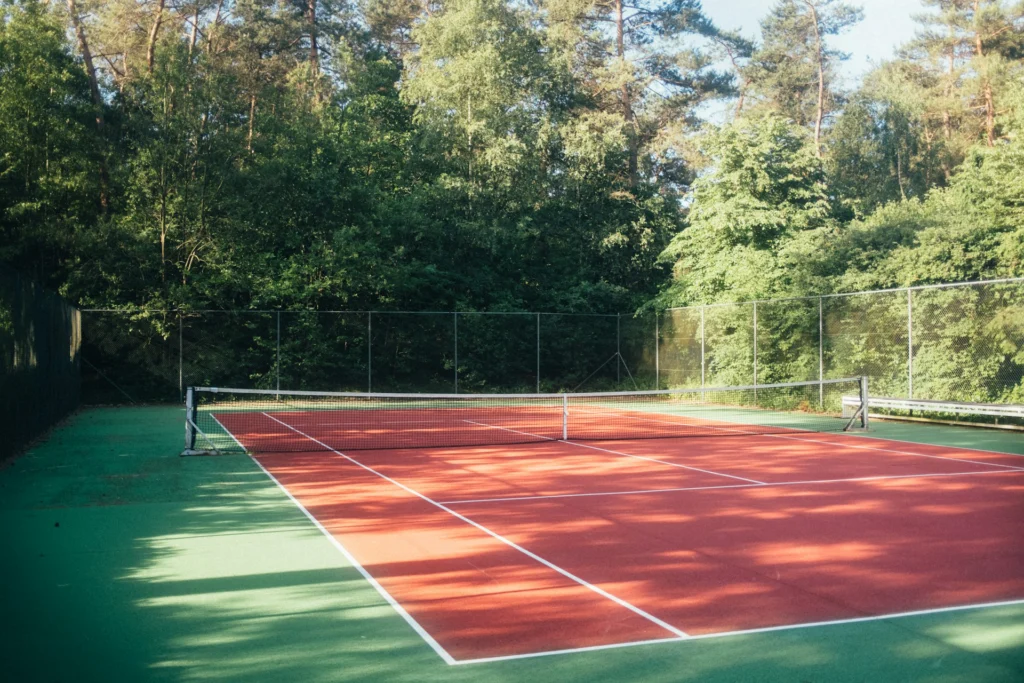
Yes, two padel courts fit in the space of one tennis court, sometimes even more, depending on the exact dimensions of the tennis court and the available space around the field. This makes converting a tennis court into padel courts an attractive option for clubs looking to increase their capacity.
A standard tennis court including run-off zones quickly covers 36 by 18 meters, which amounts to approximately 648 m². Two padel courts including run-off zones together take up approximately 21 by 28 meters, so 588 m². That fits in theory within the space of one tennis court, although the exact layout always depends on the location.
When converting a tennis court to padel courts, the existing foundation also plays a role. In some cases, part of the substructure can be reused, which saves costs. Whether that’s possible depends on the condition of the existing foundation, the soil conditions, and the requirements set for the new courts. A structural assessment on site is always the first step in determining that.
Converting 2 tennis courts into 4 padel courts — read about the possibilities here: Converting a tennis court into a padel court | I-Padel
What are the dimensions of a padel court for custom work or special locations?
The official playing dimensions of a padel court are fixed and always measure 20 by 10 meters. What can vary are the structural solutions around that fixed size: the height of the cage, the weight of the steel structure, the layout of glass and mesh, and the run-off zones.
At special locations — such as a hall with a low ceiling height, a narrow strip of land, or a location with specific wind loads — the structural calculations are adjusted to the local conditions. Think of a coastal location with higher wind loads, or an indoor location with limited height where the light masts are configured differently.
Sound-absorbing panels also require structural customization. When panels are attached to the outside of the cage, wind permeability decreases. The cage structure then needs to be reinforced with heavier uprights, additional columns, or adapted connections. This applies both to new courts and to existing courts where panels are added afterward. Without that adjustment, the structure is neither safe nor durable.
In short: the playing dimensions are fixed, but the structure around those dimensions is always custom work per location.
What type of foundation suits the dimensions and location of a padel court?
The choice of the right foundation type depends on the location, the intended use, and the soil conditions. The three most commonly used foundation types for padel courts are drainage concrete, Supersub, and ZOAB asphalt (porous asphalt). Each type has its own properties that make it more or less suitable for a specific situation.
-
Drainage concrete
Drainage concrete is a water-permeable type of concrete where rainwater is drained directly through the foundation into the soil. It's a widely used solution for outdoor padel courts where drainage and stability are important. A drainage concrete foundation lasts on average 25 to 40 years and is resistant to frost, heat, and intensive use. -
Supersub
Supersub is a foundation solution based on foam concrete, a lightweight, self-leveling material that provides a flat and stable base. It is shock-absorbing, water-permeable in its outdoor variant, and particularly suitable for both new construction and conversion projects. When converting a tennis court into padel courts, Supersub is regularly used, with a thickness of approximately 10 cm for renovation and approximately 15 cm for new construction. -
ZOAB asphalt
ZOAB asphalt (open-graded asphalt concrete) is a porous asphalt variant that allows water through. It's used less often for padel courts but can be a good choice in certain situations, for example at locations where an asphalt surface is already present.
Certification and quality mark
All foundation components must be certified in the Netherlands by Kiwa ISA Sport. This quality mark ensures that the materials meet the applicable standards for sports infrastructure. Anyone insufficiently aware of this risks using materials that aren’t certified, with consequences for the court’s inspection and its use for official matches. Working with certified materials is therefore not an extra, but a requirement.
When installing padel courts, we always advise based on a site assessment: soil conditions, wind load, intensity of use, and budget together determine which foundation type is the best fit. At I-Padel, we supply and install all three types, so you always get the solution that fits your situation — not whatever happens to be in stock.
Are you considering converting a tennis court into padel courts, or do you want to know what’s possible at your location? We’re happy to think along with you, free of obligation, about the possibilities, the dimensions, and the best approach for your project.
Frequently Asked Questions
Can I build a padel court on an existing grass surface or unpaved ground?
An unpaved or grassy surface is not in itself a suitable base for a padel court, but it’s certainly not an insurmountable obstacle. The existing soil is first assessed for load-bearing capacity and stability, after which a suitable foundation such as drainage concrete or Supersub is installed. A site assessment beforehand is essential to determine what preparatory groundwork is needed and what impact this has on the total budget.
What are the most common mistakes when planning the space for a padel court?
The most common mistake is calculating only with the playing dimensions (20 x 10 meters) and forgetting that the cage structure, run-off zones, access paths, and technical spaces require additional room. A second common mistake is underestimating the clear height needed for indoor locations: 6 meters is the absolute minimum, but in practice a lower ceiling height leads to structural adjustments that bring extra costs. Always plan with a total outer dimension of at least 21 x 11 meters as a starting point, and preferably 21 x 14 meters.
How long does it typically take to build a padel court, from first contact to completion?
The lead time for a padel court project usually varies between 6 and 16 weeks, depending on the complexity of the site, the required permits, and the contractor’s schedule. The actual construction time on site is relatively short, often 1 to 2 weeks per court, but the preparation — such as the site assessment, structural calculations, and any groundwork — largely determines the total timeline. Starting the planning phase early prevents unnecessary delays.
Do I need a permit to build a padel court?
Whether a building permit (“omgevingsvergunning”) is required depends on the municipality, the location, and whether the court is built indoors or outdoors. Outdoor padel courts are in many cases considered structures for which a permit is required, especially when a cage structure with a foundation is being installed. It’s strongly advisable to check this with the municipality early on, so that the permit procedure doesn’t cause delays in the project planning.
What does converting a tennis court into two padel courts generally cost?
The costs of a conversion project vary considerably depending on the condition of the existing foundation, the chosen materials, the type of cage, and the location-specific circumstances. Generally speaking, the costs for two padel courts including foundation, cage structure, and artificial turf range between €80,000 and €150,000, but this depends heavily on the situation on site. When part of the existing tennis court foundation can be reused, costs can be significantly lower; a structural assessment on site provides clarity on this.
What type of artificial turf is suitable for a padel court, and does it make a difference for playing quality?
Padel courts use specific artificial turf that is approved by the World Padel Tour (WPT) and meets the requirements of the FIP (Federación Internacional de Pádel). The pile height, fiber thickness, and the type of infill sand or rubber determine the playing speed, the ball’s bounce characteristics, and player comfort. Choosing certified artificial turf is not only a matter of quality but also a requirement if the court is used for official matches or tournaments.
Is it possible to expand or modify a padel court later, for example by adding sound-absorbing panels?
Yes, it’s possible to modify an existing padel court afterward, but this always requires a structural reassessment of the cage. Sound-absorbing panels on the outside reduce wind permeability, which puts extra load on the uprights and connections; without reinforcing the structure, this is not safe. It’s wise to already take future expansions into account during the initial construction, so the structure can be prepared for this and later modifications are less invasive and costly.