
What are the dimensions of a padel court compared to a tennis court?
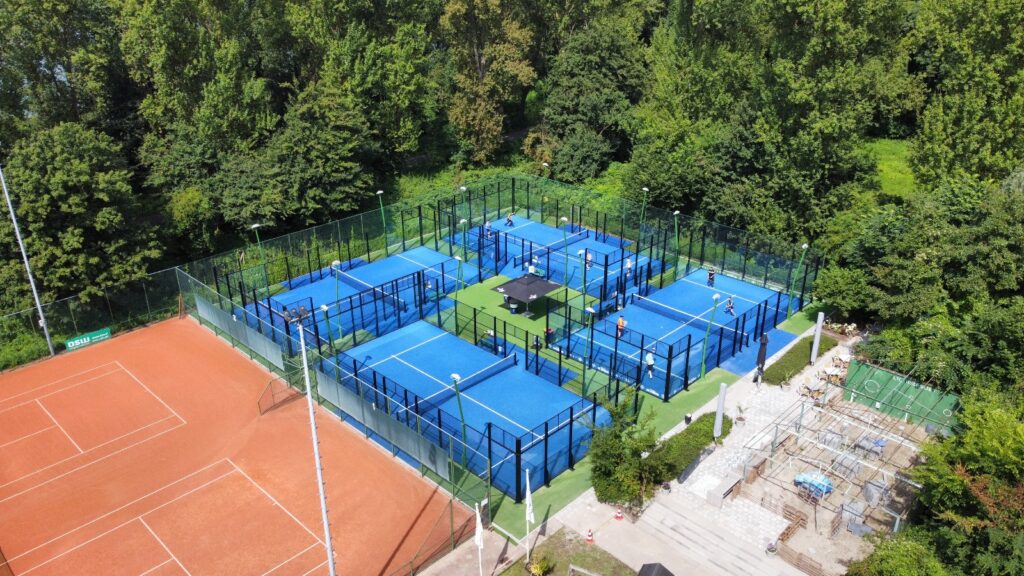
A padel court and a tennis court may look similar at first glance, but their dimensions differ considerably. A padel court measures 20 by 10 meters; a tennis court is roughly twice as large. That difference has major practical consequences, especially if you’re considering converting a tennis court into padel courts. Below you’ll find all the measurements at a glance, including the space, foundation, and custom work you’ll need. What are the official dimensions of a padel court? An official padel court measures 20 meters long and 10 meters wide. These are the international playing dimensions that apply to both competitive matches and recreational use. The playing field is enclosed by a cage structure of glass and mesh, which is part of the game itself. Besides the playing dimensions, there’s also an important distinction between the net playing area and the total space needed for the structure itself. The cage structure takes up slightly more room than just the playing field. For assembly and safety, you should plan for a minimum outer dimension of 21 by 11 meters. The cage’s standard height is 4 meters on the sides, with glass up to 3 meters high at the back wall, and the light mast reaches 6 meters at its highest point. For indoor padel courts, the hall’s clear height also plays a role. The minimum recommended clear height is 6 meters. The higher the hall, the better the playing quality, and the fewer restrictions players face on high balls. Read more about building padel courts How big is the difference between a padel court and a tennis court? A padel court has a playing surface of 200 m² (20 x 10 meters). A tennis court for doubles covers more than 260 m² of playing surface, but including the mandatory run-off zones, the total area quickly exceeds 600 m². The difference in required space is therefore two to three times as large in padel’s favor. This difference is exactly why padel is so appealing to tennis clubs and locations with limited space. In the space of one tennis court, multiple padel courts can fit, meaning you can achieve more playing capacity with the same amount of ground area. That translates directly into more playing hours, more members, and better utilization of the facility. Besides surface area, the playing experience also differs. Padel is played in an enclosed cage, where the walls are an active part of the game. Tennis is an open court without an enclosing structure. That fundamental difference in gameplay also explains why the courts differ so much in size. How much space do you need to build a padel court? To build one padel court, you need a minimum of 21 by 11 meters. This is the minimum assembly space including the cage structure. For an optimal playing experience with sufficient run-off space on the sides, 21 by 14 meters is recommended. That extra space on the sides, known as the run-off zones, is not only pleasant for players but also important for safety. At busy locations or for competitive use, sufficient space between two adjacent courts is also a point of attention. For indoor locations, the clear height also matters. A minimum of 6 meters is needed, but more is always better. When planning, also take into account access paths, emergency exits, and any technical spaces for lighting or electrical equipment. A thorough site assessment beforehand prevents surprises during construction. Can multiple padel courts fit in the space of one tennis court? Yes, two padel courts fit in the space of one tennis court, sometimes even more, depending on the exact dimensions of the tennis court and the available space around the field. This makes converting a tennis court into padel courts an attractive option for clubs looking to increase their capacity. A standard tennis court including run-off zones quickly covers 36 by 18 meters, which amounts to approximately 648 m². Two padel courts including run-off zones together take up approximately 21 by 28 meters, so 588 m². That fits in theory within the space of one tennis court, although the exact layout always depends on the location. When converting a tennis court to padel courts, the existing foundation also plays a role. In some cases, part of the substructure can be reused, which saves costs. Whether that’s possible depends on the condition of the existing foundation, the soil conditions, and the requirements set for the new courts. A structural assessment on site is always the first step in determining that. Converting 2 tennis courts into 4 padel courts — read about the possibilities here: Converting a tennis court into a padel court | I-Padel What are the dimensions of a padel court for custom work or special locations? The official playing dimensions of a padel court are fixed and always measure 20 by 10 meters. What can vary are the structural solutions around that fixed size: the height of the cage, the weight of the steel structure, the layout of glass and mesh, and the run-off zones. At special locations — such as a hall with a low ceiling height, a narrow strip of land, or a location with specific wind loads — the structural calculations are adjusted to the local conditions. Think of a coastal location with higher wind loads, or an indoor location with limited height where the light masts are configured differently. Sound-absorbing panels also require structural customization. When panels are attached to the outside of the cage, wind permeability decreases. The cage structure then needs to be reinforced with heavier uprights, additional columns, or adapted connections. This applies both to new courts and to existing courts where panels are added afterward. Without that adjustment, the structure is neither safe nor durable. In short: the playing dimensions are fixed, but the structure around those dimensions is always custom work per location. Read more about custom padel courts What type of foundation suits the dimensions and location of a padel court? The choice of