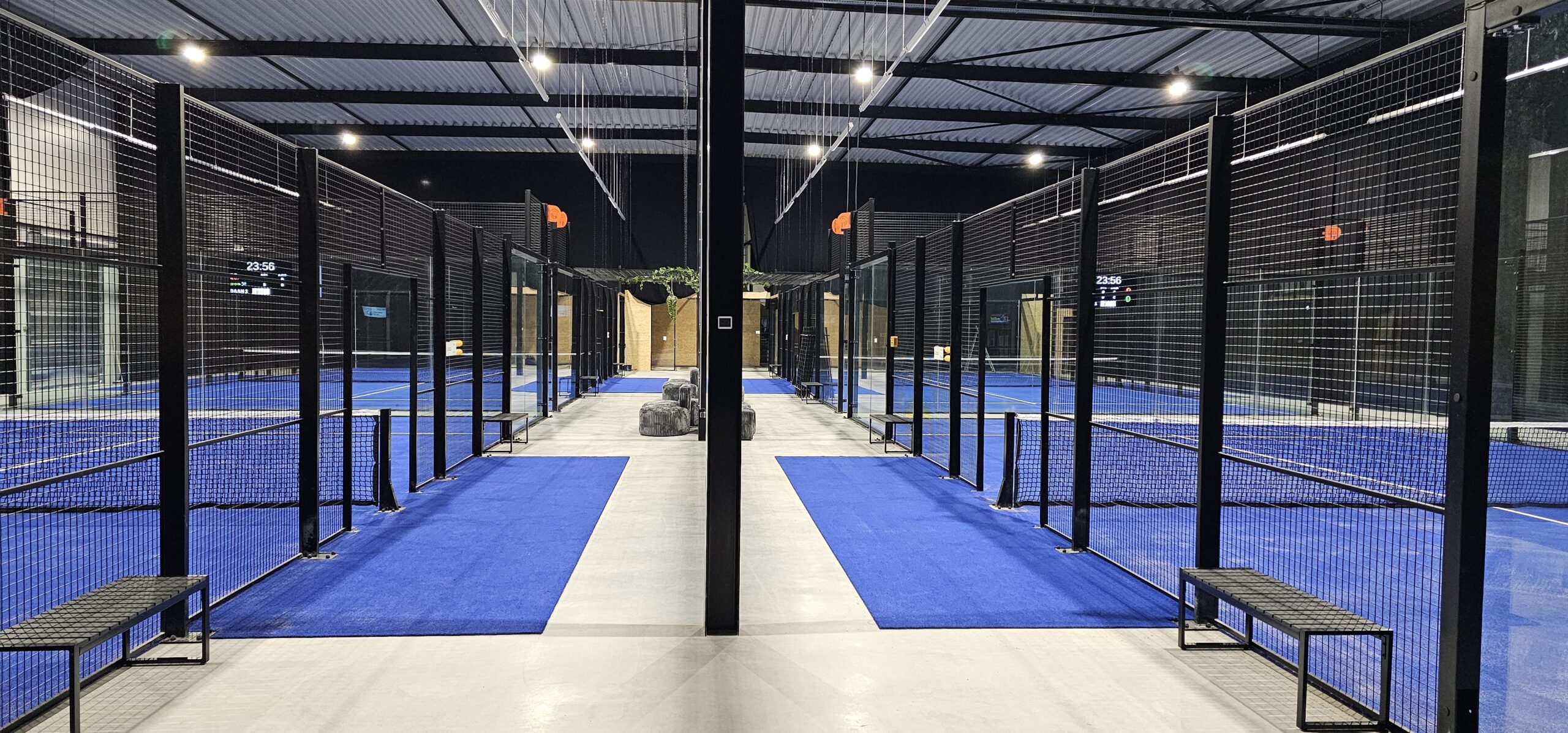
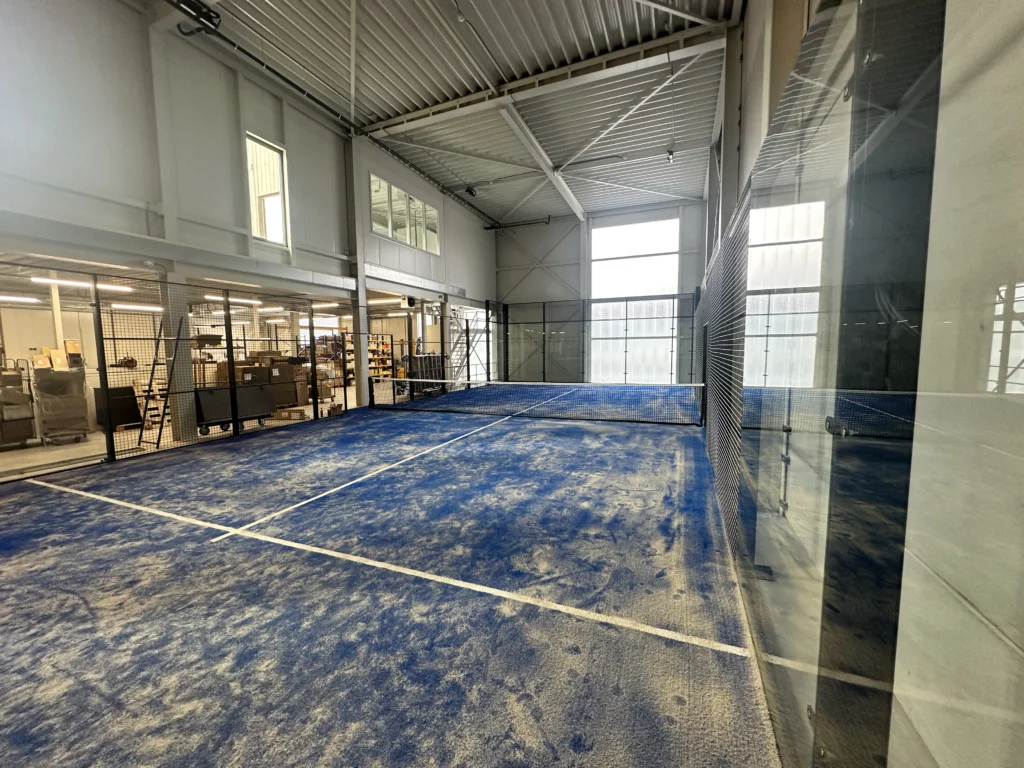
The minimum clear height for a padel hall is 6 meters. That is the minimum needed to play padel responsibly, without the ball constantly bouncing off the ceiling. For professional use, matches, or a more comfortable playing experience, the rule is: the higher, the better. Do you have a hall in mind and want to know if it’s suitable? Then the dimensions of the padel court are the starting point of every good plan.
In this article we answer the most frequently asked questions about the height and dimensions of a padel hall, so you know exactly what to pay attention to when planning your location.
Does the same minimum height apply to every spot in the hall?
The minimum clear height of 6 meters applies to the entire playing field, including the space directly above the court. This concerns the clear height: the distance from the floor to the lowest obstruction above the playing field, such as a roof beam, a light fixture, or an installation pipe. That 6 meters must be achieved everywhere above the playing surface.
In practice, we see that halls with steel structures often have roof beams or purlins that hang lower at regular intervals. So it is not enough to only measure the ridge or the highest point of the hall. Always check the lowest point above the playing field itself. If in doubt, an on-site measurement is the only reliable way to be certain.
Also take the LED lighting above the court into account. The light masts of a padel court are standard 6 meters high. If the lighting is integrated into the roof structure, there must be enough room for both the fixtures and the clear playing space beneath them. A hall of exactly 6 meters is tight in that case and requires custom lighting arrangements.
What happens if the hall just falls short of the minimum height?
If the clear height comes in just under 6 meters, recreational play is sometimes still possible, but professional use and official matches are then not allowed. A court that does not meet the height requirements cannot receive certification from Kiwa ISA Sport, which is mandatory for competition use under the KNLTB.
That has concrete consequences. Without valid certification, the court may not be used for official competition. For commercial operators or clubs wanting to organize matches, that is a serious limitation. Tenants or buyers who later still want to apply for certification then run into a wall.
Practically speaking, solutions are sometimes possible depending on the exact situation. Think of lowering the floor, adjusting the roof structure, or choosing a different court layout within the hall. But these are drastic and costly adjustments. The wisest approach is to always check the height of a hall first, before making further plans.
What other dimensions are required for an indoor padel court?
Besides the minimum height of 6 meters, fixed dimensions apply for the playing field and the necessary space around it. The playing surface of a padel court is always 20 x 10 meters. For assembly of the cage structure you need at least 21 x 11 meters. The recommended space, including run-off zones, is 21 x 14 meters.
Those run-off zones exist for a reason. They ensure the safety of players who end up behind the court and noticeably improve the playing experience. In a hall with multiple courts side by side, those extra meters add up quickly, so factor them into your space planning.
- Playing field: 20 x 10 meters
- Minimum assembly space: 21 x 11 meters
- Recommended space including run-off zones: 21 x 14 meters
- Minimum clear height: 6 meters
For a hall with multiple courts, you add up the width per court, including the space between courts. An aisle of at least 1 to 2 meters between two courts is common and also advisable from a safety standpoint. When planning, always take emergency exits, escape routes, and local fire department requirements into account.
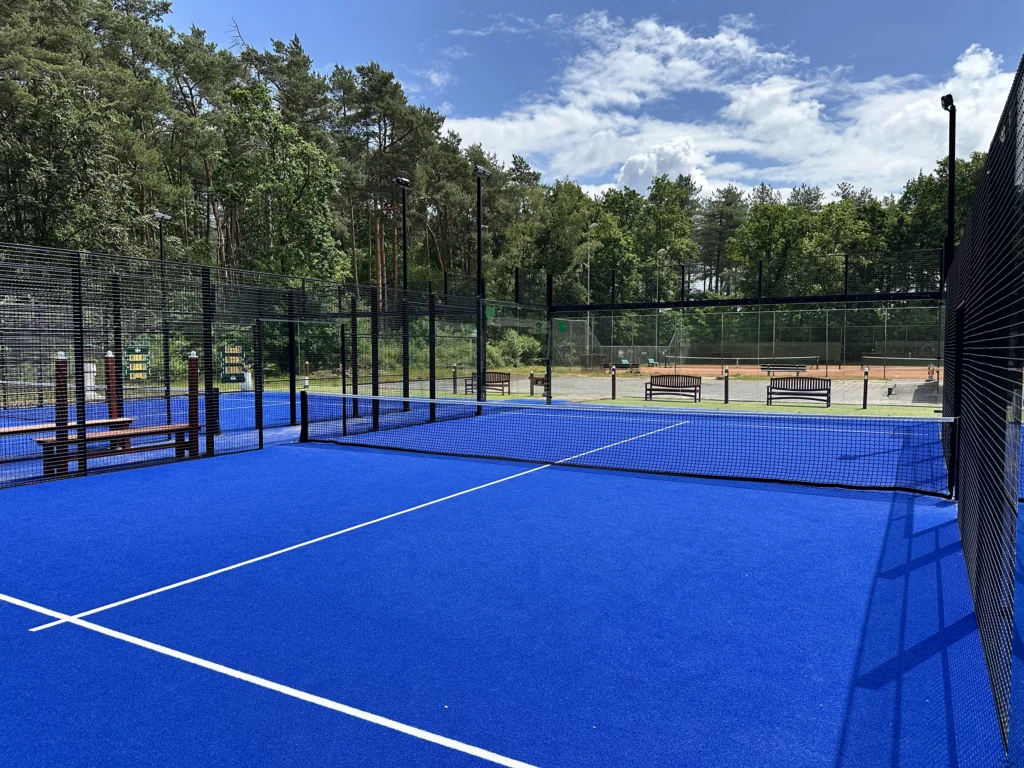
What is the difference between an indoor and outdoor padel court in terms of construction requirements?
The biggest difference lies in the steel structure. An outdoor padel court is exposed to wind, rain, frost, and sunlight. That requires a heavier steel structure, better protection of the steel, and a foundation calculated for wind load and weather influences. With an indoor padel court, a large part of those requirements no longer applies, because the hall protects the court.
Concretely, this means outdoor courts are standardly built with hot-dip galvanized steel as protection against rust and corrosion. The structure is also dimensioned more heavily to absorb wind forces, especially in open areas or coastal regions. This is not necessary for indoor courts, which makes the structure simpler and cheaper.
The foundation also differs. For outdoor courts, the foundation is a major and location-dependent cost item. Drainage concrete and Supersub are commonly used foundation types for outdoor use, where rainwater is drained directly through the foundation. For indoor courts, water drainage through the foundation is less relevant, and the build-up is tailored to the indoor environment. The exact foundation choice always depends on the soil
conditions and the specific location.
Finally, permits play a different role. An indoor padel court in an existing hall does not always require a separate building permit, depending on the situation. An outdoor padel court requires an environmental permit in almost all cases due to noise, lighting, and spatial impact.
How much does it cost to have an indoor padel court built?
As an indication, a standard indoor padel court, including cage structure, glass, artificial turf, LED lighting, and installation, may be possible from approximately €23,000 per court. The exact price always depends on the type of court, the number of courts, the accessibility of the location, and the chosen specification.
A common mistake is looking only at the lowest price. In practice, this often leads to higher costs in the long run, due to lower-quality materials, limited warranty, or technical limitations that are expensive to correct later. A padel court is an investment that must last for decades, so the total costs over the lifespan are more relevant than just the purchase price.
Factors that influence the price:
-
Type of court:
Pro, Panorama, or Single, each with its own look and construction -
Number of courts:
with multiple courts, economies of scale arise in production and installation -
Accessibility:
transport and assembly conditions within the hall -
Artificial turf and LED lighting:
different quality levels are available -
Extra options:
run-off zones, sound-absorbing panels, or alternative lighting systems
Keep in mind that this price level applies to indoor courts. Outdoor courts are more expensive due to the heavier construction and the foundation, which is a separate and major cost factor.
How do you choose the right foundation for an indoor padel court?
The right foundation for an indoor padel court depends on the soil conditions, the existing floor, and the use of the location. In new construction in a hall without an existing floor, the foundation is built entirely from scratch. With an existing floor or a conversion of another
sports floor, part of the substructure can sometimes be reused.
Supersub is a foundation solution based on foam concrete that works well for both new construction and renovations. The material is lightweight, self-leveling, and ensures an extremely flat surface, which is important for consistent ball bounce. For indoor use, a non-water-permeable variant is applied, tailored to the indoor environment. The thickness is typically 10 to 15 cm, depending on the soil conditions and project requirements.
Drainage concrete is another commonly used option, particularly for outdoor courts, but also applicable in certain indoor situations. The material is water-permeable and has high stability and load-bearing capacity, suitable for the heavy load of a steel structure with glass walls.
An important point to know: all foundation components must be certified in the Netherlands by Kiwa ISA Sport. Working with certified materials is not only a matter of quality but also a condition for official competition use. Inexperienced buyers who are unaware of this run the risk of using materials that later fail certification.
Based on a soil survey, a foundation recommendation is always drawn up. Without that survey, a reliable foundation recommendation is simply not possible, because soil conditions can vary greatly by location.
At I-Padel, we manufacture the steel structure entirely in-house and handle the complete process from foundation to delivery. This gives you a single point of contact and a single responsibility for the entire project. Want to know the possibilities for your location? Get in touch for an initial exploration, and we’re happy to think along with you without obligation.
Frequently asked questions
How long does it typically take to install an indoor padel court?
The installation time for an indoor padel court usually varies between 3 and 7 working days
per court, depending on the complexity of the location, accessibility within the hall, and the number of courts being installed simultaneously. With multiple courts at once, the total lead time can be shorter due to more efficient planning of assembly and material logistics. Also factor in time for foundation preparation, which takes place separately from assembly and depends on the drying time of the chosen foundation material.
What permits do I need for an indoor padel court in an existing hall?
For placing an indoor padel court in an existing hall, a separate building permit is often not required, but this strongly depends on the municipality and the specific situation. Always check with the local municipality whether an environmental permit is needed, especially if the hall is being renovated or if the use of the building is changing. Also take fire safety requirements into account: the local fire department sets requirements for escape routes, emergency exits, and fire alarm systems that can affect the court layout.
Can I convert an existing sports hall or industrial hall into a padel hall?
Yes, converting an existing sports hall or industrial hall into a padel hall is possible in many cases, provided the clear height is at least 6 meters and the floor area is sufficient for the desired court layout including run-off zones. The existing floor can sometimes be reused or adapted, depending on its condition and the type of substrate. A site survey and soil investigation are always the first step in determining what is technically possible and what the renovation realistically costs.
What are the most common mistakes in planning a padel hall?
The most common mistake is underestimating the required space: many planners only calculate with the playing field of 20 x 10 meters and forget the run-off zones, aisles between courts, and space for emergency exits. A second common mistake is not checking the clear height at the lowest point above the playing field early enough, causing the hall to turn out unsuitable for certification later on. Finally, lighting planning is regularly overlooked: light fixtures that hang too low can limit the clear playing space and require an expensive adjustment afterward.
What exactly does Kiwa ISA Sport certification mean and why is it so important?
Kiwa ISA Sport is the independent certification body that inspects padel courts in the Netherlands for safety, dimensions, and material quality. A valid Kiwa ISA Sport certification is mandatory for official competition use under the KNLTB and applies both to the court itself and to the foundation materials used. Without this certificate, the court may not be used for official matches, which is a direct limitation for commercial operators and clubs on usability and, therefore, on the payback period of the investment.
How many courts fit in a standard sports hall of 40 x 20 meters?
In a hall of 40 x 20 meters, two padel courts theoretically fit side by side, but in practice that is tight. Two courts, including run-off zones and an aisle between the courts, quickly require 28 to 30 meters in width, depending on the chosen run-off space. A hall of 40 x 20 meters is better suited for one court with generous run-off zones, or two courts placed end to end lengthwise, provided the hall is deep enough. An accurate floor plan and professional advice are essential to determine the optimal court layout for your specific hall.
What type of artificial turf is recommended for an indoor padel court and how long does it last?
For indoor padel courts, short-pile artificial turf with a pile height of 10 to 13 mm is generally used, filled with sand to ensure proper ball bounce and grip. The lifespan of quality artificial turf on an indoor court averages between 5 and 8 years, depending on the intensity of use and maintenance. Regular brushing and keeping the sand infill topped up significantly extends the lifespan. Always choose artificial turf that is certified by Kiwa ISA Sport, so the court qualifies for official competition use.