
What is the minimum height for a padel hall?
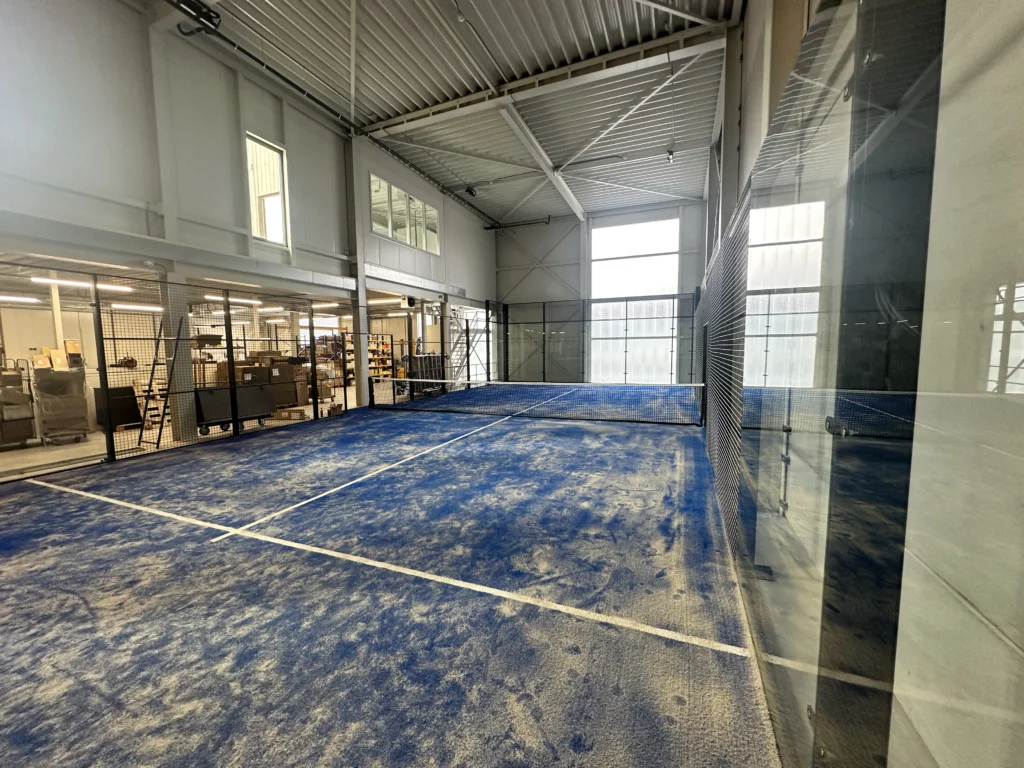
The minimum clear height for a padel hall is 6 meters. That is the minimum needed to play padel responsibly, without the ball constantly bouncing off the ceiling. For professional use, matches, or a more comfortable playing experience, the rule is: the higher, the better. Do you have a hall in mind and want to know if it’s suitable? Then the dimensions of the padel court are the starting point of every good plan. In this article we answer the most frequently asked questions about the height and dimensions of a padel hall, so you know exactly what to pay attention to when planning your location. Does the same minimum height apply to every spot in the hall? The minimum clear height of 6 meters applies to the entire playing field, including the space directly above the court. This concerns the clear height: the distance from the floor to the lowest obstruction above the playing field, such as a roof beam, a light fixture, or an installation pipe. That 6 meters must be achieved everywhere above the playing surface. In practice, we see that halls with steel structures often have roof beams or purlins that hang lower at regular intervals. So it is not enough to only measure the ridge or the highest point of the hall. Always check the lowest point above the playing field itself. If in doubt, an on-site measurement is the only reliable way to be certain. Also take the LED lighting above the court into account. The light masts of a padel court are standard 6 meters high. If the lighting is integrated into the roof structure, there must be enough room for both the fixtures and the clear playing space beneath them. A hall of exactly 6 meters is tight in that case and requires custom lighting arrangements. What happens if the hall just falls short of the minimum height? If the clear height comes in just under 6 meters, recreational play is sometimes still possible, but professional use and official matches are then not allowed. A court that does not meet the height requirements cannot receive certification from Kiwa ISA Sport, which is mandatory for competition use under the KNLTB. That has concrete consequences. Without valid certification, the court may not be used for official competition. For commercial operators or clubs wanting to organize matches, that is a serious limitation. Tenants or buyers who later still want to apply for certification then run into a wall. Practically speaking, solutions are sometimes possible depending on the exact situation. Think of lowering the floor, adjusting the roof structure, or choosing a different court layout within the hall. But these are drastic and costly adjustments. The wisest approach is to always check the height of a hall first, before making further plans. What other dimensions are required for an indoor padel court? Besides the minimum height of 6 meters, fixed dimensions apply for the playing field and the necessary space around it. The playing surface of a padel court is always 20 x 10 meters. For assembly of the cage structure you need at least 21 x 11 meters. The recommended space, including run-off zones, is 21 x 14 meters. Those run-off zones exist for a reason. They ensure the safety of players who end up behind the court and noticeably improve the playing experience. In a hall with multiple courts side by side, those extra meters add up quickly, so factor them into your space planning. Playing field: 20 x 10 meters Minimum assembly space: 21 x 11 meters Recommended space including run-off zones: 21 x 14 meters Minimum clear height: 6 meters For a hall with multiple courts, you add up the width per court, including the space between courts. An aisle of at least 1 to 2 meters between two courts is common and also advisable from a safety standpoint. When planning, always take emergency exits, escape routes, and local fire department requirements into account. What is the difference between an indoor and outdoor padel court in terms of construction requirements? The biggest difference lies in the steel structure. An outdoor padel court is exposed to wind, rain, frost, and sunlight. That requires a heavier steel structure, better protection of the steel, and a foundation calculated for wind load and weather influences. With an indoor padel court, a large part of those requirements no longer applies, because the hall protects the court. Concretely, this means outdoor courts are standardly built with hot-dip galvanized steel as protection against rust and corrosion. The structure is also dimensioned more heavily to absorb wind forces, especially in open areas or coastal regions. This is not necessary for indoor courts, which makes the structure simpler and cheaper. The foundation also differs. For outdoor courts, the foundation is a major and location-dependent cost item. Drainage concrete and Supersub are commonly used foundation types for outdoor use, where rainwater is drained directly through the foundation. For indoor courts, water drainage through the foundation is less relevant, and the build-up is tailored to the indoor environment. The exact foundation choice always depends on the soil conditions and the specific location. Finally, permits play a different role. An indoor padel court in an existing hall does not always require a separate building permit, depending on the situation. An outdoor padel court requires an environmental permit in almost all cases due to noise, lighting, and spatial impact. How much does it cost to have an indoor padel court built? As an indication, a standard indoor padel court, including cage structure, glass, artificial turf, LED lighting, and installation, may be possible from approximately €23,000 per court. The exact price always depends on the type of court, the number of courts, the accessibility of the location, and the chosen specification. A common mistake is looking only at the lowest price. In practice, this often leads to higher costs in the long run, due to lower-quality materials, limited warranty, or technical limitations that are