Noise nuisance is one of the most frequently asked questions when installing a padel court, and that’s understandable. Padel is a loud sport: the combination of a hard ball, glass walls, and a steel cage construction produces a recognizable sound that can carry far. Still, the situation with an indoor padel court is fundamentally different from an outdoor court. In this article we explain how much noise an indoor padel court produces, what the rules are, and which measures you can take to prevent noise complaints.
How much noise does an indoor padel court produce?
What are the legal noise standards for padel courts in the Netherlands?
As a guideline, the government applies the following limit values for sports facilities, measured at the facade of nearby homes:
-
Daytime (07:00 to 19:00):
maximum 50 dB(A) long-term average -
Evening (19:00 to 23:00):
maximum 45 dB(A) long-term average -
Night (23:00 to 07:00):
maximum 40 dB(A) long-term average
For an indoor padel court in an existing, well-insulated hall, meeting these standards is often realistic without extra measures. For a new hall or a poorly insulated space, an acoustic study is almost always advisable and in many cases also required as part of the permit application. The municipality assesses per situation whether additional measures are needed.
What is the difference in noise nuisance between indoor and outdoor padel courts?
-
Indoor:
In an existing hall without structural changes, a separate building permit is not always required. Whether an acoustic study is needed depends on the situation. -
Outdoor:
An environmental permit is almost always required. An acoustic study is a standard part of the permit application for outdoor padel courts near residential areas.
That doesn’t mean an indoor padel court never causes noise complaints. If the hall borders homes, has poor facade insulation, or if the padel court is positioned right next to an exterior wall, sound can still leak outside. The hall offers protection, but it is not a guarantee.
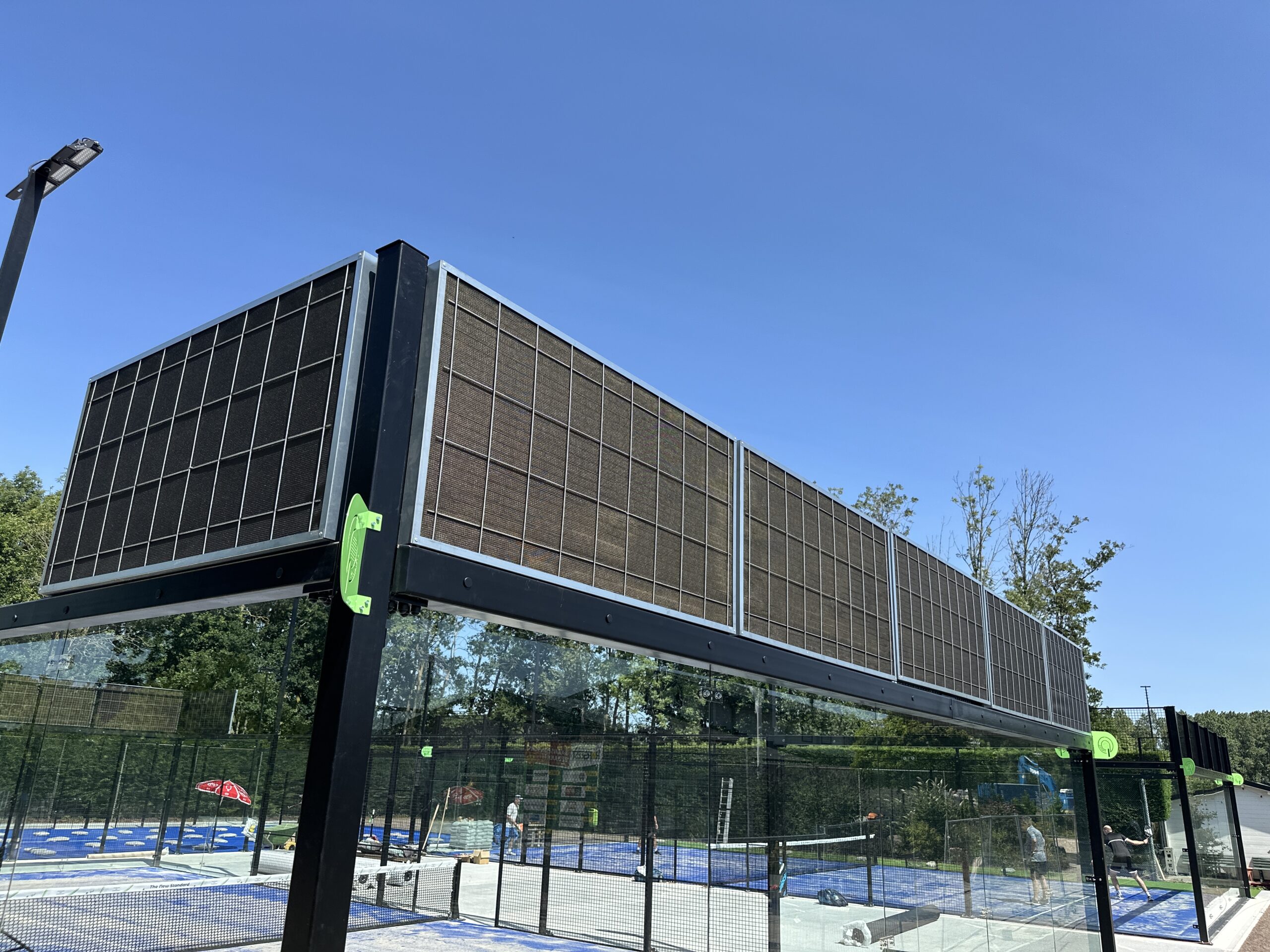
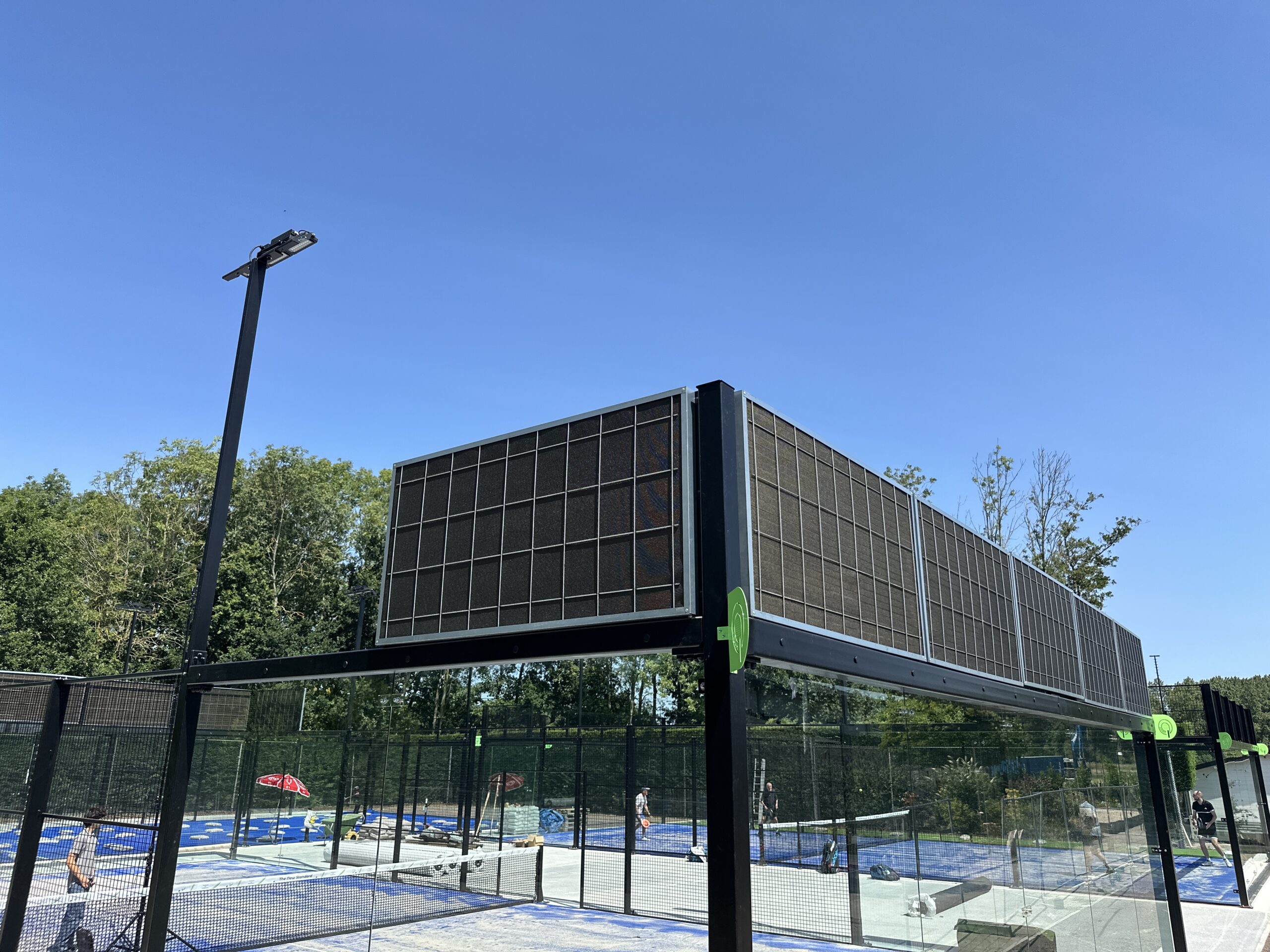
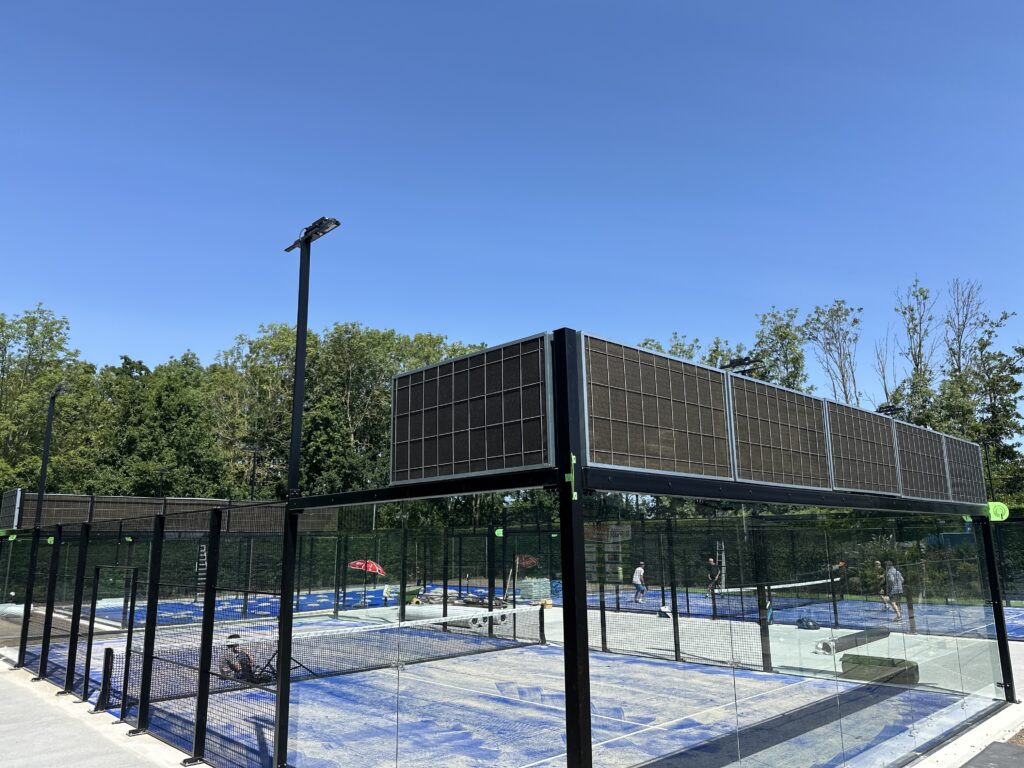
How do sound-absorbing panels work on a padel court?
The panels have been independently tested in an acoustic laboratory and achieve the following results:
- Sound absorption class: A
- Absorption value αw: 0.80
- Absorption index DLα: 8 dB
- Airborne sound insulation Rw: 22 dB
- Sound insulation index DLR: 19 dB
Can every padel court be equipped with sound-absorbing panels?
Not every existing padel court can simply be fitted with sound-absorbing panels. The panels change the wind load on the cage construction, which means the structure must be recalculated for each location. Whether an existing court is suitable for panels depends on the current structural specifications and the wind zone in which the court is located.
New padel courts can be designed with panels included in the building plan as standard, so that the steel structure is calculated directly for the correct load from the start. For existing courts, a structural assessment is needed before panels can be installed. In some cases, adjustments to the existing structure are sufficient; in other cases, replacement or reinforcement of components is necessary.
Another point of attention is the location and orientation of the panels. Panels facing an open area catch more wind than panels facing a building. The calculation must always take the specific local situation into account, including surrounding buildings and the position relative to the wind direction.
When are noise measures mandatory for a new padel court?
Noise measures are mandatory when an acoustic study shows that the padel court exceeds the applicable noise standards at the facade of nearby homes. For outdoor padel courts near residential areas, this study is almost always a mandatory part of the environmental permit. For indoor padel courts, the situation depends on the insulation value of the hall and its location.
The municipality determines, based on the acoustic study, whether additional measures are required. Think of:
- Installing sound-absorbing panels on one or more sides of the court
- Constructing a noise barrier next to or around the padel court
- A combination of panels and a noise barrier
- Adjusting opening hours (less playing in the evening hours)
It is wise to have an acoustic study carried out early in the planning process. This way you know which measures are needed before the permit application, and you can factor them directly into the design and budget. Making adjustments afterward is always more expensive and sometimes technically more complicated.
For post-installation inspection, all foundation components used in the Netherlands must be certified by Kiwa ISA Sport. Working with certified materials is not only a matter of quality, but also protects you against non-conformity during official inspections.
How do you prevent noise complaints when installing an indoor padel court?
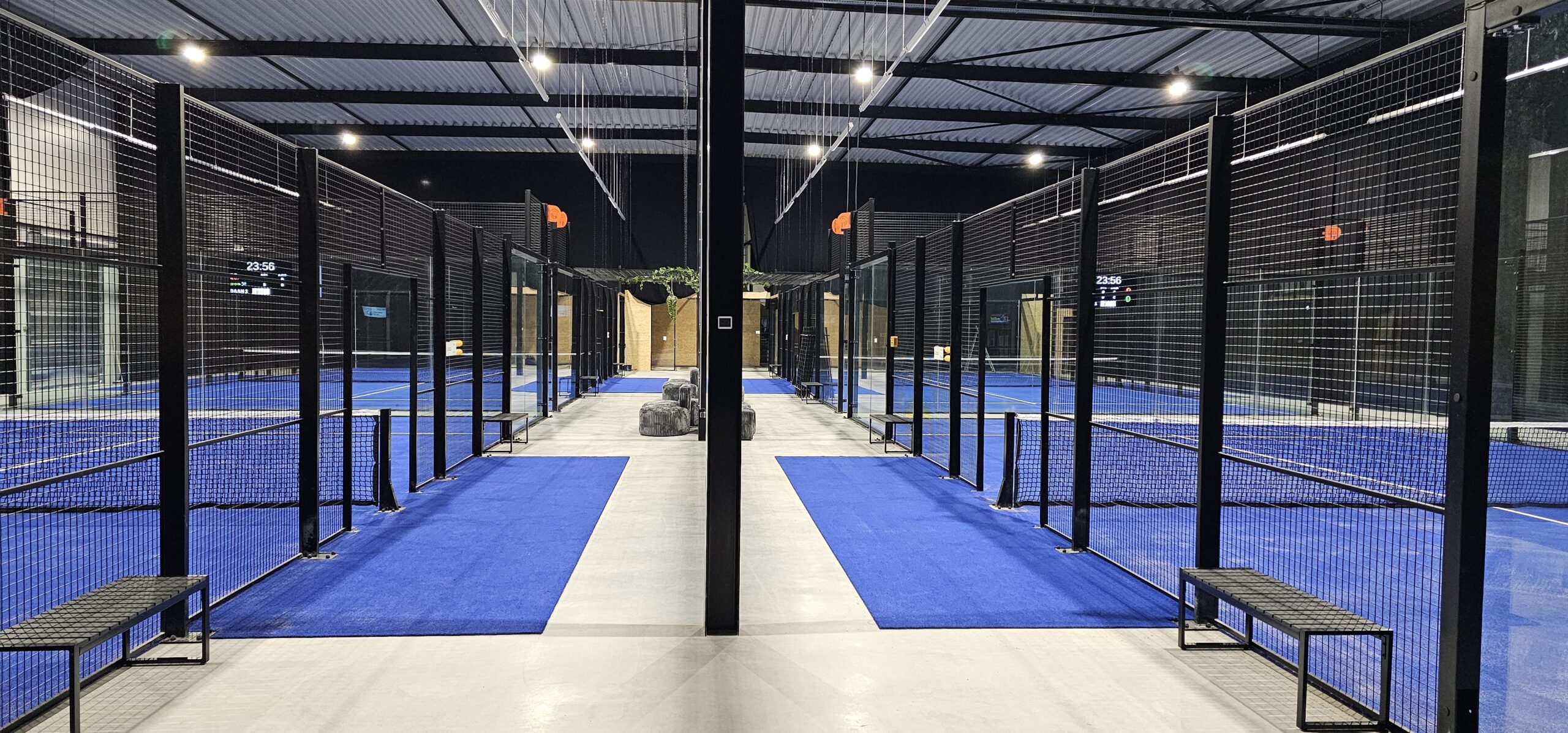
You prevent noise complaints with an indoor padel court by taking noise into account early in the process, not only afterward. The most effective approach combines a good choice of location within the hall, the right construction, and, where needed, sound-absorbing panels. This way you address the problem at the source, instead of having to solve it once complaints have already arisen.
Concrete steps that make a difference:
-
Have an acoustic study carried out before making a final plan.
This way you know what the situation requires and avoid surprises during the permit application. -
Choose the right position for the court within the hall.
A padel court directly bordering an exterior facade facing homes requires more attention than a court located on the interior side of a hall. -
Consider sound-absorbing panels already at the design stage.
If you want to add them later, the structure will still need to be recalculated and possibly reinforced. That is more expensive than including them from the start. -
Communicate proactively with the municipality.
Municipalities respond better to initiators who come forward themselves with an acoustic report and a noise plan than to applicants who only respond once objections arise. -
Involve nearby residents early in the process.
Inform local residents about the plans and the measures you are taking. This prevents objection procedures and builds understanding.
At I-Padel we guide this process from start to finish. We handle the structural calculations, coordinate the acoustic study, and help think through the best noise solution for your location. Whether it concerns installing a padel court with sound-absorbing panels or assessing an existing situation, we’re happy to think along with you, without obligation.
Frequently Asked Questions
Do I need an acoustic study if I want to place a padel court in an existing sports hall?
That depends on the insulation value of the hall and the distance to nearby homes. In many cases an acoustic study is advisable, even if it is not formally required — it gives you certainty before the permit application and prevents costly adjustments afterward. If in doubt, always first ask for preliminary advice from an acoustics firm or your padel court supplier.
What does it cost to add sound-absorbing panels to an existing padel court afterward?
Adding panels afterward is almost always more expensive than including them directly in the design, because the steel structure has to be recalculated and possibly reinforced or partially replaced. The exact additional costs depend on the age and type of construction, the wind zone, and how many sides of the court are fitted with panels. Have a structural assessment carried out before requesting a quote, so you have a realistic overall picture.
May padel courts be used in the evening and on weekends without extra noise measures?
That depends entirely on the outcome of the acoustic study and the permit conditions set by the municipality. The legal noise standards are stricter in the evening hours (19:00–23:00) than during the day, which means a court that meets the standards during the day may still cause problems in the evening. Always check the specific opening hours included in the environmental permit and adjust the playing schedule accordingly if needed.
What mistakes do initiators most often make when installing a padel court in relation to noise?
The most common mistake is only treating noise as a problem once complaints or objections have already arisen — at that point, adjustments are technically more complicated and considerably more expensive. A second common mistake is not aligning the position of the court within the hall with the location of nearby homes, causing the court to end up unnecessarily close to an exterior facade facing a residential area. Therefore, always start with an acoustic assessment and incorporate the findings into the initial design.
Do sound-absorbing panels also help against noise inside the hall, for players and spectators?
The panels are primarily designed to reduce noise going outward, but they also have a positive effect on the acoustics inside the hall. Because of the absorbing material, less sound is reflected back within the cage construction, which reduces reverberation in the immediate area around the court. For a full improvement of the hall’s acoustics — for example with multiple courts next to each other — additional acoustic measures on the ceiling or walls of the hall are sometimes worthwhile.
What is a noise barrier and when is it a better solution than absorbing panels?
A noise barrier is a physical dividing wall, often made of concrete, wood, or a combination of materials, placed between the padel court and the surroundings to block sound propagation. A noise barrier is particularly effective for outdoor padel courts at locations where the court cannot be relocated and where noise needs to be blocked in one specific direction. For indoor padel courts, a noise barrier is rarely the primary solution; here, structural adjustments to the hall or absorbing panels are generally more effective and more cost-efficient.
What should I include in my budget if I want to account for noise measures?
In addition to the cost of the panels themselves, budget for the cost of an acoustic study (depending on the complexity of the situation), a structural recalculation of the cage construction, and any reinforcement of the posts or columns. If a noise barrier is needed, the construction and material costs should be added as well. By including these items in the budget early on, you avoid them appearing later as unexpected additional costs, and you can plan the financing realistically.
Contact us!

Contact details:
- +31 52 72 100 40
- info@i-padel.nl
- Hoornse Hop 10, 8321 WX, URK