
Does an indoor padel court cause noise nuisance to the surrounding area?
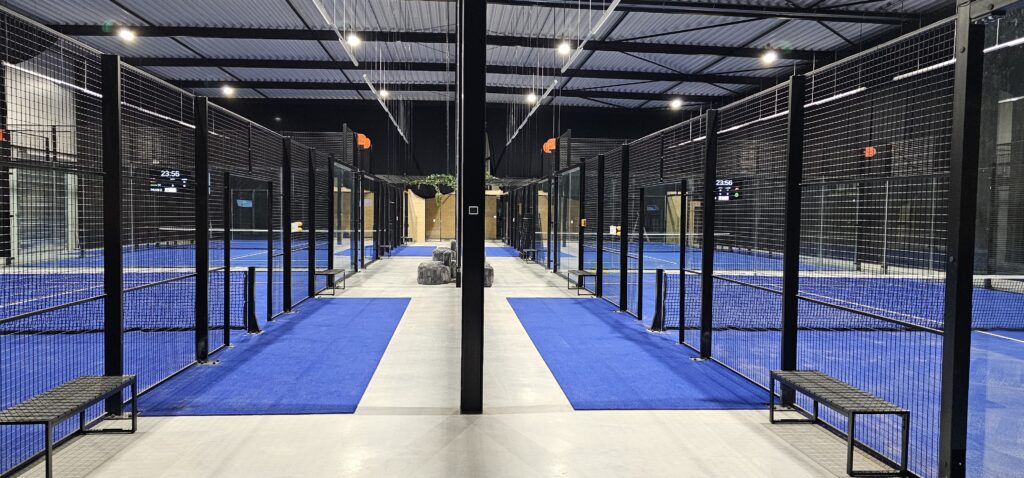
Noise nuisance is one of the most frequently asked questions when installing a padel court, and that’s understandable. Padel is a loud sport: the combination of a hard ball, glass walls, and a steel cage construction produces a recognizable sound that can carry far. Still, the situation with an indoor padel court is fundamentally different from an outdoor court. In this article we explain how much noise an indoor padel court produces, what the rules are, and which measures you can take to prevent noise complaints. How much noise does an indoor padel court produce? A padel court produces an average sound power of approximately 91 dB. That is roughly 10 dB more than a tennis court. The noise arises from two sources: the contact of the racket with the ball, and the contact of the ball with the glass and mesh of the cage construction. That second type of noise, the contact noise, is responsible for the largest part of the perceived nuisance. The cage construction amplifies this effect. Glass and steel reflect sound rather than absorbing it, which means the court functions as a kind of resonance chamber. With an indoor padel court, the hall itself also plays a role: the walls, ceiling, and floor partly determine how the sound spreads and whether it is audible outside the hall. Important to know: 91 dB is the source power at the court itself. At greater distances, the sound decreases quickly. Whether nearby residents experience nuisance from an indoor padel court depends heavily on the insulation value of the hall, the distance to homes, and the construction of the court. What are the legal noise standards for padel courts in the Netherlands? In the Netherlands, padel courts fall under the rules of the Activities Decree (Activiteitenbesluit milieubeheer) for environmental management. For sports activities, limit values apply for the long-term average assessment level (LAr,LT) and the maximum sound level (LAmax). The exact standards depend on the surroundings: stricter requirements apply in a residential area than in an industrial zone. As a guideline, the government applies the following limit values for sports facilities, measured at the facade of nearby homes: Daytime (07:00 to 19:00): maximum 50 dB(A) long-term average Evening (19:00 to 23:00): maximum 45 dB(A) long-term average Night (23:00 to 07:00): maximum 40 dB(A) long-term average For an indoor padel court in an existing, well-insulated hall, meeting these standards is often realistic without extra measures. For a new hall or a poorly insulated space, an acoustic study is almost always advisable and in many cases also required as part of the permit application. The municipality assesses per situation whether additional measures are needed. What is the difference in noise nuisance between indoor and outdoor padel courts? Indoor padel courts generally cause less noise nuisance for the surroundings than outdoor padel courts. The hall acts as a natural sound buffer: walls, roof, and insulation contain a large part of the sound. With an outdoor padel court, the sound spreads freely in all directions, without any damping from a building.