Anyone planning to build a padel court naturally looks at the purchase price first. But annual maintenance costs are regularly underestimated when weighing a padel court’s investment return. Yet it’s precisely these recurring costs that largely determine whether a court is profitable in the long run. As a general guideline: budget annual maintenance costs of between €500 and €2,000 for an indoor padel court, depending on usage and construction. For an outdoor padel court, these costs are higher due to additional wear from weather exposure.
In this article, we’ve laid out the key maintenance questions so you have a realistic picture of what a padel court will cost you after construction.
What are the average annual maintenance costs of a padel court?
The average annual maintenance costs of a padel court range between €500 and €2,000 for an indoor court. For an outdoor padel court, costs are higher: budget €800 to €2,000 per year, depending on usage, location, and weather conditions. These are costs for regular maintenance, excluding major replacements.
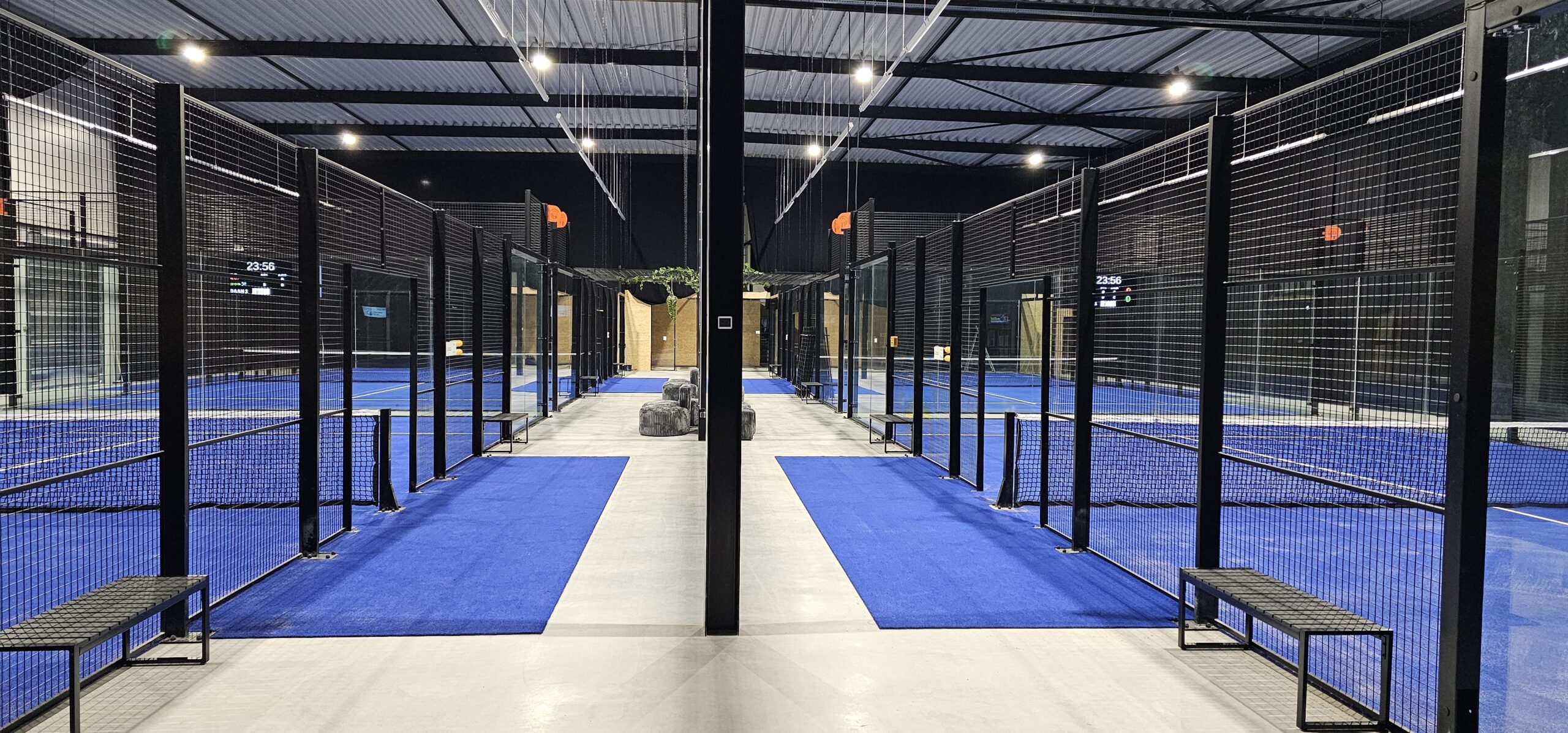
That range is wide, and rightly so. An indoor padel court in a sports hall that’s used intensively for ten hours a day requires more maintenance than a court used two evenings a week. The biggest cost items are the artificial turf, the lighting, and, occasionally, glass or structural maintenance.
What helps many operators is to plan maintenance as a fixed annual budget rather than treating it as an unexpected expense. This prevents minor upkeep from growing into costly repairs.
Which parts of a padel court require the most maintenance?
The three components that require the most maintenance are the artificial turf, the LED lighting, and the glass. The artificial turf has the shortest lifespan and also requires regular interim care. The LED lighting and glass are more durable, but do need attention if damage occurs.
-
Artificial turf
The artificial turf is the most labor-intensive part of a padel court. The sand used as infill material shifts with intensive use. Regular replenishing and leveling is needed to guarantee consistent ball bounce and to meet the KNLTB's sport-technical requirements. Budget for at least two to three professional maintenance sessions per year. -
Glass
The glass surrounding the court is generally very durable. Still, a hard impact from a ball or racket can damage a pane. Replacing a single glass panel typically costs a few hundred euros. Inspect the glass annually for small hairline cracks, since these can grow into larger damage during frost, particularly on outdoor courts. -
LED lighting
Quality LED lighting lasts a long time, but fixtures and mounting structures require periodic inspection. On outdoor courts, moisture plays a bigger role. Replace faulty fixtures promptly, since uneven lighting reduces playing quality and can pose a safety risk. -
Steel structure
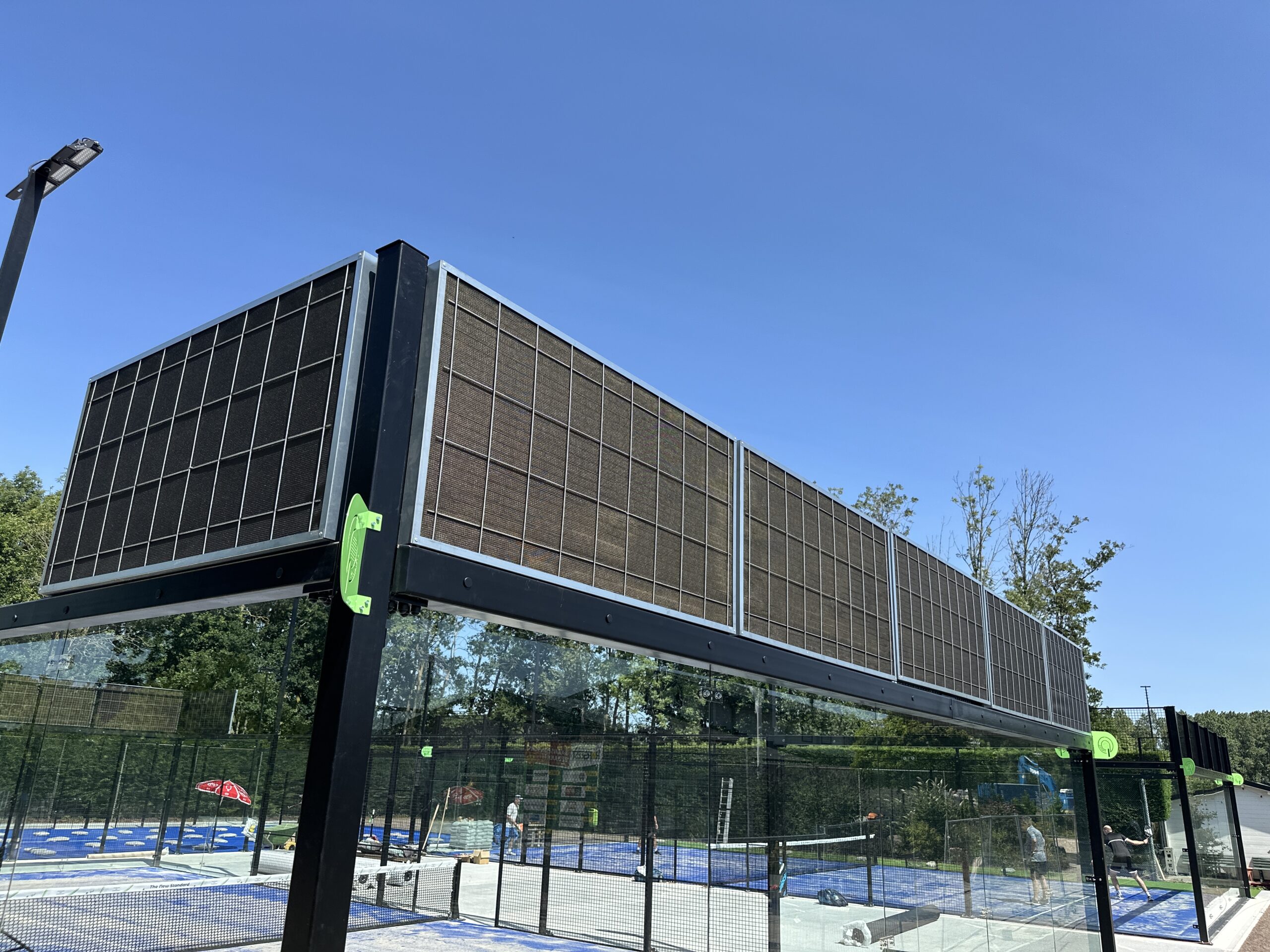
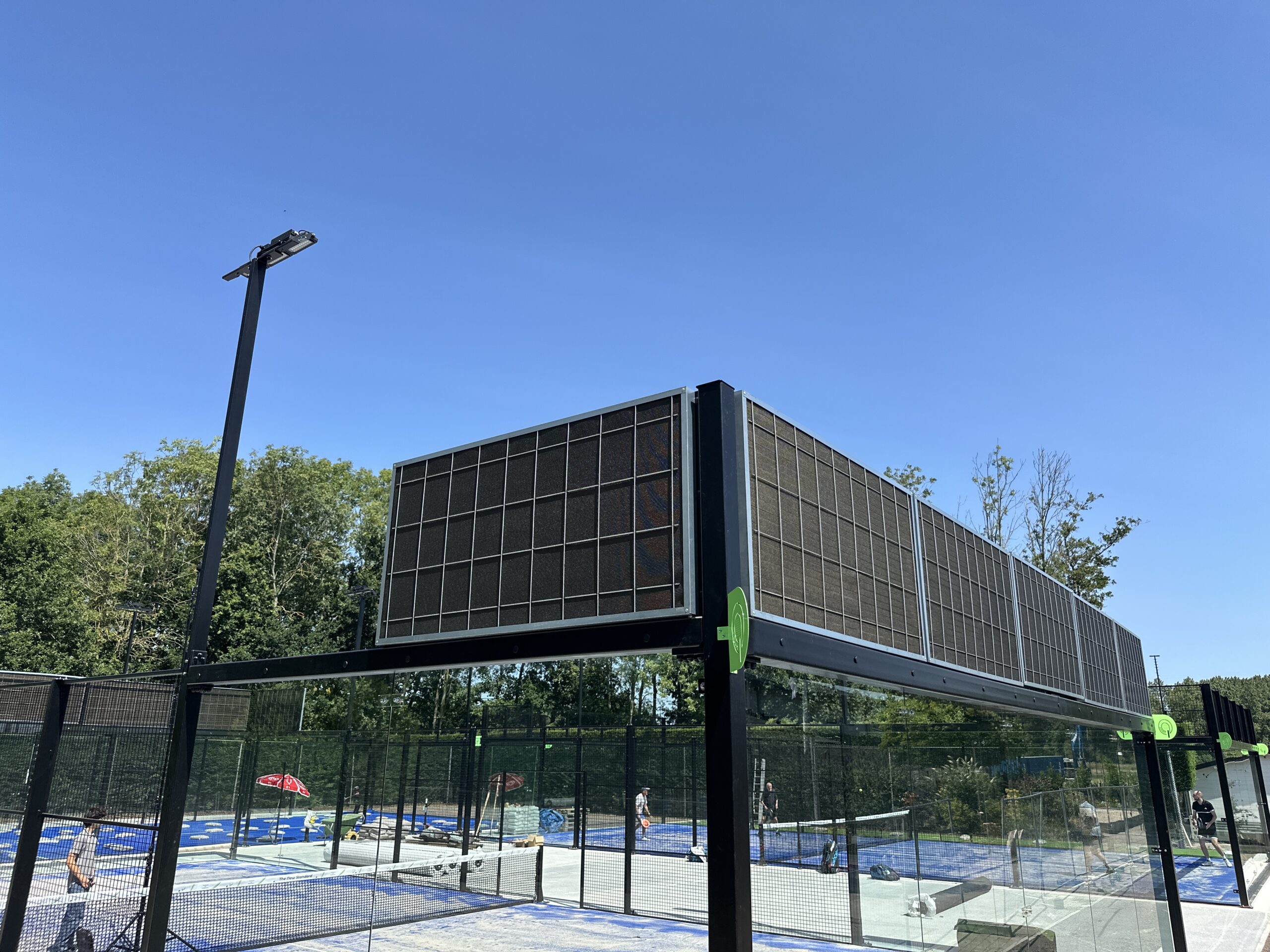
The steel structure requires relatively little active maintenance, provided the coating is in good condition. Check annually for rust, loose connections, or damage to the coating. This is more important for outdoor courts than indoor ones, since weather exposure degrades the coating faster.
How often does the artificial turf on a padel court need to be replaced?
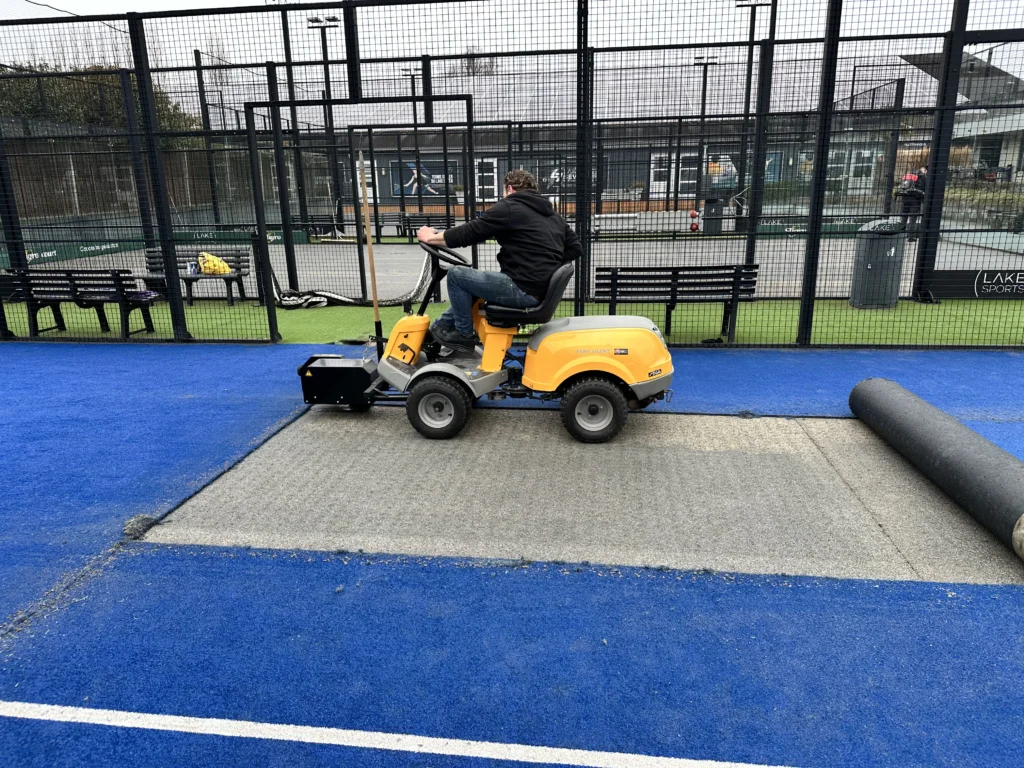
The artificial turf on a padel court needs to be replaced on average every 8 to 12 years under normal intensive use. With very intensive use, such as at a commercial location with multiple hours of play per day, the lifespan can be shorter. With careful maintenance and less intensive use, you can sometimes exceed 12 years.
How do you know when replacement is needed? There are a few clear signs:
- The turf fibers lie flat and no longer recover after play.
- The infill material (sand) has become structurally too thin and can no longer be topped up adequately.
- Ball bounce is inconsistent, which leads to rejection during a Kiwa ISA Sport inspection.
- There are visible wear spots near the service line or back wall.
All artificial turf for padel courts in the Netherlands must comply with NOC*NSF sport-technical regulations and be certified via the sports products list. Only certified turf qualifies for competition use under KNLTB auspices. Keep this in mind when replacing turf: always choose a product that appears on that list and has been inspected by Kiwa ISA Sport.
The costs for turf replacement average between €4,000 and €8,000 per court, depending on the chosen product and installation conditions.
What's the difference in maintenance costs between an indoor and outdoor padel court?
Outdoor padel courts have structurally higher maintenance costs than indoor courts. The main difference lies in the influence of weather conditions: rain, frost, UV radiation, and wind wear down materials faster. Budget for an outdoor court’s annual maintenance costs to run roughly one-and-a-half to two times higher than for a comparable indoor court.
Specifically, there are a few cost differences you’ll notice quickly:
-
Artificial turf:
Outdoor turf wears faster due to UV radiation and the combination of dryness and precipitation. The fibers become more brittle, and infill material partially washes away during heavy rain. -
Steel structure:
Outdoor structures are hot-dip galvanized as standard protection, but the coating requires more frequent inspection. Damage from weather conditions or vandalism occurs more often. -
Foundation:
The foundation of an outdoor court, often drainage concrete or Supersub, requires periodic inspection for subsidence or cracking. Drainage concrete has an average lifespan of 25 to 40 years, but interim repairs can't be ruled out. -
Cleaning:
Outdoor courts collect leaves, moss, and algae. Periodic cleaning is needed to maintain playability and safety.
Indoor courts benefit from a stable climate. Temperature fluctuations are minimal, there’s no precipitation, and UV exposure barely plays a role. That makes indoor courts considerably cheaper to maintain over their full lifespan, which contributes to a better ratio between padel court investment and return.
Which maintenance costs are often forgotten when purchasing a padel court?
The most commonly forgotten maintenance costs for a padel court are periodic inspections, topping up infill material, cleaning costs, and the replacement of small parts such as mesh panels, door hinges, or lighting mounting hardware. These costs are individually small each year, but they add up.
An overview of items regularly left out of calculations:
-
Periodic inspection:
Official inspection by Kiwa ISA Sport is mandatory for competition use. This inspection costs money and should be planned as a recurring item. -
Topping up infill material:
The sand in the turf shifts with intensive use. Topping up and leveling costs a few hundred euros each time, but is necessary for consistent ball bounce. -
Cleaning:
Professional cleaning of the turf and glass, including algae removal on outdoor courts, is regularly forgotten in budgets. -
Minor repairs:
Door locks, hinges, mesh panel fasteners, and small glass damage are each individually cheap to fix, but operators often forget to include them in their budget. -
Permit-related costs:
If the municipality requires additional noise or light measurements after commissioning, these are costs not everyone accounts for in advance.
The advice is to maintain an annual maintenance reserve in your padel court business case of at least 1 to 2 percent of the total investment. This provides room for both planned and unplanned maintenance, without putting direct pressure on returns.
How do you lower the maintenance costs of a padel court?
You lower a padel court’s maintenance costs most effectively by investing in quality during construction, following a good maintenance schedule, and catching small problems early. Building cheaply almost always leads to higher costs in the long run, while quality materials and a solid foundation extend the lifespan of all components.
Practical measures that have a direct impact:
-
Choose certified materials:
Artificial turf and foundation components approved by Kiwa ISA Sport meet proven quality standards. This protects you against premature wear and non-compliance during inspections. -
Plan preventive maintenance:
Inspecting and touching up the turf two to three times a year is cheaper than waiting until replacement becomes necessary. -
Choose the right foundation for your location:
A foundation that doesn't match the soil conditions or usage leads to subsidence and structural damage. Get advice based on soil surveys and usage, not on what's cheapest. -
Invest in a good coating:
Especially for outdoor courts, a quality coating on the steel structure significantly extends its lifespan and prevents costly repair work. -
Work with one responsible party:
When multiple suppliers are involved in construction, it becomes unclear who's responsible in case of damage or wear. One party handling the full package provides clarity and saves discussion later.
Want to know how to keep the total costs of construction and maintenance as favorable as possible? At I-Padel, we’re happy to think along with you about the best approach for your location and usage. From choosing the right foundation type to selecting turf that lasts: we guide the entire process. Check out our approach to building padel courts or get in touch with us. We’re glad to think along with you, with no obligation.
Frequently Asked Questions
Can I do the maintenance on my padel court myself, or should I always hire a professional?
Some maintenance tasks you can do yourself, such as regularly sweeping the court, removing leaves, and visually inspecting the glass and structure. For technical maintenance such as leveling and topping up infill material, professional cleaning of the turf, and carrying out inspections, it’s wise to hire a specialized party. Performing maintenance yourself without the right knowledge or equipment can damage the turf or lead to non-compliance during an official inspection.
What happens if I don't have the mandatory Kiwa ISA Sport inspection carried out?
Without a valid Kiwa ISA Sport inspection, the court may not be officially used for competition matches under KNLTB auspices. This can mean that as an operator you can’t make use of the official competition calendar, which directly impacts occupancy rate and therefore the return on your investment. Moreover, you run the risk that a rejection reveals larger, more expensive problems that could have been prevented with earlier preventive maintenance.
How does usage intensity affect maintenance frequency and costs?
Usage intensity has a direct effect on the wear of the artificial turf and therefore on maintenance frequency. A commercial padel court used eight to ten hours a day needs professional maintenance two to three times as often as a court used only a few evenings a week. It’s wise to distinguish between light, average, and intensive use in your business case, so you can realistically estimate the maintenance budget and avoid unexpected costs.
Is it worth taking out a maintenance contract for a padel court?
A maintenance contract can definitely be worthwhile, especially for operators managing multiple courts or with little time to coordinate maintenance themselves. The big advantage is that preventive maintenance is guaranteed to happen at fixed intervals, preventing costly repairs and rejections. Always compare exactly what’s included in the contract: some contracts cover only inspections, while others also include topping up infill material, cleaning, and minor repairs.
Which foundation choice has the greatest impact on long-term maintenance costs?
The choice of foundation has a major impact on maintenance costs, particularly for outdoor courts. Drainage concrete has an average lifespan of 25 to 40 years and requires little active maintenance, but is more expensive to build. A less suitable foundation that doesn’t match the soil conditions can lead to subsidence, cracking, and structural damage within just a few years, resulting in significantly higher repair costs. Always get advice based on a soil survey and the specific usage conditions of your location.
How large should the maintenance reserve be if I operate multiple padel courts?
If you operate multiple padel courts, the same guideline applies per court: reserve at least 1 to 2 percent of the total investment value per court annually for maintenance. With multiple courts, however, it pays to maintain a combined reserve fund, so that larger replacements, such as turf replacement across multiple courts at once, can be spread out or combined. This also provides negotiating leverage with suppliers and maintenance companies, which can lower costs per court.
What are the first signs that my padel court urgently needs maintenance?
The most recognizable signals that maintenance can no longer wait are: turf fibers that remain structurally flattened, inconsistent or irregular ball bounce, visible wear spots near the service line or back wall, hairline cracks in the glass, rust on the steel structure, and uneven or non-functioning lighting. On outdoor courts, moss and algae growth on the playing surface is also a clear sign that cleaning is needed. Waiting too long to intervene can allow small problems to grow into costly replacements.