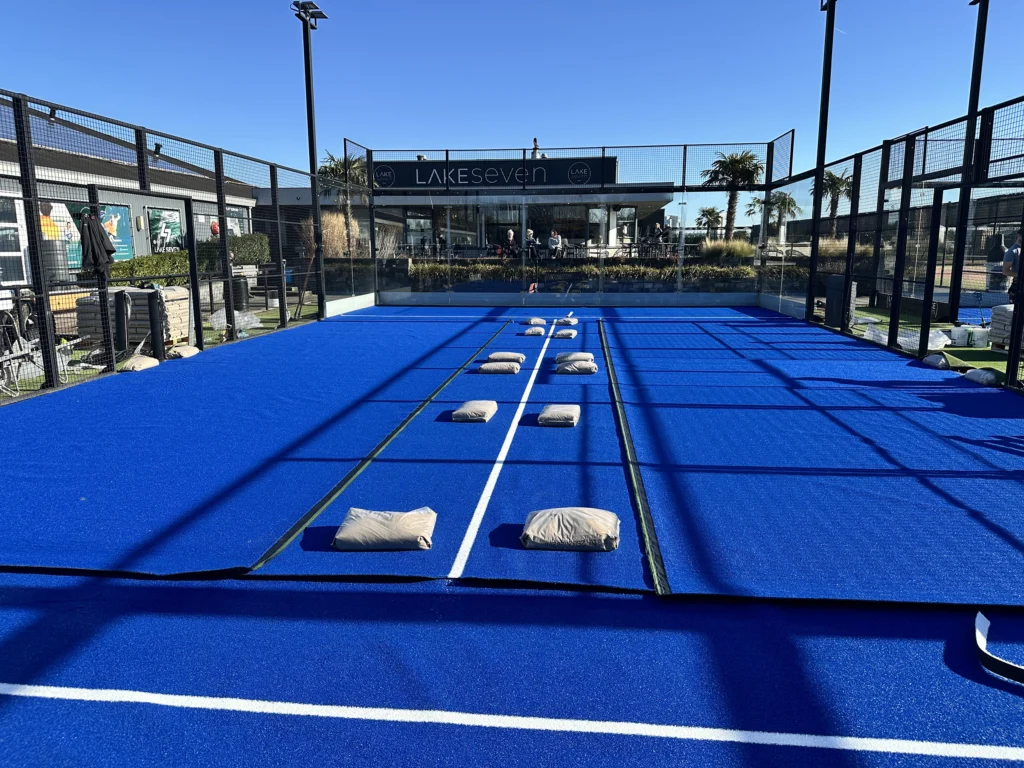
When installing a padel court, choosing the right artificial turf is one of the most important practical decisions you’ll make. The turf doesn’t just determine how the ball bounces and how players move, but also how long the court lasts and what maintenance will cost. Whether you’re planning an indoor padel court or an outdoor court, the choice of artificial turf deserves serious attention.
In short: padel courts use short-pile artificial turf made of polyethylene (PE) or polypropylene (PP), infilled with silica sand. Fiber height is typically between 10 and 13 millimeters. Below we explain everything you need to know about artificial turf for padel courts.
What exactly is artificial turf for a padel court?
Artificial turf for a padel court is a synthetic playing surface consisting of synthetic fibers tufted into a backing mat and infilled with silica sand. This sand bed ensures proper ball bounce characteristics and provides grip for players’ shoe soles. The turf sits directly on the foundation and forms the top layer of the complete court system.
This isn’t decorative grass like you’d see in a garden. Padel-specific turf is developed for intensive sports use: it must behave consistently with every ball bounce, be wear-resistant, and remain safe for players who change direction quickly. The fibers are typically short, stiff, and evenly distributed across the mat. Without the right sand bed, the turf doesn’t function properly, since the sand keeps the fibers upright and regulates ball response.
What types of artificial turf are used for padel courts?
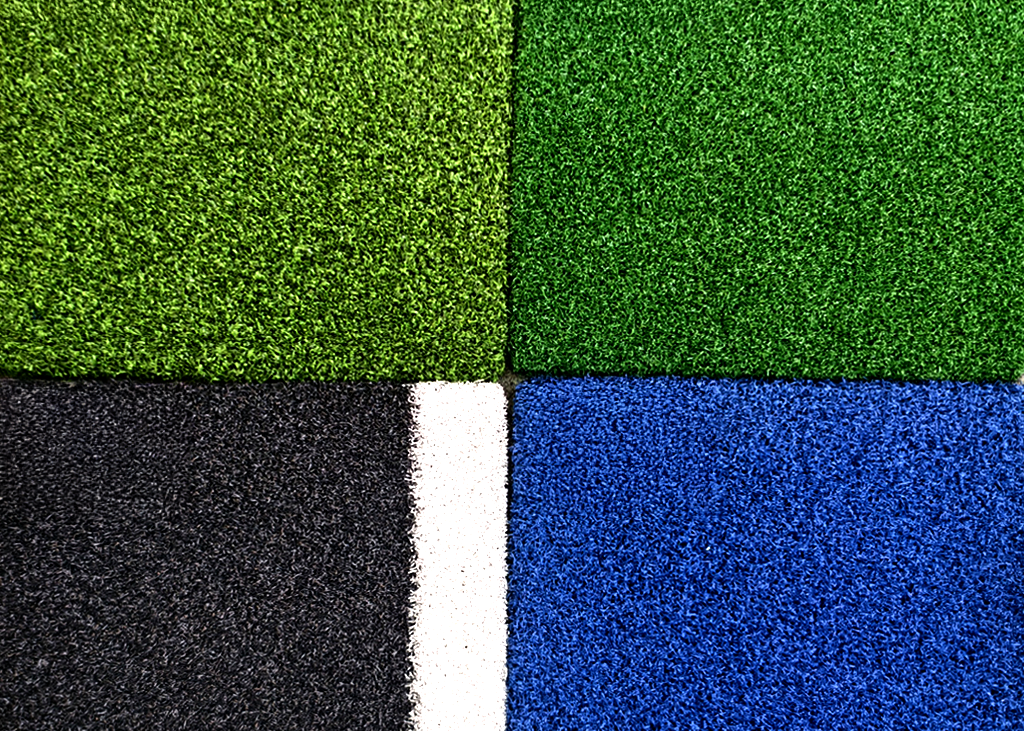
Three fiber types are used for padel courts: fibrillated fibers, monofilament (straight) fibers, and curled fibers. Each type has different playing characteristics. Fibrillated fibers are the most common in padel and provide a consistent ball bounce. Monofilament fibers are smoother and more durable but require a higher stitch density. Curled fibers are used less often but offer a softer playing feel.
-
Fibrillated fibers
Fibrillated fibers are thin, ribbon-like fibers that split slightly with use. This creates a dense, closed surface that guides the ball well. This type is popular in padel because it gives a reliable, predictable ball bounce. According to current inspection standards, fibrillated fibers require a minimum stitch density of 42,000 stitches per square meter. -
Monofilament fibers
Monofilament fibers are round, single-strand threads that stay firmly upright. They're more wear-resistant than fibrillated fibers and retain their shape longer under intensive use. Monofilament turf requires a higher minimum stitch density of 52,000 stitches per square meter, which contributes to a more even surface. -
Curled fibers
Curled fibers are used occasionally and provide a softer, more resilient playing feel. They're less common in padel than in other sports but can be a good choice in specific situations. The minimum stitch density is the same as for fibrillated fibers: 42,000 stitches per square meter.
What's the difference between indoor and outdoor artificial turf for padel?
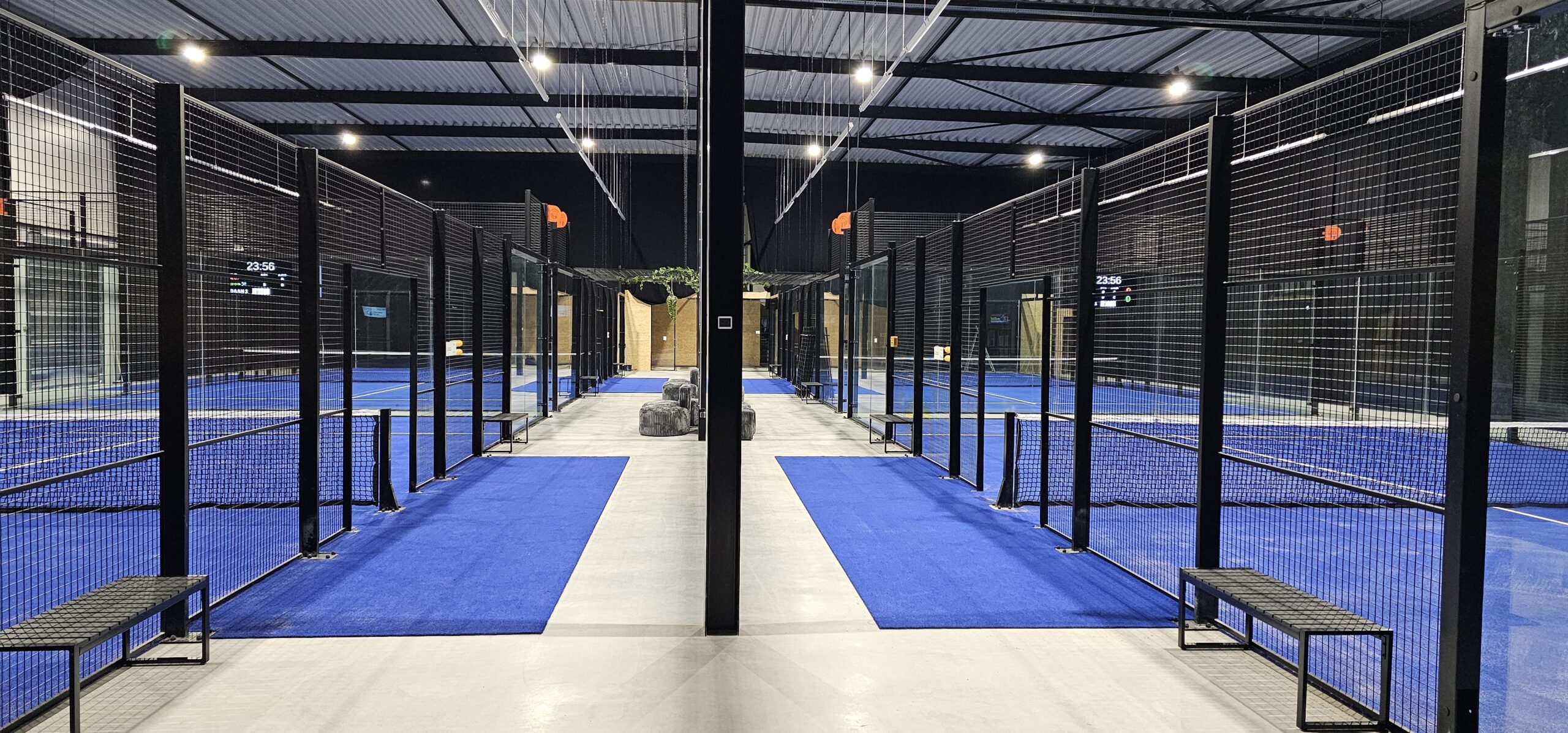
The biggest difference between indoor and outdoor artificial turf for padel is weather resistance. Outdoor turf must withstand UV radiation, frost, rain, and temperature fluctuations without discoloring or degrading. Indoor turf doesn’t need to meet these requirements, but it must be suitable for use on a hard indoor surface without affecting ball bounce.
In an indoor padel court, the environment is more stable: no direct sunlight, no rain, and fewer temperature fluctuations. This means the turf grays and wears less quickly due to weather influences. The fibers stay in good condition longer and the sand bed remains more stable. For an outdoor court, using UV-stabilized fibers is an absolute requirement. Without this stabilization, the fibers break down faster and the surface loses its playing characteristics.
Water drainage also plays a role for outdoor turf. Outdoor courts always combine the turf with a water-permeable foundation, such as drainage concrete or Supersub. The turf itself is then installed so that rainwater can drain away quickly, preventing puddle formation and allowing the court to be playable again shortly after rain.
How long does artificial turf on a padel court last?
Artificial turf on a padel court lasts an average of 8 to 12 years, depending on usage intensity, turf quality, and maintenance. At commercial venues with daily intensive use, the lifespan tends toward the shorter end. At club courts with more limited occupancy, the turf can last longer.
Wear occurs most heavily in the most-played zones: the service boxes and the areas directly behind the net. Here the fibers flatten faster and the sand bed loses its even distribution. When ball bounce becomes noticeably less consistent or the fibers are visibly flattened, replacement is warranted.
A good foundation indirectly extends the lifespan of the turf. A flat, stable base ensures the turf is evenly loaded and prevents local subsidence. Such subsidence can mechanically damage the turf and negatively affect playing characteristics.
Does artificial turf for padel courts need to be certified?
Yes. Artificial turf used for padel courts intended for official matches must meet the standards of Kiwa ISA Sport and the KNLTB (Royal Dutch Tennis Association). Kiwa ISA Sport is the recognized certification body in the Netherlands that tests sports products for technical and sport-technical properties. Without certification, a court may not be used for official matches.
The inspection includes material-technical examination of the turf mat, including the number of stitches per square meter, fiber height, distance between stitch rows, and the composition of the infill material. Field samples of at least 1 by 1 meter undergo laboratory testing and are checked against the specifications stated by the manufacturer. Only when all measurement results fall within the permitted product margins is the certificate issued.
As a buyer, it’s important to verify that the artificial turf being offered is actually certified for use in the Netherlands. Not all products on the market meet the Kiwa ISA Sport requirements. Inexperienced buyers who don’t check this may unknowingly have non-compliant material installed, which causes problems at handover and during any subsequent inspections.
What does artificial turf for a padel court cost?
The cost of artificial turf for a padel court depends heavily on the type of turf, the quality, and whether installation is included. As part of a turnkey indoor padel court, the turf costs are usually incorporated into the total price. As an indication, a complete turnkey indoor padel court is possible from approximately €23,000, including structure, glass, artificial turf, LED lighting, and installation.
Apart from a total package, turf costs per square meter vary depending on the fiber type, stitch density, and supplier. For a standard padel court of 20 by 10 meters, you need 200 square meters of turf for the playing field itself. Additional runoff zones around the court, which are also covered with turf, come on top of that.
Note that the price of artificial turf should never be considered separately from installation. Cheap turf that isn’t installed correctly or doesn’t meet the Kiwa ISA Sport requirements can lead to higher costs in the long run due to faster wear, rejection during inspections, or the need to replace the surface before its expected lifespan is reached.
How is artificial turf installed on a padel court?
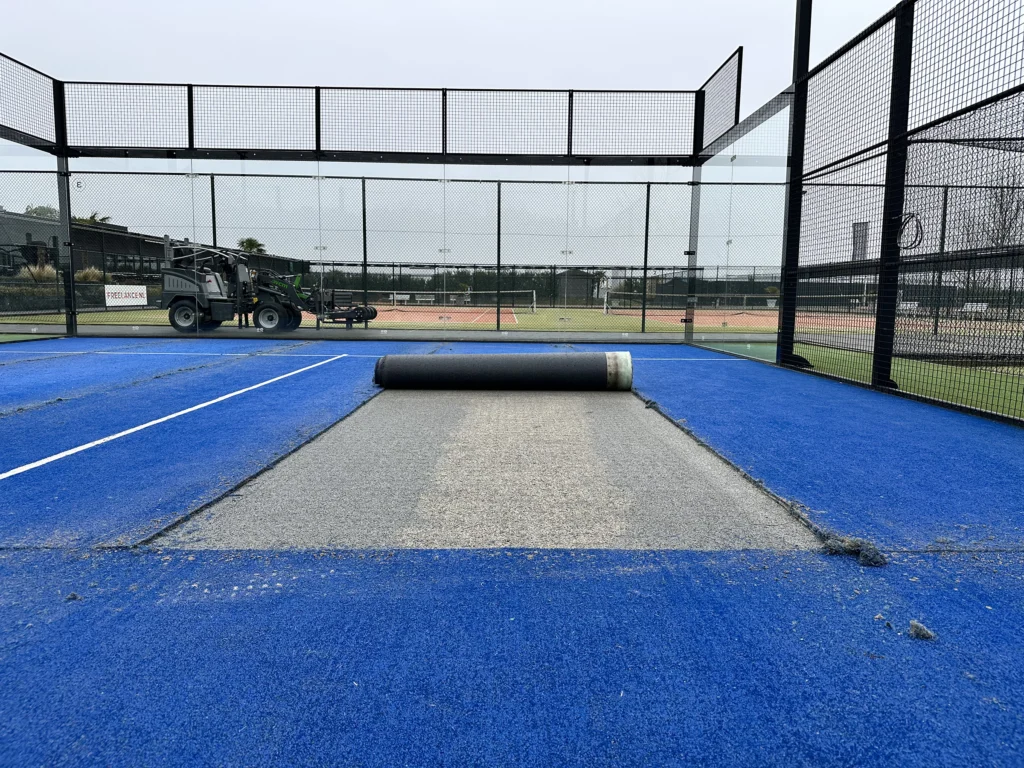
Installing artificial turf on a padel court consists of four steps: leveling the base, rolling out the turf mat, joining the strips, and applying the silica sand bed. Total installation time is usually one to two days, depending on the number of courts and site conditions.
-
Preparing the base:
The foundation must be completely flat and stable before the turf is laid. Irregularities in the base translate directly into the playing surface and affect ball bounce. -
Rolling out the turf mat:
The mat is rolled out in strips and positioned correctly. The fiber direction must be consistent across the entire playing field. -
Joining the strips:
The seams between the individual turf strips are professionally joined so there are no gaps or height differences at the seam. -
Applying the silica sand bed:
Silica sand is evenly spread and worked between the fibers using a brushing machine. This sand bed determines the playing characteristics and keeps the fibers upright. -
Applying the lines:
The court lines are stitched or glued into the turf, according to the official dimensions of a padel court.
A correctly applied sand bed isn’t something you can easily correct later. Too little sand gives an unreliable ball bounce. Too much sand makes the playing surface slow and heavy. The correct amount is determined based on the fiber type used and the manufacturer’s recommendations.
How do you maintain the artificial turf of a padel court?
You maintain the artificial turf of a padel court by regularly brushing it, checking the sand level, and keeping the surface free of leaves, dirt, and organic material. With good maintenance, the turf stays in good condition longer and you retain the desired playing characteristics throughout the surface’s full lifespan.
The most common maintenance tasks are:
-
Brushing:
The fibers lie flat after intensive use. Regular brushing keeps the fibers upright and redistributes the sand bed evenly. -
Checking sand levels:
Sand can gradually shift or wash out due to use and precipitation. Check the sand level periodically and top up where needed. -
Cleaning:
Leaves and organic material must be removed before they start to rot. This is needed more often on outdoor courts than on an indoor padel court. -
Periodic deep cleaning:
For intensive use, an annual or biennial deep cleaning is recommended, in which the sand bed is loosened and the turf is thoroughly brushed.
For outdoor courts, extra attention is needed for moss and algae growth, particularly in shaded or damp environments. Preventive treatment with a suitable cleaning agent can slow moss growth. Some types of glass are designed not to make contact with the ground, which limits moss growth at the base of the glass and lets the surface dry faster after rain.
At I-Padel, we not only handle the installation of artificial turf as part of a complete padel court build, but we’re also happy to think along with you about maintenance and renovation. Is your existing turf no longer performing well? We’re glad to think along with you, without obligation, about the best solution for your location.
Frequently asked questions
Can I decide for myself how much silica sand is put into the artificial turf?
The amount of silica sand is determined based on the fiber type and the manufacturer’s specifications. This isn’t a free choice. Too little sand results in an unreliable ball bounce and insufficient grip, while too much sand makes the playing surface slow and heavy. Always have the sand quantity determined and applied by a specialized contractor familiar with the requirements of the specific turf type you’re using.
What are the most common mistakes when choosing artificial turf for a padel court?
The most common mistake is choosing based on price alone, without checking whether the turf is certified by Kiwa ISA Sport and meets KNLTB standards. Another common mistake is failing to match the fiber type to the intended use: a busy commercial court has different requirements than a club court. Finally, many buyers underestimate the importance of skilled installation. Even the best artificial turf performs poorly if the base isn’t perfectly flat or the sand bed is applied unevenly.
Is it possible to replace the artificial turf of an existing padel court without rebuilding the entire court?
Yes, in many cases the artificial turf can be replaced while the structure, glass, and foundation remain in place. This is a cost-effective option when the underlying structure is still in good condition but the playing surface needs replacing. It’s essential, however, that the foundation is inspected beforehand for flatness and stability, so the new turf can perform optimally and reach its expected lifespan.
How can I tell that the artificial turf of my padel court needs replacing?
The clearest signs are a noticeably less consistent ball bounce, visibly flattened or worn fibers — particularly in the service boxes and areas around the net — and an uneven sand bed that can no longer be corrected with regular brushing. On outdoor courts, discoloration from UV degradation and crumbling fibers can also indicate the end of the lifespan. Not sure? Have the surface assessed by a specialist before investing in a full replacement.
Which fiber type is best for a busy commercial padel court?
For a commercial venue with intensive daily use, monofilament turf is generally the best choice due to its higher wear resistance and long-term retention of fiber structure. The required minimum stitch density of 52,000 stitches per square meter ensures an even, durable surface. Fibrillated fibers are an excellent choice for club courts or venues with more limited occupancy, where the emphasis is more on predictable ball bounce than on maximum wear resistance.
Does the type of foundation affect the choice of artificial turf?
Yes, the foundation and the artificial turf must be matched as a system. For an outdoor court with a water-permeable foundation such as drainage concrete or Supersub, the turf must be installed so rainwater can drain away quickly. For an indoor court, water drainage plays no role, but the flatness of the foundation is even more critical because there’s no compensation possible via drainage. Always discuss the foundation choice together with the turf choice with your contractor, so both components work together optimally.
How often should I have professional maintenance performed on the artificial turf of my padel court?
For courts with intensive use, a professional deep cleaning is recommended at least once a year, in which the sand bed is loosened and the turf is thoroughly brushed. For outdoor courts in shaded or damp environments, it’s also wise to schedule preventive treatments against moss and algae growth. Daily or weekly regular maintenance, such as brushing and removing leaves and dirt, can be done yourself and has a major impact on the surface’s lifespan.