Padel noise is considered a nuisance as soon as it regularly and unexpectedly enters the living environment of nearby residents, particularly during the evening or at quiet times. The combination of impulse sounds, such as the loud impact of a ball against glass, and the sound-amplifying effect of the cage structure makes padel acoustically different from most other outdoor sports. The questions below provide a clear picture of when padel noise becomes problematic, which standards apply and which measures may be considered.
How loud is a padel court actually?
A padel court produces an average sound power level of approximately 91 dB during active play. That is about 10 dB more than a tennis court. The difference may sound small, but in acoustics, 10 dB is equivalent to a doubling of the perceived loudness. Padel is therefore objectively a louder sport than tennis, even though the game may look visually similar.
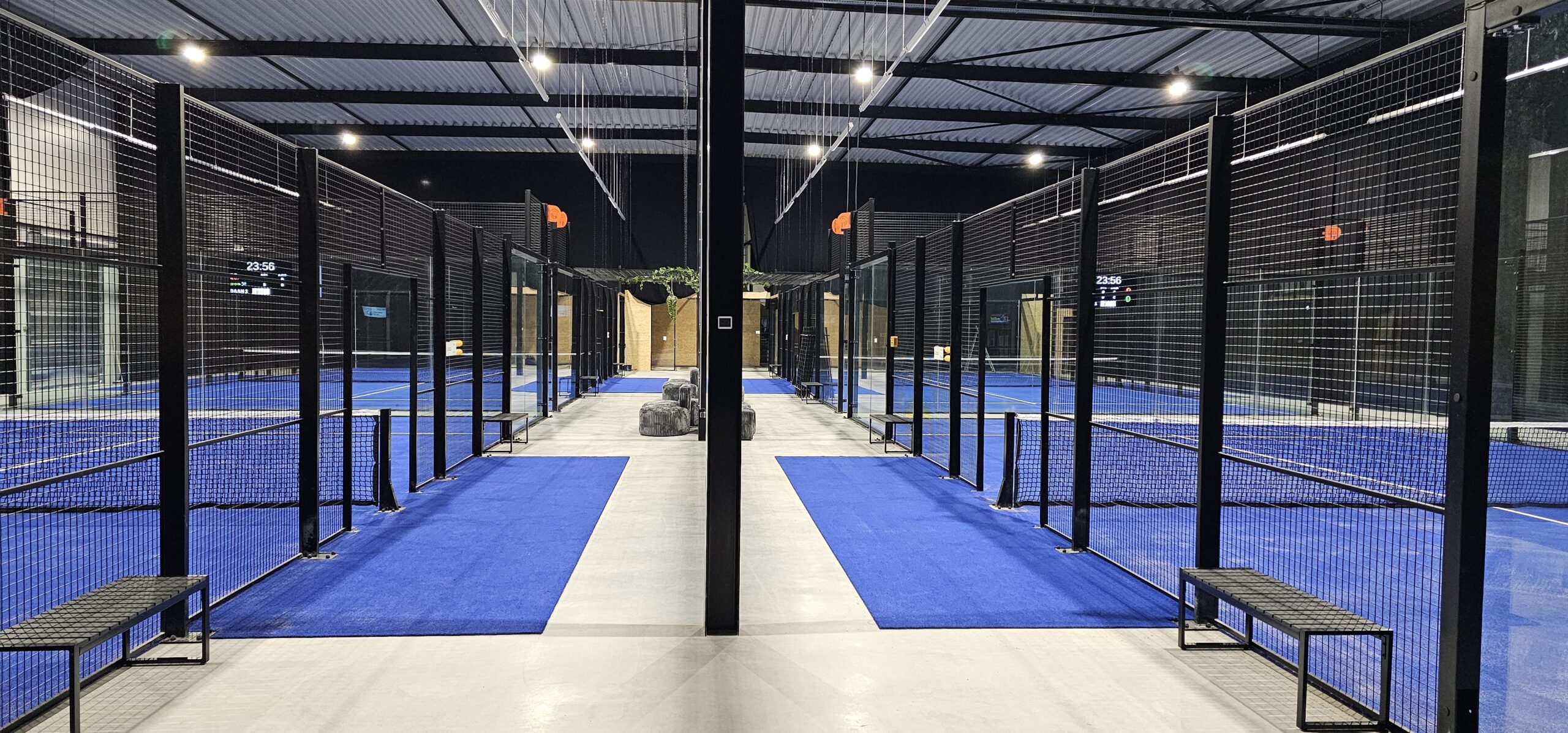
The sound is generated in two ways. First, there is the direct source sound of the racket hitting the ball. Second, and acoustically the more significant factor, is the impact sound of the ball hitting the glass and steel fencing. The cage structure acts as a sound box: the enclosed nature of the court amplifies and disperses the sound into the surrounding area.
It almost always concerns impulse noise, short and loud peaks that are clearly distinguishable above the background noise. This characteristic plays a major role in how nearby residents experience the noise, which we explain further below.
When does padel noise exceed the statutory noise limits?
Whether padel noise exceeds the statutory limits depends on the distance to residential properties, the time at which games are played and the applicable noise standards in the zoning plan or environmental permit. There is no fixed national threshold that applies to every situation. Municipalities generally apply the standards from the Activities Decree or set location-specific requirements through the permit.
In practice, noise limits for sports activities at residential properties are typically 50 dB(A) during the day, 45 dB(A) in the evening and 40 dB(A) at night, measured at the façade of the nearest dwelling. Whether a padel court exceeds these limits depends on the distance, the site layout, the presence of sound-reflecting surfaces and the number of courts in use.
Because padel produces impulse noise, the peak limit may also play a role. Peaks may generally not exceed 70 dB(A) during the evening period. An independent acoustic consultancy can calculate whether a specific location falls within the limits and which measures may be required. We provide the relevant technical product specifications and structural data for this purpose, but the assessment itself is carried out by the acoustic consultant.
Why do nearby residents experience padel noise as more disturbing than other sports noise?
Nearby residents experience padel noise as more disturbing than many other sports noises because it consists of repeated, sharp impulse peaks that are difficult to ignore. Human hearing is particularly sensitive to sudden changes in sound. Every change in rally, every hard hit against the glass, unconsciously draws attention, even if the average sound level itself is not extremely high.
In addition, padel is generally played during the evening, when background noise is low and the surroundings are quiet. A padel court that is barely noticeable during the day can be experienced as disruptive in the evening because the contrast with the surrounding silence is greater.
The cage structure reinforces this effect. Glass and steel reflect sound, and the enclosed structure of the court directs the sound in certain directions. As a result, the noise may still be clearly audible at a greater distance, while it may seem less noticeable at close range. This makes it difficult to assess noise nuisance without an acoustic study.
At what distance from residential properties can a padel court be permitted?
There is no legally established minimum distance at which a padel court can always be permitted. Whether it can be permitted is determined by a combination of the actual noise impact at the façade of nearby residential properties, the applicable noise standards and the measures taken. A padel court 30 metres from residential properties may be permitted with the right noise mitigation measures, while a court 80 metres away may cause problems without measures if the circumstances are unfavourable.
Factors affecting whether a court can be permitted include the orientation of the court in relation to residential properties, the presence of sound-reflecting buildings, the number of courts, opening hours and the nature of the surroundings. A location in an open polder behaves acoustically differently from a location in a built-up residential area.
Municipalities assess applications for a permit for a padel court based on an acoustic study. This study calculates the expected noise impact at the relevant residential properties and assesses it against the applicable standards. Based on the results, it can be determined whether additional measures are required and, if so, which ones.
Which factors determine whether a location will experience noise problems?
Whether a location will experience noise problems is determined by a combination of technical, spatial and usage-related factors. The distance to residential properties is the most decisive factor, but certainly not the only one. Even at greater distances, noise can be problematic if the circumstances are unfavourable.
The main factors are:
-
Distance to the nearest residential properties:
the shorter the distance, the higher the noise impact at the façade. -
Orientation of the court:
the direction of the glass and open sides partly determines where the noise is distributed most strongly. -
Presence of reflecting surfaces:
buildings, walls and hard surfaces in the surrounding area can reflect sound back towards residential properties. -
Wind direction and wind zone:
wind can strengthen noise in a particular direction. The geographical wind zone of a location is also relevant to the structural load, particularly when noise-reducing panels are applied. -
Number of courts and intensity of use:
more courts and longer opening hours result in a higher cumulative noise impact. -
Evening use:
playing after 19:00 falls under stricter noise standards and increases the likelihood of complaints.
A location analysis at an early stage helps identify these factors before irreversible decisions are made about the position and layout of the courts. For an outdoor padel court, this is a step we always recommend before the engineering phase begins.
When is an acoustic study mandatory for a padel court?
An acoustic study is in most cases mandatory when an outdoor padel court is constructed near residential properties or other noise-sensitive destinations. The municipality will generally request this study as part of the permit application. For indoor padel courts in an existing hall, an acoustic study is required less often, but the municipality may also impose additional requirements in such cases.
The requirement stems from the fact that padel, as a sports activity, falls under the rules for noise generated by establishments. Municipalities are required to assess whether a new activity complies with the applicable noise standards. Without supporting evidence in the form of an acoustic report, this assessment is not possible, meaning that the permit cannot be granted.
In practical terms, an acoustic study is also useful beyond the formal requirement. It provides insight in advance into the expected noise impact and makes clear whether measures are required and which ones. This prevents surprises during or after the permit procedure. An independent acoustic consultancy carries out the study. We provide the necessary technical information about the court configuration, the construction and any acoustic solutions for padel being considered.
What is the difference between a noise barrier and noise-reducing panels at a padel court?
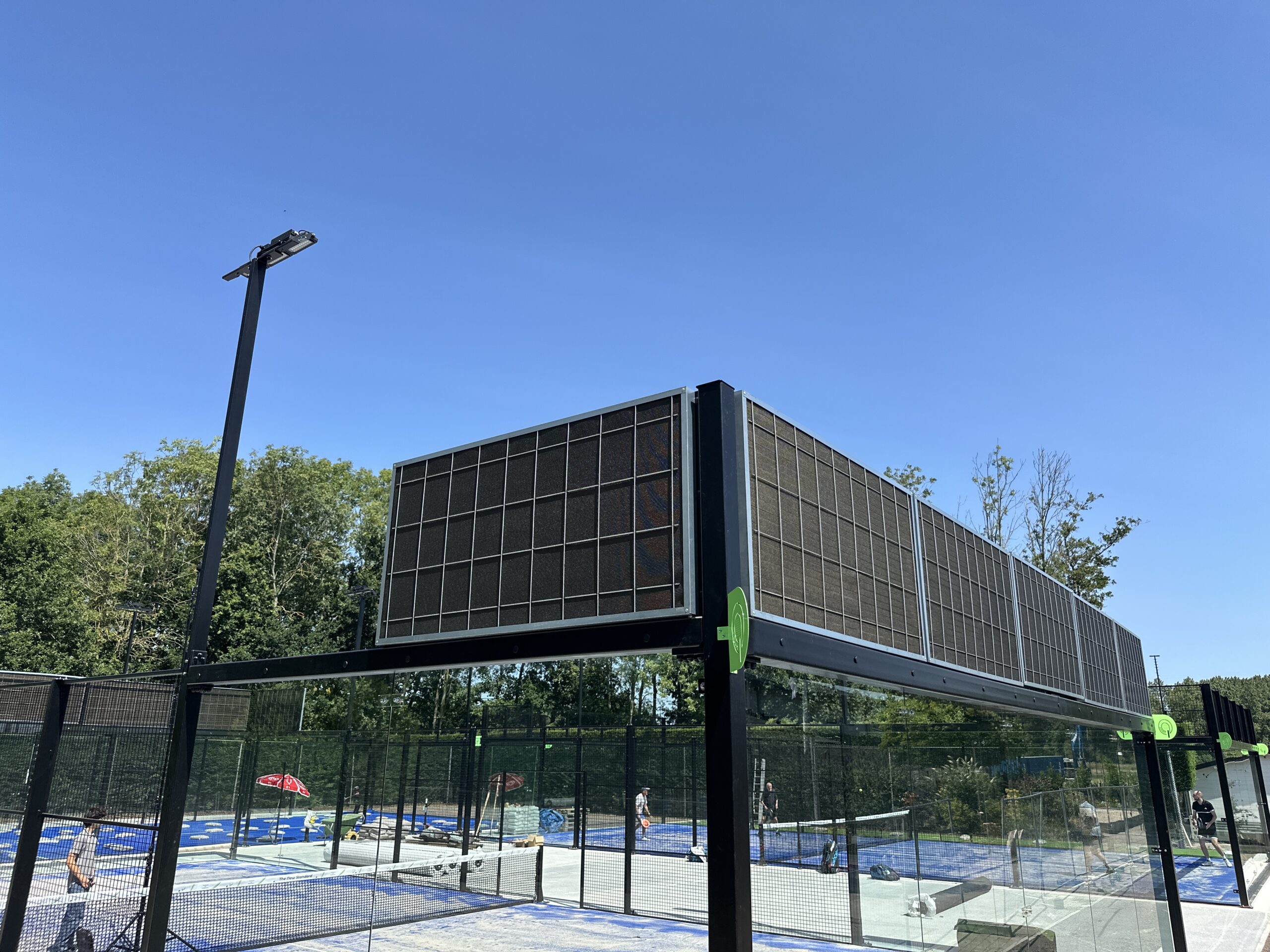
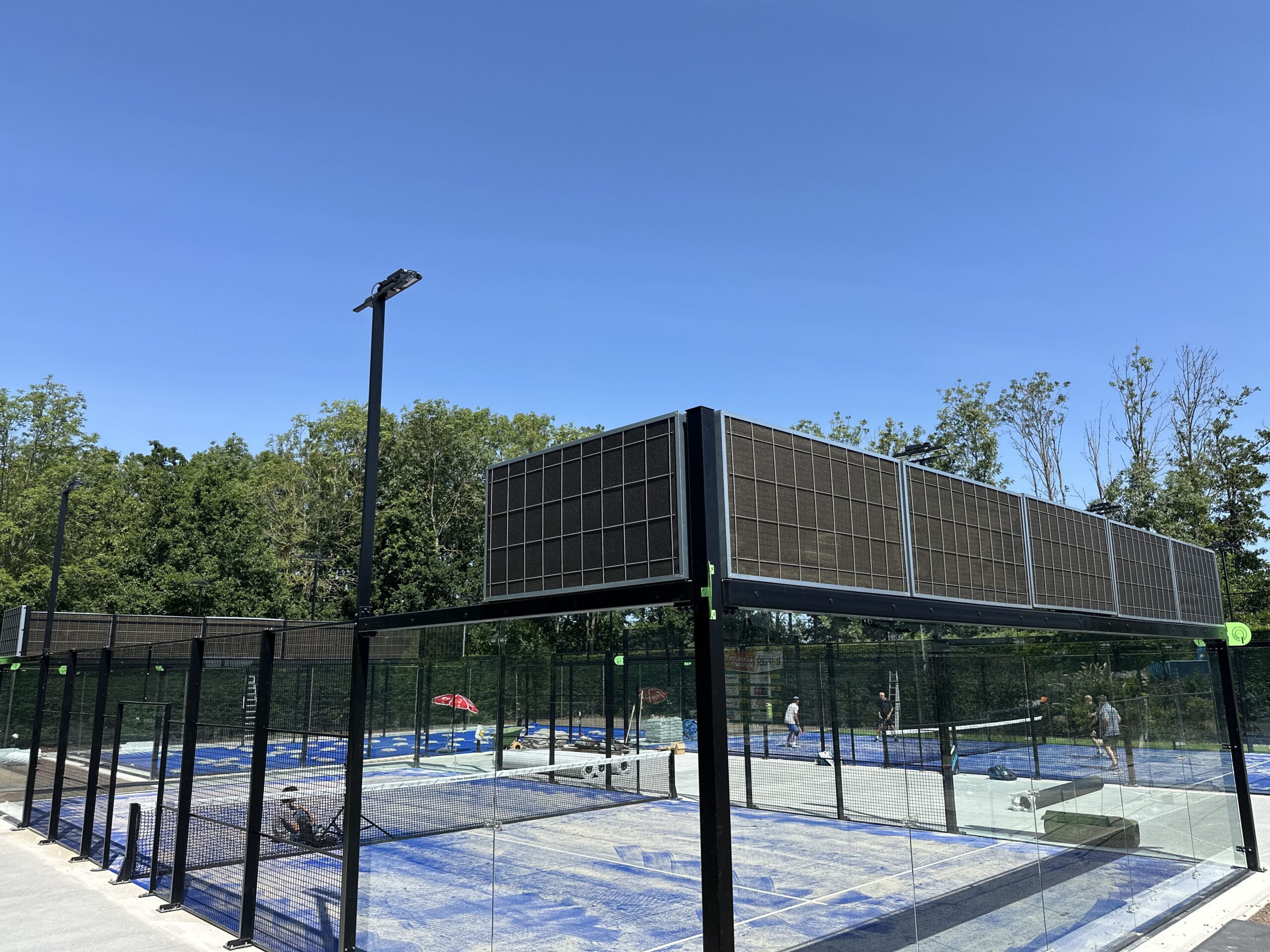
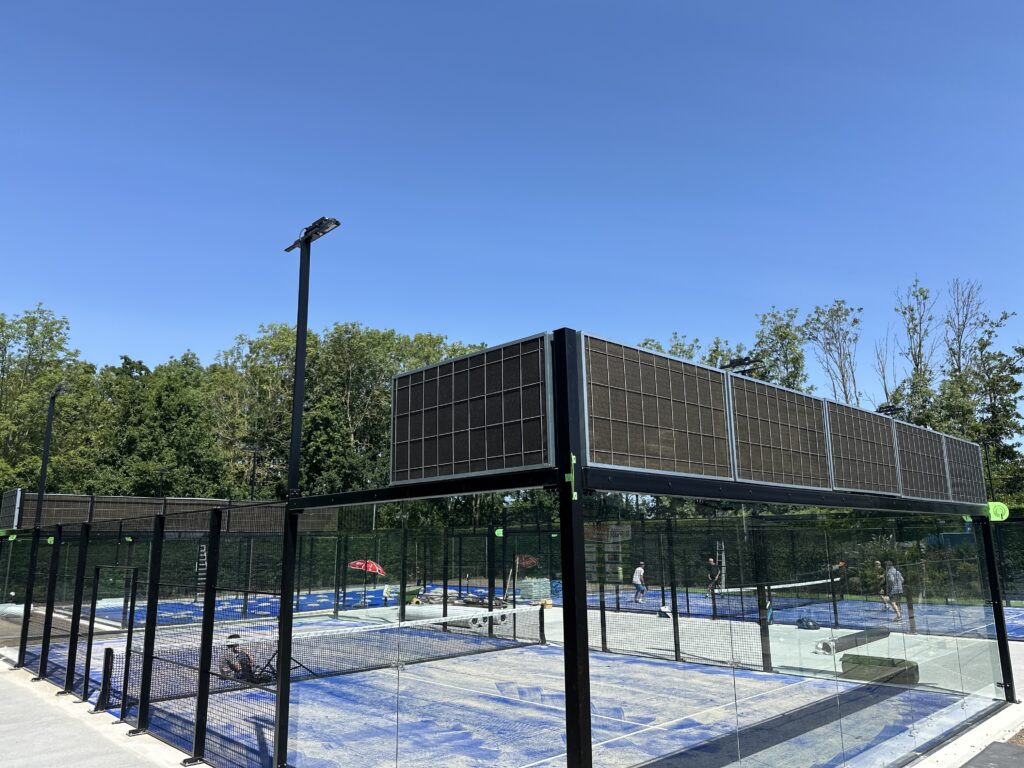
The main difference is their position relative to the sound source. Noise-reducing panels are placed directly on the cage structure of the padel court and act as a source measure: they limit the spread of sound at the location where it is generated. A noise barrier is a freestanding structure placed next to or around the court and blocks the sound after it has already left the court.
-
Noise-reducing panels as a source measure
Panels are attached to the outside of the mesh of the cage structure. They are made from materials such as rock wool, a mineral fibre with an open structure that absorbs sound waves by converting the kinetic energy of air particles into heat. As a result, part of the sound energy is absorbed rather than reflected back into the surrounding area. An important technical consideration is that panels reduce the wind permeability of the structure. Closed surfaces catch more wind, resulting in higher wind loads on the steel structure and foundation. Before panels are applied, the structure must be calculated for this additional load. This applies both to new courts and to existing structures to which panels are added afterwards. During a practical measurement at LTC Hofgeest, an indicative noise reduction of approximately 3 dB(A) was measured within the configuration under investigation after correction for background noise. These results apply exclusively to the situation investigated and should not be regarded as a general product guarantee. -
Noise barriers and noise berms as transmission measures
A noise berm or freestanding noise barrier works in a different way. It places a physical barrier between the court and the residential properties, thereby limiting sound transmission through the air. Noise berms can be constructed at heights of up to 6 to 8 metres and can be tens of metres long. They are effective when the sound source and receiver are positioned along a certain line and the berm can interrupt that line. The disadvantage of a noise berm is its spatial impact. A high, long structure requires considerable space, has visual consequences for the surroundings and almost always requires an environmental permit because it is considered a structure. Structural calculations and soil investigation data are also required. In many situations, a combination of both measures is most appropriate. Noise-reducing panels limit the sound at the source, allowing a potential noise berm to be constructed at a lower height. This can reduce costs and simplify the permit process. Which approach is suitable depends on the location, the distance to residential properties, the available space and the results of the acoustic study. There is no standard solution that works for every situation. More information about the various options can be found on our page about acoustic solutions for padel.
Unsure whether outdoor padel is feasible at your location?
We are happy to think along with you about the court configuration, structural preparation and possible noise mitigation measures. Together with your acoustic consultant, we look at which solution is technically feasible and suitable for the project. Contact us via our page about noise solutions for padel courts for an initial, no-obligation consultation.
Frequently Asked Questions
Can existing padel courts be fitted with noise mitigation measures afterwards if complaints arise?
Yes, existing padel courts can be fitted afterwards with noise-reducing panels or a noise berm, but this is more complex than with new construction. When adding panels to an existing cage structure, the steel structure and foundation must first be calculated for the additional wind load. It is strongly recommended to involve an acoustic consultancy as soon as the first complaints arise, so that the appropriate measure can be selected and further escalation — including enforcement by the municipality — can be prevented.
How much noise reduction can I realistically expect from noise-reducing panels?
Based on a practical measurement at LTC Hofgeest, an indicative reduction of approximately 3 dB(A) was measured for the configuration investigated. In acoustics, this may sound modest, but 3 dB(A) is equivalent to a halving of the sound energy and can make the difference between complying or not complying with the permit standards. The actual reduction depends on the location and configuration; an acoustic consultant can calculate whether this is sufficient for your specific situation.
What if my municipality has not established specific noise standards for padel courts?
If the municipality has not established location-specific standards, the padel court falls back on the general standards from the Activities Decree on Environmental Management. These standards apply as the default for sports facilities and are the starting point for most municipalities when assessing the permit application. It is advisable to verify this with the municipality in advance, so that the acoustic study is assessed against the correct regulatory framework.
What steps do I need to take if I want to construct an outdoor padel court near residential properties?
The recommended sequence is: (1) carry out an early location analysis to identify risk factors such as distance, orientation and reflecting surfaces, (2) engage an independent acoustic consultancy for a noise calculation based on the court configuration, (3) determine which measures are required based on the results, and (4) submit the permit application including the acoustic report. By following these steps in the correct order, you avoid having to make expensive adjustments to the structure or location at a late stage.
Does it matter how many padel courts are constructed next to each other in terms of noise impact?
Yes, the number of courts has a direct impact on the cumulative noise impact. Each additional court adds sound energy, and when multiple courts are played on simultaneously, the total sound level increases measurably. The acoustic study always uses the critical scenario: the maximum number of courts that can be in use simultaneously. This is an important consideration when planning larger padel locations or extensions to existing complexes.
Are there opening hours that I should preferably avoid to prevent noise complaints?
Playing after 19:00 falls under the stricter evening standards (generally 45 dB(A) at the façade), which significantly increases the likelihood of exceeding the standards. In addition, background noise is lower in the evening, making padel noise subjectively more disturbing. Limiting opening hours to before 19:00 — or at least reducing the number of courts in use in the evening — is one of the simplest and most effective non-technical measures to prevent complaints.
Can a noise berm also be combined with planting or a green design?
A green or planted noise berm is technically possible and is regularly used in urban and recreational environments because of its lower visual impact. It is important to know that planting itself has little noise-reducing effect; the acoustic effectiveness comes from the solid core of the berm, not from the vegetation. The planting does, however, provide benefits for spatial integration and can help the permit process proceed more smoothly because residents and municipalities may find the structure less objectionable.