
When is padel noise perceived as a nuisance?
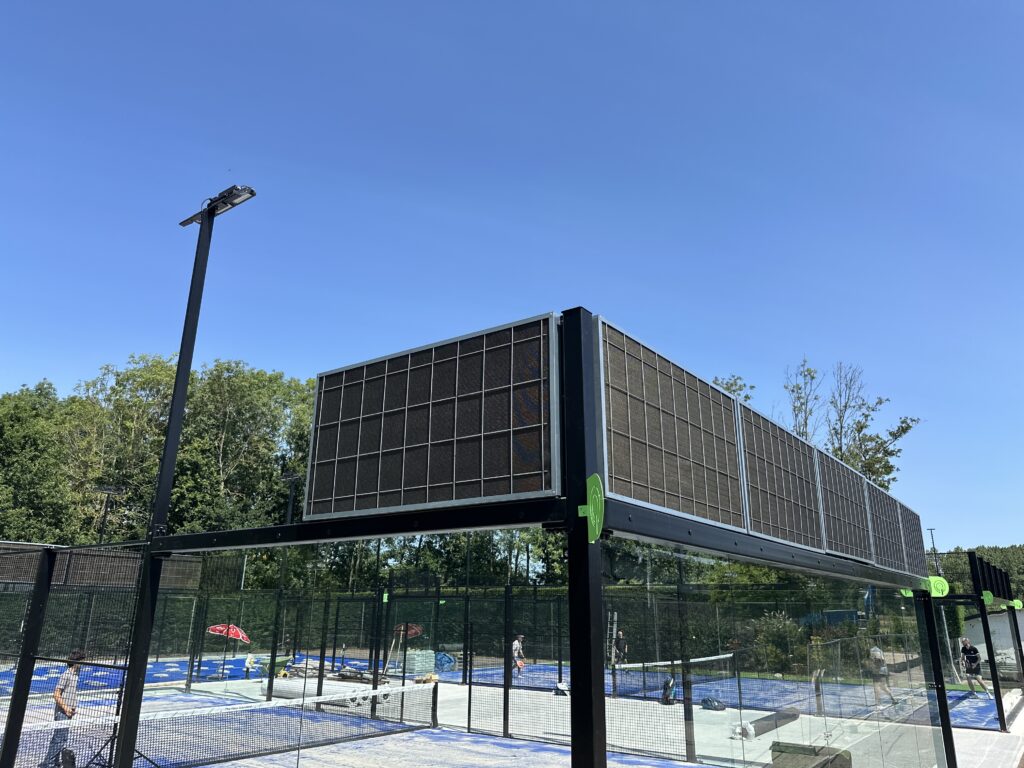
Padel noise is considered a nuisance as soon as it regularly and unexpectedly enters the living environment of nearby residents, particularly during the evening or at quiet times. The combination of impulse sounds, such as the loud impact of a ball against glass, and the sound-amplifying effect of the cage structure makes padel acoustically different from most other outdoor sports. The questions below provide a clear picture of when padel noise becomes problematic, which standards apply and which measures may be considered. How loud is a padel court actually? A padel court produces an average sound power level of approximately 91 dB during active play. That is about 10 dB more than a tennis court. The difference may sound small, but in acoustics, 10 dB is equivalent to a doubling of the perceived loudness. Padel is therefore objectively a louder sport than tennis, even though the game may look visually similar. The sound is generated in two ways. First, there is the direct source sound of the racket hitting the ball. Second, and acoustically the more significant factor, is the impact sound of the ball hitting the glass and steel fencing. The cage structure acts as a sound box: the enclosed nature of the court amplifies and disperses the sound into the surrounding area. It almost always concerns impulse noise, short and loud peaks that are clearly distinguishable above the background noise. This characteristic plays a major role in how nearby residents experience the noise, which we explain further below. When does padel noise exceed the statutory noise limits? Whether padel noise exceeds the statutory limits depends on the distance to residential properties, the time at which games are played and the applicable noise standards in the zoning plan or environmental permit. There is no fixed national threshold that applies to every situation. Municipalities generally apply the standards from the Activities Decree or set location-specific requirements through the permit. In practice, noise limits for sports activities at residential properties are typically 50 dB(A) during the day, 45 dB(A) in the evening and 40 dB(A) at night, measured at the façade of the nearest dwelling. Whether a padel court exceeds these limits depends on the distance, the site layout, the presence of sound-reflecting surfaces and the number of courts in use. Because padel produces impulse noise, the peak limit may also play a role. Peaks may generally not exceed 70 dB(A) during the evening period. An independent acoustic consultancy can calculate whether a specific location falls within the limits and which measures may be required. We provide the relevant technical product specifications and structural data for this purpose, but the assessment itself is carried out by the acoustic consultant. Why do nearby residents experience padel noise as more disturbing than other sports noise? Nearby residents experience padel noise as more disturbing than many other sports noises because it consists of repeated, sharp impulse peaks that are difficult to ignore. Human hearing is particularly sensitive to sudden changes in sound. Every change in rally, every hard hit against the glass, unconsciously draws attention, even if the average sound level itself is not extremely high. In addition, padel is generally played during the evening, when background noise is low and the surroundings are quiet. A padel court that is barely noticeable during the day can be experienced as disruptive in the evening because the contrast with the surrounding silence is greater. The cage structure reinforces this effect. Glass and steel reflect sound, and the enclosed structure of the court directs the sound in certain directions. As a result, the noise may still be clearly audible at a greater distance, while it may seem less noticeable at close range. This makes it difficult to assess noise nuisance without an acoustic study. At what distance from residential properties can a padel court be permitted? There is no legally established minimum distance at which a padel court can always be permitted. Whether it can be permitted is determined by a combination of the actual noise impact at the façade of nearby residential properties, the applicable noise standards and the measures taken. A padel court 30 metres from residential properties may be permitted with the right noise mitigation measures, while a court 80 metres away may cause problems without measures if the circumstances are unfavourable. Factors affecting whether a court can be permitted include the orientation of the court in relation to residential properties, the presence of sound-reflecting buildings, the number of courts, opening hours and the nature of the surroundings. A location in an open polder behaves acoustically differently from a location in a built-up residential area. Municipalities assess applications for a permit for a padel court based on an acoustic study. This study calculates the expected noise impact at the relevant residential properties and assesses it against the applicable standards. Based on the results, it can be determined whether additional measures are required and, if so, which ones. Read more about permits Which factors determine whether a location will experience noise problems? Whether a location will experience noise problems is determined by a combination of technical, spatial and usage-related factors. The distance to residential properties is the most decisive factor, but certainly not the only one. Even at greater distances, noise can be problematic if the circumstances are unfavourable. The main factors are: Distance to the nearest residential properties: the shorter the distance, the higher the noise impact at the façade. Orientation of the court: the direction of the glass and open sides partly determines where the noise is distributed most strongly. Presence of reflecting surfaces: buildings, walls and hard surfaces in the surrounding area can reflect sound back towards residential properties. Wind direction and wind zone: wind can strengthen noise in a particular direction. The geographical wind zone of a location is also relevant to the structural load, particularly when noise-reducing panels are applied. Number of courts and intensity of use: more courts and longer opening hours result in a higher cumulative noise