For a padel court you need at least 21 x 11 meters. If you also want to include run-off zones, which are strongly recommended for safety and playing comfort, then 21 x 14 meters is the practical standard. This applies to a single court; for multiple courts placed next to each other, you must add the required spacing between them.
Whether you want to convert a sports hall, transform a tennis court, or develop a new location: spatial requirements are always the starting point. In this article we answer the most frequently asked questions about the dimensions of a padel court, so you can get started with a realistic understanding.
What are the official dimensions of a padel court?
An official padel court is 20 meters long and 10 meters wide, measured between the walls. These are the international playing dimensions used for competitions and official certification. The line markings are 5 centimeters wide, the service line is located 6.95 meters from the center line, and the net is 0.92 meters high at the posts and 0.88 meters in the center.
These dimensions are defined by the KNLTB and apply as the standard for certification by Kiwa ISA Sport. If you want a court to be approved for official matches, the measurements must fall within the allowed tolerances. The length may deviate by a maximum of 0.10 meters, and the width as well.
In addition to the playing field itself, run-off zones are also defined: 8 meters along the long sides and 2 meters along the short sides. These zones are not a mandatory part of the cage structure itself, but they give players space to move behind the court and significantly increase safety.
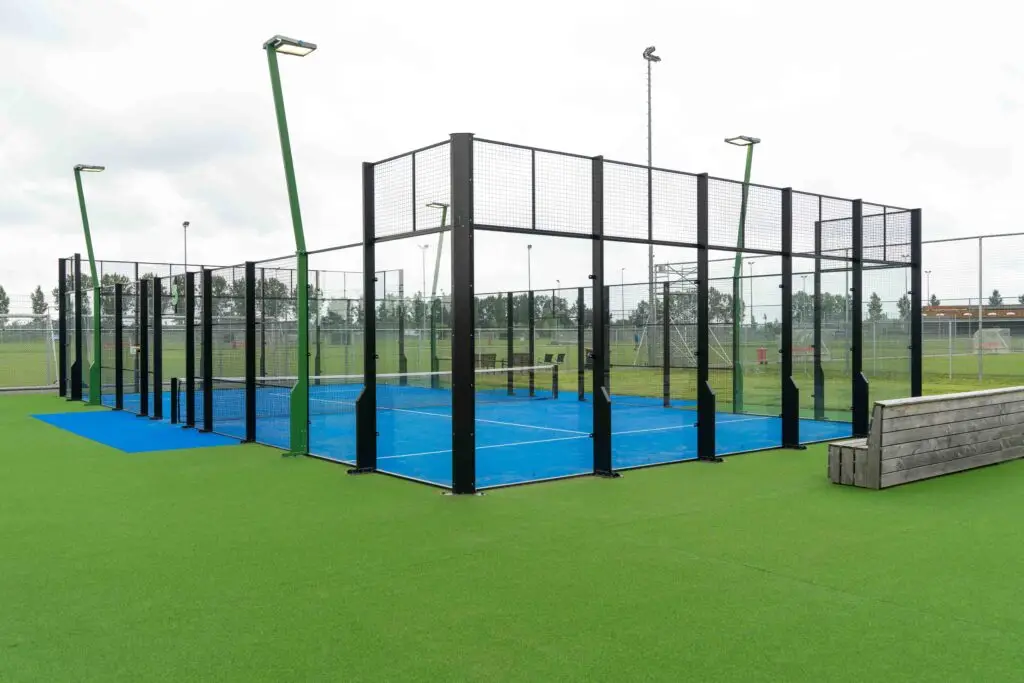
How much space do you need around a padel court?
Around the cage structure you need at least 0.5 meters on each side for installation and access. In practice, a minimum total space of 21 x 11 meters per court applies. The recommended space including run-off zones is 21 x 14 meters. This gives players sufficient movement space at the short ends and reduces the risk of injuries.
The run-off zone at the back of the court is the most relevant: players often hit the ball deep and need space to recover without immediately hitting a wall or fence. In sports complexes with multiple courts next to each other, a minimum spacing of 1.20 meters applies without run-off zones, or 2.00 meters if you include full run-off zones.
Also take into account space for:
- Access doors at the short ends of the court
- Possible technical space for LED lighting and installations
- Walkways for players and spectators
- Storage of equipment such as rackets and balls
What is the difference between indoor and outdoor padel courts in terms of space?
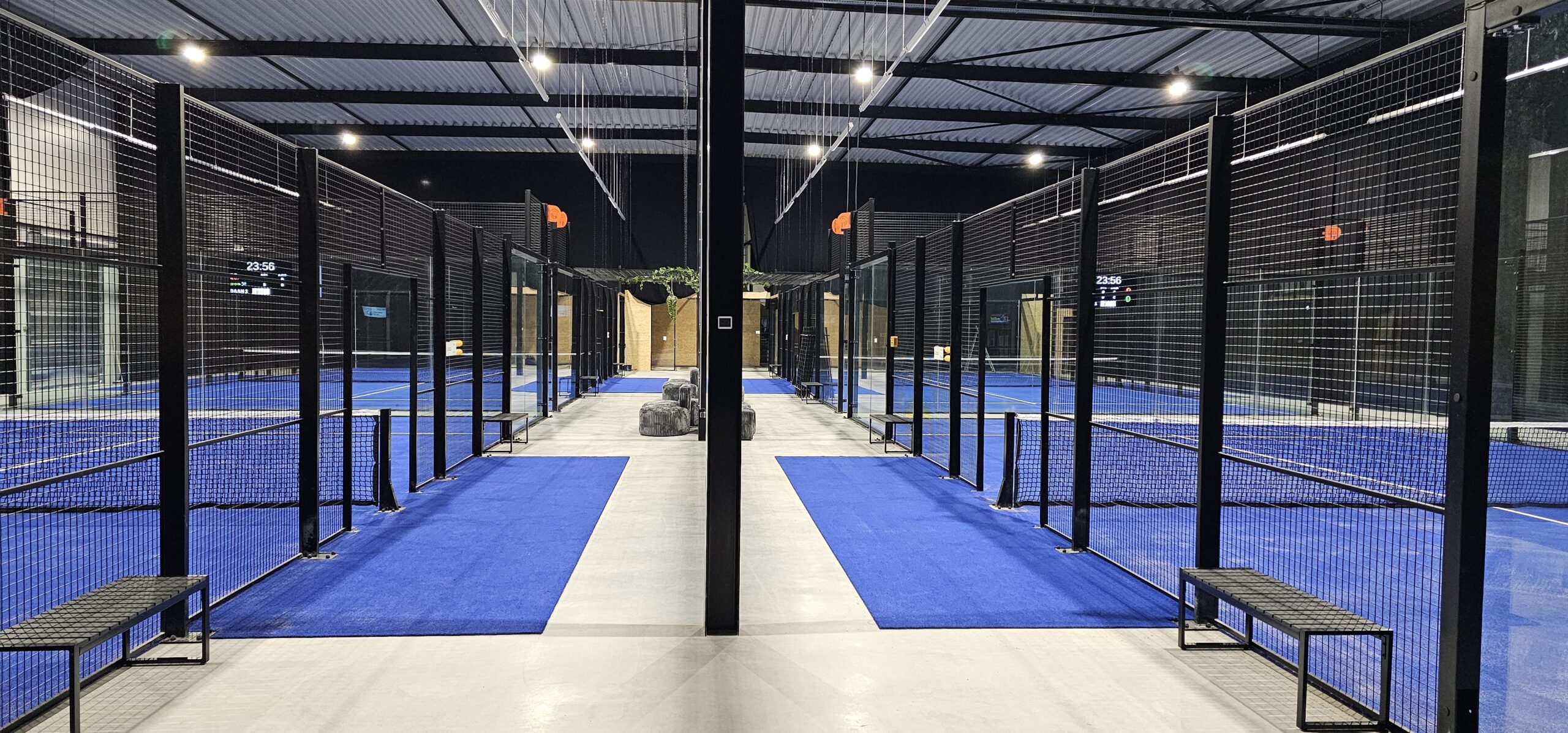
The playing dimensions of indoor and outdoor padel courts are identical: 20 x 10 meters. The difference lies in the surrounding space. For indoor courts, the available hall space is decisive. For outdoor courts, foundation, wind load, and possible noise mitigation also play a role in total planning.
For indoor courts, ceiling height is a factor you do not have outdoors: the minimum recommended height is 6 meters. The higher the hall, the better the playing quality. A 6-meter hall is functional, but for professional use more height is desirable. Also check whether columns, skylights, or roof structures limit the playing area.
For outdoor courts you need more space for:
- The foundation, which extends beyond the cage structure
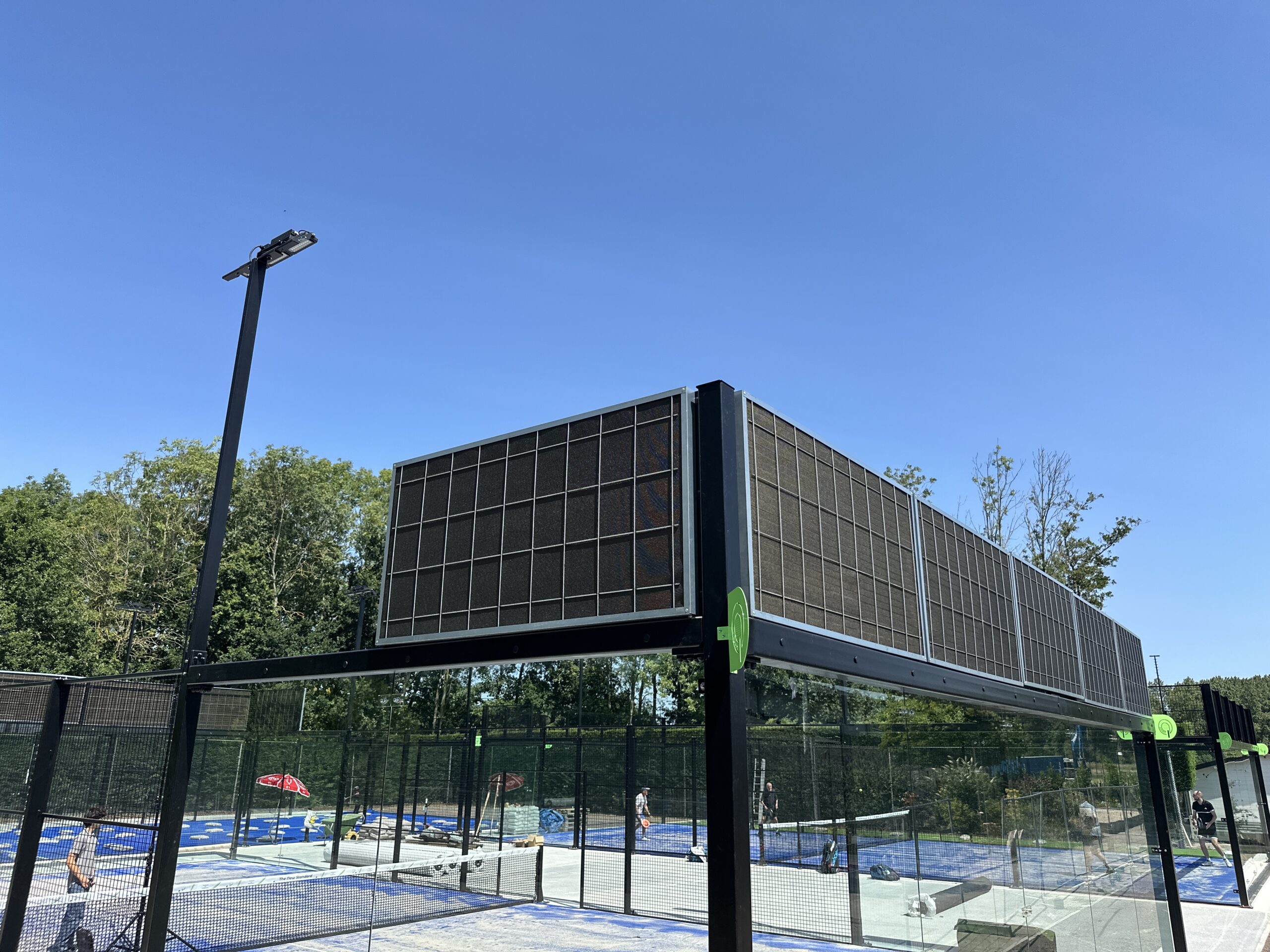
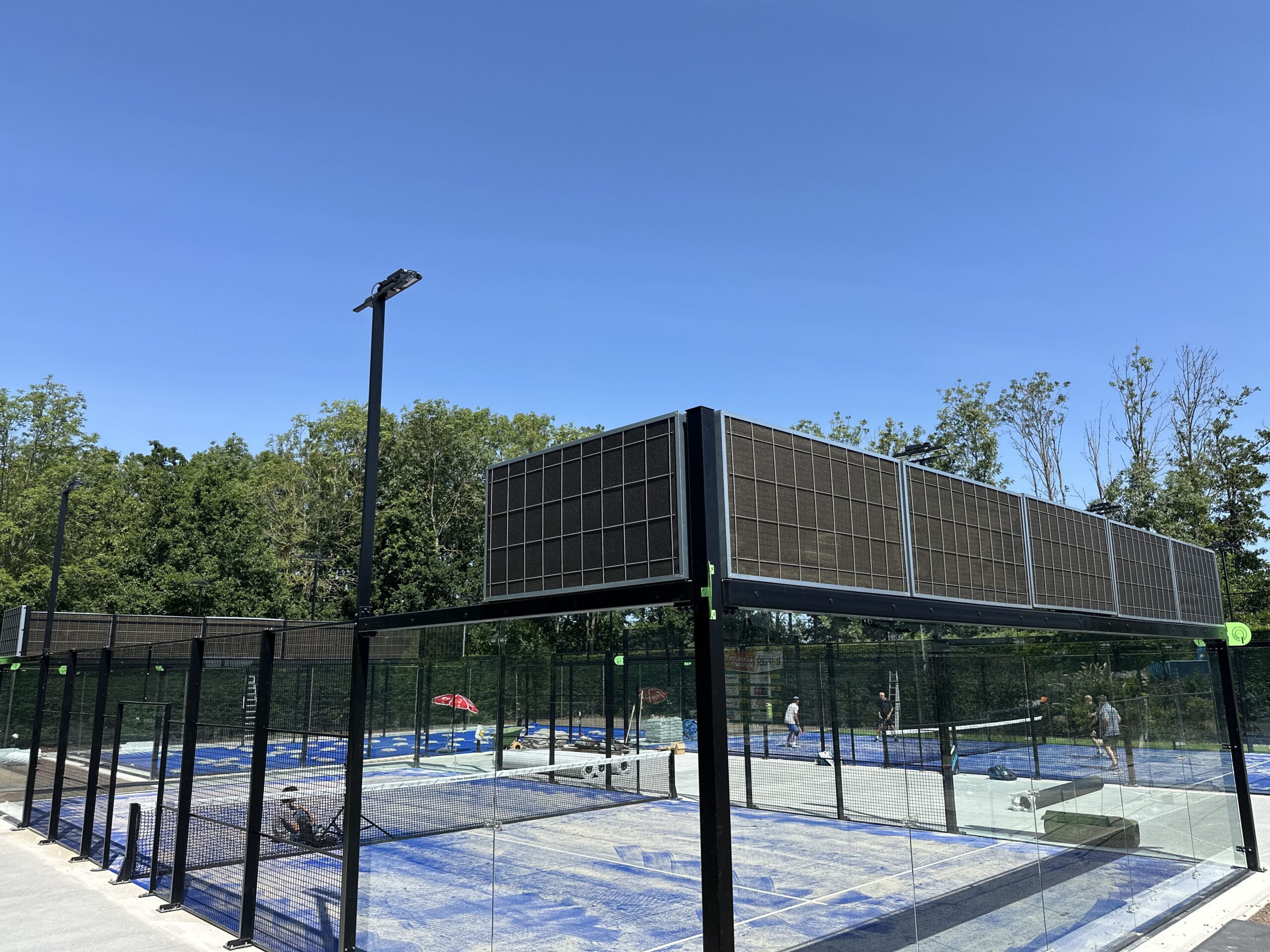
- Sound-absorbing panels or noise barriers, which require extra side space
- Drainage and water management around the court
- Possible fencing or shielding
In short: the playing size is the same, but the total space requirement at site level is larger for outdoor courts and depends more on the specific situation.
Read more about indoor and outdoor courts:
How many padel courts fit on a site?
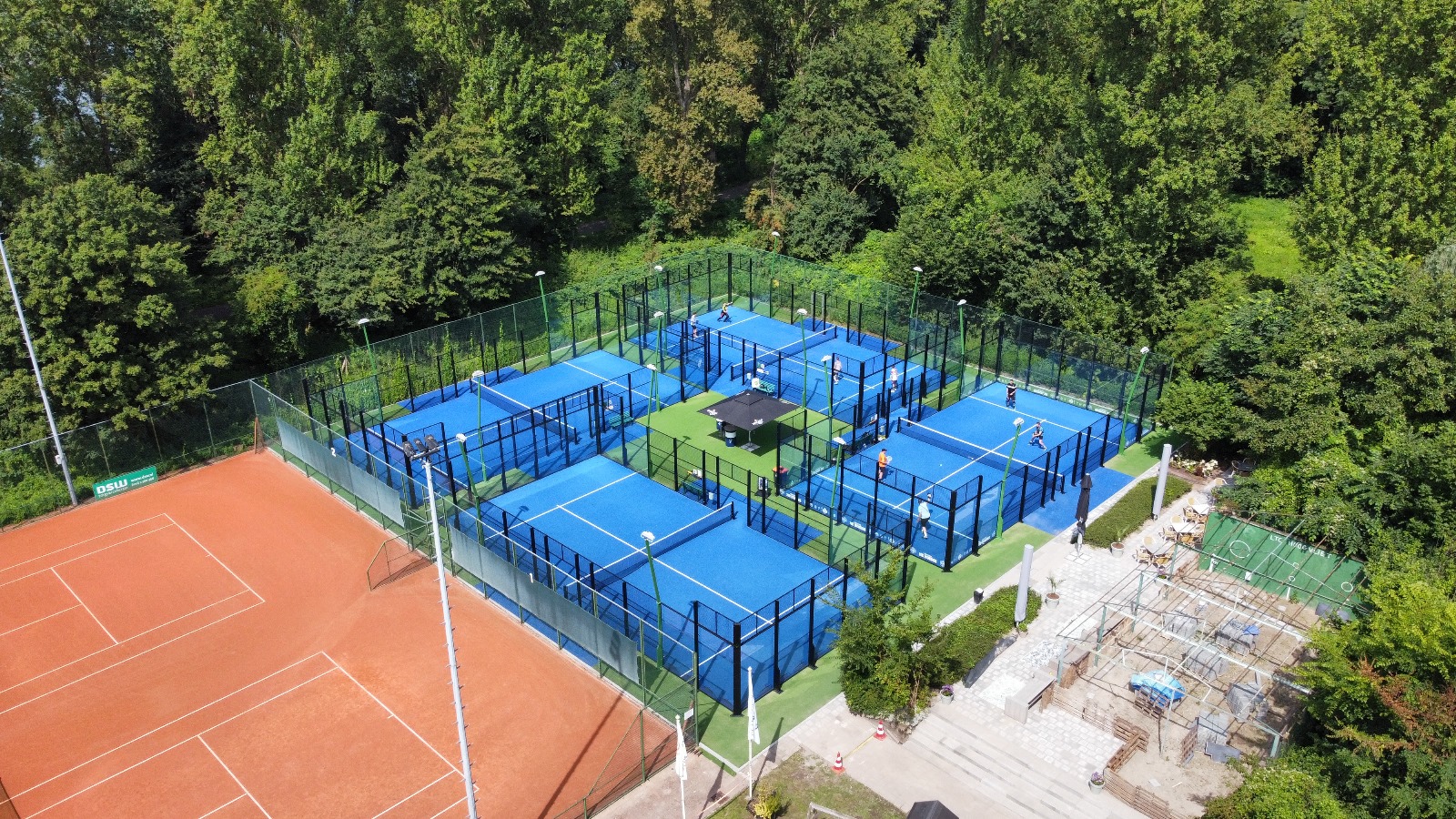
On a site of 1,000 m² you can theoretically fit four to six courts, depending on layout and spacing. The practical calculation is: count per court 21 x 14 meters (including run-off zones) and add walkways and access areas. In an efficient side-by-side layout you can assume about 21 x 12 meters net floor area per court.
For multiple courts next to each other, a minimum spacing of 1.20 meters applies without run-off zones. If players also need to move between courts, 2.00 meters is the standard. At the ends of a row of courts you need more space for full run-off zones.
A practical example for a hall with six courts in a row:
- Six courts of 10 meters width each: 60 meters
- Five gaps of 2 meters: 10 meters
- Two outer margins of 1 meter: 2 meters
- Total width: approximately 72 meters
- Length including run-off zones: approximately 28 meters
These are indicative measurements. Exact layout depends on site shape, column placement, and desired routing.
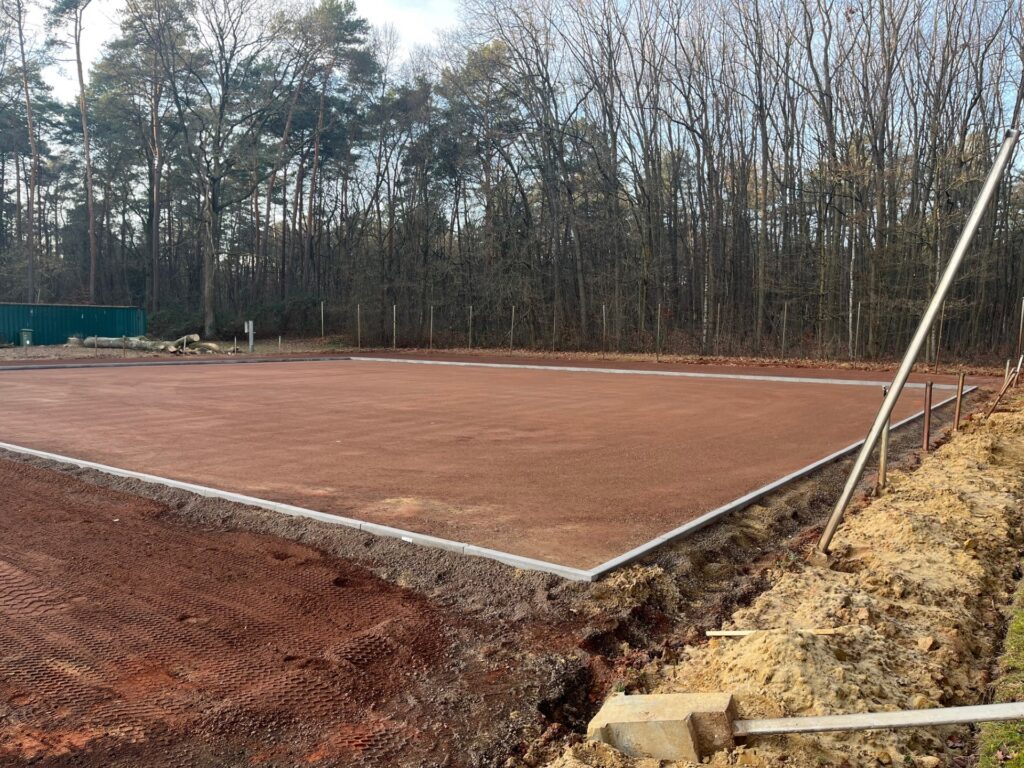
What space is required for the foundation of a padel court?
The foundation of a padel court extends slightly beyond the cage structure. In most cases, a foundation area is used that extends about 0.5 to 1 meter beyond the structure on all sides. The exact size depends on the foundation type and soil conditions.
There are three commonly used foundation types:
- Drain concrete: a permeable concrete floor that drains water directly through the foundation.
- Supersub: a foam concrete-based solution, lightweight and self-leveling.
- ZOAB asphalt: a porous asphalt variant that allows water drainage.
Besides the foundation area itself, site accessibility is also important: construction machinery needs access space. This must be considered during planning, especially in tight or urban locations.
All foundation components used in the Netherlands must be approved by Kiwa ISA Sport. This is required for certification.
Read more here about the foundation and construction of padel courts:
Can a padel court be installed on a small or irregular site?
Yes, a padel court can be installed on a small or irregular site, provided that the minimum dimensions of 21 x 11 meters are available. In such cases, custom engineering is required. Standard solutions do not always fit constrained locations.
Irregular sites require case-by-case structural design, such as:
- Uneven soil conditions or height differences
- Indoor columns or structural obstacles
- Wind exposure differences in outdoor areas
- Noise mitigation requirements
Noise is a specific point of attention at small locations. If the track is situated close to homes or a building facade, sound-absorbing panels may be required. These panels are placed on the outside of the mesh of the cage structure and reduce wind permeability. This means that the steel structure must be structurally reinforced to withstand the additional wind load. This is a technical calculation that must be performed for each location.
In short: a small or irregular location is not an automatic impediment, but it does require more preparation and customization than a standard situation.
What does a padel court cost including surrounding space?
The costs for setting up a padel court depend heavily on the type of court, the location, and the desired finish. As an indication, a turnkey indoor padel court, including steel structure, glass, artificial grass, LED lighting, and installation, is possible from approximately €23,000 per court. For an outdoor court including foundation, the target price starts at approximately €50,000 per court.
The landscaping of the area surrounding the court entails additional costs that should not be underestimated:
- Foundation: €20,000–€40,000
- Groundworks: excavation, leveling and site preparation
- Lighting: LED lighting usually included in turnkey packages
- Noise measures: optional, sometimes required near residential areas
- Permits: vary by municipality and situation
Outdoor courts require a heavier steel structure, which increases costs compared to indoor courts. A fixed price for foundations is difficult without a site inspection because soil conditions vary strongly.
If you want to know what a padel court costs at your location: at I-Padel we manufacture our steel structures in-house, allowing us to stay more competitive than suppliers who import everything. We support the entire process from design to completion, including foundation, glass, artificial grass and LED lighting. Read more on our padel court installation page or contact us for an initial consultation. We are happy to think along with you.
Read more about indoor and outdoor padel court costs:
FAQ
How long does it take to build a padel court from planning to completion?
The lead time varies, but typically 3 to 6 months from first planning to completion. Permits, engineering calculations and possible acoustic studies usually take the most time. Actual construction can often be completed within a few weeks if the site is accessible and materials are available.
Do I need a permit to install a padel court?
In most cases a permit is required, especially for outdoor courts and permanent structures. Requirements depend on municipality, location and height of the structure. Indoor courts in existing halls may require fewer permits, but fire safety and zoning regulations may still apply.
Which surface or artificial grass is best suited for a padel court?
Padel courts almost always use artificial grass with silica sand infill, specifically developed for padel. This provides grip, bounce and durability. The exact fiber structure depends on indoor or outdoor use and playing intensity. All artificial grass used for certified courts in the Netherlands must be approved by Kiwa ISA Sport.
What are the most common mistakes when planning a padel court?
The most common mistake is underestimating total space requirements: people often calculate with the 20 x 10 meter playing area only and forget run-off zones, foundation margins and walkways. Another common mistake is starting the permit process too late. Soil conditions are also often checked too late, while they strongly affect foundation costs.
Can an existing tennis court be converted into one or more padel courts?
Yes, in many cases a tennis court can be converted. A standard 36 x 18 meter tennis court can theoretically fit two padel courts side by side, including spacing. However, the condition of the existing base must be checked to determine whether it can be reused.
What about noise and what measures are available?
Noise is one of the most underestimated challenges, especially outdoors near residential areas. Ball impact on glass and steel can cause disturbance. Sound-absorbing panels significantly reduce noise but require a stronger steel structure due to increased wind load. In some municipalities an acoustic study is mandatory before permits are granted.
What is the difference between certified and non-certified padel courts?
A certified padel court meets KNLTB and Kiwa ISA Sport standards, required for official matches. For recreational or commercial use certification is not always mandatory, but it ensures quality, correct dimensions and compliance with standards.