
What noise control measures are mandatory for an outdoor padel court?
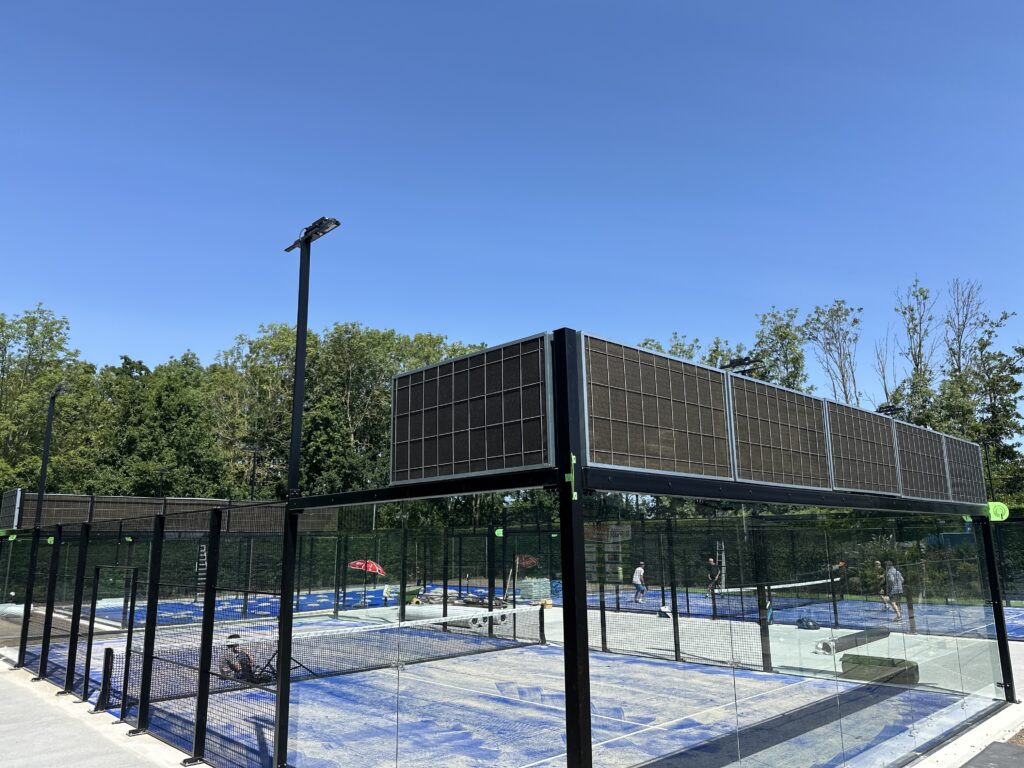
Noise nuisance at an outdoor padel court is one of the most common reasons why permit applications are delayed or rejected. The noise from a padel court is measurably louder than that of a tennis court, and municipalities are setting increasingly strict requirements for new outdoor courts. In this article we explain where that noise comes from, which standards apply, when you need a permit, and which measures you can take to limit noise nuisance. Why does an outdoor padel court cause noise nuisance? An outdoor padel court produces more noise than a tennis court, because the steel-and-glass cage structure functions as a sound box. The noise of the ball hitting the glass walls and the steel mesh is reflected back instead of being absorbed. That makes padel considerably louder than outdoor sports where no hard walls are present. The average sound power of a padel court is around 91 dB. By comparison, a tennis court produces on average about 10 dB less. That sounds like a small difference, but in acoustics 10 dB equals a doubling of perceived loudness. Two sound sources play a role here: The source noise of the racket hitting the ball The impact noise of the ball hitting the glass and mesh That second type of noise is responsible for the largest part of the experienced nuisance. The hard, reflective surfaces of the cage structure cause the sound to carry far, especially in open areas without natural shielding. An outdoor court also has no hall to absorb the sound. That makes the choice of location and the surrounding environment decisive for the degree of nuisance experienced by local residents. Which legal noise standards apply to an outdoor padel court? In the Netherlands, outdoor padel courts fall under the noise standards of the Activities Decree for Environmental Management (Activiteitenbesluit milieubeheer). For sports activities at clubs and commercial operators, limit values apply that depend on the time of day: during the day (07:00 to 19:00) higher noise levels are permitted than in the evening or at night. The municipality assesses whether the court meets these standards at the facade of the nearest home. The exact limit values are determined by the designated use of the location and the zoning plan (bestemmingsplan). A padel court at a sports park in an outer district has different standards than a court bordering a residential neighborhood or a quiet street. Municipalities use the guidelines of the VNG (Association of Netherlands Municipalities) for businesses and environmental zoning as a reference framework. Because padel is on average louder than most other outdoor sports, courts without measures exceed the applicable standards in many situations. This means that when applying for an environmental permit, you almost always have to submit an acoustic study. That study demonstrates whether the court meets the standards and which measures are needed if it does not. When is an environmental permit mandatory for a padel court? An environmental permit is almost always mandatory for an outdoor padel court. In the Netherlands, a padel court is considered a structure (bouwwerk), which means building regulations apply to it. Installing one without a permit is not an option: the municipality can halt the project, impose a fine, or even require the structure to be removed. A permit is mandatory in any case if: The padel court is placed outdoors Structural work takes place Noise or lighting affects the surroundings The location is within or near residential buildings For an indoor padel court in an existing hall without structural modifications, a separate building permit is not always required, but fire safety and usage rules still apply. For outdoor courts, the situation is almost always different: the spatial impact, the noise, and the lighting make a permit necessary. The average processing time for a permit application is 8 to 12 weeks, depending on the municipality and the complexity of the project. Prepare well: for the application you typically need structural calculations, an acoustic study, a lighting study, and a site plan. Sometimes the municipality also asks for an ecological or archaeological study. Read more about permits Which noise measures are permitted and effective? There are two proven measures to limit noise nuisance at an outdoor padel court: sound-absorbing panels attached to the cage structure, and freestanding noise barriers placed next to or around the court. Both measures are permitted and are recognized by municipalities as effective solutions, provided they demonstrably deliver sufficient reduction. Sound-absorbing panels Panels are placed on the outside of the mesh of the cage structure. They absorb the sound at the source instead of reflecting it back. The court remains visually open and the play dynamics do not change. Independently tested in an acoustic laboratory, the panels achieve sound absorption class A, with an absorption value of 0.80 and a sound insulation index of 19 dB. In practice this leads to a clearly audible reduction at distances of 40 to 100 meters. Noise barriers A noise barrier is a freestanding, noise-blocking structure placed next to the court that shields sound in the direction of homes. Barriers can be built up to 6 to 8 meters high and dozens of meters long. They are effective at greater distances and can be planted with climbing plants on coconut fiber or green mesh, which increases acceptance by the municipality and local residents. In many cases, a combination of panels and a noise barrier is the most effective. The panels reduce the noise at the source. The barrier blocks the remaining noise in the direction of the homes. Thanks to that combination, a noise barrier can sometimes be built lower, which saves costs and makes the permit process easier. Important to know: both measures must be structurally calculated and fit within the permit process. They are not standard solutions that can be applied without further consideration. Read more about sound solutions What is the difference between a noise screen and sound-absorbing panels? The main difference is the position relative to the court. Sound-absorbing panels are